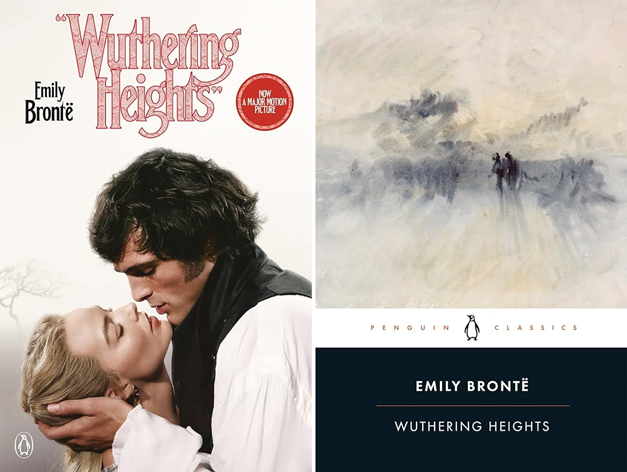
Just before my daughter and I went to see Emerald Fennell’s movie “Wuthering Heights”, I decided to re-read Emily Brontë’s one and only novel, Wuthering Heights. The novel was published in 1847, just one year before Emily, a reclusive spinster, died at the age of 30. Critic V.S. Pritchett said “There is no other novel in the English language like Wuthering Heights“. Indeed, the novel has endured for 179 years and, if nothing else, might expect an uptick in readers based on Fennell’s movie. New readers, however, are likely to be flummoxed.
I read Wuthering Heights for the first time when I was in high school, so 50 years ago. My memories of it going into this re-read were of Catherine and Heathcliff, tortured lovers on the moors of Yorkshire. I always credit this novel for setting up my romantic expectations/aspirations, which may explain why I have always been drawn to angsty love affairs: couples who love each other but can’t be together, or lovers who shouldn’t love each other but do, are totally my romantic jam. Probably also explains why I am single. My romantic expectations were skewed at an early age.
In my memory, Catherine and Heathcliff were passionately in love with each other, but he wasn’t the right guy for her socially; she needed to marry up the social ladder. Enter Edgar Linton. What I didn’t remember was that Catherine was dead by page 200 and for the rest of his miserable life, Heathcliff tries to ruin the lives of everyone around him including his son, Linton, and Catherine’s daughter, Cathy.
As a teenager, I saw Wuthering Heights as a tragic but ultimately romantic love story, but upon re-reading I discovered it’s slightly more complicated than that.
Catherine and Heathcliff’s story is told to Mr. Lockwood, a lodger at Thrushcross Grange, who falls ill and convalesces under the care of Ellen “Nelly” Dean, housekeeper at both Thrushcross and Wuthering Heights, Catherine Earnshaw’s family home. She tells Mr. Lockwood about how Mr. Earnshaw, in an act of benevolence, plucks Heathcliff from the streets and brings him back to Wuthering Heights, “a sullen, patient child; hardened, perhaps to ill-treatment”, ill-treatment which he further endures at the hands of Catherine’s older brother, Hindley, the most odious of characters.
Catherine takes an immediate shine to Heathcliff. “”She was much too fond of Heathcliff,” Nelly tells Mr. Lockwood. “”The greatest punishment we could invent for her was to keep her separate from him””. They pass their childhoods running wild on the heath.
Catherine has a willful streak and a fiery temper; she is no shrinking violet. In fact, even Mr. Earnshaw favoured Heathcliff over his own daughter “who was too mischievous and wayward for a favourite.”
Certainly, she had ways with her such as I never saw a child take up before; and she put all of us past our patience fifty times and oftener in a day: from the hour she came downstairs till the hour she went to bed, we had not a minute’s security that she wouldn’t be in mischief. Her spirits were always at high-water mark, her tongue always going–singing, laughing, and plaguing everybody who would not do the same. A wild, wicked slip she was–but she had the bonniest eye, the sweetest smile, and the lightest foot in the parish; and, after all, I believe she meant no harm.
When Edgar Linton asks Catherine to marry him, she tells Nelly “I’ve no more business to marry Edgar Linton than I have to be in heaven […] It would degrade me to marry Heathcliff now; so he shall never know how I love him: and that’s not because he’s handsome, Nelly, but because he’s more myself than I am. Whatever our souls are made of, his and mine are the same.”
So, she does marry Edgar and moves to the palatial Thrushcross Grange to live with him and his sister, Isabella. Heathcliff disappears and when he reappears, three years later, he is much changed.
He had grown a tall, athletic, well-formed man; beside whom my master seemed quite slender and youth-like. His upright carriage suggested the idea of his having been in the army. His countenance was much older in expression and decision of feature than Mr. Linton’s; it looked intelligent, and retained no marks of his former degradation. A half-civilized ferocity lurked yet in the depressed brows and eyes full of black fire, but it was subdued; and his manner was even dignified: quite divested of roughness, though too stern for grace.
His reappearance shakes up everyone. To Edgar Linton, Heathcliff was nothing more than “the gypsy–the ploughboy” but, well, we know what Catherine thought of him. Surely, this will not end well.
And, of course, it doesn’t.
The vitriol against Emerald Fennell’s adaptation of what she says is her favourite book of all time is both deserved and undeserved. “Wuthering Heights” is Wuthering Heights adjacent; it is not a faithful adaptation of the book. My daughter, who is 28, loved the movie. She sobbed for the last fifteen minutes. She has never read the book.
Fennell encountered the book when she was about 14, so a similar age to my first exposure. I think she saw something similar to what I saw when I first read it: a great love story. Her movie is fanfiction, really, because it imagines (in a kind of annoying music video montage), a lot more sex than exists in the novel. In fact, Heathcliff and Catherine are never physically intimate in the book. The on-screen sex is not graphic, despite one of my friends calling it “porny.” As an avid consumer of fanfiction back in the day, I know how graphic writers can be when describing what they ‘imagine’ happens when the source material fades to black–and truthfully, that’s what Fennell is doing here–but what we see on screen is pretty tame; nary a breast or a butt.
It also portrays Nelly as the villain of the piece; she deliberately coaxes from Catherine the confession that she can’t marry Heathcliff because he is beneath her when she knows that Heathcliff will hear, but he doesn’t hear when Catherine when says she loves him or see how tortured she is about the decision. Hindley doesn’t exist in this version. Isabella is played for laughs and as a submissive in a bizarre scene where she is chained up in Heathcliff’s house and barks like a dog.
Another criticism of the movie is the casting. Margot Robbie is 35; Catherine was 18 or 19 when she died in childbirth. Jacob Elordi is not by any stretch (and at 6’5″ there’s a lot of stretching to be done) a “dark-skinned gipsy”. But I didn’t care too much about that because both of these people can actually act and they are beautiful to look at and since the movie isn’t *really* Wuthering Heights, I was content to let the whole thing play out. Yes, I understand this is problematic whitewashing, but it was clear to me that Fennell was making a version, her 14-year-old wishful thinking version, of the book. For example, the actor who plays Edgar Linton is played by Shazad Latif, who is by no means the insipid Edgar I imagined. In the book he is described as light-skinned, blue-eyed, and slender. So, make of that what you will.
The whole movie is beautiful, really, but certainly not the Wuthering Heights of my teenage imagination. (In fact Wuthering Heights, the house, looked like it was made of plastic. It was weird.) The costumes, the landscape, the overall aesthetic was easy on the eyes. But the movie doesn’t demand anything of you beyond your belief that Heathcliff and Catherine love each other. That’s what I believed at 15.
Maybe now I think their relationship is more obsessive, complicated, and toxic, but I will not deny that I still find the tale hopelessly romantic even though Catherine and Heathcliff are not especially likeable and are certainly, on occasion, horrible to each other and others. The movie doesn’t portray anything beyond Catherine’s death, but the book still has 200 pages to go after she dies and in those pages we see Heathcliff destroy everything in his path. Does he do it because of grief? Eighteen years after her death, he admits to Nelly that he bribed a sexton to open her coffin, and when he saw her face again “it was hers yet.”
…she has disturbed me, night and day, through eighteen years–incessantly–remorselessly. […] I felt Cathy was there: not under me, but on the earth. A sudden sense of relief flowed from my heart through every limb. I relinquished my labour of agony, and turned consoled at once: it remained while I refilled the grave, and led me home.
Emily Brontë’s novel is a masterpiece of mood, passion, and tension. In her introduction to the Modern Library edition of the novel, Diane Johnson writes: “In their rage and frustration at the impediments that society and conventional morality impose on them, preventing the perfect expression of the erotic life force they embody, the two lovers symbolize the ultimate tragedy of man’s earthly condition.”
Emerald Fennell’s movie is Wuthering Heights for the TikTok generation. I enjoyed watching it, but I enjoyed my re-read far more.
 The Ludic Reader
Maybe I should give it a reread. Like you, I read it in my teens and fell in love with the moors and those two tortured souls. As a 40+ year old who reread it, the cynical me was still in love with the moors but beyond exasperated with Cathy and Heathcliff. In fact, I preferred the children over them, especially because they were able to find the happy ending that we wanted their elders to have. Funnily enough, Jane Eyre was always my ultimate favorite until I read Anne Bronte’s The Tenant at Wildfell Hall, which I adored. I just read Shirley by Charlotte Bronte with the #hashtagbrigade on Litsy, and hated it. She should have stopped with Jane Eyre just like (IMHO) Harper Lee should have never kept Go Set a Watchman for her publishers to coerce her to publish.
Will I see the movie? Too early to tell. I haven’t seen a movie in a theater since Inside Out. Maybe it’s time.
🩵
Maybe I should give it a reread. Like you, I read it in my teens and fell in love with the moors and those two tortured souls. As a 40+ year old who reread it, the cynical me was still in love with the moors but beyond exasperated with Cathy and Heathcliff. In fact, I preferred the children over them, especially because they were able to find the happy ending that we wanted their elders to have. Funnily enough, Jane Eyre was always my ultimate favorite until I read Anne Bronte’s The Tenant at Wildfell Hall, which I adored. I just read Shirley by Charlotte Bronte with the #hashtagbrigade on Litsy, and hated it. She should have stopped with Jane Eyre just like (IMHO) Harper Lee should have never kept Go Set a Watchman for her publishers to coerce her to publish.
Will I see the movie? Too early to tell. I haven’t seen a movie in a theater since Inside Out. Maybe it’s time.
🩵
Honestly, if you just take the movie as what it is and don’t expect it to be the book, it’s a fine confection. I mean, Jacob Elordi is easy on the eyes, there’s definitely a lot more kissing and for Mal at least, the ending is heartbreaking and tragic. If I was a WH purest, I expect I would have hated it. But I am not, so I didn’t.