Hot on the heels of my last novel about sisters, False Witness, comes another book about sisters: The Comfort of Monsters by Willa C. Richards.
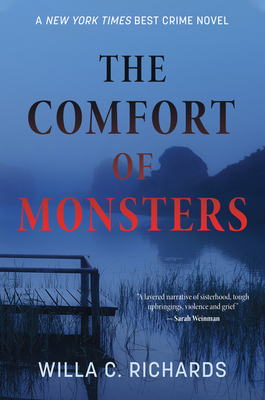
In this story, Peg McBride recalls the summer of 1991 when her younger sister, Dee, disappears. Dee’s disappearance barely causes a ripple in the crime landscape because she goes missing in Milwaukee in 1991, the same time as Jeffrey Dahmer was arrested.
Peg narrates the story of her relationship with her sister as children and young adults up until Dee’s disappearance, and then thirty years in the future when her ailing mother hires an internet-famous psychic in a last-ditch effort to find out what happened to Dee. It’s this development that causes Peg to reminisce about her sister, although I think Dee has informed every single decision Peg has made over the past 30 years.
Peg has always been convinced that Dee’s much older boyfriend, Frank, was responsible for Dee’s disappearance. She hadn’t liked him pretty much on sight.
Frank hugged me when we met. I didn’t like the feeling of his body against mine. I kept my arms awkwardly by my sides. When he pulled away, I felt like he was looking through my clothes. Some men seem to be able to do that–to make you feel totally naked.
After Dee’s disappearance, Frank vanishes into the ether and the case languishes. But despite being billed as a crime novel, the mystery of what happens to Dee isn’t really what this book is about. Sure, it informs Peg’s character (which isn’t particularly likable), but readers looking for a fast-paced mystery are not going to find that in The Comfort of Monsters.
Instead, the novel is a slow-moving, meandering character study of family dynamics, romantic entanglements, our fascination with true crime, race and memory.
Memory, of course, is also a story. It feels like the truth, especially when there is no one to dispute your recollection of events. But it is a story nonetheless–some moments have been elided, and others have been emphasized and made either luminous or horrific or both. […] And because now, more than ever, my sister’s case depends on these memories, I am terrified that crucial pieces of evidence have been lost along the way.
I liked it, but didn’t love it.

