The White Iris by Sandy MacDonald

This book was chosen for our book club last month…and the woman who chose it was quite sure that she’d win ‘best book’ this year with this comical look at three eccentric women in rural Nova Scotia.

The White Iris was written by lawyer Sandy MacDonald and after reading it (well, trying to read it) I would humbly suggest that he not give up his day job. The story is hardly the sparkling and witty examination of environmental issues it claims to be. For me- it was a diatribe of a novel peopled by stock characters, pedestrian prose and enough lifeless filler for three novels.

Worst book I’ve read this year.

Come Closer by Sara Gran

I dunno. Margot Livesey said Come Closer ought to carry a warning to readers. It’s impossible to begin this intense, clever, beautifully written novel without turning every page.” And Stewart O’Nan said: “Sara Gran has created a sly, satisfying novel of one young woman possessed not only by a demon but also by her own secret desires.”

I quote these two reviews because I have read both Livesey and O’Nan and admire their writing. Believing their assessment of this book is sort of like reading fic recced by an author you like. You sort of hope they’ll point you in the direction of the good stuff.

And while Gran’s novel isn’t exactly what I’d call the good stuff- it wasn’t rotten, either.

Amanda is an architect who lives with her wonderful husband, Ed, in an unnamed American city. We don’t get any real insight into Amanda’s life before weird things start to happen: funny noises in her home, strange and troubling dreams, black outs, missing time she can’t account for.  These events transpire in little snippets. Things happen, we hear about them and then we’re on to the next thing. I never really felt connected to Amanda. I didn’t fear for her or care for her and if the novel has a failing for me, that’s probably it. As Amanada says herself: “What we think is impossible happens all the time.” And sometimes those impossible occurrences are horrific.

Just not in this book.

Which is apparently being made into a flick.

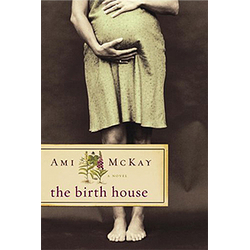
The Birth House by Ami McKay

One of the first books I read this year and easily the best novel I encountered in 2006, this account of a midwife in turn-of-the-(20th)-century Nova Scotia is everything a novel should be: funny and tragic, joyful and sorrowful, filled with rich, carefully drawn characters and experiences that linger long in the mind.

The Birth House
spent most of the year on bestseller lists and marked the arrival of a splendid new talent. I can’t wait to see what Ami McKay does next.
– Robert Wiersema, for the Vancouver Sun.

Ami McKay’s book The Birth House is a natural selection for book clubs. Set in rural Nova Scotia circa the First World War, it tells the story of Dora Rare, the “only daughter in five generations of Rares.” Dora is a smart girl who spends much of her time with Miss B, the area midwife. Miss B is part-healer and part-witch and Dora learns much under her tutelage.

Truthfully, it took me a while to get settled into Dora’s quiet world, but the book’s charms are undeniable. For one thing, Dora is utterly likeable. She is kind and sensible and although she is young, she is no shrinking violet. McKay does a wonderful job of creating a world far removed from technology and the horrors of the war, but certainly not immune to either. For example, Dora’s faith in midwifery is tested (as is the faith of all the women of her community) when Dr. Thomas arrives in the area and sets up a hospital, offering women pain-free births. And when the Halifax Explosion of 1917 happens, Dora rushes off to help and is forever changed by the experience. Scots Bay isn’t modern and McKay paints a riveting picture of poverty and backwoods thinking.

But the book isn’t without a sense of humour either. Dora’s marriage to town hunk, Archer, necessitates a visit to Dr. Thomas where he diagnoses her with “neurasthenia” and prescribes treatment using the Swedish Movement Health Generator. I dare you to keep a straight face.

The Birth House isn’t a flashy book, but it’s a book that will resonate with readers, particularly women, and I heartily recommend it.

Twilight by Stephanie Meyer

“Propelled by suspense and romance in equal parts, this story will keep readers madly flipping the pages of Meyer’s tantalizing debut.” – Publishers Weekly

I picked up Twilight by Stephenie Meyer despite the fact that it is geared for a teenage reader. How could I resist this?

About three things I was absolutely positive. First, Edward was a vampire. Second, there was a part of him- and I didn’t know how dominant that part might be- that thirsted for my blood. And third, I was unconditionally and irrevocably in love with him.

This is the story of 17 year old Isabella (Bella) who moves to Forks, Washington to temporarily live with her father, Charlie, the local Chief of Police, while her mother goes off to Florida with her new husband. Bella hates Forks; her childhood memories of the place include the devastating end of her parents’ marriage.

At her new school she gets her first glimpse of the Cullens, their faces “so different, so similar… all devastatingly, inhumanly beautiful.” She is particularly taken by Edward Cullen, who turns up in her Biology class and also turns out to have taken an immediate and hostile dislike to her.

But Edward is hiding a dark secret. And, of course, Bella is drawn to him– moth to flame.

There are, of course, lots of vampire stories out there. But I have to say that I liked this one quite a lot, even though it was rather tame. (As it would be given that it was written for teens.)

Bella is a smart, likeable character and Edward is haunted and beautiful– perhaps too perfect. The prose is clear and straightforward and the story (all 498 pages of it) moves along at a good clip.

You begin these sorts of stories with a willingness to suspend disbelief anyway. And my view of vampires is coloured by my love of those in the Jossverse. Although Edward (and the vampire mythology employed here) is quite unlike any I’ve ever read about– he was a seductive character.

And apparently the book has legions of fans…there are lots of sites dedicated to Edward and Bella.

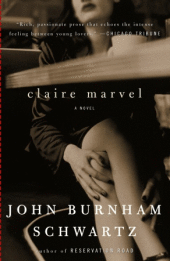
Claire Marvel by John Burnham Schwartz

A few year’s back I read Jonathan Burnham Schwartz’s devastating novel Reservation Road and was really impressed. So I was really looking forward to reading Claire Marvel. The book’s opening lines: “There was before her and now there is after her and that is the difference in my life” promised great things– but I’m not sure Schwartz actually delivers.

The book is narrated by Julian Rose, a grad student at Harvard who meets and falls immediately in love with Claire Marvel during a rainstorm. The book traces their relationship through all the requisite romantic obstacles and I suppose I can fairly say that the only thing that prevents this book from being totally been there, done that is the quality of Schwartz’s prose.

As Julian chases and abandons and chases and abandons the love of his life, we are never really certain of her and, in fact, even though the book is named after her– we really come to know very little about Claire as a person.

Members of my book club loved this book…but I found it somehow unsatisfying.

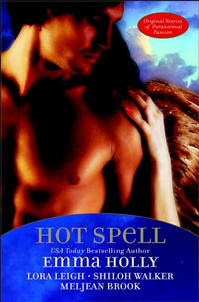
Hot Spell by Leigh, Walker, Brook

Oh dear. I bought Hot Spell on a whim, intrigued by the promise of ‘paranormal passion’. What I got were four rather tame novellas rife with cliched descriptions of sex with four perfect men.

In the first story, “The Countess’s Pleasure”, the heroine Georgiana DuBarry hooks up with an indentured demon, Sawai. Recently widowed, Georgiana hires Sawai to deflower her, because although she had positive feelings for her husband– theirs was a sexless marriage. Sawai is hot!hot!hot! and brings Georgiana to the pleasure of the title many times over…and in less time than it takes for you to say ‘multiple orgasms’, they’ve fallen in love.

In Leigh’s story, “The Breed Next Door”, Tarek Jordan is a member of the Feline Breed on an undercover stakeout. One might think he’s scouting for coffee and fresh-baked bread because he does quite a bit of drooling over the smells coming from his neighbour, Lyra’s, kitchen. There’s a convoluted plot, of course, but it turns out that Lyra is Tarek’s mate. So, there’s sex…and a happy ending.

In “Falling for Anthony” by Meljean Brook, a young doctor is granted the opportunity to come back from the dead as a Guardian, to help the sister of his childhood friend recover from a vampire’s bite. (And when he does recover, he’s one of those sweet vampire types, apparently.)

And finally, werewolves battle vampires in “The Blood Kiss” by Shiloh Walker. The prize, Julianna Capriet (um- obvious much? Why not call her Capulet – she may as well have been, the story is a total rip off of Shakespeare’s play) is the daughter of the Vampire King…but her heart belongs to Roman, the Wolf King. La la la.

Three of the women in these stories are virgins, ripe for the taking. The men are all perfect specimens. There are lots of sighs and moans and breaching of virgin tissue. I might have loved this book 20 years ago, but for my money fanfiction is a hundred times better.

A good book for the beach because you won’t be heartbroken if you leave it in the sand.

Breakheart Hill by Thomas H. Cook

“You’ll think you know who (and maybe you do) and you’ll think you know why (and I suppose it’s possible); but trust me, you won’t have guessed everything. “Breakheart Hill” is one of the best written and most marvelously crafted books I’ve read in a long, long time. It’s dark and it’s sad and it’s very, very good. Read it.” – Mystery NewsI picked up Thomas H. Cook’s 1995 novel Breakheart Hill at the second hand store. On the cover was the tagline “a mesmerizing tale of love and betrayal” and I thought, okay, good Sunday afternoon book and bought it. The opening line is one of the most intriguing I’ve read in recent memory: “This is the darkest story that I have ever heard, and all my life I have labored not to tell it.”

The narrator of this dark tale is Ben Wade, a respected doctor in Choctaw, Alabama. As a teenager, Ben grows to love the beautiful Kelli Troy who has moved to Choctaw from the north. It is 1962. The story expertly weaves Ben’s memories of high school with present day, dropping ominous clues about just what happened the afternoon Kelli’s battered body was discovered on Breakheart Hill.

I suppose in some ways, I’ve been spoiled by mystery/thriller/suspense novels which unfold at breakneck speed; I was often impatient reading this book. Sometimes it seemed to take forever to get anywhere, but ultimately that’s one of the book’s many charms.

Breakheart Hill is a leisurely southern gothic novel, filled with a real sense of place and time. The characters are interesting and flawed and I was 100% surprised by the ending, which wasn’t a cheat even though it felt like it should have been.

If you like an intelligent mystery that will break your heart, this is the book for you.

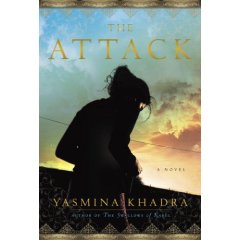
The Attack by Yasmina Khadra

Yasmina Khadra’s novel The Attack set off a firestorm of debate at book club. The novel follows the journey of Muslim surgeon Amin Jaafari, a naturalized citizen of Tel Aviv. He shares his life with the love of his life, Sihem. It isn’t giving anything away to say that Amin’s wife turns out to be a suicide bomber, detonating herself in the middle of a restaurant filled with school children. The novel then follows Amin’s journey from denial and disbelief to acceptance, if not of his wife’s actions then at least of the motivation behind the attack.

I didn’t like the book. The problem for me is that the character of Sihem is never humanzied. She is “the creature I loved most in the world.” Anything we learn about her, we learn through the eyes of the extremists with whom she had aligned herself behind her husband’s back. He doesn’t understand and neither did I. Mostly I felt as though I was getting a lecture about the very messy and complicated and, clearly, emotional landscape of the Middle East.

Still, the book led to a great, and often heated, discussion– if that’s your thing.

The Girls He Adored by Jonathan Nasaw

Years ago I read the Dean Koontz book, Intensity. It was freakin’ terrifying. I generally find Koontz to be a pretty reliable writer, delivering fast-paced and exciting suspense, sometimes with a dash of the supernatural. (Of late I find him a little wordy, but never mind that.)

I was hoping Nasaw’s book would offer me the same thrill ride as Intensity, you know- one of those page-turners that you carry with you everywhere and can’t put down. The Girls He Adored is well-written (as these sorts of books often aren’t) and the potential for some serious suspense exists and the three main characters, Irene Cogan (psychiatrist), E.L. Pender (FBI) and Ulysses “Max” Maxwell  (total nutjob) are all interesting. But something is missing from this book.

Max has multiple personality disorder. He’s a violent killer who targets women with strawberry blonde hair. Pender has been on his trail for ten years, but it’s a difficult trail to follow because no one knows Max’s real name, plus he’s super intelligent. Then, by fluke, he gets caught and Dr. Cogan is assigned to see whether he is fit to stand trail. But Max is cunning and he escapes. And kidnaps Irene…and you can see where this is going.

If you’re interested in multiple personality disorder, you might find all the pycho-babble interesting. For me, when I read this sort of book,  I want to feel my heart race. I want to be afraid for the characters. And I wasn’t.

The Memory Keeper’s Daughter by Kim Edwards

Everyone is raving about Kim Edwards’ book, The Memory Keeper’s Daughter. The Library Journal said “first time novelist Edwards  has written a heart-wrenching book, by turns light and dark, literary and suspenseful. A natural for book discussions groups; recommended.”

The Memory Keeper’s Daughter follows the lives of Dr. David Henry and his wife Norah at the beginning of their married lives. It is 1964 and Norah is pregnant. She delivers twins, a boy first and then a girl with Down syndrome. David makes the decision to keep the little girl a secret, handing her to his nurse, Caroline, with instructions to take her to an institution– not an uncommon thing for the time when babies born with Down weren’t expected to live long or healthy lives. This decision shapes all the characters in the book in unexpected and complicated ways.

I didn’t like the book, but I was in the minority when we discussed it at book club. The characters– all of them– are chilly people and it was very hard to find their emotional center. But not everyone agreed with me. Most of the women in my group felt enormously sorry for Norah, who didn’t have a chance to say goodbye to her daughter and who suffered enormously because of the secret her husband kept from her. The guilt of his decision haunted and shaped David, who already had some serious issues. Their marriage was irreparably damaged; Norah’s relationship with her son, Paul, was tentative.

The book was easily 100 pages too long.

Still, many people will love this book. Just not me.