That’s Not My Name – Megan Lally

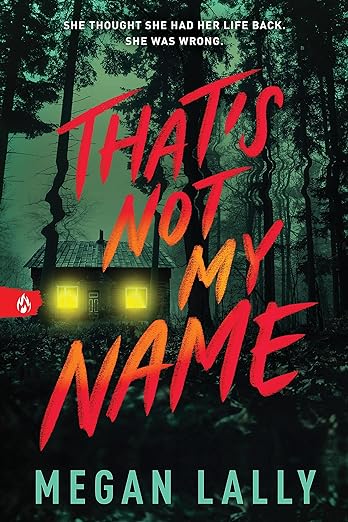
Megan Lally’s YA thriller That’s Not My Name starts with a bang and pretty much kept me on the edge of my seat until the very end.

I think I might be dead.

I try to gather my bearings, but I can’t see. I feel nothing. Not even my own body. The lack of sensation, the way the silence wraps me in a hug and squeezes–it’s unnerving. I want it to stop–

Until the pain comes.

The police pick up a girl on the side of the road. She doesn’t know how she got there; she doesn’t even really know where there is. She doesn’t know her name. When her father shows up at the police station, she doesn’t recognize him. She was in a car accident, he explains. Or at least that’s what he thinks must have happened. He produces all her identification–her name is Mary–so the cop who found her feels comfortable releasing her into his care.

Then, in another town, we meet Drew. “Life really goes to shit when everyone thinks you killed your girlfriend,” he says. Lola has been missing for five weeks. She vanished without a trace and Drew was the last person to see her alive. Everyone, including the cops, think Drew must have done something to her, but they haven’t found a body so he hasn’t been charged with a crime.

As Mary slowly starts to doubt the veracity of her circumstances, Drew starts to do more to find out what happened to Lola, including following leads that the police won’t. It all makes for a page-turning ride that doesn’t exactly deviate from the tried and true thriller tropes but still manages to deliver a fast-paced narrative that teens will gobble up. I read it in one sitting.

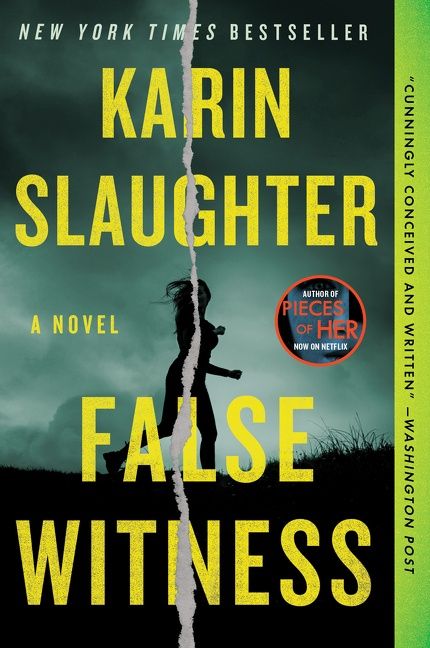
False Witness – Karin Slaughter

I know that American crime writer Karin Slaughter has legions of rabid fans, but I don’t think that I am one of them. I mean, maybe I am throwing in the towel too early because I have only read one other book, Pretty Girls, besides this one. Like that one, this is a propulsive read about estranged sisters, and horrible crimes against women.

Leigh Collier is a lawyer working her way up the food chain. Her younger sister, Callie, is a hard core drug addict living mostly on the streets. Their lives rarely intersect until Leigh is assigned a new case that sends her hurtling back to her teen years.

Andrew Tenant has been accused of brutally raping a woman and leaving her handcuffed to a table in a park. He’s fired his lawyer and hired Leigh. Turns out, he’s not a stranger.

She would never forget him. Trevor Waleski had been a sweet kid. A little awkward. A lot clingy. The last time Leigh had seen him, he was drugged into oblivion. She had watched her sister gently kiss the top of his head.

Trevor aka Andrew hired Leigh because he knows something devastating about Leigh and her sister and he won’t stop until he gets exactly what he wants. The book spends 600+ pages with the sisters as they try to outmaneuver Andrew who, as it turns out, is pretty dang smart. And also a psychopath.

The book has all the requisite twists and turns. Callie was my favourite sister and her relationship with Dr. Jerry, the memory-impaired veterinarian for whom she sometimes works (and steals drugs from) is my favourite relationship in the book. Leigh’s husband, Walter, is also a great guy. He is kind to Callie and supportive of Leigh even though they are currently separated.

The book takes place during the height of Covid – so there’s social distancing and masks. Not sure it adds anything in particular to the story, but Slaughter herself said “Covid has exposed the ever-widening chasm between the haves and have-nots, spotlighted the housing crisis and food insecurity, focused attention on the lack of proper funding for schools, hospitals, and elder care, exposed a bankruptcy of trust in our government institutions, exacerbated the horrendous treatment of inmates in our jails and prisons, exponentially worsened xenophobic, misogynistic, and racist hate speech, heightened racial inequalities, and as usual, has grossly overburdened the lives of women; all topics I have attempted to touch on within the pages of [this] book”.

None of the Covid stuff did any of that for me, really, but perhaps other people will find that it added another layer to the story. I don’t know that I would have kept reading except that I wanted to find out how Callie and Leigh were going to get out of the bind they were in. Was the ending satisfying? Believable? Not sure. Lots of people will love this book, but I think my journey with Slaughter ends here.

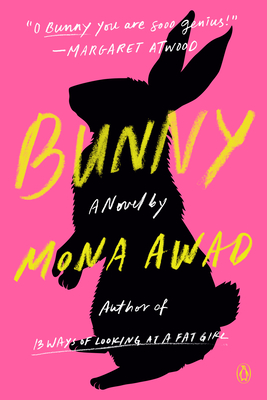
Bunny – Mona Awad

For a while, Bunny was everywhere and so I bought it and shelved it and, finally, I’ve read it. Canadian writer Mona Awad’s story of academia, writing, and mental health (??) is a masterclass of a fever dream and more than once I was scratching my head and asking myself just what in the heck is going on. When I turned the last page, I still can’t say for sure what I read.

Samantha Mackey is in the graduate writing program at an elite New England college, Warren University. In her writing class of five, she is the outlier; the other four women in the class, The Duchess, Cupcake, Creepy Doll, and Vignette, are an insular group who affectionately call each other Bunny. Their affectation drives Samantha crazy and she and her bestie, Ava, spend most of their time mocking the other women.

How fiercely they gripped each other’s pink-and-white bodies. forming a hot little circle of such rib-crushing love and understanding it took my break away.

[…]

I quietly prayed for the hug implosion all last year. That their ardent squeezing might cause the flesh to ooze from the sleeves, neckholes and A-line hems of their cupcake dresses like so much inane frosting.

But then, one day, Samantha gets invited to Smut Salon, a gathering of the bunnies where they share their “Absolute Truth” and drink a “bile-green concoction in which what looks like a small black turd floats.” Suddenly Samantha finds herself one of the members of this strange sisterhood and losing, it seems, her grip on reality.

This is a crazy novel, honestly, but I gobbled it up in a couple sittings without complaint. I think much of what happens is deliberately ambiguous. Is Samantha going crazy? Are the student bunnies really turning actual bunnies into subservient men (although men without penises and who have to wear gloves because their hands are deformed)? Is the whole thing a metaphor for the creative process? Why can’t Samantha write anything? Why does Ava disappear? Who is Max? So many questions and although none of them are answered in a specific way, I think I am satisfied with my own interpretation of the the book. Which I am not going to share here because you’ll want your own.

Definitely worth a read.

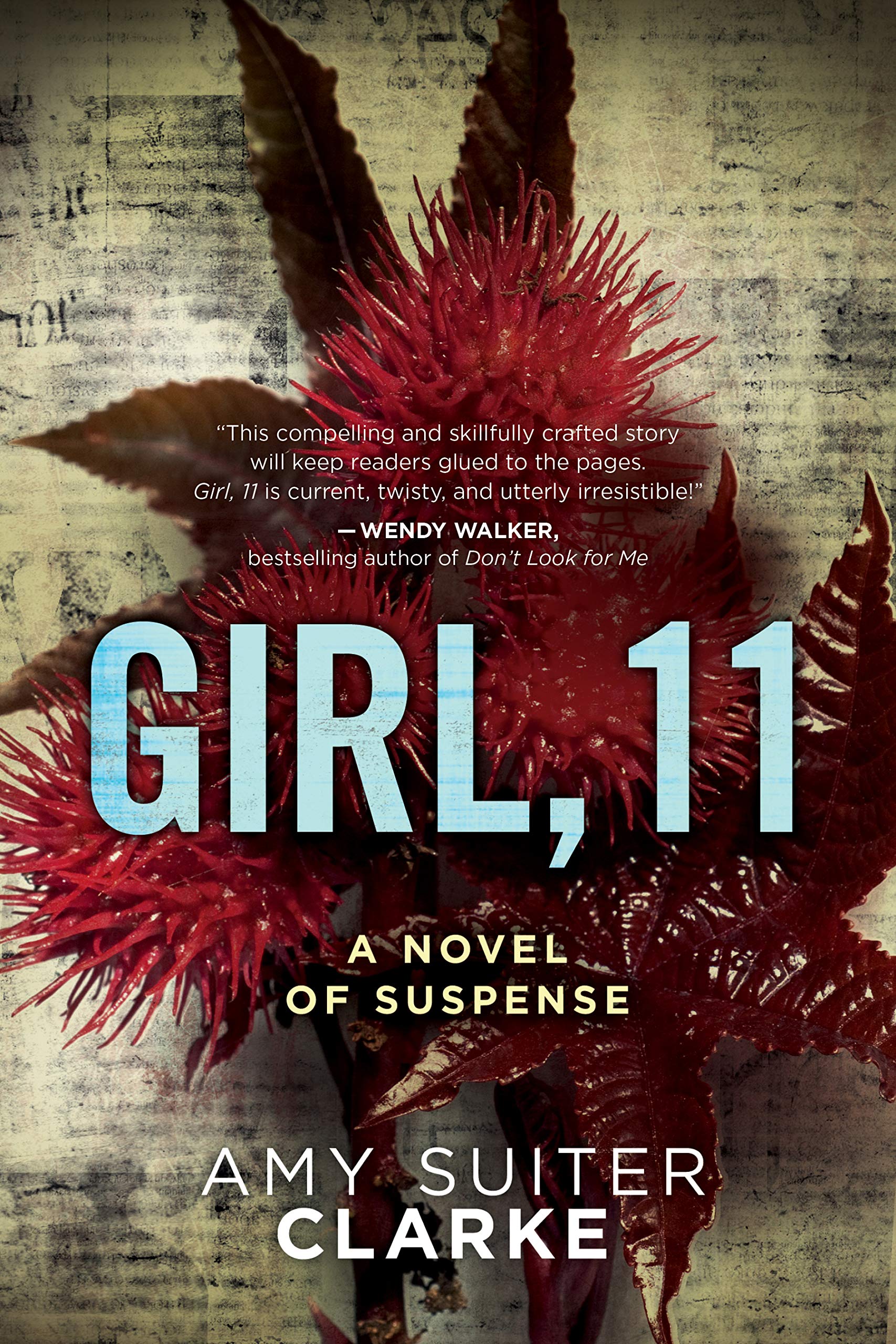
Girl, 11 – Amy Suiter Clarke

The notion of using a podcast transcript as a structural element in a novel has been around for almost a decade. Kathleen Barber’s 2017 novel Are You Sleeping is widely considered the first book to include a podcast and it must have seemed like a cool gimmick at the time. Loads of novels have done it since. Sadie, None of This is True, and Listen for the Lie are a few of the titles I have read that use this formula.

Amy Suiter Clarke’s novel Girl, 11 follows Elle Castillo, whose podcast Justice Delayed tackles unsolved cold cases. Formerly a social worker, Elle brings a strong stomach and a desire to help victims not glorify perpetrators to her work, and she’s had some successes. But now she is trying to solve the case of The Countdown Killer (TCK).

This case has involved several murders with a distinct signature. Girls, in descending order of age, are kidnapped, held for seven days, poisoned, whipped and then deposited someplace where they are easily found. There is definitely a rigid pattern to the crimes.

According to John Douglas, the former FBI special agent who made his name interviewing and analyzing serial killers, there is a difference between the modus operandi–the way a crime is committed–and the signature. The signature is what the killer does to achieve fulfillment. The way they kill might change over time, and it won’t necessarily impact the killer’s satisfaction. But every killer has a signature, something they have to do, or the kill won’t give them the release they’re after. Based on what we know, the numbers are his signature. The three girls, three days apart; the seven days of captivity; the twenty-one lashes.

The numbers mattered more than anything else. And that tells us something.

Elle is like a dog with a bone and she has earned some street cred with the police, so when another girl goes missing after a long period of dormancy, Elle is brought in to consult. The cops don’t think this can possibly be TCK, but when Elle suffers a very personal loss, it begins to look like he’s back.

The New York Times Book Review called Girl, 11 “propulsive” and, I dunno, it wasn’t propulsive for me. It was long and relatively slow and, at times, repetitive. There are multiple perspectives in the novel and some of those perspectives felt like exposition: let me show you why this person behaves this way. Here’s the backstory. I never really love that.

But, overall, this is a well-written novel and if you haven’t had a lot of experience with books like this, you could do a lot worse.

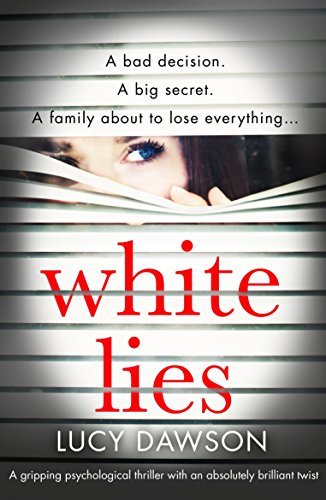
White Lies – Lucy Dawson

Many years ago I read Lucy Dawson’s novel His Other Lover which I remember really enjoying. That’s probably why I picked up White Lies, but I am sorry to report that it didn’t land quite the same.

Alexandra Inglis is a family doctor at a group practice somewhere in England. She is married to Rob and mother to two little girls, Maisie and Tilly. Her life is blissfully happy until, in retaliation for Rob’s indiscretion, she gets blinding drunk while on a girls’ weekend and sleeps with a complete stranger.

He straightened up, and I realized he was tall. I drank in a tight T-shirt, gym-honed arms, beautiful eyes–and didn’t stop staring. He looked confused at my brazenness, but then came a shy smile.

I saw how it was going to go immediately.

What Alex fails to realize in her inebriated state is this hot guy is actually a seventeen-year-old patient and sleeping with him opens up a whole world of complications.

White Lies offers more than one perspective for although Alex insists that she was too drunk to know she was crossing the line because she absolutely 100% did not know who this guy (kid?) was, he has a completely different story.

So, what we end up with is a he said/she said narrative with two wholly unreliable narrators and a a cast of secondary characters who have a vested interest in the truth.

This book was easy enough to read, but truthfully, not actually all that plausible and the ending felt like it belonged in a completely different story.

Mileage will vary.

Take Me There – Carolee Dean

Seventeen-year-old Dylan Dawson just can’t seem to catch a break. When Carolee Dean’s YA novel Take Me There opens, Dylan and his best friend, Wade, are on the run. They’ve been in trouble before and even did a stint in juvie together and because Wade had rescued Dylan from a sticky situation when they were locked up, Dylan just can’t give up on him up now.

Dylan and Wade are headed to Texas. That’s where Dylan’s father, Dylan Dawson Sr, is currently sitting on death row. Dylan hasn’t seen his father or communicated with him in any way since he’d been locked up eleven years ago. But his execution date is imminent and Dylan has questions only his father can answer.

Dylan is also trying to put as much distance between them and members of the Baker Street Butchers, a gang of street thugs who had tried to bring the teens into the fold in a plan that had gone horribly wrong, thus the running. But leaving California also meant leaving Jess, a girl Dylan had known as a kid and later, by sheer coincidence, reconnected with. Their blossoming romance helped Dylan imagine a different sort of life for himself and that’s where he thought he was headed until things took a sharp turn at murder.

The truth is, Dylan has a lot of cards stacked against him. His mother has never been quite the same since his father’s arrest. Dylan is unable to read and dropped out of high school. The positive male role models in his life are few and far between, although the man who owns the garage where he and Wade work is definitely a contender.

Dylan is a sympathetic character and he always tries to do the right thing. People don’t always do right by him, though, and it’s hard to watch him struggle against the system and the people who haven’t always had his best interests at heart.

Although the book falls apart a little at the end, I flew through this story and I know lots of my students will really enjoy it.

Things Don’t Break on Their Own – Sarah Easter Collins

Although Things Don’t Break on Their Own is touted as a “miraculous literary thriller”, I think that’s doing Sarah Easter Collins’ debut a disservice. While the book is definitely literary and it’s definitely a page turner, I don’t think I would call it a “thriller”. But maybe that’s nitpicking and it really doesn’t matter.

Robyn and her wife, Cat, have invited some friends and family round for dinner. There’s Robyn’s older brother, Michael, and his girlfriend, Liv. There’s Nate, Cat’s brother, and his new girlfriend, Claudette, and then there’s Willa and her boyfriend, Jamie. Robyn and Willa have history; when they were 17 and in boarding school together they were roommates and then lovers, but it ended badly. That was years ago, now, though and the two women are friends. It wasn’t a particularly happy time for Willa. Her younger sister, Laika, disappeared when she was just 13 and nearly 22 years later, the family still doesn’t know what happened to her.

The story changes perspectives and doesn’t follow a straight line. As Robyn anticipates Willa’s arrival, she remembers the summer she took her back to Tea Mountain, the remote place she calls home. It is a transformative experience for Willa, whose own family is a dysfunctional mess. Robyn’s father is a potter, and as he repairs a broken bowl using the Japanese method of kintsugi, he assures Willa (without even knowing her all that well) that “You can fix anything, given the right tools.”

There is no fixing Willa’s fractured family though. Her father, Bryce, has a successful business, so money is not an issue, but he is a horrible and abusive bully, especially to Willa’s mother and Laika. In fact, Bryce never touched Willa, and perhaps some of her guilt stems from that. About Laika, Robyn says

I tried to keep her safe. I really did. I told her, keep your head down, don’t bring unnecessary attention to yourself, just do what you’re told, all the things that just came naturally to me. But I was so busy keeping her safe from herself that I forgot to warn her about the outside world. I should have told her that there were people out there, men, women even, who could harm her.

So much was my fault.

Robyn and Cat’s dinner party proves to be revelatory, but by the time you get to the “twist” (maybe that’s why they call this book a thriller), you’ll be so invested in these characters that –well, I don’t want to say it hardly matters, but it was honestly the least interesting part of the book.

I really enjoyed Things Don’t Break on Their Own. The writing was great, the characters were compelling, and the mystery surrounding Laika’s disappearance was intriguing. It’s a solid debut and I highly recommend it.

The Wasp Trap – Mark Edwards

I whipped through Mark Edwards’ thriller The Wasp Trap in a couple sittings (helped along by two storm days), but it wasn’t really because the book was anything particularly special.

Twenty-five years ago, Professor Sebastian Marlowe assembled his “revolutionaries”, six 20-somethings with particular skills, and invited them to come to Thornwood, a stately country manor, to develop a dating app based on years of his own research.

At the end of the summer, after a party-gone-wrong, the six were shipped off to their homes in various parts of England and with the exception of Theo and Georgina, who had fallen in love and subsequently married, they don’t speak to each other until after Marlow has died and Theo and Georgina invite them to a dinner party in their former employer’s honour.

This is one of those locked room mysteries where you are meant to be suspicious of everyone’s motives. The story is mostly told through Will’s eyes. He’d been hired to write the web site’s copy, so it makes sense that he’s the observant one, the one who tries to piece things together when things go sideways. Which they do.

Once all the gang’s back together, someone in the house turns out not to be who they said they were…well, more than one someone, actually. Suddenly, the revolutionaries find themselves unwilling participants in a deadly game of “tell me your secret”.

The Wasp Trap toggles between the summer at Thornwood and the present day and reveals to the reader that, Lily, the genius of the group was also working on a separate project, an app that could figure out whether or not someone is a psychopath. As Will notes when Lily broaches the idea

The genius. The lothario. The salesman. The affluent couple, the joker and the local girl. Finally me, the wordsmith, whose role was to write it all down.

If any of us were a psychopath, I already had a good idea who it would be.

This is one of those books that will appeal to a lot of readers. It’s fast-paced, there are clearly stakes, lots of twists and cliffhangers that will make you turn the pages. It was just okay for me, but that’s just me. I didn’t really care for any of the characters that much and I wasn’t a huge fan of the ending.

Mileage will definitely vary.

Razorblade Tears – S.A. Cosby

Razorblade Tears is my second book by S.A. Cosby (All the Sinners Bleed). It’s a straightforward revenge thriller that grabs you by the throat immediately and shakes the living daylights out of you until the end.

Ike Randolph and Buddy Lee Jenkins have very little in common with each other except for the fact that Ike’s son, Isiah, fell in love with Buddy Lee’s son, Derek. Neither man had a solid relationship with their son for reasons that are more complicated than their sexual orientation. Ike spent several years in prison when Isiah was younger. Buddy Lee also spent time in prison. Ike has been out for a few years now, and has built a successful lawncare business; Buddy Lee lives in a rundown trailer and drinks too much. Ike is Black and married to his high school sweetheart; Buddy Lee is white and divorced.

Then their sons are murdered. And when it doesn’t look like the police intend to solve the crime, Ike and Buddy Lee join forces to find out what happened to them and make it right. And by make it right, I mean cause bodily harm to anyone involved.

It is often the case, and certainly true for Ike and Buddy Lee, that we only realize how much we love someone when they are gone. I mean, sure, these fathers loved their sons, but they also couldn’t abide the fact of their homosexuality. Their deaths stir up all sorts of unresolved feelings and also calls into question the validity of those feelings. Buddy Lee gets there a little quicker than Ike:

Derek was different. Whatever rot that lived in the roots of the Jenkins family tree had bypassed Derek. His son was so full of positive potential it had made him glow like a shooting star from the day he was born. He had accomplished more in his twenty-seven years than most of the entire Jenkins bloodline had in a generation.

Once the men start to ask questions about their sons, they find themselves in the crosshairs of a gang of bikers, and someone powerful further up the food chain. Ike and Buddy Lee are not without skills and they find themselves in some truly terrifying situations. Their partnership grows from wary colleagues to something like friendship as they take a wrecking ball to the mystery surrounding their sons’ deaths.

Razorblade Tears is violent, funny, heartfelt and a total page turner. It asks a lot of questions, not the least of which is what happens to a person who is not allowed to be their authentic selves. You will be rooting for these middle-aged men from start to finish.

The Safest Lies – Megan Miranda

Seventeen-year-old Kelsey and her mother live in a fortress of a house; it even has a safe room in the basement. Kelsey has always felt safe there and, in fact, “The black iron gates used to be [her] favorite thing about the house.” She acknowledges that her life isn’t like the lives of her classmates. For starters, her mother hasn’t left the house in 17 years. For another, she has to meet with Jan.

Seeing Jan was part of my mother’s deal to keep me. Jan was assigned by the state. I’ve come to rely on her, but I also don’t totally trust her, because she reports to someone else, who decides my fate. My mother relies on her even more, and trusts her even less.

Although previously homeschooled, Kelsey now attends high school and on her way home one day she has a car accident. Ryan, classmate and local volunteer firefighter, is first on the scene and “saves” her from certain death. His heroism lands the pair in the paper and that’s when Kelsey’s life starts to unravel.

She does something she shouldn’t and sneaks out of the house one night to see Ryan receive a medal for saving her life. When she returns home, she discovers the gate at the front unlocked, and when she makes her way inside, her mother is missing. It’s a big deal because, remember, mom hasn’t been outside in 17 years.

Megan Miranda’s YA thriller The Safest Lies is pretty much what you’d expect from a book of this type. A plucky heroine, a solid love interest, a couple red herrings, a mystery and enough action to propel the plot forward. I was pretty invested when there seemed to be stakes (who are the shadowy figures lurking around and I guess that safe room will come in handy after all, eh?) It doesn’t necessarily wrap up as satisfactorily or as believably as I might have hoped, but as a seasoned thriller reader, that’s to be expected.

Teens probably won’t be able to turn the pages fast enough.