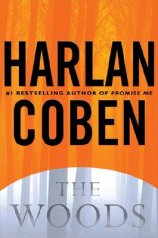
The Woods by Harlan Coben

Woods

So, I know there are loads of Harlan Coben fans out there. I get why people like him. He’s a straight-up writer, lots of dialogue and characters and plot threads to keep you busy. Coben’s the sort of writer you read when you’re looking for something fast-paced and, dare I say it, fluffy.

The Woods has a convoluted plot that concerns Paul Copeland, County Prosecutor. Twenty years ago his sister, Camille, went missing (presumed dead) along with three of her friends while they were all at a camp for teens. When one of the presumed dead turns up dead (again) twenty years later, it cracks open a door to a past that Paul knows nothing about.

I liked Paul’s character. He’s a smart-mouthed lawyer who isn’t afraid to look the bad guy in the eye. His chief investigator, Muse, is the female equivalent of Paul and they make a fine team.

For me, though, The Woods was just too busy and, at the end of the day, the secrets buried in the woods just weren’t enough to hang 400 pages on.

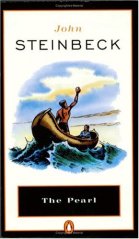
The Pearl by John Steinbeck

pearl

I taught The Pearl at summer school this year. Although I have read a couple other Steinbeck novels, I’d never read this one. It’s a great little novella to teach because of its simplicity and easily recognizable themes of greed and hope.

Kino and his wife Juana lead a simple life in La Paz, Mexico around 1900. Kino is a pearl diver, depending on the canoe passed down through the generations and his own work ethic.  He’s a man content with his lot in life because he appreciates what he has. When his infant son, Coyotito, is stung by a scorpion it sets off a chain of events that not only ruins Kino, but upsets the delicate balance of the natural world (if only metaphorically) and the community in which Kino had so happily lived.

The Pearl is an accessible novel. It gave us lots to talk about – do you need money and possessions to make you happy? Should you judge a man by the clothes he wears or his character? Is violence ever justified? Today’s teens often do think that money buys happiness and if ever there was a novel to disprove this assumption, The Pearl might well be it.

If I were just reading it for pleasure, though, I might have been disappointed. I’m not a gigantic fan of Steinbeck’s writing at the best of times (although he certainly deserves his place in that list of great American writers). The Pearl is simplistic and at times unrealistic (which likely has to do with the fact that it’s a parable which comes from the oral tradition of storytelling). As it teacher it offered me lots to work with; as a reader it was less enchanting.

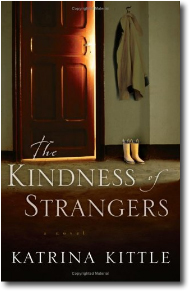
The Kindness of Strangers by Katrina Kittle

Man, this was a hard book to read and, strangely enough, a hard book to put down. Katrina Kittle’s novel tells the story of widowed, Sarah, and her two sons, Danny, 10, and Nate, 16. Like many other novels these days, Kittle employs alternating viewpoints, allowing the story to be told (mainly) from Sarah and Nate’s points of view. And Jordan’s.

In fact, this is Jordan’s story. He’s a classmate of Danny’s. One day Sarah sees him walking along the road in the pouring rain and she stops to pick him up. He seems ill, more than ill and when he asks to stop at a service station port-a-potty to be sick, she does. Her mother senses are jangling like crazy and when she goes to check on him, she discovers that he’s collapsed with a hypodermic needle jabbed in his neck.

Jordan’s mother, Courtney, is Sarah’s best friend, but Jordan’s desperate act opens a dark door into his life and this story asks Sarah and the reader to step through it. The Kindness of Strangers is about the worst kind of abuse and it doesn’t shy away from the topic.  Sarah and her sons are barely recovered from the death of their husband and father when they are called upon to help Jordan. In some ways the social network depicted in this novel seems like a best-case scenario; Jordan has some caring adults in his corner, but to live in today’s world is to know that that is often just fiction.

Kittle does a terrific job of getting us into Sarah’s headspace: her horror over what her best friend has been accused of, her horror over what Jordan has suffered, her struggle to balance her own issues with the day to day business of running a house and business and looking after two sons.  She was equally adept at letting us see what motivates Nate, a character who is both flippant and incredibly mature. Finally, Jordan’s voice is heartbreaking; the mother in me nearly wept every time he spoke.

The main story of The Kindness of Strangers is bracketed with chapters from Danny.  I think I understand why his is the first and last voices we hear, but I don’t think losing those two chapters would have harmed the book in anyway.

Not everyone will be able to stomach this novel’s subject matter, but if you think you can, it’s a fantastic book about a very serious topic.
Dark Debts by Karen Hall

debtsKaren Hall’s novel Dark Debts is a lot of things, but the most ‘terrifying horror thriller of the last decade’ is not one of them. That’s not to say that I didn’t enjoy this book – I did. But it didn’t scare me.

Dark Debts tells the story of Randa, a newspaper writer; Jack, eldest son of a cursed family (all of whom have either committed suicide or been executed); and Michael, a Jesuit priest who’s in love with Tess, a book editor. Their connection isn’t immediately apparent, but as it turns out they have more in common than you’d think. Don’t worry, all is revealed by the book’s rather neat-bow ending.

What I liked about Dark Debts had less to do with its, at times, heavy-handed musing on the nature of faith and more to do with Hall’s ability to write dialogue that is often very funny.It’s the dialogue that propels the novel along, and so it shouldn’t come as any surprise that Hall’s other career is as a successful television writer. (The fact that Dark Debts is destined for the big screen should therefore be no surprise either. )

Her characters are all likable, too, even when they do unrealistic things.

There’s a lot going on in Dark Debts – murders and devils and exorcisms, but none of it’s scary –  or maybe I’ve just been forever spoiled by the demon who possessed Regan in The Exorcist.

Envy by Kathryn Harrison

envy

I have mad love for Kathryn Harrison. I think she’s a beautiful writer and she often tackles difficult subjects, train wrecks from which you can not turn away.

Envy is the story of psychoanalyst Will Moreland. The landscape of his life is pitted with estranged relationships (his identical – save for the brother’s wine-stain birthmark – twin, Mitch); death (his young son, Luke, killed in a boating accident) and a strained sexual relationship with his wife, Carole (they still do it, but not face to face and Will isn’t allowed to touch her).  From these more-connected-than-you-think threads, Harrison weaves a story which is often funny, sometimes creepy, and slightly over-wrought (particularly near the end).

The novel opens as Will is about to return to his alma mater  for his 25th reunion. He’s clearly not interested in the majority of his classmates. He’s on the lookout for two people in particular: his brother, whom he hasn’t seen since he married Carole 15 years ago and Elizabeth, his college girlfriend.  His brother is a no-show. Elizabeth is there, but their reunion brings to the surface a disturbing revelation.

There are elements of Envy which revisit  some of the themes Harrison has used before in her work: sex used as power, grief, incest. It’s one of the reasons why I like her work so much- she’s practically fearless. Still, I didn’t love this book. I understand Will is traumatized by the death of his young son. I understand that as a professional in the mental health field he’s likely to be less astute about his own feelings and motives, but Envy (for me at least) suffers under the strain of too much plot. For instance, I liked Will’s dad, but do I care about his extra-marital relationship or his second career as a photographer. Not particularly.

And I didn’t like the ending all that much.  Some pretty devastating things happen in this novel, yet Carole and Will seem to move past it all almost effortlessly.  Since the book is told entirely from Will’s point of view, Carole’s feelings about the loss of her son, her struggles to carry on, her own traumatic experiences are exposed only in dialogue and only at the very end. On the other hand, Will examines and re-examines his feelings, sort of distantly and myopically, though. Sometimes I just wanted to see him as  a middle-aged man trying to do his best. And who, might I ask, is paying the least bit of attention to Samantha, the couple’s surving child?

Still, it’s Kathryn Harrison and I’ll take one of her books over just about anything else out there any day of the week.

The Story of Edgar Sawtelle by David Wroblewski

sawtelle

When B. pulled The Story of Edgar Sawtelle out of her bag at last month’s book club reveal there was a silent sigh of dismay. I know I felt it. Despite the fact that the book has garnered heaps of praise and was flying off the shelf at Indigo last summer, I had no desire to read it. When my friend said she was going to take it with her when she went to England with her mom I said: “Don’t do it; this book weighs a ton!”

As it turned out,  of the ten members of my book club I was (along with B.) the only person who read it. Er…finished it. One person got about half way through, a few others read 50-100 pages. The book is l-o-n-g…562 pages but lest you think I actually judge a book by its length, let me say that The Story of Edgar Sawtelle is very well written. I would have said that dog lovers would eat this book up- but this wasn’t the case with the dog lovers in my book club; none of them finished.

It’s hard to put my finger on exactly why I didn’t love this book in the way most others have- well, the critics at least, who have compared this book to Shakespeare, an “American Hamlet” even (Mark Doty). The book concerns the Sawtelle family, parents Trudy and Gar and their son, Edgar, who is born mute. They live on a farm in Wisconsin where they breed dogs known as the ‘Sawtelle’ dogs, remarkable because they can read Edgar’s signs. When Gar’s younger brother, Claude, returns to the farm Edgar’s idyllic life starts to unravel and when his father dies suddenly, Edgar’s grief is palpable. As Claude grows closer to his mother and assumes more of a role on the farm, Edgar becomes obssessed with proving that Claude had something to do with his father’s death.

Things don’t work out quite as Edgar plans though, and he leaves the farm, taking three ‘Sawtelle’ dogs with him. Eventually, though, he returns to the farm to confront his uncle – with dramatic results. (I actually thought the ending was spectacularly melodramatic.)

Why do some books work and others not so much? I can’t fault Wroblewski’s writing. In some ways I felt like he jammed the book with every possible theme, like maybe this debut might mark the beginning and end of his literary career. Ultimately, though, there was just too much ‘dog talk’ – sits and stays and day-to-day kennel business that just wasn’t of interest to me and, in some ways, diluted the book’s larger themes of revenge and love.  It wasn’t that I had a hard time reading the book…I just never really invested my heart in Edgar’s story.

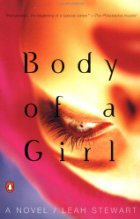
Body of a Girl by Leah Stewart

bodyofgirl

I read Leah Stewart’s novel The Myth of You and Me a couple years back and I had a lot of problems with it. I had a lot of problems with Body of a Girl, too.

Olivia Dale is a crime reporter for a Memphis newspaper. She’s not a rookie, but she’s young and it shows despite her best attempts to hide her reactions to the horrible things she’s called upon to write about. When the novel opens, she’s at a crime scene. Timing allows her to be closer to the body of a girl than she would normally be allowed.

“I’ve learned to stomach the photographs they show me,” Dale says, “but now I know it’s nothing like being so close you could lean down and touch that dead, dead skin” (2).

Perhaps because the dead girl is similar in age and appearance or perhaps she’s just the final straw in Dale’s precariously constructed life-  either way,  she  becomes obsessed with finding out everything there is to know about the dead girl. Not only does she throw  her personal safety out the window, she chucks out her common sense as well. As the book chugs along I felt less and less sympathetic and more and more annoyed with her.

I think Body of a Girl attempts to answer some of the questions we all ask: what makes us the same, what makes us different? How close to the edge can we walk without toppling over? Can we ever really know someone? The problem with Dale is that, despite her profession, she’s a piss-poor judge of character and doesn’t seem to have a compass of any sort. Her journey, ultimately, seems self-destructive, rather than a real attempt to understand the human condition. Dale just seems reckless and stupid by the novel’s rather sappy ending.

Standing Still by Kelly Simmons

standing

I loved pretty much everything about Kelly Simmons’  novel Standing Still. It’s always a relief to read something you can be excited about after a couple of mediocre books. Standing Still is just a terrific book: part page-turner (there’s an intriguing mystery at this book’s core) and part meditation on marriage and family and the lives women leave behind in order to have those things.

Claire Cooper, mother of three young daughters, spends a lot of time alone because her husband, Sam, travels for business. One night someone breaks into her house and Claire finds him about to make off with one of her daughters. “Take me,” she tells the man. “Take me instead.”

The man does take Claire and over the week of her captivity the reader has access to   Claire’s thoughts about her children and husband, as well as to her growing relationship with her captor, a relationship that proves to be far more profound and moving than you might expect. Their relationship becomes one of intimacy and, dare I say it, friendship and I know there is probably some psychological explanation for what happens between kidnap victims and their abductors, but I don’t think that explanation would actually suffice in this case. Claire is carrying a lot of emotional baggage and for the first time in her life she is forced to confront some of it. It is her time with this unlikely ‘therapist’ that makes healing possible.

On top of all this human drama, Simmons is a beautiful writer. Claire is a fully realized character, fragile and brave. Her unnamed captor is equally interesting –  a scene towards the novel’s conclusion where Claire makes the observation that, sleeping next to him will be the last time she’ll ever feel this safe (232) is both ironic and heartbreaking.

I also really loved that Claire is a woman who is trying to reconcile motherhood and marriage with the fact that she was, once, a very successful career woman. I loved her wild past, her ability to fall in love with a man based on a single characteristic, her yearning for that simple pleasure once again.

This was a book I couldn’t wait to get to at the end of the day…and one I was sorry to finish even as I was racing to the end.

Love: A User’s Guide by Clare Naylor

usersguide1

It’s been a long time since I’ve read a book this bad. And when I say bad I mean stinky bad- filled with clunky writing, unrealistic characters, stupid plot. So I’m lying a bit when I count it as a book I’ve actually read- mostly I skimmed.

Amy works for Vogue in London. She’s beautiful and smart and funny and quirky and perfect and fashionable and and and. Orlando Rock is a movie star. He’s gorgeous and perfect and kind and hot and not even remotely stuck on himself.

Amy and Orlando meet on a beach (shortly after Amy has her first sexual encounter of the lesbian kind with someone who happens to be a dear friend of Orlando’s). He’s smitten. So is she.

What followes is a completely ridiculous courtship followed by even more ridiculous plot machinations aka tabloids which drive a temporary wedge between our lovers. Every once and a while the author speaks  about the characters as if she’s some sort of benevolent angel watching over their love affair.

“…we have to make allowances for love and hope that the lesson they learn won’t be too painful.” (170)

Yeah okay- what about the pain you’re causing your readers, Ms. Naylor?

This book was so bad, I had to make a new tag category: really bad books.

A bookish weekend…

Every May, our local Public Library has a huge book sale. Last year I scored big time…hauling off bags of books for $5. (This year it was “an armload of books for $1″. ) Sadly, I didn’t fare as well this year- just not the same selection or something. I came away with three books: Perpetual Ending by Kirsten den Hartog, Vinegar Hill by A. Manette Ansay, In the Night Room by Peter Straub

Not satisfied with that, I stopped by Bean Books once more. I knew I could get a decent cup of King Cole tea (which I did) and I scored a hard cover copy of Clive Barker’s latest novel Mister B. Gone, for the bargain price of $8.95! (I’d come across this book during my Indigo days and it looked intriguing. I do enjoy a decent horror novel every once and awhile.)

My book accumulation this week was rounded off by purchasing The Book of Negroes by Lawrence Hill. This book is this month’s book club pick. I also received, as a gift A Reliable Wife by Robert Goolrick- which is Indigo’s book club pick.

I may not have stated this, but I decided back in January (with 200 waiting-to-be-read books eyeing me haughtily from their shelf) that I wasn’t going to buy any books this year except for the two a month I’d need for book club. I can’t do it.

Hi. My name is Christie and I’m a book-a-holic.

(Originally published May 3, 2009)