Seventeen-year-old Hermione Winters is a spitfire. Co-captain of her high school 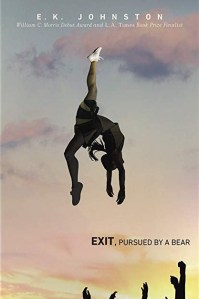 cheerleading team, she is looking forward to one last cheerleading camp, one last year of school and then the freedom her future offers her. She is smart, fun-loving and although she loves cheerleading and takes it seriously, she is not the stereotypical cheerleader. To be honest, there isn’t actually a mean or petty girl in E.K. Johnston’s YA novel Exit, Pursued by a Bear.
I wonder if Johnston chose Hermione’s name as an allusion -to the character from Shakespeare’s play The Winter’s Tale. That’s where the novel’s title comes from; it’s is a famous stage direction from the same play. Never mind, as a character she is sympathetic and admirable. And her life is about to get a lot more complicated.
Every year, the cheerleaders meet at Camp Manitouwabing, which is about an hour from Parry Sound. Teams from different schools meet there for two weeks of intense training. At a dance, just before the end of the camp, someone slips something into Hermione’s drink, and when she wakes up, she’s in the hospital. She has no memory of what happened, but she spends the next year dealing with the aftermath of the event.
There are lots of YA novels out there that deal with rape, but I have to say that this is one of the better ones I have read. After the attack, Hermione’s squad closes rank, insulating her from the inevitable rumours. Only Hermione’s boyfriend, Leo, fails to step up. Not that she needs him; she’s got her bestie, Polly, a pit bull of a friend, who is always at the ready to fend of anyone who even looks sideways at Hermione.
There are lots of great people in her corner, actually. Her psychiatrist, the female police officer tasked with finding the perp, Hermione’s parents who want to protect her, but know that offering too much protection would do their daughter a great disservice at the end of the day.
The novel is brisk, but it does allow readers a glimpse into Hermione’s PTSD, and how she tries to figure out the best way to deal with what has happened to her. Will she let this one incident set the course for her life? I am happy to say that the answer is a resounding no.
One scene I particularly liked was when Hermione and Polly are interviewed by a local reporter. Their cheerleading squad is a pretty big deal, but the journalist does manage to ask a question about the attack:
“Hermione, after your attack at the end of last summer, do you have any words of advice on how other girls can be smart, and stop such awful things happening to them.”
Polly, as always, speaks the truth.
“You’re okay with asking asking a girl who was wearing a pretty dress and had nice hair, who went to the dance with her cabin mates, who drank from the same punch bowl as everyone else – you’re okay with asking that girl what mistake she made, and you wouldn’t think to ask a boy how he would avoid raping someone?”
The conversation has to change. Polly knows it. Hermione knows it. It’s time everyone did.
I really liked this book for a lot of reasons. It’s Canadian, it’s well-written, it says important things without being didactic and you will root for Hermione.
 I could NOT put this book down. From the moment I met Julian and Adam, the two narrators of Robin Roe’s debut novel A List of Cages, I was immediately invested. This is a book with so much to say, but its messages are never didactic. It’s horrifying and heart-warming in equal measure.
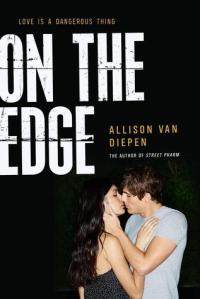 One of my favourite YA tropes is bad boy/good girl. I can’t seem to get enough of it, really, and if there’s a heaping helping of angst thrown in, well, it doesn’t really get much better than that. Allison Van Diepen’s novel On the Edge seemed like it might have the goods, but it was only just okay.
 finally picked it up. The book was well-reviewed and was a finalist for Crime Writers’ Association’s Steel Dagger Award. What can go wrong, right?
 Although I don’t usually trust author endorsements on book covers (except for Stephen King’s praise; he’s a pretty reliable reader), Simone St. James’s novel The Broken Girls had an equal number of positive reviews from places like Kirkus, Library Journal and Booklist. I felt pretty confident when I chose it as my book club pick back in March.




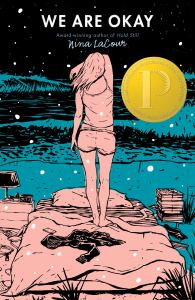 nature of grief. This is a quiet novel, and so I would caution readers not to expect histrionics or very much action. Instead, LaCour focuses on the protagonist’s interior life, which has been altered by loss.
 I can’t remember the last time I cried actual tears reading a book, but Jared Reck’s debut novel A Short History of the Girl Next Door actually made me cry. And also laugh.
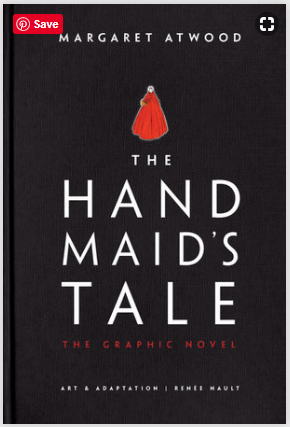 never read Margaret Atwood’s novel The Handmaid’s Tale. I haven’t watched the series, either. I know, I know. I figured that I could rectify that by reading Renee Nault’s stunning graphic novel of Atwood’s book.
 Rufus Holt is having a really fucking bad day. I use the expletive because, well, there’s a lot of F-bombs in Caleb Roehrig’s YA mystery White Rabbit. I’m not a prude by any stretch, but I have to admit that by the end of the novel I was getting a little tired of all the swearing. Surely teenagers as smart as the ones who populate Roehrig’s world would have the vocabularies to match.
 The Ludic Reader