Never Change – Elizabeth Berg

Many years ago, certainly predating this blog, I read Elizabeth Berg’s novel Joy School and found it to be a beautiful and heartbreaking book about a young girl trying to find her place in her family and falling in love with a young mechanic who is, of course, too old for her but who treats her heart like the precious thing that it is.

Never Change is the story of Myra Lipinski, a middle aged unmarried visiting nurse who lives a quiet life with her dog, Frank.

You know people like me. I’m the one who sat on a folding chair out in the hall with a cigar box on my lap, selling tickets to the prom, but never going — even though in the late sixties only nerds went to proms. But I would have gone. I would have happily gone; I would have been so happy.

Myra has always felt like an outsider, even though the pretty girls at school would call her to talk about things that were serious because Myra “knew how to listen.” Even in her own home, Myra felt other. She was not a pretty child, her face “unfortunate, with its too small eyes, its too wide mouth. The hair mousy brown, too thin and straight, greasy after half a day, no matter what.”

Myra is a good nurse though – efficient, kind and well liked by her clients, a motley crew including a teenage mother, a bickering elderly couple, and a man with a gunshot wound who lives in a part of town no one else will visit. Then, a new name is added to her roster: Chip Reardon.

Chip and Myra went to high school together and although they were friendly, they weren’t exactly friends. Chip was “Every girl’s dream boy. The handsome star athlete with a good head on his shoulder’s too. And a genuinely nice guy.” Now he’s back in their home town living with his parents because he has a brain tumour and his clock is running out.

Never Change is the story of how this reunion cracks Myra’s life open in unexpected ways. Opposite to what the title suggests, Myra does change. She opens up to people, including Chip, and allows people to love her, also including Chip.

This is a lovely, albeit sad, story of how sometimes our blinders prevent letting people into our lives in a meaningful way. We don’t always see ourselves as others see us. This is a quiet book and I very much enjoyed my time with these characters.

A Step Past Darkness – Vera Kurian

It’s 1995 in the small Pennsylvania town of Wesley Falls when six classmates (but not friends) are grouped together for a summer Capstone project. There’s Jia Kwon, whose mother owns the local gem and astrology store and who has the gift of sight; Padma Subramanian, the only other Asian in the small town; Maddy Wesley, beautiful, popular and mean; Kelly Boyle, relatively new at the school and trying to fit in; James Curry, Kelly’s childhood bestie and perpetual outsider, and Casey Cooper, superstar football player.

While there are some alliances in the group, there are also some animosities. Nevertheless, they decide to head to the long abandoned Devil’s Peak coal mine for a school-wide party. James has been in the boarded-up mine several times and when there’s a cave-in, he tries to lead them to safety. But on the way to the Heart of the mine, the group witnesses something horrific – something horrific enough that they swear each other to secrecy and which, in fact, causes them to go their separate ways. They don’t see each for twenty years, when a murder in Wesley Falls reunites them.

Vera Kurian’s novel A Step Past Darkness is, in the author’s own words “an homage to Stephen King’s IT— I have always been taken with its focus on friendship, kids being in over their heads, and the return to a place that both is and isn’t home.” Before I read this in the acknowledgments, I was certainly getting those Derry, Maine vibes. There’s no Pennywise in Kurian’s book, but there is the creepy Pastor Jim Preiss of Golden Praise, the town’s mega church.

Priess is a much beloved figure in the church, an enigmatic character who worked his flock into a lather when he delivered his sermons. From Casey’s point of view, he was the only thing worth paying attention to during the church services. “On more than one occasion, Casey had seen someone pass out. He had to admit, that was kind of badass.”

Golden Praise is a strange place, though. Cult-like. Maddy belongs to the group Circle Girls, “An elite corps of girls who floated through the halls of school, each wearing a small silver circular pin inset with a gem. […]Being a Circle Girl had to do with some combination of popularity in Golden Praise’s Youth Fellowship and a purity promise.” Certain members of the Wesley Falls community are elders at the church. And the church has eyes everywhere.

I was wholly invested in these characters (and some, but not all, parts of their story.) It’s a long book, but I eagerly returned to Wesley Falls and had no trouble turning the pages. It’s not IT, a book I read when it first came out and which holds a special place in my heart, but it’s definitely worth the investment of time and I would certainly read more from this author.

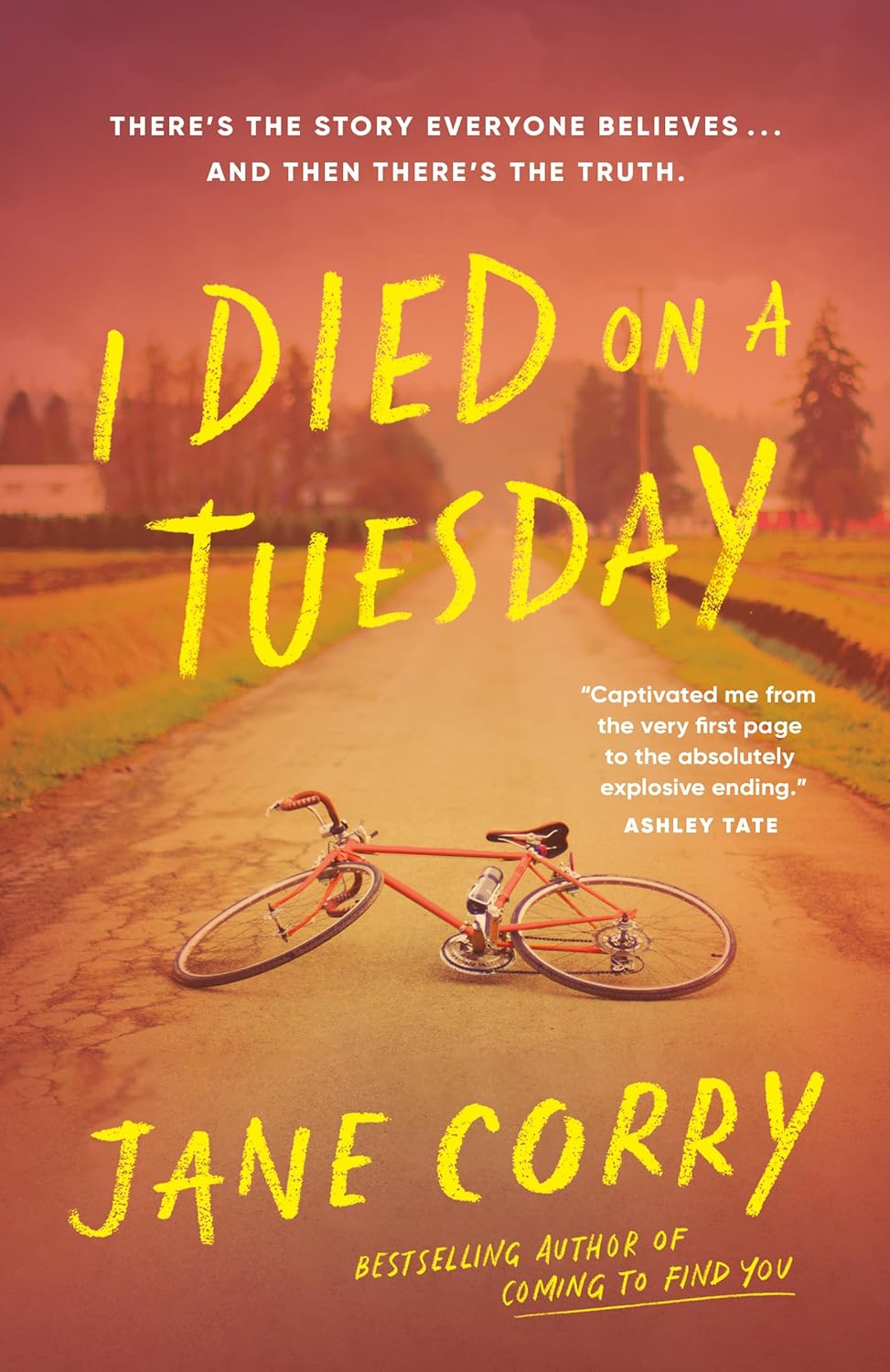
I Died on a Tuesday – Jane Corry

Janie White, 18, is just about to move to London to start a job in publishing when she is run down while biking home from the beach. “On the day I died, the sea was exceptionally flat,” she recalls. So, clearly not dead then. Twenty years later, an arrest is made in this horrific hit and run and the culprit appears to be pop sensation Robbie Manning. He surrenders without argument because “the past has finally caught up with him.”

Jane Corry’s novel I Died on a Tuesday is an overly long (465 pgs), overly complicated, not-very-well-written thriller. Besides these two narratives (well, Janie can’t speak anymore, but she can sing) we also hear from Vanessa, a widow who works at the local courthouse as a witness service volunteer, who comes into Janie and Robbie’s orbit through the trial.

Things might have been a little more palatable if Corry had focused on just one story, but everyone gets in on the action. For example, Vanessa’s marriage is harbouring a huge secret and her friend, Richard, a local judge (and whom she cleverly refers to as Judge) has a secret, and Janie’s mother went missing around the time she had her accident. But did she though? And Robbie’s rise to fame is suspicious. And all these threads, somehow – and mostly unbelievably – tie themselves into a neat little bow by the time we get to the end of the book. Some people might (and did) say that this book was full of twists. Honestly I just felt like yelling “squirrel” every time I turned the page.

None of these characters were remotely believable to me. None of their motives sufficiently explained their decisions. None of the dialogue felt real to me. It was all tell. I knew by about page 50 that I wasn’t going to like it, but I slogged through hoping that where the writing suffered, there might be a pay off in the plot. I will happily read a book with mediocre prose if the story is a banger.

Nothing to see here.

Such a Pretty Girl – T. Greenwood

Although T. Greenwood is a prolific writer, Such a Pretty Girl is the first of her books I have read. It’s one of those books where nothing happens–I mean this is a book driven by character, not plot–and yet it is absolutely riveting.

When the novel opens, Ryan Flannigan is counting down the last few days before her daughter, Sasha, heads to the West coast to start college. Ryan’s childhood bestie, Gilly, keeps sending her urgent texts before finally just sending her a link to a story from the Times. Ryan is shocked to discover that the story is about her mother, Fiona, from whom Ryan is mostly estranged. Worse, the story is about the discovery of a very personal photo of Ryan when she was just a girl that was found in the possession of Zev Brenner, a billionaire who has been charged with sex trafficking and pedophilia a la Jeffrey Epstein. This news is followed by even more shocking news and Gilly begs Ryan to come back to New York City.

Such a Pretty Girl bounces between the 1970s and present day 2019. As a child, Ryan lived with her mother, Fiona, in Lost River, Vermont, home to the Lost River Playhouse where Fiona was an aspiring actress. Lost River was meant to be a “summer respite for actors who worked in the city and a place for aspiring actors to apprentice themselves.” Fiona had been there since 1965 and she and Ryan lived there full time. Gilly and his family also live at Lost River, but only in the summer. Gilly’s father is a working actor and his mother an artist in New York.

Fiona decides to leave Lost River and go into the city to give acting a more serious try, but in the end it is Ryan, who is just ten, who is discovered–first as a model and then as an actress. This strains the relationship between mother and daughter. The time the novel spends in NYC

After Gilly gives Ryan the news about the discovery of the photograph, he begs Ryan to come back to Westbeth, an apartment building populated by dancers and actors and artists and, famously, Jackie O. It’s a real place, actually. It’s worth reading about its interesting history and it is definitely a character in Greenwood’s book. So, in the present day Ryan and her daughter head back to the city and to the place that she, for a very important time in her life at least, called home. There are matters to attend to, and ghosts to exorcise.

This book is very evocative of a time and place and as someone who loves New York and grew up in the 1970s, I found that very compelling. I also loved Ryan’s recollection of her childhood, the perspective skewed through the lens of adulthood. When she recalls her first major ad campaign (for Love’s Baby Soft, a mainstay of every teenage girl in the 1970s) she says

I am wearing fake eyelashes, pink rouge on my cheeks, and lip gloss so thick and shiny you can almost see your reflection in my pout. I am holding a pale pink stuffed bunny. But you can’t tell if I am a child made up to look like an adult, or an adult made to look like a child. When I found the ad years later, it felt like someone had punched me in my throat.

And if you are wondering where Ryan’s mother was in all this, yeah, that’s kind of the point.

This is a terrific, well-written book. Highly recommended.