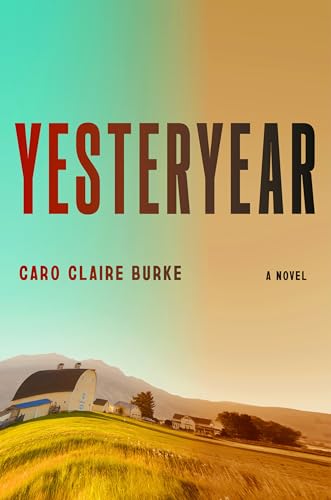
Yesteryear – Caro Claire Burke

It’s been a couple of weeks since I finished Caro Claire Burke’s debut novel, Yesteryear, but life has been very busy as it always is at the end of the school year. Exams are over now, though, and all the marking is done so once prom and grad are over and done with, it’s just a coast to the end of the year and a whole summer of reading on my deck.

I probably needed some time to sit with Yesteryear anyway. A couple of the young teachers that I work with were both raving about it, couldn’t put it down, and so I moved it up the tbr pile. My feelings are more ambivalent than theirs.

Natalie Heller Mills lives in a beautiful restored farmhouse “nestled in the rolling divots between two mountain ranges in Idaho.”

She and her husband, Caleb, are parents to five children and Natalie is pregnant with baby number six. They are living the American Dream. But it’s a curated dream because Natalie is a social media influencer. Her stock and trade is selling her lifestyle to over a million followers. That’s a lifestyle that takes a lot of work.

Through the camera’s discerning eye, the cooking space was perfectly cluttered: a half-filled mason jar of water here, a flour spill there, a few forgotten flower stems strewn across a worn-looking cutting board. It looked like a space where a mother worked; like a kitchen in the real world, only obviously better than anything the real world had to offer.

It takes a lot of effort to sell the dream Natalie is selling. She needs help to do, but she never shows the help because Natalie “wouldn’t be able to forgive [herself] if [her] social media account ended up compromising them in any way.”

Yesteryear is very timely in that it captures the current juggernaut that is tradwives. Natalie is a devout Christian (but is she?) who bakes sourdough bread, homeschools her children and eschews the modern world in favour of the world she has created. She is definitely the brains behind the operation – as readers will come to understand when they read about her upbringing, her time away at college and her decision to marry Caleb, “the youngest of five boys, the runt of the litter in an American dynasty.”

But then one morning Natalie wakes up in an unfamiliar room under an unfamiliar blanket. When she makes her way to the kitchen she discovers her family, her children but not her children “all wearing raggedy-looking clothes that remind [her] of a pioneer reenactment.” Her husband’s “eyes are not [her] husband’s eyes. This man’s eyes are black and cold and dead.” What in the actual heck is going on? Is she on some weird reality television show?Is she actually expected to live the life she sells online?

When I think about trad wives, I think about Nara Smith.

Back when I used to have Instagram I would sometimes watch her videos and laugh – her voice, the ridiculous outfits, making Froot Loops and Fruit Rollups from scratch because her kids wanted to eat them. But, she’s coining it and is clearly not a dumb woman. She has at least four kids and is 25, so she definitely fits the mold. She and her husband, Lucky Blue, are both models and Mormon. I suspect Natalie isn’t quite as glamorous as Nara, but you get the idea.

I find trad wives fascinating and terrifying, but they aren’t a new phenomenon. Remember The Stepford Wives?

Yesteryear has a great premise and it’s a timely novel and it’s well written. Natalie is a character you will love to hate because she is self-involved and fake. But I also felt some sympathy for her, although maybe I wasn’t supposed to. But I didn’t love the book. I found it too long and the reveal was sort of unbelievable for a variety of reasons that would be spoilery to talk about. I think the book does offer some pointed commentary about motherhood, fame, the patriarchy, misogyny, influencer culture and so there’s certainly lots to talk about. It was just okay for me.

Auto Buy Authors: Carolyn Slaughter

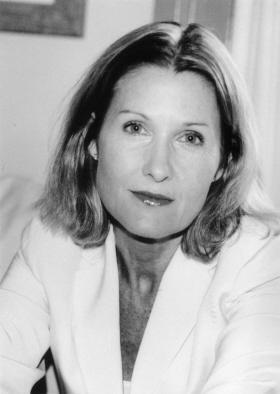
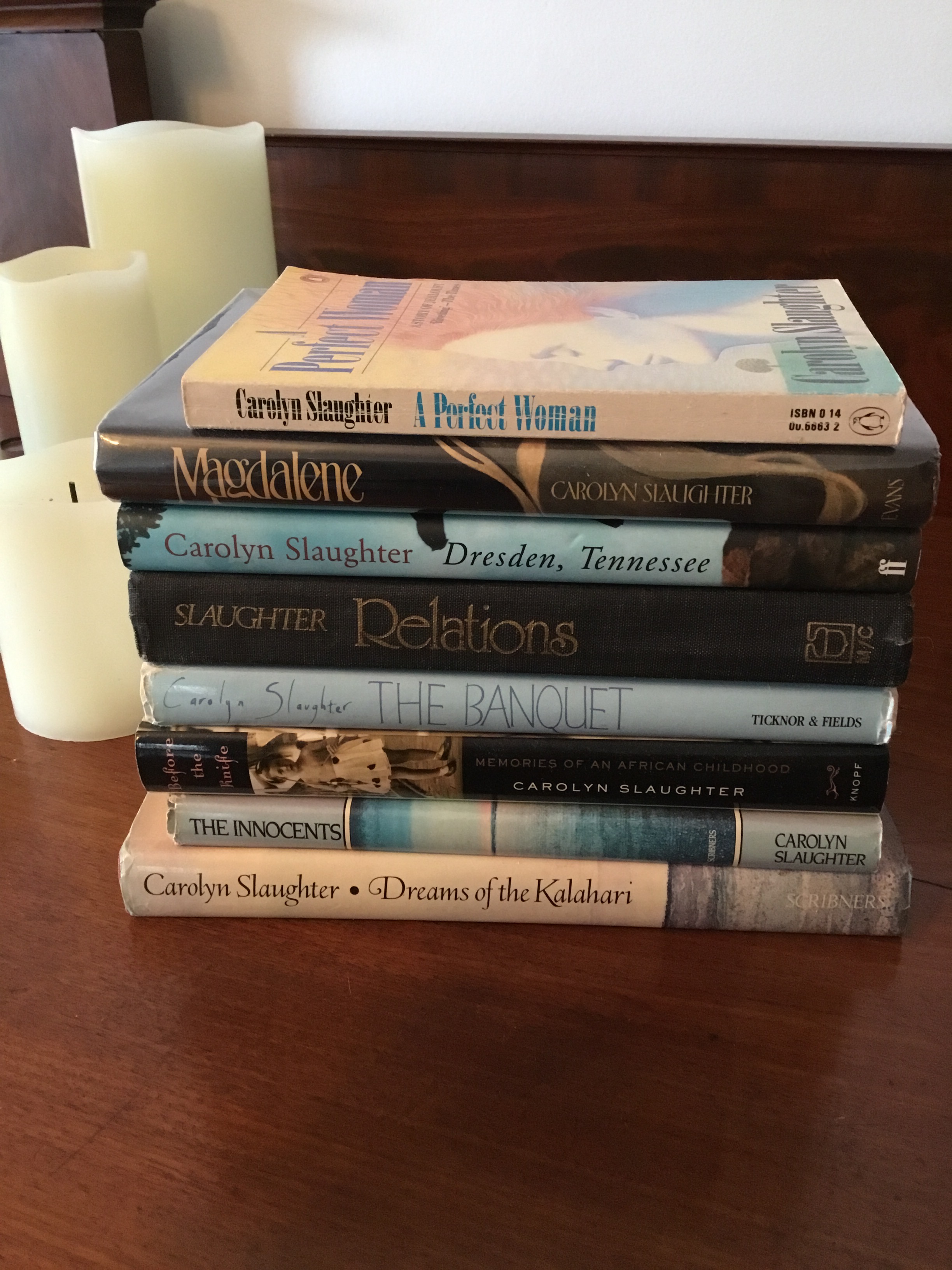
My love affair with Carolyn Slaughter began in the 80s when I happened upon her novel The Banquet in a second-hand bookstore in Hamilton, Ontario. That book, which opens with the lines “I am waiting for them to come. I am not frightened at all”, was a sucker punch of a read and sent me on a treasure hunt for more of Ms. Slaughter’s books.

Slaughter was born in India in 1946, but the family moved soon after to the Kalahari Desert in what is now Botswana. She lived there until her family moved to London in 1961.

Every single book of Slaughter’s I have managed to find has felt like a stroke of luck because like Thomas H. Cook, you’re not picking up one of her books at the local big box book store. Sadly, everything I have read by Slaughter predates this blog with the exception of her memoir Before the Knife, which was published in 2002 and chronicles her childhood in Africa. It is the book she says she wrote to make sense of why she’d been driven to write about violence and murder up until that point. There’s a 12-year gap between The Widow and this memoir. Slaughter hasn’t published anything since 2007’s Dresden, Tennessee which, sadly I DNF. Although I suspect she may be retired, Slaughter became a psychotherapist in lives in (according to Wiki) New Jersey.

I have read and enjoyed several of her novels.

The Story of the Weasel (in North America it was called Relations), 1976

”This my third attempt to put my thoughts down on paper; in my mind they chafe mercilessly.”

This is the story of Christopher and Cathy, siblings in the late 1800s, whose relationship is, let’s just say, complicated. If you recall another set of siblings named Christopher and Cathy, you’ll have a clue as to why. This book floored me when I read it.

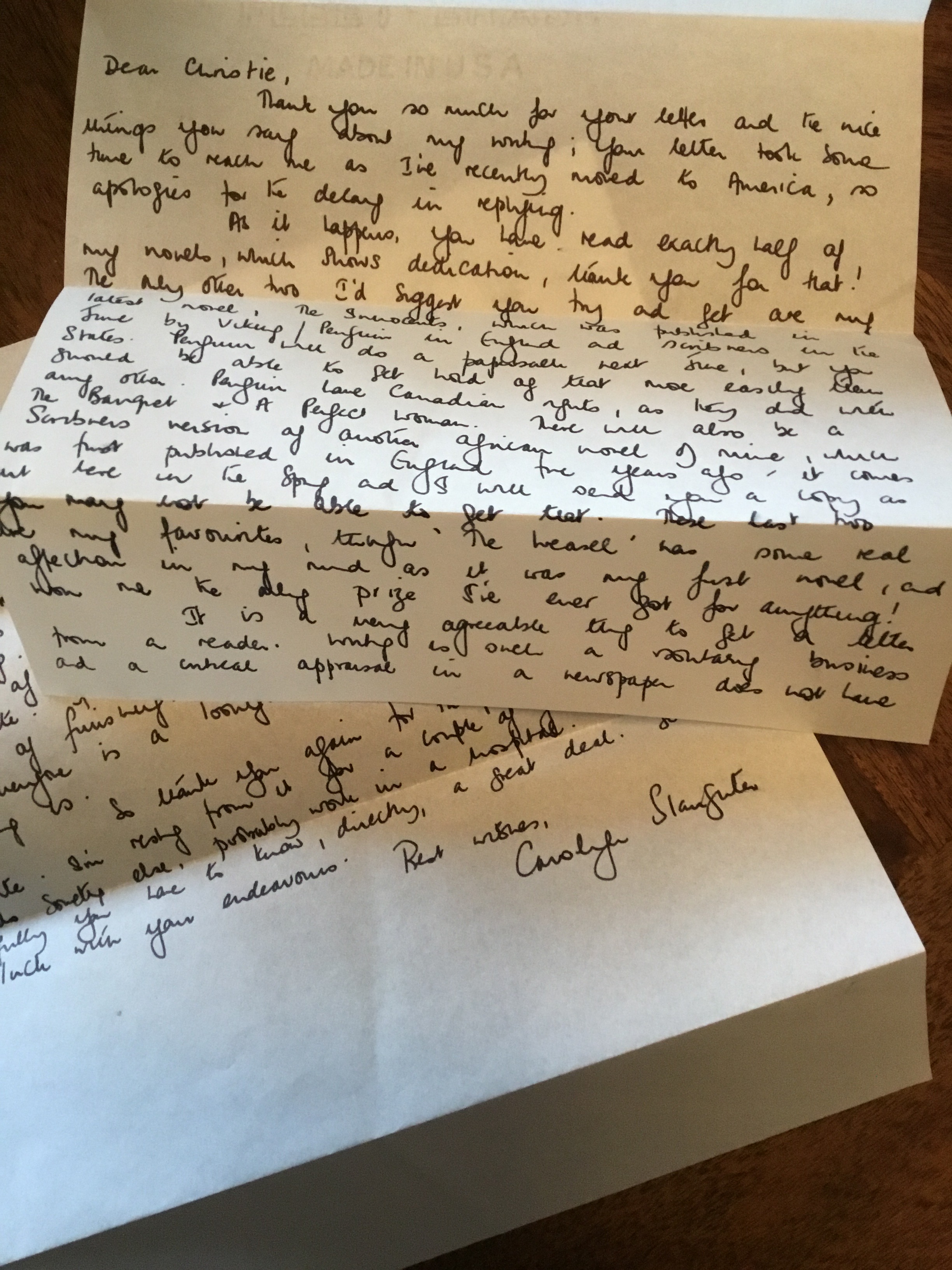
This was Slaughter’s debut and the second book I read. This is also the book that prompted me to write my first and only fan letter to an author and, miraculously, she responded!

Magdalene, 1978

”Today is my birthday, today I am thirty-seven. And look, here is my face floating in the polished silver mirror.”

This is the story of Mary Magdalene and her relationship with Christ. I remember this book as being as angsty as heck.

Dreams of the Kalahari, 1981

“The small girl sat on the sand under the thorn tree.”

An autobiographical novel of a young girl’s coming of age in the Kalahari.

The Banquet, 1983

This is the story of an architect called Harold who meets a young shopgirl called Blossom at a Marks & Spencer. She is the most beautiful woman Harold has ever seen and the two eventually fall in love. One of the most beautiful and horrifying books I have ever read.

A Perfect Woman, 1984

“A woman stood by her window looking out at the garden with the gaze of someone surveying the sea or a long sweep of hills and fields.”

The story of a love triangle.

The Innocents, 1986

“I’m being buried alive.”

A tale of South Africa during the Apartheid

My collection will be complete when I get my hands on Columba, 1977; Heart of the River, 1982; The Widow, 1989. I own, but have not yet read, A Black Englishman, 2004.