Unknown's avatar

About Christie

Book lover. Tea Drinker. Teacher. Writer. Mother. Canadian.

Shattering Glass – Gail Giles

Although Gail Giles is now a well-known name in the world of YA, she had to start somewhere and that somewhere was with her 2002 debut Shattering Glass.

Young Steward, so named due to a complicated family tree, narrates the story of what happens when his best friend, Rob, decides to elevate class doofus, Simon Glass, from zero to hero.

Simon was textbook geek. Skin like the underside of a toad and mushy fat. His pants were too short and his zipper gaped about an inch from the top. And his Fruit of the Looms rode up over his pants in back because he tucked his shirt into his tightey-whiteys. He had a plastic pocket protector, no joke, crammed with about a dozen pens and a calculator.

Rob is the most popular guy in their Texas high school. “He wore confidence like the rest of us wore favorite sweatshirts.” When he decides to make a bit of a project out of Simon, none of the members of their group including the handsome Bobster and star football player Coop raise an objection. Coop, in particular, seems to form an authentic relationship with Simon, but Young has a different view because “Simon Glass was easy to hate.” Young can’t say no to Rob though, although he does wonder why Rob is so eager to change Simon’s social standing.

The novel follows Simon’s gradual metamorphosis from nobody to somebody and how this act also changes the dynamic between the friends. It is clear from the beginning that something awful has happened. Each chapter begins with a short comment from some other secondary character, which allows readers to anticipate an event that the main narrative builds towards. Let’s just say that the book’s title is not merely figurative.

The book examines bro culture to a degree. Why do people follow others even when their conscience tells them they shouldn’t? Young is sympathetic, but also frustrating as he makes one bad choice after another. Even his decision at the novel’s expected but startling climax does nothing to redeem him.

Shattering Glass is a solid book. It’s well written and there’s lots to talk about.
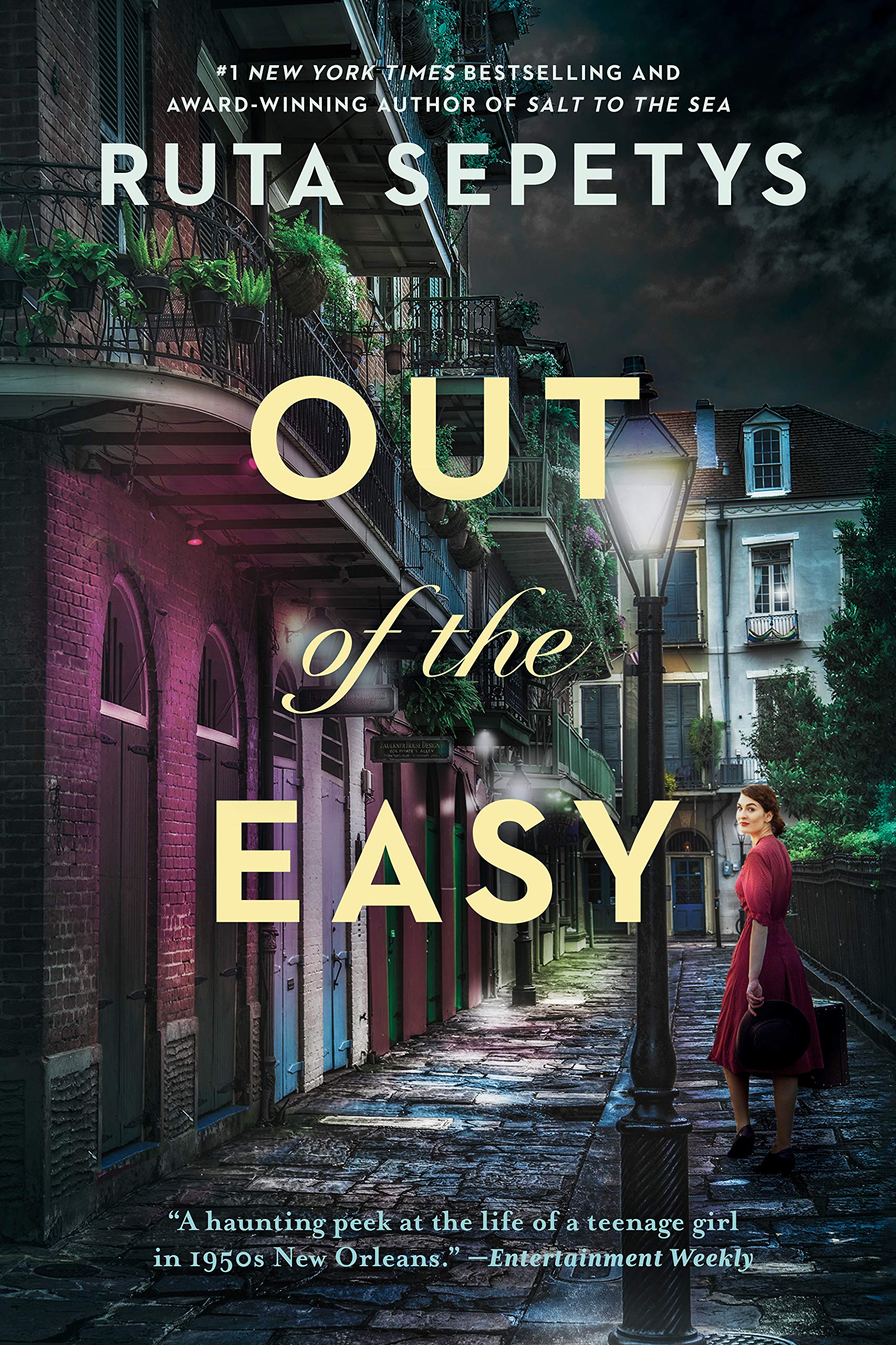
Out of the Easy – Ruta Sepetys

I have yet to meet a book by Ruta Sepetys (Salt to the Sea, The Fountains of Silence, Between Shades of Gray) that I haven’t liked.

Out of the Easy is the story of Josie Moraine, a just-turned-eighteen-year-old who lives in a little room over the book shop where she works with her BFF, Patrick, whose father owns the store. Josie has lives there since she was twelve. Josie’s mother, Louise, is a prostitute in the employ of Willie Woodley, a madam who owns a brothel on Conti Street. The story is set in the 1950s.

I saw her hand first, veiny and pale, draped over the arm of an upholstered wingback. […] The voice was thick and had mileage on it. Her platinum blond hair was pulled tight in a clasp engraved with the initials WW. The woman’s eyes, lined in charcoal, had wrinkles fringing out from the corners. Her lips were scarlet, but not bloody. She was pretty once.

Willie, gruff as she is, is more of a mother to Josie than Louise has ever been and although Josie loves her mother, she also recognizes that she is bad news and mostly they stay out of each other’s way.

More than anything, Josie wants to attend college. When she befriends right-side-of-the-tracks, Charlotte, it looks like realizing her dream and getting out of New Orleans might be in the cards for her. But nothing is ever as easy as it seems, especially when Josie finds herself in the crosshairs of Charlotte’s icky Uncle John and a local mob boss.

Out of the Easy is jam-packed with plot, but sacrifices nothing because of it. I was wholly invested in Josie’s story and I loved all the secondary characters, including Cokie, Willie’s driver; Jesse, a local mechanic; and Sweety, Dora, and Sadie, some of the women who work at Willie’s.

Josie is constantly reminded of the kindness of others and that sometimes our true family has less to do with biology than we think.

I very much enjoyed this book.

Coming Up For Air – Nicole B. Tyndall

Nicole B. Tyndall’s 2020 YA debut Coming Up For Air was a pleasant surprise. In her acknowledgments, Tyndall said that the story had a piece of her heart.

It started as pages from my high school journal, and now, somehow, it’s a real book. And I want to say that I’m grateful for that sixteen-year-old girl who was brave enough to write down all the ways she hurt…

The story definitely has the ring of truth.

High school junior Hadley Butler lives with her parents and older twin siblings. Her besties, Becca and Ty, and her passion for photography keep her grounded and busy.

Then she meets superstar swimmer Braden Roberts. If the rumours are to be believed, Braden is a player and the advice Hadley’s sister offers is to stay away because “he’s friends with Wyatt [her ex], and from what [she’s] heard, he’s even worse than him.”

Turns out, though, the rumours are far from the truth. When Hadley is tasked to attend a swim meet, circumstances put Hadley and Braden in each other’s orbit and the rest is history.

The first part of the book, which takes place during junior year, allows us a window into the teens as their feelings for each other grow deeper. These are two nuanced and intelligent people and you can’t help but root for them as they navigate “first love.” And it’s all sweet and romantic until it’s not.

Braden is an elite swimmer hoping for a scholarship to college. Then he gets an injury. Hadley’s life is pretty perfect too, until her mother’s cancer makes a return visit. How will these obstacles impact Braden and Hadley? Well, that’s the path this book travels.

I really enjoyed this book. The first part was swoon-worthy, really, and the banter between Hadley and Braden was terrific. The second half of the book is definitely more serious, but it wasn’t over-wrought. I think Tyndall handled all of the drama with a great deal of care for her characters. What happens when you love someone, but can’t help them?

I don’t know if this author has written anything else, but I would definitely read it based on this book.

The Secret Year – Jennifer R. Hubbard

Colten Morrissey has a secret and it’s a big one. For the past year, he and Julia Vernon have been hooking up, but no one knows about it because 1. Julia has a boyfriend and 2. “she lived up on Black Mountain Road, in a house that was five times as big” as Colt’s. Yeah, Colt’s not in Julia’s snack bracket at all. So at school, the two don’t even speak to each other or even acknowledge that they know each other. But outside of school

We’d meet on the banks of the river, clutch at each other in the backseat of her car, steam up her windows and write messages and jokes to each other in the fog on the glass, and argue about whether to turn on the A/C. Sometimes we swam in the river late at night when the water was black and no one could see us.

When Jennifer R. Hubbard’s YA novel The Secret Year opens, we learn that Julia is dead. Colt is trying to process this devastating loss and he has to do it privately. After her death, Julia’s brother, Michael, approaches him in the school cafeteria and as it turns out, he knew about his sister and Colt. Well, he found Julia’s journal and put the clues together. Now he wants Colt to have Julia’s notebook. It is both a blessing and a curse.

The Secret Year is sort of Romeo & Juliet, but without the angst (or the poetry) of the play. Sure, Colt and Julia have vastly different lives but that doesn’t seem to matter when they’re making out. And of course, because Julia is dead when the book opens we only ever see her through the eyes of other people and what she reveals about herself in the journal – which isn’t anything very deep, to be honest. Mostly it’s that she has to break up with her boyfriend and she has to do it soon, no, she’s going to do it this minute, but she never does. Truthfully, it’s hard to see what drew these two together other than hormones.

The Cemetery Boys – Heather Brewer

Seventeen-year-old Stephen and his father have packed up their lives in Denver and moved to Spencer to live with Stephen’s taciturn grandmother. It’s the summer before Stephen’s senior year and Stephen isn’t happy about – well – anything. First of all, Spencer is a weird backwater, population 813. Secondly, they’ve left Stephen’s mother behind. Well, she’s been institutionalized. Stephen’s father is unemployed. Stephen’s grandmother is expecting a little help around the house in exchange for their room and board.

At the start of Heather Brewer’s YA novel The Cemetery Boys I was sure I was in for a fast-paced thrill ride.

My fingers were going numb, my bound wrists worn raw by the ropes, but I twisted again, hard this time. I pulled until my skin must have split, because I felt my palms grow wet, then sticky, with what I was pretty sure was my blood. The knots were tight, but I had to get loose. Those things were coming for me, I just knew it.

Those things, it turns out, are The Winged Ones, some supernatural entity that demand a human blood sacrifice every so often for the sake of the town’s prosperity. At first it just seems like some made up bull designed to scare newcomers, but when Stephen meets Devon and the other boys who hang out in “The Playground” aka the local cemetery, he discovers that Devon actually believes in The Winged Ones.

Then there’s Cara, Devon’s beautiful twin sister with whom Stephen experiences an insta-love connection. Not entirely believable.

Despite starting with a bang, The Cemetery Boys ends with a whimper. There is certainly something sort of Stepford-esque about the town and its inhabitants, but nothing really goes anywhere and the book is mostly about a bunch of teenaged boys getting together and drinking their asses off. Until it’s late in the day denouement that is relatively anticlimactic.

Just okay for me.

The Hellbound Heart – Clive Barker

So, apparently British horror writer Clive Barker’s 1986 novella The Hellbound Heart is a classic. It spawned the cult movie Hellraiser, which I have never seen…and am not likely to see after having finished the book.

Frank is tired of the world. In fact, “there was nothing left out there to excite him. No heat. No sweat. No passion, only sudden lust, and just as sudden indifference.” Then he finds Lemarchand’s box, which offers him an intriguing puzzle to solve and if he does, untold pleasure of the darkest kind.

Of course, you can’t make a fair bargain with the Cenobites. They are tricky entities. Frank soon discovers “There was no pleasure in the air; or at least not as humankind understood it.”

Frank’s brother Rory and his wife Julia have recently moved into Frank and Rory’s childhood home. One of the rooms is damp and creepy and Julia soon discovers the reason why. Some version of Frank inhabits the walls and in order to be made whole he needs blood. Julia, who had a pre-marital tryst with Frank, an event that “had in every regard but the matter of her acquiescence, all the aggression and joylessness of rape”, feels her lust for Frank reunited. despite the abhorrent form he currently takes.

It was human, she saw, or had been. But the body had been ripped apart and sewn together again with most of its pieces either missing or twisted and blacked as if in a furnace. There was an eye, gleaming at her, and the ladder of a spine, the vertebrae stripped of muscle, a few unrecognizable fragments of anatomy. That was it. That such a thing might live beggared reason–

The plot is relatively straightforward – equal parts predictable and revolting. I didn’t love it, but I didn’t hate it either.

Wildman – J.C. Geiger

Eighteen-year-old Lance Hendricks is on his way home after auditioning for a spot at a prestigious music school when his ’93 Buick breaks down. Lance is really anxious to get home to a party where he and his long-time girlfriend, Miriam, are finally going to do the deed, but his car is towed off and it looks like he’s going to be stranded in the middle of nowhere because he is not leaving his car behind. Not the car his father left for him.

J.C. Geiger’s YA novel Wildman is essentially the story of what happens when a person whose life is all figured out discovers that maybe that buttoned-up life isn’t the one he wants after all.

Lance takes a room at the Trainsong – a dumpy roadside motel – and heads over to The Float, the only spot for miles where someone can get something to eat (and drink, even if you are underage). There he meets Mason, Rocco, and Meebs. And Dakota.

She was watching him.

A girl in the darkness. In possession of perfect stillness. Her stillness made him stop, and because he stopped, it came. The feeling he’d been aching for. Toes in ice water. feathers up his calves. A hair-prickling, teeth rattling rush of a shiver so good it made his eyes sting.

As Lance waits for his car, he gets caught up in a world vastly different from his own. Lance was on the fast track to success: valedictorian of his graduating class, a full-ride scholarship, a summer internship at the bank. The future is all mapped out. Until he loses his way or, maybe, finds a different more appealing way.

I enjoyed my time with Lance and the people he meets on this journey. The book is well-written, often laugh-out-loud funny and asks some big questions at a pivotal time in a young person’s life.

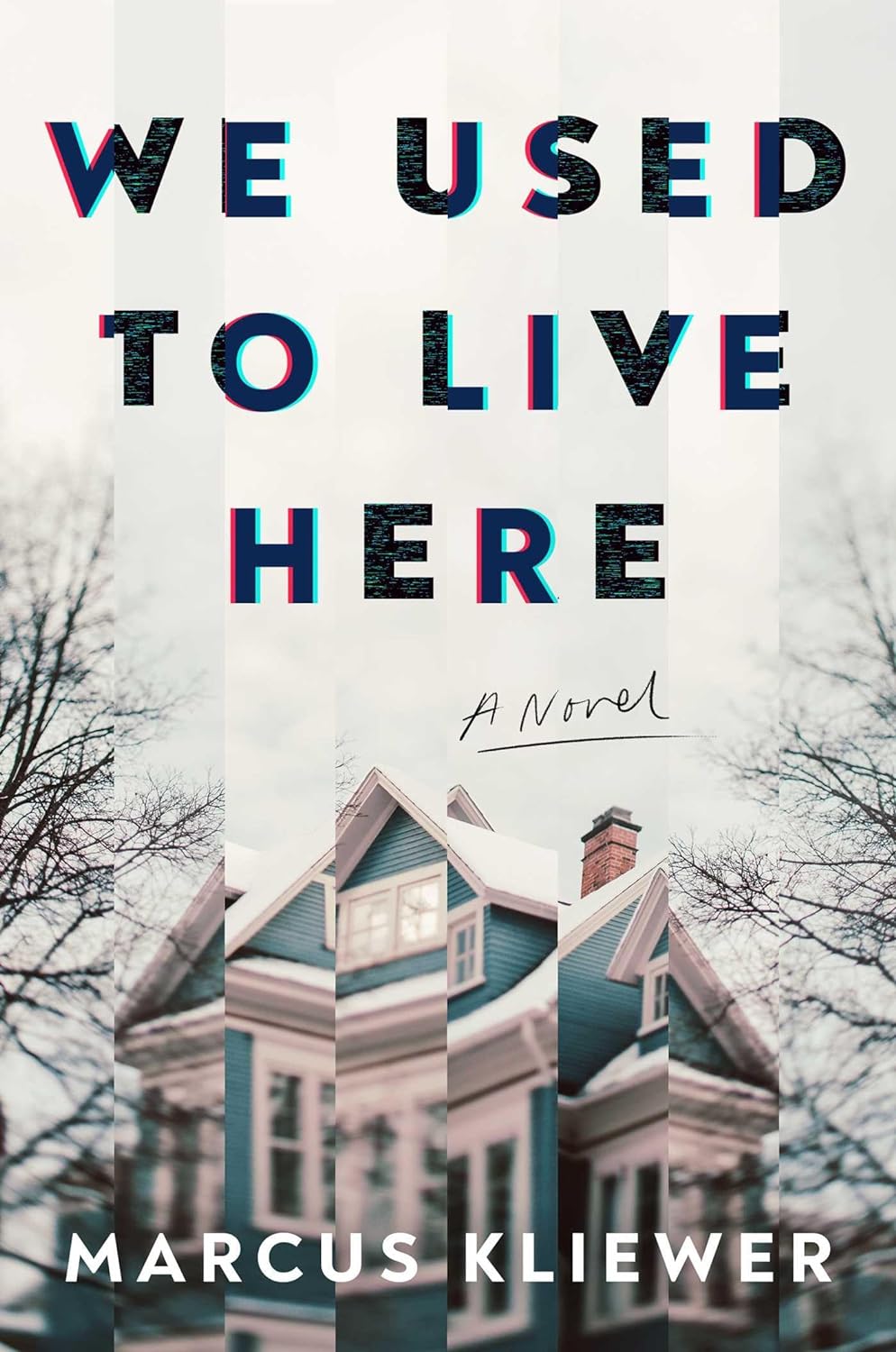
We Used to Live Here – Marcus Kliewer

Years ago, I started to watch the movie The Strangers and I couldn’t make it past the first twenty minutes. Totally creeped me out.

While I eventually did make it through the whole thing, I don’t think I’d ever be looking to repeat the experience. Except maybe in book form.

Marcus Kliewer’s novel We Used to Love Here began its life on Creepypasta. I have only had one other experience with a book with the same starting point: Pen Pal. Like that book, this one started off with a bang and ended with a bit of a whimper.

Eve and Charlie have recently purchased an old fixer-upper in a secluded location with the intent of either renovating or demolishing and rebuilding. Eve is home alone one evening when the doorbell rings. There’s a family on her doorstep and Eve concludes

All in all, they seemed the kind of brood that would cap a Sunday-morning sermon with brunch at Applebee’s. Eve was more than familiar with this crowd.

The father wants to know if he can bring his family in because he used to live in the house. Weird, right?

Eve is reluctant to let them in and so she plays the only card she has: she’ll check with her girlfriend because

The distant alarm bells of her subconscious rang out. She vaguely remembered hearing stories. Stories of strangers showing up at houses, claiming they had lived there once, asking to take a quick look around. Then, when the unsuspecting victims had let down their guard: robbery, torture, murder.

What starts as a relatively straightforward domestic thriller soon morphs into something completely unhinged. The family starts to seem less “off” and Eve starts to feel way more unreliable. And the house, yeah, the house is changing, too. “”The basement’s bigger that you’d think,”” Thomas tells Eve. “”Lots of nooks, crannies, places to hunker down.”” Similarly, the attic is labyrinthine. But this discovery, like the basement, is new to Eve – discovered only after the arrival of the family.

We Used to Live Here was certainly easy to read – but I found it sort of disjointed, especially as things went along. It wasn’t scary, although there were certainly some creepy moments. I didn’t finish it feeling satisfied, mostly because I wasn’t 100% sure I understood exactly what had happened. That may be my own fault rather than the book’s – so your mileage might vary.

The Sealed Letter – Emma Donoghue

I started reading Emma Donoghue’s 2008 novel The Sealed Letter at the start of September, in anticipation of our book club discussion on Sept 25. I figured it would take me a while because of the many pages (close to 400) and tiny font, so I wanted to leave myself a lot of time. I barely finished in time – and not because of either of the aforementioned reasons. I couldn’t read more than three or four page before I nodded off.

Emily “Fido” Faithfull is a business woman in 1860s London. She runs a printing press where she gives young woman an opportunity to make their own money. True, she hasn’t had any luck in love and is, at 29, a spinster, but she is a woman of independent means.

When the novel opens, she runs into Helen Codrington, a slightly older woman with whom she was once friends. Their friendship lost its way due to miscommunication, but now Helen and her husband, a ranking officer in the navy, are back in London and the two women begin to see each other again.

It isn’t long, though, before Fido is drawn into Helen’s extra-marital intrigue and I would like to say that that speeds things up, but it doesn’t. When Helen’s husband, Harry, a stiff older man, gets wind of his wife’s shenanigans and decides to leave her, Fido suddenly finds herself pulled into a court case (because divorces were settled in court with a jury and witnesses etc) which upends the life she had created for herself.

I would have definitely abandoned this book if it hadn’t been for the fact that it was a book club pick and I hate not finishing those. Although the writing was fine (although not really my cup of tea), I didn’t like Fido or Helen. I really could not have cared less about how things were all going to work out. For someone so smart, Fido sure was blinded by her affection for Helen who was manipulative and duplicitous.

The “sealed letter” of the title comes to play only near the end and is ultimately a disappointment. And while it’s alluded to throughout the novel (and the LAMBDA winning status is on full display), that aspect of the novel feels like a plot point.

If you’re looking for a historical page-turner, I recommend Fingersmith. This one is a no from me.

In the Wild Light – Jeff Zentner

Well, that’s three 5 star books for Jeff Zentner. There’s just something about the way he writes characters that breaks my heart and Cash Pruitt, the sixteen-year-old protagonist of In the Wild Light now joins the ranks of Dill (The Serpent King) and Carver (Goodbye Days) as one of my all-time favourites.

Cash lives with his Papaw and Mamaw in Sawyer, Tennessee. It’s a backwater town and Cash doesn’t imagine much of a future for himself even though it is a place he loves. His mother died of a drug overdose; he never knew his father, but his grandparents are just salt of the earth people.

Cash’s best friend is Delaney Doyle. They met at a support group for people with family members who are addicts. Delaney is a genius, and that’s not an overstatement. For Cash, trying to understand how her mind works “is like trying to form a coherent thought in a dream.”

When Delaney makes an important scientific discovery, it earns her a full ride at Middleford Academy, a fancy private school in Connecticut. Delaney has no reason to stay in Sawyer – and every reason to go – but she isn’t going without Cash. Cash isn’t sure he wants to leave his grandfather who has end stage emphysema.

Cash agrees to go with Delaney and it is a decision that changes his life. First of all, he makes friends with a Alex, a boy he meets on the rowing team. He develops a crush on Delaney’s roommate, Vi, and he takes a poetry class, and this experience (and the teacher, Dr. Adkins) blow his world wide open. She tells him:

“I have two intuitions about you. The first is that you’ve got in your hear that poetry has to be elaborate, and that’s what’s fueling your hesitancy.

[…]

Number two: that you’re someone who pays attention to the world around him.”

Dr. Adkins is not wrong. Cash notices everything: the way people smell, the way Delaney worries the skin on her thumbs, the way water looks. “Ever since I first became aware that the world contains mysteries and incomprehensible wonders, I’ve tried to live as a witness to them.”

In the Wild Light is a coming-of-age story about a kid who has had to grow up way too fast, who feels out of his depth, but who learns to trust himself. Like every Zentner book I’ve read, this one made me cry on more than one occasion.

Highly recommended.