Despite the fact that they have been estranged for several years, when 30-something Vera Crowder’s mother, Daphne, asks her to come home because she is dying, Vera packs up her less-than-stellar life and heads home to the house that was both heaven and hell.
Her father, Francis Crowder, had built the house long before she was born, back when his marriage to Vera’s mother was new. Back before everything else happened, before everyone knew his name. He’d built it with his two strong hands, built it right in the middle of his square patch of green land, built two stories above the ground and dug one below.
It is really Vera’s complicated feelings for her father that drive her back home, “that, and the impossible reality of her mother’s voice on the phone, rippling with sickness.”
Home is now a bit of a circus. In order to make ends meet, Daphne has been renting out the garden shed to artists, writers, and lookie-loos hoping to be inspired by Francis Crowder’s madness. The latest inhabitant is James Duvall, an artist who feels he has a special right to be there because his father had written the definitive book about Francis’s crimes. Vera hates him on sight.
As a child, Vera was convinced that something nefarious was happening in Crowder house, particular in the basement where she was often awoken by “wet slapping noises” coming from down there. Francis kept the basement locked and Vera was given strict instructions to never go down there.
Generally speaking, her relationship with her father is easier than her relationship with her mother.
He’s a big wall of clean soap with curly brown hair that’s thinning in back, a crooked smile with a chipped tooth in front, big ropy muscles in his arms from cutting lumber all day. He’ll scoop Vera up close into a hug after he’s checked the bed and the closet and the curtains and the corners. He’ll tell her that no monsters are there. He’ll check twice.
Just Like Home is a novel about family as much as it’s about anything. And I was wholly invested in watching the family dynamics play out; Vera’s growing understanding (but strangely not horror) of what her father was up to, the erosion of her relationship with her mother. It also examines the weird cult of leeches who feed off the misfortune of others. Vera isn’t particularly likeable, although she is somehow sympathetic.
Then there’s that ending. I was all in until that. Still, worth a read.
I grew up in an era where we were told too much television would rot our brains. Turns out, our brains are rotting because of a little device that every person in the world, toddlers even, carry around in their pockets. I can see my high school students rolling their eyes at me: blame it on the phones, boomer. They don’t know a life when phones weren’t melded to their palms, though. They don’t actually know what they’re missing and what’s being stolen from them.
When Facebook was launched in 2004, I had two young children and no interest. I think I called it FaceDevil or something. But then FOMO kicked in; all my friends were on there and I just gave in and joined. For a while it was okay, I guess. It was nice to catch up with people I hadn’t seen in a long time and share a little bit of my life. There are all sorts of reasons why the platform has become shittier over the last few years and I opted out in January 2025. Don’t miss it at all. Yes, I still have Instagram; yes, that has to go too.
Jaron Lanier, a well-known computer scientist, author, and philosopher makes a compelling pitch to ditch your social media accounts in his book of essays Ten Arguments for Deleting Your Social Media Accounts Right Now. His argument, that social media platforms are turning us into nasty sheeple lacking in critical thinking skills and ripe for being duped by bad actors, is both horrifying and motivating. Lanier encourages us to be like a cat (which is an apt simile since cute cat videos started taking over the Internet in 2005. And let’s face it, who doesn’t love watching cats get scared out of their wits by tinfoil?) Cats, Lanier suggests
have done the seemingly impossible: They’ve integrated themselves into the modern high-tech world without giving themselves up. They are still in charge. There is no worry that some stealthy meme crafted by algorithms and paid for by a creepy, hidden oligarch has taken over your cat
We, however, are not cats. Every interaction on social media is being tracked or, as Lanier explains, is a BUMMER (Behavior of Users Modified and Made into an Empire for Rent). BUMMER, simply put, is a “statistical machine that lives in the clouds. It gathers data from users to whom it has no responsibility and uses that data to manipulate the user and make tremendous profit while simultaneously undermining the economic dignity of the user…with Google and Facebook we are not the customers, we are the product.” (Law & Liberty)
Big Brother is watching and he’s not benevolent.
It is hard to be optimistic about the state of the world given the current political landscape. Lanier’s argument in the essay “Social media is undermining truth” is that
People are clustered into paranoia peer groups because then they can be more easily and predictable swayed….The only reason BUMMER reinforces this stuff is that paranoia turns out, as a matter of course, to be an efficient way of corralling attention.
…
In order to benefit in the long term as technology improves, we have to find a way to not let our improved comfort and security turn into cover for a lazy drift into perilous fantasy. Media forms that promote truth are essential for survival, but the dominant media of our age do no such thing.
I come from a generation of newspaper readers. The paper came every evening and we all read it. We watched the supper hour news. News was impartial (or, okay, at least somewhat objective.) Journalism has been steadily eroded and more and more young people get their news from TikTok influencers. Truth, so it seems, is fluid. Or, if you’re Fox News, optional.
In his essay “Social media is destroying your capacity for empathy”, Lanier argues that our “worldview is distorted” and that we “have less awareness of other people’s worldviews.” Empathy, let’s face it, has been seriously eroded as we are pitted against each other by the powers that be. They’re coming for your jobs; interaction with trans or gay people will make you trans or gay. One of my favourite lines from Harper Lee’s novel To Kill a Mockingbird is when Atticus tells Scout “You never really understand a person until you consider things from his point of view…until you climb inside of his skin and walk around in it.” It’s one of the things I love about teaching high school English, encouraging my students to read widely and see that there are other ways of looking at things, that not everyone has the same experience that you have. Of course, as Trump defunds schools and libraries and bans books, well, I guess that’s a topic for another day. (I should also point out that I am Canadian and watching the dumpster fire that is what is happening in the US with abject horror.)
Lanier isn’t a fan of Trump either but he says “What’s really going on is that we see less than ever before of what others are seeing, so we have less opportunity to understand each other.” It seems like the exact opposite of what the Internet should/could be facilitating: a way to see that we share the planet and the human experience and we should be working together for the betterment of both of those things.
Julie Myerson’s novel The Stopped Heart clocks in at 500 pages and so while not especially easy to hold up in bed, which is where I do a lot of my reading, I was wholly invested in the story and its dual timelines.
In the present day, Mary and her husband, Graham, have left their lives in the city and moved to a little cottage in Suffolk. It’s clear that something traumatic has happened in their lives to necessitate this move, but the details of that event will take some time to be revealed. The cottage, filled with what Graham hopes will be “possibilities” freaks Mary out a little bit from the start. She sees things and hears things but the truth is that grief has made her a little punch drunk.
Many decades earlier, Eliza lives with her parents and younger siblings on this very property, which was once a working farm. Her life consists of helping her mother and caring for her brothers and sisters, but everything changes the night of the big storm that topples an old elm beside the cottage. “The night he came, a storm. Just like him, it seemed to come from nowhere,” Eliza recalls.
The tree misses the newcomer by inches and suddenly he’s been invited into the house.
His hair was bright red, the reddest I’d ever seen on any person. Thick on top, but shaved short around the sides and over the ears. His face was rough and bitter. He had the look of someone who’d just walked out of a room where bad things had happened.
His name is James Dix and he will change 13-year-old Eliza’s life.
Myerson’s book runs on these parallel tracks, pulling the reader along to places I definitely did not want to go. For example, I figured out relatively early on what haunted Mary, even without knowing the exact details. Her grief was palpable and exhausting and explained her isolation and her strange friendship with the husband of a neighbour Graham befriends and with whom they occasionally have dinner. Why is Mary telling Eddie these things when she should be sharing them with Graham?
Eliza’s story is even more compelling actually. Although he seems to have cast a spell on everyone, she doesn’t like James. He unnerves her and when he looks at her it’s “into the very center of [her] eyes and he smiled as if he had just turned over a card and found he’d won a great fat prize.” She is right to be wary.
I think this book would fit squarely in the grief horror category. That’s a story that explores themes of grief and loss, and includes supernatural elements. It’s beautifully written, the characters are compelling and there are some very creepy moments. I might have left Eddie out of the whole thing and Graham’s daughter from his first marriage, Ruby, is a distraction, but otherwise, this was a surprisingly great read that I plucked from my tbr shelf where it has been languishing for many years.
Claire Wright wants to be an actress and that’s why she’s moved from the UK to NYC where she makes ends meet by working for a lawyer who is trying to catch husbands who cheat on their wives. Claire is the lure and she’s damn good at it; she can be whoever you want her to be.
Then she is tasked to entrap Patrick Fogler. His wife, Stella, seems overly concerned for Claire’s safety, telling Claire that Patrick “Is like no man you’ve ever met.”
Claire’s not worried though. When she “bumps” into Patrick at a bar she describes him as “Good looking, in a quiet, intellectual way.” He doesn’t seem to be the kind of guy who would cheat, but Claire acknowledges that the likable, charming guys “tend to be the ones who cheat most.”
Patrick, though, doesn’t take the bait. And that might have been the end of it, except that Stella turns up dead and Claire finds herself a suspect, which is how she comes to be in the crosshairs of Detective Frank Durban and Forensic Psychologist Kathryn Latham. They have a very special job for her. They think Patrick is responsible for Stella’s death, and perhaps a string of other murders, too, and they want Claire to infiltrate his life.
The set up for this book was terrific. I was wholly invested in Claire and the seedy world of depravity she suddenly finds herself in (although that doesn’t really go anywhere.) Somewhere in the middle of the book, though, things started to fall apart a little bit for me. And, then, I guess the ship rights itself towards the end. It’s not an altogether satisfying thriller because of all the red herrings and characters air dropped into the narrative to aid with the plot.
The novel seems to want the reader to “believe” and then spends all its effort in misdirecting us. I read a lot of thrillers, and this was okay.
Many years ago, certainly predating this blog, I read Elizabeth Berg’s novel Joy School and found it to be a beautiful and heartbreaking book about a young girl trying to find her place in her family and falling in love with a young mechanic who is, of course, too old for her but who treats her heart like the precious thing that it is.
Never Change is the story of Myra Lipinski, a middle aged unmarried visiting nurse who lives a quiet life with her dog, Frank.
You know people like me. I’m the one who sat on a folding chair out in the hall with a cigar box on my lap, selling tickets to the prom, but never going — even though in the late sixties only nerds went to proms. But I would have gone. I would have happily gone; I would have been so happy.
Myra has always felt like an outsider, even though the pretty girls at school would call her to talk about things that were serious because Myra “knew how to listen.” Even in her own home, Myra felt other. She was not a pretty child, her face “unfortunate, with its too small eyes, its too wide mouth. The hair mousy brown, too thin and straight, greasy after half a day, no matter what.”
Myra is a good nurse though – efficient, kind and well liked by her clients, a motley crew including a teenage mother, a bickering elderly couple, and a man with a gunshot wound who lives in a part of town no one else will visit. Then, a new name is added to her roster: Chip Reardon.
Chip and Myra went to high school together and although they were friendly, they weren’t exactly friends. Chip was “Every girl’s dream boy. The handsome star athlete with a good head on his shoulder’s too. And a genuinely nice guy.” Now he’s back in their home town living with his parents because he has a brain tumour and his clock is running out.
Never Change is the story of how this reunion cracks Myra’s life open in unexpected ways. Opposite to what the title suggests, Myra does change. She opens up to people, including Chip, and allows people to love her, also including Chip.
This is a lovely, albeit sad, story of how sometimes our blinders prevent letting people into our lives in a meaningful way. We don’t always see ourselves as others see us. This is a quiet book and I very much enjoyed my time with these characters.
It’s 1995 in the small Pennsylvania town of Wesley Falls when six classmates (but not friends) are grouped together for a summer Capstone project. There’s Jia Kwon, whose mother owns the local gem and astrology store and who has the gift of sight; Padma Subramanian, the only other Asian in the small town; Maddy Wesley, beautiful, popular and mean; Kelly Boyle, relatively new at the school and trying to fit in; James Curry, Kelly’s childhood bestie and perpetual outsider, and Casey Cooper, superstar football player.
While there are some alliances in the group, there are also some animosities. Nevertheless, they decide to head to the long abandoned Devil’s Peak coal mine for a school-wide party. James has been in the boarded-up mine several times and when there’s a cave-in, he tries to lead them to safety. But on the way to the Heart of the mine, the group witnesses something horrific – something horrific enough that they swear each other to secrecy and which, in fact, causes them to go their separate ways. They don’t see each for twenty years, when a murder in Wesley Falls reunites them.
Vera Kurian’s novel A Step Past Darkness is, in the author’s own words “an homage to Stephen King’s IT— I have always been taken with its focus on friendship, kids being in over their heads, and the return to a place that both is and isn’t home.” Before I read this in the acknowledgments, I was certainly getting those Derry, Maine vibes. There’s no Pennywise in Kurian’s book, but there is the creepy Pastor Jim Preiss of Golden Praise, the town’s mega church.
Priess is a much beloved figure in the church, an enigmatic character who worked his flock into a lather when he delivered his sermons. From Casey’s point of view, he was the only thing worth paying attention to during the church services. “On more than one occasion, Casey had seen someone pass out. He had to admit, that was kind of badass.”
Golden Praise is a strange place, though. Cult-like. Maddy belongs to the group Circle Girls, “An elite corps of girls who floated through the halls of school, each wearing a small silver circular pin inset with a gem. […]Being a Circle Girl had to do with some combination of popularity in Golden Praise’s Youth Fellowship and a purity promise.” Certain members of the Wesley Falls community are elders at the church. And the church has eyes everywhere.
I was wholly invested in these characters (and some, but not all, parts of their story.) It’s a long book, but I eagerly returned to Wesley Falls and had no trouble turning the pages. It’s not IT, a book I read when it first came out and which holds a special place in my heart, but it’s definitely worth the investment of time and I would certainly read more from this author.
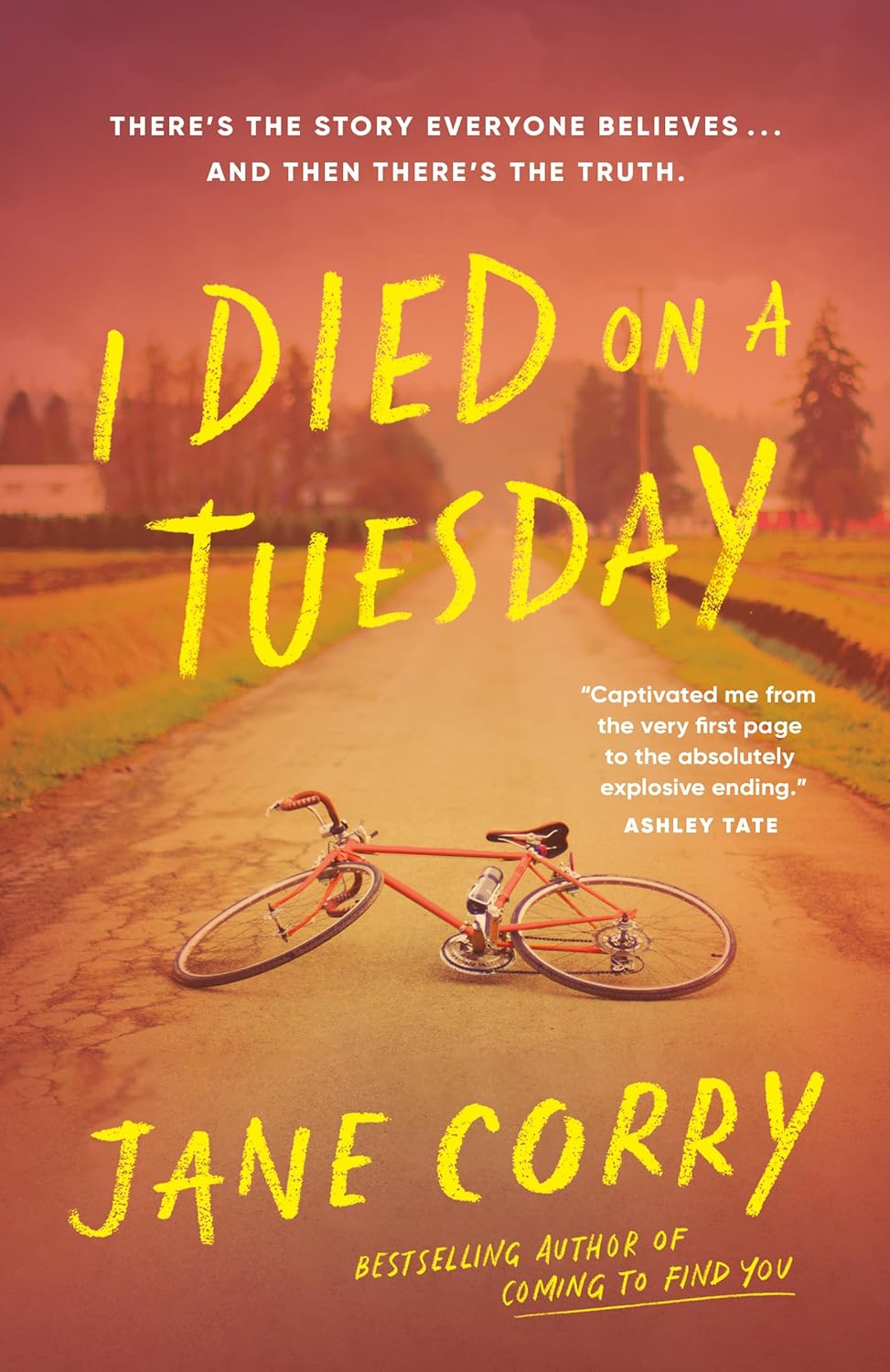
Janie White, 18, is just about to move to London to start a job in publishing when she is run down while biking home from the beach. “On the day I died, the sea was exceptionally flat,” she recalls. So, clearly not dead then. Twenty years later, an arrest is made in this horrific hit and run and the culprit appears to be pop sensation Robbie Manning. He surrenders without argument because “the past has finally caught up with him.”
Jane Corry’s novel I Died on a Tuesday is an overly long (465 pgs), overly complicated, not-very-well-written thriller. Besides these two narratives (well, Janie can’t speak anymore, but she can sing) we also hear from Vanessa, a widow who works at the local courthouse as a witness service volunteer, who comes into Janie and Robbie’s orbit through the trial.
Things might have been a little more palatable if Corry had focused on just one story, but everyone gets in on the action. For example, Vanessa’s marriage is harbouring a huge secret and her friend, Richard, a local judge (and whom she cleverly refers to as Judge) has a secret, and Janie’s mother went missing around the time she had her accident. But did she though? And Robbie’s rise to fame is suspicious. And all these threads, somehow – and mostly unbelievably – tie themselves into a neat little bow by the time we get to the end of the book. Some people might (and did) say that this book was full of twists. Honestly I just felt like yelling “squirrel” every time I turned the page.
None of these characters were remotely believable to me. None of their motives sufficiently explained their decisions. None of the dialogue felt real to me. It was all tell. I knew by about page 50 that I wasn’t going to like it, but I slogged through hoping that where the writing suffered, there might be a pay off in the plot. I will happily read a book with mediocre prose if the story is a banger.
Although T. Greenwood is a prolific writer, Such a Pretty Girl is the first of her books I have read. It’s one of those books where nothing happens–I mean this is a book driven by character, not plot–and yet it is absolutely riveting.
When the novel opens, Ryan Flannigan is counting down the last few days before her daughter, Sasha, heads to the West coast to start college. Ryan’s childhood bestie, Gilly, keeps sending her urgent texts before finally just sending her a link to a story from the Times. Ryan is shocked to discover that the story is about her mother, Fiona, from whom Ryan is mostly estranged. Worse, the story is about the discovery of a very personal photo of Ryan when she was just a girl that was found in the possession of Zev Brenner, a billionaire who has been charged with sex trafficking and pedophilia a la Jeffrey Epstein. This news is followed by even more shocking news and Gilly begs Ryan to come back to New York City.
Such a Pretty Girl bounces between the 1970s and present day 2019. As a child, Ryan lived with her mother, Fiona, in Lost River, Vermont, home to the Lost River Playhouse where Fiona was an aspiring actress. Lost River was meant to be a “summer respite for actors who worked in the city and a place for aspiring actors to apprentice themselves.” Fiona had been there since 1965 and she and Ryan lived there full time. Gilly and his family also live at Lost River, but only in the summer. Gilly’s father is a working actor and his mother an artist in New York.
Fiona decides to leave Lost River and go into the city to give acting a more serious try, but in the end it is Ryan, who is just ten, who is discovered–first as a model and then as an actress. This strains the relationship between mother and daughter. The time the novel spends in NYC
After Gilly gives Ryan the news about the discovery of the photograph, he begs Ryan to come back to Westbeth, an apartment building populated by dancers and actors and artists and, famously, Jackie O. It’s a real place, actually. It’s worth reading about its interesting history and it is definitely a character in Greenwood’s book. So, in the present day Ryan and her daughter head back to the city and to the place that she, for a very important time in her life at least, called home. There are matters to attend to, and ghosts to exorcise.
This book is very evocative of a time and place and as someone who loves New York and grew up in the 1970s, I found that very compelling. I also loved Ryan’s recollection of her childhood, the perspective skewed through the lens of adulthood. When she recalls her first major ad campaign (for Love’s Baby Soft, a mainstay of every teenage girl in the 1970s) she says
I am wearing fake eyelashes, pink rouge on my cheeks, and lip gloss so thick and shiny you can almost see your reflection in my pout. I am holding a pale pink stuffed bunny. But you can’t tell if I am a child made up to look like an adult, or an adult made to look like a child. When I found the ad years later, it felt like someone had punched me in my throat.
And if you are wondering where Ryan’s mother was in all this, yeah, that’s kind of the point.
This is a terrific, well-written book. Highly recommended.
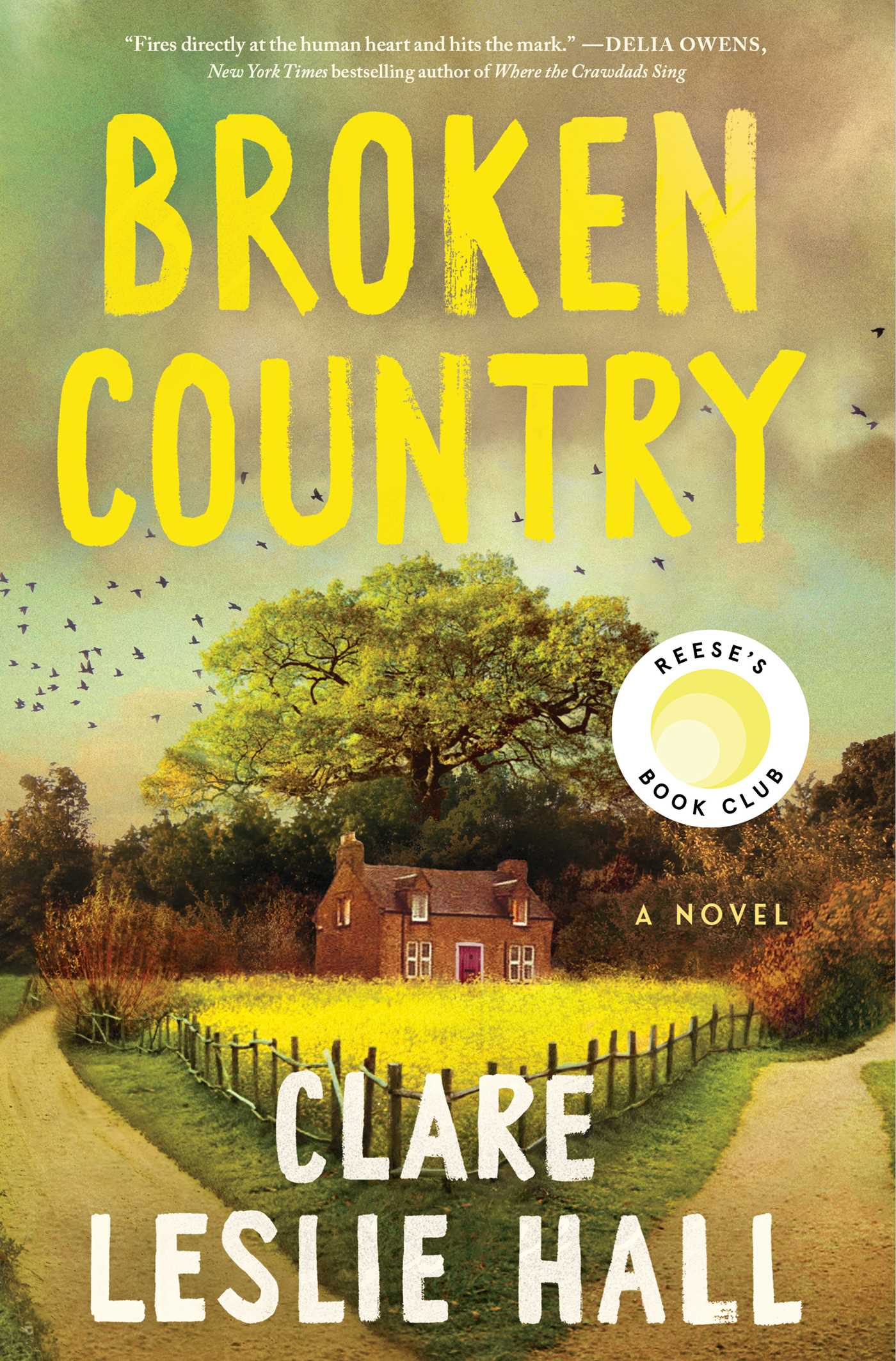
I am clearly more of a sucker for the hype than I originally thought. I watch a decent amount of BookTube and follow a few bookish accounts on Insta. (I ditched Facebook a few months ago, but haven’t abandoned this Meta dumpster fire product yet – mostly because I have found it less dominated by advertising.) I have been seeing Clare Leslie Hall’s book Broken Country lauded all over the place and, of course, it’s a Reese’s Book Club pick. (I love that Reese is such a bookworm and that she is turning these books into movies and series.) The clincher for me was the book had been compared to The Paper Palace and regular readers of this blog will know that that was my favourite book of 2021. (Miranda Cowley Heller, author of The Paper Palace, even blurbed Broken Country.)
It is 1968 and Frank and Beth are happily married, living a quiet but busy life on their farm in North Dorset. They have had some recent heartbreak, the loss of their son, Bobby, but they’re healing and they have each other and Frank’s younger brother, Jimmy, who is like a little brother to Beth.
In all the fantasies over the years of meeting Gabriel Wolfe again, driving his child and his dead dog home was never one of them.
So, who is this man who upsets the apple cart of Beth’s life? They’d met thirteen years before, when they were teenagers and Beth was out walking and ended up on private land owned by Gabriel’s wealthy family. Beth has heard of him through the small-town grapevine. He was “the famously handsome boy from the big house.” Of course he’s beautiful (they always are), but Beth also remarks that “He’s not my type at all.” (Yeah, totally believable.)
Their relationship is swift and intense and all-consuming, until it isn’t (for reasons I will let you discover on your own, but it’s pretty standard Romance 101 fare). After things end with Gabriel, Beth returns home and into the waiting arms of Frank, who has been carrying a torch for her since they were kids. They build a life together and it’s a life that Beth loves. Until Gabriel resurfaces at his family home, Meadowlands.
Look, Broken Country, was easy peasy to read. I finished it in a couple sittings. I am a sucker for anything angsty and when I started this book I was sure it was going to fill my angst cup to overflowing.
You can live a whole lifetime in a final moment. We are that boy and girl again with all of it ahead, a glory-stretch of light and wondrous beauty, of nights beneath the stars.
Broken Country starts with a murder trial, and so that propels the book along because it’s a while before you learn the circumstances of who and why. There are a couple twists you might not see coming. The writing is decent. The characters are all good people trying to make the best choices they can under the circumstances they are presented with. The issue is that I just didn’t understand the insta-love between Gabriel and Beth, like, at all. And truthfully, I wasn’t even really rooting for them. We are shown their relationship in flashbacks, but it wasn’t anything earth shattering. Same with Beth’s relationship with Frank. By all accounts, he’s a top-shelf guy. And he sticks by Beth even when some might say he shouldn’t. And then there’s Jimmy – whose reaction to business that is not his is, imho, over the top.
Lots of people have gushed about the inherent heartbreak in the story of these people, but I wasn’t moved. I could see all the moving parts, I was just never invested. I think loads of people will (and have) love this book. I don’t begrudge the time I spent with it at all. It was just okay for me.
Kristopher Triana is a new-to-me author, but I think he is relatively well known in the horror community, particularly for readers of cosmic or extreme horror. To be honest, I don’t think I knew much about what constituted those two subgenres of horror, so I did a little research. According to Wikipedia, cosmic horror (also known as Lovecraftian or eldritch horror) is “is a subgenre of horror, fantasy, or weird fiction that emphasizes the horror of the unknowable and incomprehensible more than gore or other elements of shock.It is named after American author H.P. Lovecraft (1890–1937). His work emphasizes themes of cosmic dread, forbidden and dangerous knowledge, madness, non-human influences on humanity, religion and superstition, fate and inevitability.” Extreme horror didn’t have its own entry on Wiki, but it has been called splatterpunk, which is described as a “literary genre characterised by graphically described scenes of an extremely gory nature.”
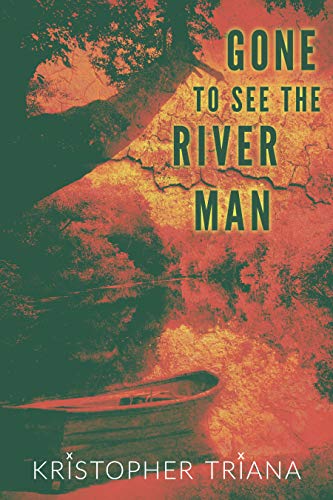
So that brings us to Triana’s novel Gone to See the River Man, a book that has been described as both cosmic and extreme. What exactly was I getting myself into? I wondered.
Thirty-nine-year-old Lori lives with her older sister Abby, not necessarily because she wants to but because Abby needs care. Lori doesn’t have much of a life. She works at a diner, has just broken up with her boyfriend, and is obsessed with Edmond Cox, a notoriously violent sexual sadist and serial killer. Cox isn’t the first incarcerated psychopath Lori has corresponded with, but she really feels the two share a special bond. She’s visited him a handful of times at Varden prison and she has just agreed to do Cox a favour.
“You’ll find the key in the chest,” he said, reiterating the letter’s instructions. “You’ll find it deep in the low valley of Killen, along the Hollow River, in the shack I done told you about. The one they never knew about.”
“You can count on me. I’ll bring the key as soon as –“
“Nah. Ya ain’t gonna bring it to me. I ain’t the one the key belongs to no more, see? Ya gotta take it to The River Man.”
So, not really understanding the quest or who The River Man is, Lori and her sister set out on a journey that will change her life forever.
Gone to See the River Man surprised me and I mean that in a good way. I tracked it down (not necessarily easy because it’s not traditionally published) because I had heard a lot of book tubers talk about it and I thought, sure, I’ll give it a go. I thought the writing was terrific. Lori herself was a complex character and certainly not who I expected her to be. As her story unravels (told in flashbacks), we see that she has some darkness in her that makes her attraction to Cox more understandable.
As she and Abby head out into the wilderness, first looking for the shack and the key and then heading down the river to find the River Man, things do get weird. Extreme? I don’t know – maybe I have a high tolerance for squick. There was definitely some of that, but mostly the imagery was nightmarish without being necessarily gratuitously violent.



 The Ludic Reader