1,001 Ways to Be Creative – Barbara Ann Kipfer

1001-Ways-to-Be-Creative-cover-300x300Creativity is a funny thing. I look around and see all these people who are tremendously creative. Both of my children are talented artists. My daughter spent many years studying ballet and is a beautiful dancer. Both my children are musical; my son taught himself to play guitar. I have other friends who are artists, painting with words or yarn or fabric or glass or clay. Some put their art on a plate. But I am probably not the only person on the planet who feels like they don’t have a creative bone in their body. I don’t draw or paint. I don’t dance. I can’t sing. The one thing I do like to do is write.  I love to do it and have been doing it for as long as I can remember.

In her book 1,001 Ways to Be Creative,  Barbara Ann Kipfer suggests that creativity “isn’t only about artistic skills; it is a way of seeing the world. It gives you the power to shape your life, unify and balance your interests, and emphasize your uniqueness.”

I love that Kipfer gives readers permission to explore their creativity. Honing it, she suggests, gives you “that inexplicable burst of inspiration that suddenly allows you to see from a new angle or bring something new into existence.” We might call that ‘out-of-the-box’ thinking and its value to every-day problem solving should not be under-estimated.

1,001 Ways to Be Creative offers is a lovely little book that will surely offer inspiration to people like me who probably don’t realize that they are creative (or could be) in a million different ways (or a 1,001) every single day. It’s all in how you look at it.

Kipfer’s suggestions include things like:

356. Ask a stupid question.

429. Look for the unusual in everything you do.

464. Use sealing wax as a dramatic way to end a letter.

494. Change your look for one day.

764. Observe, collect, analyze, and compare patterns.

868. Carve a face in a fruit or vegetable

Kipfer  “speaks to all who seek greater creativity in their lives.”  You can easily start your creative journey with this book.

Thanks to TLC for the opportunity to review this book.
The Never List – Koethi Zan

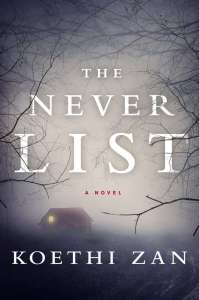
Never-List-Blog-pictureThe Never List never really got off the ground for me, although the premise had a lot of potential. Koethi Zan’s debut novel is the story of Sarah, a reclusive young woman who is still suffering from the psychological scars of having been held captive by a sadist, Dr. Jack Derber.

There were four of us down there for the first thirty-two months and eleven days of our captivity. And then, very suddenly and without warning, there were three. Even though the fourth person hadn’t made any noise at all in several months, the room got very quiet when she was gone. For a long time after that, we sat in silence, in the dark, wondering which of us would be next in the box.

That was ten years ago. Now Sarah is living a quiet life as Caroline. She’s an actuary in New York City (specifically chosen so that there would always be a lot of people around). Her therapy is at a standstill, she doesn’t have any meaningful relationships (unless you count Jim McCordy, an FBI agent) and she rarely leaves her apartment. Every so often Jack Derber sends Sarah a letter from prison, and it’s the latest letter and the fact that Jack’s parole hearing is coming up that sends Sarah digging into her past.

The novel’s title comes from Sarah and her best friend Jennifer’s ‘never list.’  The two girls, friends since childhood, had compiled a list of all the things they should avoid in order to lead a safe life: “never go to the campus library alone at night, never park more than six spaces from your destination, never trust a stranger with a flat tire. Never, never, never.”

Sarah’s decision to speak at Jack’s parole hearing, even though the thought of facing Jack again fills her with dread, is prompted by her love for Jennifer, who was the girl in the box and whose body was never recovered from Jack’s remote house, where the girls were kept chained in the cellar.

So, the ingredients for a creepy, twisted thriller, are certainly there, but there are lots of things that didn’t work. For one, too many characters and sub plots that just all come together in a rather unsatisfying way in the end. Also, Sarah’s character development was unbelievable. Can the reader really be expected to believe that a woman who is afraid to drive alone in the dark, will actually lead her fellow survivors back to the very place where they’d been held prisoner? Without police? Cue eye roll. And these reserves of strength come out of the blue.

Jack Derber is only seen through the eyes of other characters, so he is never really a threat. Whatever he was doing to those women – none of it is described. I don’t necessarily need to hear all the graphic details – I’ve got a pretty good imagination – but other than ‘the rack’ it’s all pretty vague. Likewise, a trip to a BDSM club is pretty vanilla. And although there is clearly something going on, with Jack Derber still safely behind bars Sarah (and the reader) hardly needs to worry about him.

Some readers will probably be genuinely freaked out by The Never List. For me, it was just okay.

Falling Into Place – Amy Zhang

fallingAmy Zhang’s novel Falling Into Place tells the story of sixteen-year-old Liz Emerson’s journey from happy child to miserable teen and the drastic choice she makes in an effort to end her emotional pain.

On the day Liz Emerson tries to die, they had reviewed Newton’s Law of  Motion in physics class. Then, after school, she put them into practice by running her Mercedes off the road.

Zhang’s elliptical novel cuts back and forth through time, unraveling Liz’s story in little non-linear pieces, while also offering us insight into the lives of Liz’s friends Kennie and Julia. Adults are pretty much non-existent in this story; Liz’s widowed mother is often away on business, leaving Liz to her own devices. (This usually means she’s partying & making out with random people, drinking alone or making herself puke.)

Liz’s car accident is no accident. She meticulously plans the event to look like an accident because she can’t stand the mess of her life – some of which is beyond her control, but some of which she created for herself. She reaches out, at the last minute, to her school’s guidance counselor, but he’s an ineffective lump (of course he is) and by then Liz has really already made up her mind.

Liz and her friends are shrill and often unkind and not entirely likeable. Which was a problem for me.  An unnamed first-person character recalls when Liz was happy and full of love, but it will be relatively obvious who that person is for careful readers.

She cannot bear to catch fireflies in jars. She hates zoos. She will not let her father teach her about constellations, because she will not trap the stars. She lives in a world made entirely of sky.

Although I didn’t find Liz particularly sympathetic, the glimpses into her childhood do humanize her. Her casual cruelty and lack of empathy, although perhaps realistic enough in today’s world, just didn’t work here the way it might work in a novel by someone like Courtney Summers. None of the characters felt real to me; they felt like shells.

Whether or not Liz survives her ‘accident’ is perhaps what will keep readers turning the pages, but for me, there was no real skin in the game.

Amelia Anne is Dead and Gone – Kat Rosenfield

ameliaanneKat Rosenfield’s YA novel Amelia Ann is Dead and Gone is lush and languid, a coming-of-age story and a mystery that sends ripples through the small, insular community of Bridgeton.

At the same time that eighteen-year-old Becca is anticipating the beginning of a new and better life away at college, the unidentified body of another young girl turns up on the side of the road, outside of town.

People buzzed and hummed and speculated. It seemed impossible that the dead girl, the rag-doll on the road-shoulder, could remain anonymous for long. Not with everybody talking about her, her, her.

Everything is about to change for Becca. She’s just graduated from high school (salutatorian, no less) and her “too-smooth boyfriend with a beater pickup and no diploma of his own” has just broken up with her.

Our first meeting was romantic. High school legend-like, it made me yearn to stay with him just for the chance to tell our someday-kids about how their father had swept me off my feet at the tender age of sixteen.

The news of the dead girl is diverting at first, but then becomes a constant buzz in the back of Becca’s head. She can’t stop wondering about her – who she is and what happened to her, and it’s this compulsive fascination that brings the novel to its dramatic climax.

Amelia is experiencing a similar ‘new beginning’. She’s just graduated from college and decided to  pursue acting, a track-jump that her boyfriend, Luke, simply cannot or will not understand. The time spent with Amelia, is time well-spent. She is a girl who is finding her feet, discovering what she wants to be and understanding that sometimes that means leaving people behind.

When Rosenfield sticks to Becca and Amelia, Amelia Anne is Dead and Gone races along like a thriller (albeit a really beautifully written thriller). Sometimes, though, she diverted my attention away to talk about the town from the vantage point of a sort of disembodied third-person omniscient vantage point.

In a small town, there are things you simply grow up knowing. You need them all – the shortcuts, secrets, and scandals that make up the town’s collective unconscious, the whispered bits and pieces passed from older lips to younger ears.

I found this stuff sort of extraneous to the plot (although I suppose it did, in some ways, explain the town’s mentality), and bogged things down a bit. A subplot about a tractor in the lake was, likewise, unnecessary. When Rosenfield stuck to Becca and Amelia’s story, though, I was all in and even with my minor grumble, I still highly recommend this book.

Bear Town – Fredrik Backman

beartownI actually put Fredrik Backman’s novel Beartown in my ‘to donate’ bag before I had reviewed it…and I guess that’s pretty telling. This was a book club selection, and not a book I would have ever chosen to read otherwise, so I guess I was skeptical from the beginning. Beartown made me cranky.
Late one evening toward the end of March, a teenager picked up a double-barreled shotgun, walked into the forest, put the gun to someone else’s forehead, and pulled the trigger.

This is the story of how we got there.

From that relatively interesting beginning, Backman spins a melodramatic tale of a small, isolated town in Sweden. Beartown is a hockey town and I mean a fanatical hockey town. It’s the day before the Beartown Ice Hockey Club plays in the country’s biggest tournament and while that might not seem like a big deal, it’s a huge deal in Beartown.

There’s not much worthy of note around here. But anyone who’s been here knows it’s a hockey town.

Everyone in this novel is connected to hockey.

Amat “sleeps with his skates by his bed every night.”

Maya “hates hockey but understands her father’s love for it.” Her father, Peter, is the hockey club’s general manager. He’s a former NHL hockey player who has returned to his hometown.

Sune is the coach of the A-team. He’s on the verge of being fired by the board even though he’s been with the hockey club forever, even though everyone knows him. He knows that they want to fire him because he tells his players to play from the heart instead of telling them to win.

There’s Kevin, Beartown’s star player. Despite the fact that he’s good enough to play in a bigger town for, perhaps, a better team, he keeps turning down the offers. “He’s a Beartown man, his dad’s a Beartown man, and that may not mean a thing anywhere else, but it means something here.”

Yeah. Okay. We get it. Beartown is a hockey town. And although it’s probably un-Canadian to say – I haven’t cared much about hockey since the days of Wayne Gretzky and Brendan Shanahan. I certainly never cared about it as much as the folks in Beartown do. I certainly have never cared about it enough to read 415 repetitive pages about how characters driven by the desire to win backstab and bully and belittle others. There’s also a crime in the book that divides the town in a way that is wholly unbelievable.

Perhaps something was lost in translation, but for me Beartown was 200 pages too long and peopled with stereotypes. I often felt the novel’s didactic impetus. Pithy nuggets like “We become what we are told we are” and “A long marriage is complicated” are sprinkled throughout and, honestly, made me roll my eyes.

A big no for me.

this is where it ends – Marieke Nijkamp

Columbine. Newtown. Parkland. The fact that we know these towns because of the school shootings that happened there is shocking. According to Everytown there have been 302 school shootings in America since 2013. True, not all of these incidents have resulted in death, but the fact that someone brought a gun into a school is pretty horrifying.

For comparisons sake, there have been seven school shootings in Canada with a total of 28 fatalities. (And I’m not talking since 2013, I’m talking in total.) The first happened at a high school in Brampton in 1975. The worst happened at École Polytechnique in 1989 where 14 women were killed. The most recent happened in La Loche, Saskatchewan in 2016 where four people were killed and seven were injured.

I know that guns (and gun control and 2nd amendment rights) are a contentious bowl of soup, but, people! Seriously.

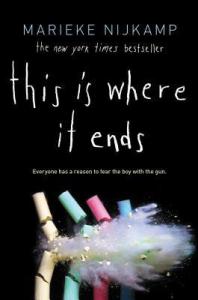
thisiswhereMarieke Nijkamp tackles gun violence in her compelling (and heartbreaking) YA novel this is where it ends.
Four narrators tell the story of what happens when a student locks the entire student body (almost) into the gym and starts shooting.

There’s Claire, a senior track star who isn’t in the gym because she’s training for an upcoming track meet.

There’s Autumn, a dancer who can’t wait to blow her popsicle stand of a town, a backwater named – ironically – Opportunity.

There’s Sylv, a girl who would sacrifice anything to keep those she loves safe, including Autumn.

And there’s Tomas, Sylv’s twin, who is breaking into the principal’s office with his friend Fareed when the chaos start.

What do these four people have in common? That would be Tyler, Autumn’s brother, a beautiful but damaged boy who clearly feels he has nothing left to care about. But really, Ty’s motives for shooting up the school don’t matter, really. The terror is real. The violence is real.

The action of the novel takes place over the course of 54 minutes. In that time, we come to understand how these five students are connected. We also learn about their hopes and dreams; we see their bravery and their fear; we root for them and we mourn with them. It’s pretty compelling stuff especially now when school shootings seem to be happening with alarming regularity.

Nijkamp was smart to let us into these character’s heads. They reveal secrets they’ve kept from each other – mostly out of love. They admit to weaknesses and also dig deep for reserves of bravery and strength. And, they even find compassion.

“Grief is one big, gaping hole, isn’t it?” Sylv says to Ty.

I don’t know if he hears me, but my words are as much for myself as for him. “It’s everywhere and all consuming. Some days you think you can’t go on because the only thing waiting for you is more despair. Some days you don’t want to go on because it’s easier to give up than to get hurt again.

this is where it ends is a timely book with an important message.


Fierce Kingdom – Gin Phillips

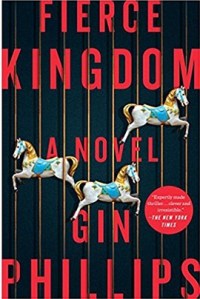
fierceJoan and her four-year-old son Lincoln are enjoying a late afternoon in the zoo when Gin Phillip’s novel Fierce Kingdom begins. It’s almost five o’clock and they are in the Dinosaur Discovery Pit playing with Lincoln’s menagerie of action figure heroes and villains.
She and Lincoln come here sometimes after she picks him up from school – they alternate between the zoo and the library and the parks and the science museum – and she steers him to the woods when she can. Here there are crickets, or something that sounds like crickets, and birds calling and leaves rustling but no human sounds except for Lincoln calling out his dialogue.

With only a few moments left before the zoo closes, Joan and Lincoln make their way to the exit. Joan has a moment of prescience when she imagines “camping in the zoo overnight, maybe even intentionally hiding back there, going to visit the animals in the pitch-black of midnight.” They are almost at the exit when Joan notices the bodies (at first she thinks they are toppled over scarecrows, but no…) and the man in dark clothes, carrying a rifle. Joan grabs Lincoln and they run. For the next three hours the pair are trapped in the zoo with armed men intent on killing them – and anyone else they find.

The scariest thing about Fierce Kingdom is probably that in the current climate it’s not such a far-fetched premise that innocent people are gunned down in what is supposed to be a safe place. I live in Canada and we don’t have the same love affair with our firearms as Americans do, but even so, it’s hard not to be paranoid about being  at the wrong place at the wrong time. Joan might have taken Lincoln to any one of their regular spots – but today they are at the zoo.

Joan’s number one priority is to get them to safety and for a big chunk of the novel they hide out in an old porcupine enclosure “deep in the twists and turns of the primate house. It does not look fit for humans, and that is what strikes her as perfect about it.”  Everything Joan does, every decision she makes, is about protecting Lincoln, and her ingenuity and bravery will likely strike a chord with anyone who has kids. Well, with anyone, really, who has a desire to live.

Phillips keeps the focus  – for the most part – on Joan and Lincoln, but she does introduce a handful of other characters (Kailynne, a teenager who works in a concession stand; Margaret Powell, an older school teacher; Robby Montgomery, a young man with a connection to the shooters), which keeps the narrative from being too insular.

As Joan works to keep Lincoln safe, she ponders the peculiarities of motherhood…the myriad of ways that harm might come to our children. As any parent knows, you can’t think about that stuff or you’ll go crazy; you’d never let your children leave the house.

Fierce Kingdom  is a book about what it means to be a parent wrapped up in a page-turning thriller.

Simon vs. The Homo Sapiens Agenda – Becky Albertalli

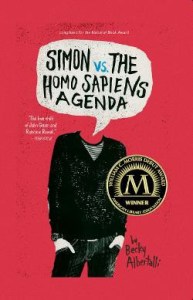
simonBecky Albertalli’s YA novel Simon vs. The Homo Sapiens Agenda won the William C. Morris Debut Award, but the accolades don’t stop there. The book has been praised or recognized by everyone from ALA, Carnegie, Oprah and Lambda. Although this book has been on my shelf for a couple years, as soon as I knew the movie was coming out – I knew I had to read it…and I am soooo sorry I waited so long.
Simon is a junior in high school. He lives with his younger sister, Nora, and his parents. His older sister, Alice, is away at college.

Simon is all kinds of awesome. He’s funny, self-aware, smart and gay. The problem is that he hasn’t told anyone yet — about being gay. Everyone knows the other stuff. Well, there’s one person who knows Simon’s secret. His name is Blue. He and Simon have been exchanging emails and those emails are what set Simon’s story in motion. When he forgets to log out of his Gmail account at school, another kid, Martin, sees the emails and uses them to blackmail Simon into helping him hook up with one of Simon’s friends, Abby. It’s kind of a ridiculous premise, really, but let’s remember the cesspool that is high school.

…the whole coming out thing doesn’t really scare me.

I don’t think it scares me.

It’s a giant holy box of awkwardness, and I won’t pretend I’m looking forward to it But it probably wouldn’t be the end of the world. Not for me.

Simon’s blackmailer is “a little bit of a goober nerd”, but Simon doesn’t want to out Blue and so he does his level best to match make, but the problem is that Abby likes someone else, Nick, who is one of Simon’s best friends. And then there’s Leah, Simon’s other bestie, who may have feelings for Nick herself. It’s a tangled web, but maneuvering through these relationships is part of the high school experience.

Watching Simon and Blue’s relationship unfold via their emails is really beautiful. Despite attending the same school, they don’t know each other’s true identity and so they speak freely about their insecurities and hopes. They fall in love without meeting and, I have to say, it’s pretty damn romantic.

The other awesome thing about Simon vs. The Homo Sapiens Agenda is that it’s funny. Like laugh-out-loud funny. And also heart-felt without being schmaltzy. Even Martin has his moment of redemption. There are no bad guys in the story, but there are plenty of opportunities to learn (sans didactics).

…people really are like houses with vast rooms and tiny windows. And maybe it’s a good thing, the way we never stop surprising each other.

High recommended.

//players.brightcove.net/823022174001/0de3ded5-8290-49c7-b25d-fcddec46dfb3_default/index.html?videoId=5713014172001

Into the Darkest Corner – Elizabeth Haynes

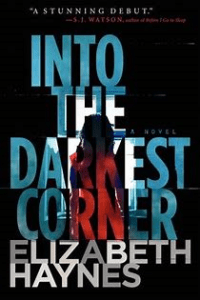
Party girl Catherine Bailey meets handsome and mysterious Lee Brightman at a nightclub. C’mon, ladies. Nothing darkest corner good ever comes from meeting some guy at a nightclub — especially a guy who seems too good to be true. But this meet cute is what sets Elizabeth Haynes’ crazy stalker story in motion. There are two narrative threads in Into the Darkest Corner. There’s the unraveling of Cathy and Lee’s romance (if you can call it that), and there’s Cathy’s subsequent escape from Lee’s clutches and her attempt to live her life.
Post-Lee Cathy lives a quiet life in a flat in London. Just getting out of the house causes her severe anxiety.

I shut the front door firmly and turned the lock, checking that the bolt had shot home by rattling the door a few times. With my fingertips I traced around the edges of the doorframe, feeling that the door was flush with the frame. I turned the doorknob six times, to make sure it was properly closed. One, two, three, four, five, six. Then the doorframe again. Then the doorknob, six times. One, two, three, four, five, six.  Then the lock. Once, and again. Then the doorframe. Lastly the knob, six times. I felt the relief that comes when I managed to do this properly.

Although it may be hard to reconcile this Cathy with the girl who admitted that the best part of a night out is “finding some dark corner of the club and being fucked against a wall”, her transformation won’t seem so far-fetched once she tells the story of how her Prince Charming turned into a sadistic psychopath. (Well, ‘turned into’ is a bit of a misnomer; Lee was always a sadistic psycho.)

There’s nothing new in Into the Darkest Corner. Readers know from the beginning how the story will unfold; the only things missing are the particulars. Haynes metes out the details in a timely fashion and it’s a page-turner, for sure, but Cathy isn’t a particularly likeable character. Sure, it’s hard not to feel sympathy for her; she has suffered terribly, but I just didn’t love her. Maybe that doesn’t matter. Because Stuart does.

Stuart’s the handsome, single child psychologist who moves into the flat upstairs and very willingly dives head-first into Cathy’s crazy. It’s perhaps the teensiest bit contrived, but without the introduction of someone in her life, Cathy would probably still be triple (times two) checking the locks on her door.

Into the Darkest Corner is not the worst of the genre, for sure, and I definitely wouldn’t be opposed to reading more books by this author.

Final Girls – Riley Sager

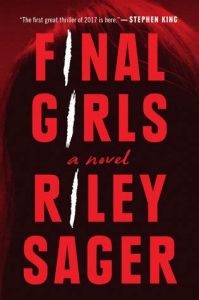
finalI didn’t realize that the term “final girls” actually referred to the last girl standing in a horror film. I chalk it up to not being a fan of stalker-type films; I can’t deal with the violence.  According to Vox “Final Girls are tough enough and strong enough to make it to end — the only people still standing when the last trickle of blood has hit the floor.” (It’s worth reading the whole article, actually, as it’s a really interesting look at Final Girls.)

Riley Sager (a  pseudonym for author Todd Ritter – and what is it about all these pseudonyms lately?) has taken this horror movie trope and spun it into his best seller Final Girls…although I would disagree with the ‘best’ part of it.

Ten years after her best friends were massacred in a remote cabin, Quincy Carpenter, the only survivor,  is still trying to recover. Now she’s a NYC baking blogger living with her lawyer boyfriend in NYC. She smooths out the rough edges of her life with Xanax, a little kleptomania, and sporadic visits with Coop, the cop who saved her life that night in the woods. He’s her touchstone, the one person who understands what she endured and ultimately survived that night when she escaped from Him. (That’s what Quincy calls the killer – a moniker that never stopped reminding me of  a BDSM master/slave.)

She’s not the only Final Girl, though. There’s Lisa, who survived a sorority house massacre at the hands of a crazed psycho and Sam, who lived through the Sack Man’s rampage at the Nightlight Inn. Lisa reaches out to Quincy with an offer to teach her how to be a Final Girl.  Sam is MIA until she unexpectedly shows up on Quincy’s door and Quincy’s life begins to unravel.

It’s Lisa’s death — an apparent suicide —  which is the catalyst for Sam’s arrival in New York and Quincy’s sudden departure from her quiet life. Sam is a bit of a wild child and suddenly Quinn’s drinking too much Wild Turkey and walking through Central Park after midnight — just looking for trouble. Sam provokes Quinn.

I want to see you get angry. You’ve earned that rage. Don’t try to hide it behind your website with your cakes and muffins and breads. You’re messed up. So am I. It’s okay to admit it. We’re damaged goods, babe.

The past starts closing in on Quincy and the book definitely does pick up some momentum even if I didn’t believe the ending one bit.

Final Girls suffers in comparison to  The Woman in the Window even though the books aren’t strictly in the same genre. I started Final Girls and read probably 100 pages and then started The Woman in the Window, which I absolutely couldn’t put down, even though I did figure out some of the twists in advance. Final Girls just felt clunky to me by comparison. Quincy is shrill and not particularly sympathetic and yes, of course, she survived a horrific event and I should cut her some slack, except that I just didn’t  care about her.

I am a big fan of psychological thrillers and I am definitely in the minority here. Even Stephen King called this book “the first great thriller of 2017.” For me, Final Girls just didn’t fulfill its blood-spattered promise.