The Catcher in the Rye – J.D. Salinger

catcher-in-the-rye-cover-imageSo I recently re-read The Catcher in the Rye for the first time in about twenty years (or maybe longer, although I shudder to think) because I am teaching Grade 11 this year and Salinger’s classic coming-of-age story is on the reading list. Now I have to figure out what I really think about this book – not just what I want the kids to think I think about it.  It’s a problem because I believe that Holden Caulfield is definitely a character adolescents should encounter, if only because he (and this novel) is alluded to in so much of the literature, music, and films that followed.

If you’re out of the loop, The Catcher in the Rye was published in 1951 and concerns almost-17-year-old Holden Caulfield, a smart but disenchanted student who has just been kicked out of Pencey Prep, a fancy boarding school in Pennsylvania. “You’ve probably heard of it,” Holden tells us. “They advertise in about a thousand magazines, always showing some hot-shot guy on a horse jumping over a fence. Like as if all you ever did at Pencey was play polo all the time.” Holden is flunking all his courses except for English (he’s a voracious reader) and so he’s being sent home.

When the novel opens though, Holden is recounting “this madman stuff that happened to me around last Christmas just before I got pretty rundown” from a rest home in California. Once he establishes where he is, Holden starts to tell his story – embellishments (by his own admission, Holden is “the most terrific liar”) and all.

There is no question that The Catcher in the Rye is dated. Holden peppers his speech with “goddam” (a rather tame expletive by today’s standards), he smokes and drinks (not that today’s teenagers don’t, but there is something old-fashioned about the way he treats these vices) and he’s able to spend an extended amount of time in New York City without breaking the bank (I wish!). Everyone Holden encounters is a “phony” and despite his obsession with sex, Holden is still a virgin. That said, there is something thoroughly modern in Holden’s quest to make sense of  his life, which has gone seriously off the rails.

At its heart, The Catcher in the Rye is a novel about growing up. Holden doesn’t want to, not really. It is perhaps the reason why he’s still a virgin and why he thinks the Museum of Natural History is a perfect place.

The best thing, though, in that museum was that everything always stayed right where it was. Nobody’d move. You could go there a hundred thousand times, and that Eskimo would still just be finished catching those two fish, the birds would still be on their way south, the deers would still be drinking out of that water hole, with their pretty antlers and their pretty, skinny legs, and that squaw with the naked bosom would still be weaving that same blanket. Nobody’d be different. The only thing that would be different would be you.

Holden can’t stop time, although I think he would desperately like to. He also can’t undo the fact that his beloved brother, Allie, is dead. “You’d have liked him,” Holden tells us. He is preoccupied with the loss of innocence that precipitates the headlong fall into adulthood. He tells his little sister, Phoebe, that he would like to be a “catcher in the rye,”

…I keep picturing all these little kids playing some game in this big field of rye and all. Thousands of little kids, and nobody’s around – nobody big, I mean – except me. And I’m standing on the edge of some crazy cliff. What I have to do, I have to catch everybody if they start to go over the cliff…

Holden’s narrative amounts to a desperate cry for help, for someone to listen to him, for someone to answer his questions, questions which, on the surface (like, where do the ducks in Central Park go when the pond freezes over) seem innocent, but which really demonstrate Holden’s search for meaning.

In Holden, Salinger has created a timeless character who will always have something to say to anyone who cares to listen.

Fitz – Mick Cochrane

fitzMick Cochrane’s YA novel, Fitz, is the story of what happens when a boy decides to confront the father he’s never met.

Fitz is a “typical fifteen-year-old boy. A sophomore on the B honor roll. A kid with a messy room, an electric guitar, a notebook full of song lyrics, vague dreams about doing something great some day, a crush on a red-haired girl.”

And like many other teens, Fitz (short for Fitzgerald) lives with his single mom. His father is an unknown entity; his mother doesn’t talk about him and although he supports Fitz financially, Fitz knows nothing about him. That doesn’t mean Fitz doesn’t think about him, though.

When Fitz was a little boy, he liked to imagine that his father was quietly, secretly watching over him, loving him, for his own good and unselfish reasons, from a distance.

Circumstances have changed, though. Fitz has inadvertently discovered his father’s home address and he’s decided to confront his dad, which, sure, that seems plausible enough. What doesn’t seem quite as likely is the fact that Fitz takes a gun with him and pretty much kidnaps his father. It’s a scenario that could go horribly wrong.

Turns out, though, that Fitz’s father, Curtis, is a decent guy – clearly, he’s been paying support all these years. Over the course of the day the two listen to music, hang out at the zoo, have lunch and visit Curtis’s office (he’s an attorney). As the day unfolds, Fitz tries to figure out what it is he really wants to know about his dad and Curtis, it seems, is only too willing to talk, has – in fact – been waiting for fifteen years to have this conversation with his son. It’s kind of sweet, really.

“You were a good baby, a beautiful baby,” that’s how he starts. That’s his once-upon-a-time. He says that Fitz was healthy, bright-eyed, curious. He had amazing blue eyes. It’s just that he didn’t sleep, at least not for long stretches.

Fitz is sensible enough to listen as his father tries to explain the story of his relationship with Fitz’s mother and smart enough to realize that even parents make mistakes because, in their own once-upon-a-time, they were young enough to make them. If the story seems just a tad sentimental, Cochrane can be forgiven because Fitz is a likeable character and, thankfully, the gun is little more than false bravado.


Amazing Grace – Lesley Crewe

Holy ol’ Jesus, Amazing Grace is awful. So awful that if it hadn’t been chosen for book club, I would have abandoned it right around the time that Amazing Grace Willingdon, 60, flies off to New York City from her trailer in Baddeck, Namazingova Scotia, to help her estranged millionaire son, Jonathan, rescue her teenage granddaughter, Melissa, from making bad decisions. You know, the kind that you make because you are sixteen.

We are to understand that Grace is a firecracker because she doesn’t suffer fools easily,  the church women give her indigestion and she yells “asshole” at drivers who speed past her. It’s not her fault that she’s curmudgeonly; Grace has had a hard life including a duel with cancer (which she won), a sham marriage and a childhood as a member of a religious cult where she and her sister (Ave Maria – not a joke) and their mother, Trixie,  were repeatedly raped by the cult leader. I wish I could say that these are the only difficulties that Grace endures, but amazingly (see what I did there) they are not.

That’s at least part of the problem with Amazing Grace. When I tried to explain the story to my son, Connor, I found that I could not adequately convey the number of ridiculous things that happened to this character or the number of times she was saved by her inheritance or her son’s private jet or just old-fashioned serendipity. But the bigger problem in Nova Scotian writer Lesley Crewe’s book is the writing itself.  It’s just…bad.

I point my finger in his face. “You are going straight to hell, Ed Wheeler. You have the devil inside you and we all know what happens to evil people. They burn forever. The very thought of it makes me giddy. You tried to destroy me, but you didn’t. You tried to possess me but you couldn’t. I am the powerful one now. The tables have turned, you creep. You have no one. You are a big nobody. You will never cross my mind again, because I win, you bastard. I win.

I live in New Brunswick – right next door to Nova Scotia – so this landscape and these people should at least be familiar to me. On top of that, I am just a few years shy of Grace’s age; she’s my contemporary. But she’s not even remotely believable to me. I have never once overslept and yelled “Holy macaroni.” I can’t imagine being a grandmother and chasing my granddaughter down the hall, grabbing her from behind and then hauling her “squirming and yelling” back to the kitchen to apologize for a snotty comment because words are “the most powerful force of all.” It’s all so melodramatic and over-the-top.

Ultimately, this is a book about family – our biological family and the family we choose. But the book is so overstuffed and the writing so pedestrian that I just couldn’t have cared any less for these people.


If You Find Me – Emily Murdoch

“Mama says no matter how poor folks are, whether you’re a have, a have-not, or break your mama’s back on the cracks in between, the world gives away the best stuff on the cheap.”

IF-YOU-FIND-METhat’s the first thing fifteen-year-old Carey tells us in Emily Murdoch’s amazing novel If You Find Me. From the moment she speaks, it’s almost impossible not to fall in love with her and as her story unspools, it’ll be even more difficult not to want to want to hug her and her little sister, Jenessa, who is just six.
Carey and Jenessa live in a trailer in  in the middle of Obed Wild and Scenic River National Park or, as the girls call it, “the Hundred Acre Wood.” Their mother, Joelle, is usually gone and has, in fact, been MIA for “over a month, maybe two at this point,” leaving the girls to fend for themselves. Carey does the best she can to look after herself and Jenessa but “when you’re livin’ in the woods…with no runnin’ water or electricity, with Mama gone to town for long stretches of time, leavin’ you in charge of feedin’ a younger sister…with a stomach rumblin’ like a California earthquake” it’s not easy. The girls exist, mostly, on beans fixed in “new and interestin’ ways.”

On this particular day, though, Carey and Jenessa have company. A woman “as thin as chicken bones, her gait uneven as her heels sink into the soft forest floor” and a man stumble into the girls’ campsite.

He hasn’t offered his name, and he isn’t familiar to me. But in that instant, hittin’ like a lightnin’ bolt, I know who he is.

If You Find Me is an amazing story of resilience and family and forgiveness, but it is also a horrific story of abuse and neglect, made all the more powerful because of Carey’s compelling and authentic narration. I fell in love with her the moment she started to tell her story and I know this is fiction, but I also know that children endure atrocities at the hands of their parents and guardians all the time.

Suddenly, Carey finds herself living with a father she doesn’t remember, a new step-mother and a step-sister who clearly resents her, attending school for the first time.  Jenessa seems to thrive in her new surroundings and although Carey contemplates returning to the her life in the woods, her love for her sister prevents her from running. Their journey is one of resilience and hope, but it’s not all smooth sailing.

I loved this book because I loved Carey. I wish the ending hadn’t seemed so rushed, though, because I don’t think Carey’s relationship with Ryan was as fully developed as it might have been and other pieces fell into place just a tad conveniently, but whatever; I haven’t read a YA book with a narrator I’ve loved quite as much as I loved Carey in a long time.

Highly recommended.

Reconstructing Amelia – Kimberly McCreight

reconstructingI’m sure all the mothers out there can appreciate how difficult it is to really know what is happening in our children’s lives these days. I mean, on the surface, it seems like it would be easier, right? We have phones that connect us immediately — but the flip side of that is that, because of this technology,  our kids can live lives very separate from us, too. When I was a teenager there was one phone and it was in the kitchen. If you got a call, you took it in full view of your parents and siblings; there were ears everywhere. Hardly anyone calls my house phone anymore – and certainly not the friends of my kids.

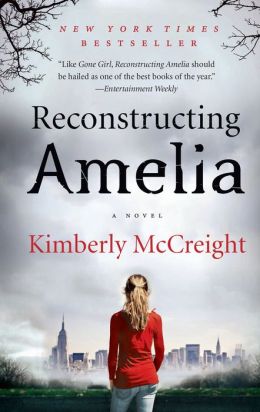
It is this very private world that is central to Kimberly McCreight’s suspenseful and timely novel Reconstructing Amelia.

Kate Baron is a high-powered lawyer and single mom. She and her  fifteen-year-old daughter, Amelia, live in Brooklyn, where Amelia attends Grace Hall, a hoity-toity private school. Despite Kate’s busy job, she and Amelia share a close bond, likely forged because it’s always been just the two of them. There have been a few bumps in the road recently: Kate chalks it up to teenage moodiness. Then she gets a call from the school: Amelia is being suspended, for plagiarizing an essay. The suspension is a shock to Kate because

Amelia had never been in trouble in her entire life. Her teachers called her a delight – bright, creative, thoughtful, focused. She excelled in athletics and was involved in every extracurricular activity under the sun. She volunteered once a month at CHIPS, a local soup kitchen, and regularly helped out at school events.

The accusation of cheating is clearly a mistake. However, when Kate arrives at Grace Hall she is devastated to discover that her daughter is dead (not a spoiler: it’s on the book jacket). Apparently, Amelia jumped from the roof of the school. Although Kate can’t quite believe her daughter would do such a thing, the police rule Amelia’s death a suicide and the case is closed.

That is until Kate gets an anonymous text: Amelia didn’t jump.

With the help of Lew, a crusty police detective, Kate begins reconstructing Amelia’s life only to discover that there were many things she didn’t know about her daughter.

There are dual narratives in McCreight’s book. Kate’s limited third person narrative allows us to take her journey, but we also have Amelia’s first person narration – which gives the reader a glimpse into a life Kate could never be privy to. There are also text conversations, Facebook posts, and an anonymous blog called ‘gRaCeFULLY,’ which tracks the comings and goings of Grace Hall students. All the bits fit together to create a picture of entitled girlhood and head-in-the-sand adulthood.

There are some bits of the book which didn’t necessarily belong (Rowan) and I am not 100% sure I bought some of the twists, (I won’t say which because, hello, spoilers) but that doesn’t mean I didn’t turn those pages at breakneck speed to find out what happened to Amelia and why.

I would like to think that the girls in Reconstructing Amelia are just fictional, but I know that’s naïve. Sometimes, even when we love our kids and feel close to them, we don’t always know what is really happening in their worlds. That’s the sad truth.

Great book.

Hausfrau – Jill Alexander Essbaum

hausfrauPoor Anna. Her life sucks. She’s the protagonist in Jill Alexander Essbaum’s novel Hausfrau,  an American living in Dietlikon, a suburb of Zurich, with Bruno, her Swiss banker husband and her children: Victor, 8, Charles, 6, and baby Polly. She doesn’t work. She’s barely even learned to speak the language despite having lived in Switzerland for almost a decade. Her mother-in-law seems wholly unimpressed with her– and no wonder: Anna disappears for hours, taking language classes and having sex with random men.

It’s hard to really like Anna very much. She’s not the effusive American one might expect. Instead of joining the other mothers when she meets her sons at school she “scuffed the  sole of a brown clog  against the sidewalk’s curb…fiddled with her hair and pretended to watch an invisible bird flying overheard.”  She claims she is “shy and cannot talk to strangers.”  That may be true, but she speaks the universal language just fine.

Yep – Anna is a serial cheater. The reader meets Archie Sutherland first, an expat Scotsman.

Archie and Anna shared a plate of cheese, some greengage plums, a bottle of mineral water. Then they set everything aside and fucked again. Archie came in her mouth. It tasted like school paste, starchy and thick. This is a good thing I am doing, Anna said inside of herself, though “good” was hardly the right word. Anna knew this. What she meant was expedient. What she meant was convenient. What she meant was wrong in nearly every way but justifiable as it makes me feel better, and for so very long I have felt so very, very bad.

Oh, well, that’s all right then. You just go ahead and fuck whomever you please without any regard for anyone else but yourself because, clearly, life is rough for you. Oh please.

I am not a prude. I think everyone deserves a chance to be happy. The problem with Hausfrau is that I didn’t care one bit about Anna and by the time Essbaum actually gave me a reason to care about her it was too late. Anna is a hot mess and for no good reason that I can see.  She’s whiney and self-centered and in one instance, treats her adored younger son, Charles, so deplorably that there was just no way for me to like her after that.

Okay — maybe I am being too harsh. I mean, it’s tough to be a modern woman. Like, she’s got three kids and she lives in a foreign country and her husband is a stoic workaholic. Oh, wait, she comes and goes as she pleases. She doesn’t have to worry about money. She recognizes that her affairs are a product of her “longing for diversion…and from boredom particular habits were born.” No Netflix in Switzerland, eh? How about knitting or a good book, Anna?

Not even her psychoanalyst, Doktor Messerli, is able to offer any real useful advice. Instead, she imparts pithy gems like “Shame lies. Shame a woman and she will believe she is fundamentally wrong, organically delinquent.” And when it is clear Anna is desperate, the good doctor tells her to stop ringing her bell and leave immediately. Okay, then.

Critics loved this book. I did not.

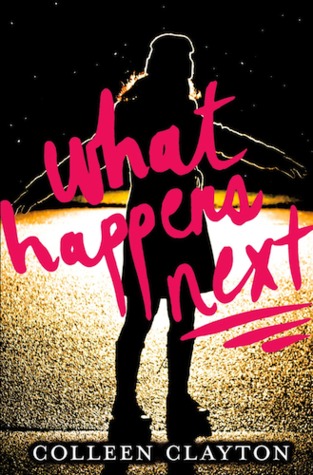
What Happens Next – Colleen Clayton

whathappensnextColleen Clayton’s debut YA novel, What Happens Next, follows sixteen year old Cassidy ‘Sid’ Murphy after she’s drugged and raped while on a school ski trip. That seems like a pretty big spoiler, I know, but it’s not. The book pretty much spoils it with the tag line “How can you talk about something you can’t remember?” Besides, it’s not the most dramatic thing that happens in this book, even though it is the impetus for Sid’s journey.

Sid and her best friends Kirsten and Paige are pretty excited about this ski trip, but of the three Sid is the amateur and so after a few hours at the bunny hill she sends her friends off to do some real skiing. While on her own, she meets Dax Windsor, “a hot specimen.” Sid can’t quite believe he’s looking at her. He’s

… the best-looking guy I have ever seen up close and he is interested in me – goofy, loud-mouthed Sid Murphy, with my crazy red hair, bubble butt and obnoxious laugh.

Dax is all slippery charm, though, and when he invites Sid to a party the next night Sid seems powerless to refuse, even though it will mean sneaking out of her chalet. But sneak she does and when she wakes up the next morning in a strange bed with no memory of what happened the night before, Sid’s world is shattered.

Instead of telling anyone – her friends, mother, police – what happened, Sid isolates herself. Her relationship with her besties fractures; she’s kicked off the cheerleading squad, her reputation is sullied, despite the fact that no one actually knows what happened.

This is where things get tricky for the reader (and mother) in me. Although Sid has no control over what has happened to her and is powerless to undo what has been done, she finds a way to quell the panic and shock she feels. First she starts running. A lot, like hours. Then she starts eating and purging. And no one notices. Is it a case of, we see what we want to see?  I don’t know. I would like to think if something this horrific happened to my daughter, I would sense that something was wrong, but all Mrs. Murphy seems to want to do is serve starch-heavy meals.

Then, into the mix, comes Corey Livingston: slacker, stoner, degenerate. Sid judges him  in exactly the same way as everyone is judging her – without knowing all the facts. As the two start spending time together, though, Sid feels herself starting to trust Corey, not enough to tell him her darkest secret, mind, but enough to at least feel like she has one friend. Their relationship is one of the nicest things about What Happens Next.

Despite a few things that didn’t quite work for me – that last 20 pages or so just seemed rushed – Clayton’s book will appeal to any teenager who has ever felt that they have a burden too insurmountable to overcome. Sid is a likeable character, but I think the real prize here is Corey.

Complicit – Stephanie Kuehn

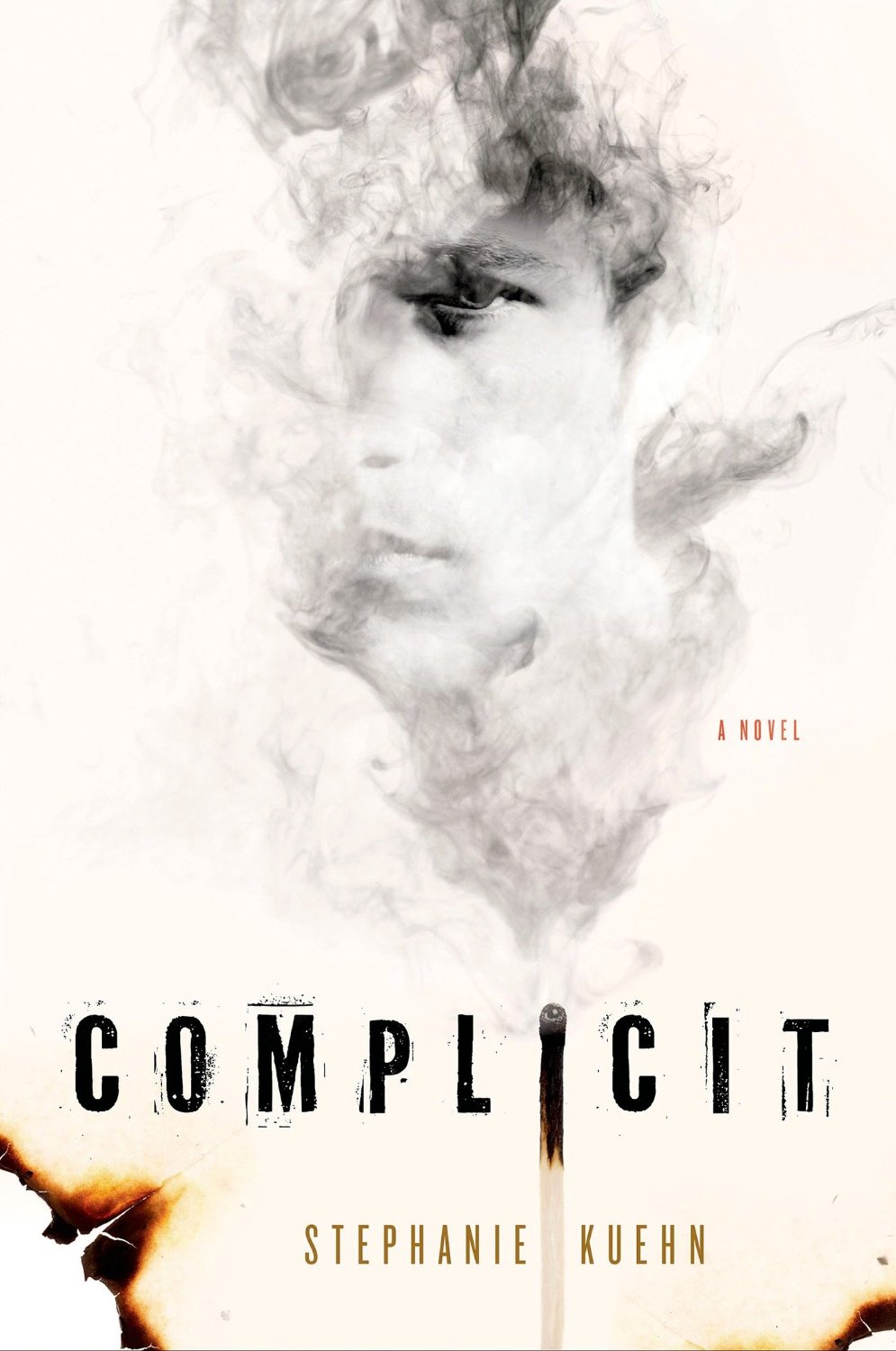
Kuehn-Stephanie-COMPLICITA few months ago I read Stephanie Kuehn’s riveting and devastating YA novel Charm & Strange so I was pretty excited to read Complicit. Also YA, Complicit is the story of siblings Jamie and Cate Henry, who have lived for a decade with their foster parents after their young mother is killed in mysterious drug-related circumstances. As a teen, Cate did some pretty bad things and she’s spent the last couple of years in juvie. To say Jamie and Cate are estranged would be an understatement.

Jamie is now sixteen. He’s an awesome piano player; he’s got a thing for a girl at school which seems to be reciprocated; he has a pretty good life. It’s not all sunshine and roses though: he has huge gaps in his memory, he sometimes blacks out and out of nowhere he loses all feeling in his hands, a condition for which there seems to be no explanation. Then Cate gets out of jail and starts calling him.

I have no proof it was Cate who called, but what if?…I can definitely see her calling me on a throwaway phone in the dead of night. That’d be Cate all the way.

Complicit reads like a psychological thriller where you’re just waiting for all the pieces to click into place. Told in Jamie’s anxious, confused voice, the reader is given a glimpse into his past when his relationship with Cate wasn’t quite so hostile. As kids, Cate was “precocious. Outgoing. Spunky.”  As a teenager, though, she seemed angry and wild, “her jeans too tight. Her shirt too low. her mood too black.”

Jamie is not really interested in a reunion, but Cate is persistent. The more she calls him, the more Jamie feels compelled to follow the bread crumb trail she leaves about their mother’s death and what really happened the night that the Ramirez barn was burned to the ground, the crime for which she spent time in juvenile detention.

Although he is desperate to “forget the empty ache where my mother should be, my sister’s madness, my own rotten feelings of guilt,” he can’t help but somehow feel complicit in Cate’s crimes. And Cate doesn’t seem to want to let Jamie forget anything.

Fortunately for the reader, Jamie’s story isn’t quite as straightforward as it seems. Kuehn paces her twists perfectly and although careful readers might think they’ve got it all sorted out by the time they’ve reached the novel’s shocking conclusion, I’m guessing not so much.

Another winner by Kuehn.

The Swimming Pool – Holly LeCraw

swimmingHolly LeCraw’s novel The Swimming Pool was well-reviewed when it was published in 2010 and so my lackluster feelings about the book make me feel like I must have missed something. I kept thinking it was ultimately bound for my Book Graveyard but I kept at, mostly because LeCraw’s writing was quite lovely even though the characters were mostly irritating.

Marcella Atkinson and her husband, Anthony, and daughter, Toni, spend a summer at Cape Cod. There, they meet the McClatcheys, Cecil and Betsy and their children, Jed and Callie. Marcella is an exotic Italian goddess, somehow separate from all the other women on the Cape and Cecil is drawn to her.

Flash forward a handful of years: Cecil and Betsy are dead and adult Jed finds an old bathing suit in the family home. He knows it belongs to Marcella, so he tracks her down. He’s at loose ends – he’s taken a leave of absence from his job as a lawyer to spend time with his sister, Callie, who has just given birth to her second child and is clearly super-depressed. Everyone in this book is depressed – maybe that’s why it seemed like such a slog. Geesh, people, you’re on the Cape, you clearly have pots of money for which you don’t have to work, some of you are having sex…on the floor…lighten up already!

Marcella welcomes Jed into her world like she’s been waiting for him all her life. After their first night together (nothing happened, btw) he watches her in the kitchen.

She was barefoot. Her feet on the wooden floor were narrow, with a high, delicate arch. Her legs were slender – he’d noticed that already, but in this morning light they were not like a young girl’s legs – the skin was different, looser, not taut and smooth. He didn’t care.

It’s hard to say whether Marcella’s feelings for Jed blossom out of all those babies she lost or the fact that he’s the son of the man she had an affair with, but before you can say strudel, those two are at it like rabbits.

All the people in The Swimming Pool have angst to spare and perhaps that’s one of the main reasons I found the book so slow. Where’s the narrative center? Is this a story about Callie and her post-partum depression? Is it the story of Marcella’s estranged relationship with her daughter? Is it a love story? Is this a story about the power of secrets to destroy families? There’s all this and more crammed into the book, but at the end of the day, the pretty writing doesn’t make up for the listless plot.

Made of Stars – Kelley York

madeofstarsHalf-siblings Hunter and Ashlin have been friends with Chance since they were kids and first started to spend summers in Maine with their father. Chance is the glue that bonds the three together, despite the fact that Hunter and his sister don’t really know all that much about him.

I knew all the things about Chance that mattered most. Chance was strangeness and whimsy in human form.

Chance was our summer.

We didn’t see him or talk to him through the winter, but when we arrived for summer vacation, the three of us came together like we’d never been apart.

This year things are different, though. Hunter and Ashlin have decided to take a gap year and spend it with their father, who is still recovering from a workplace accident (he’s a cop and was shot; Hunter and his sister were kept with their mothers and away from their dad for a couple years).

So, now they’re back in Maine with their dad and each other…and with no way to contact Chance. When they finally do track him down,  they discover that Chance hasn’t been 100% honest with them.  For one thing, his house “is nothing like what Chance described.”  His parents are clearly not glamorous jetsetters, either. Instead, his mother looks “like she cuts [her own hair], and her face is gaunt and tired. She’s wearing a gray men’s bathrobe over a nightgown and pink slippers that have seen better days.” Chance’s father is “broad-shouldered and stone-faced, with a jaw that hasn’t seen a razor in a few days.”

But Chance is the same. And not the same.

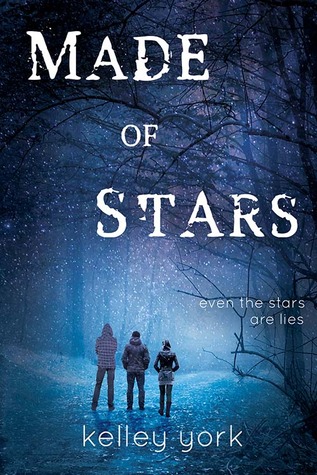
Kelley York’s YA novel Made of Stars captures that time between innocence and experience. These three teens have a shared history made more complicated by an unexpected love triangle. But Made of Stars isn’t a straight-up love story.  When someone turns up dead, Chance is implicated and Hunter and Ashlin set out to prove his innocence. Turns out, even that is more complicated and dangerous than the siblings could have imagined.

Enjoyable read.