The Interrogation – Thomas H. Cook

My love affair with Thomas H. Cook goes back several years when I stumbled upon his novel Breakheart Hill in a secondhand bookstore. Since then I have read several of his books including Instruments of Night, The Chatham School Affair, Places in the Dark, Evidence of Blood, The Fate of Katherine Carr, Master of the Delta, Red Leaves and The Cloud of Unknowing. Geesh, that’s a lot of books by one author!  In my reading life perhaps Stephen King is the only author I’ve read more of. (Yes, I am ending that sentence with a preposition; sue me.)

Cook is a prolific writer (he has over 30 novels to his credit) and has won many awards including the Edgar and the Crime Writers’ Association Duncan Laurie Award, yet you’d be lucky to find any of his novels on the shelves at your local bookstore – trust me, I look.  So how come he isn’t as well known as other authors writing in the same genre? Unless you’ve read him, or are a super mystery novel aficionado, you may have never even heard of him. How come? Ali Karim asked the same question for an article in January magazine.

I buy his books whenever I find them and I hang on to them, usually until I can replace the one I am about to read with a new one. I like to have one waiting in the wings for the next time I need a fix.

Albert Jay Smalls is an odd little man who lives in a drain pipe in a local park. He’s been 237180arrested for the murder of a little girl. The problem is there’s no evidence and no witnesses and so the police can only hold him for twelve hours before they have to cut him loose. Thomas Burke, the chief of police ( a man with his own troubles) sends  his two best interrogators into the room to get a confession from Smalls.
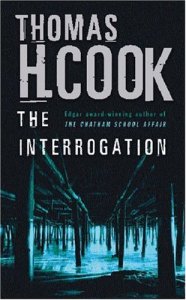
The Interrogation is the story of those two cops, Norman Cohen and Jack Pierce. Each man has a heart full of demons (Cohen is haunted by his experiences in war; Pierce’s young daughter was a murder victim), but they are tenacious and accomplished interrogators. Since the story is set in 1952 they have to rely on the evidence they gather the old-fashioned way: visiting crime scenes, talking to people, chasing leads. There’s no Google and everything takes time and time isn’t on their side.

As Cohen and Pierce question Smalls and try to follow a breadcrumb trail, the reader will try to determine Smalls’ guilt or innocence too. Make no mistake, Cook’s novels are mysteries and half the fun is trying to figure out whodunit, but that’s not the only thing Cook’s got going on.

As with every single Cook novel I’ve read – his characters are really dynamic. You believe them from the minute they open their mouths. They have complicated interior lives. His heroes are always men trying to do the right thing – even when they can’t. Minor characters, like garbage collector Eddie Lambrusco, are equally well-drawn. Cook can create empathy with just a few word as he does when we watch Eddie handle his father’s watch and thinks

a laborer’s timepiece with its chinks and scratches and slightly skewed hands that circled turgidly around the yellowing dial. After a lifetime, he thought, this.

There are a lot of father/child motifs in The Interrogation –  dads who are helpless to save their children; dads who do everything for them; dads estranged from their children. It’s a theme Cook visits often and yet he always seems to have fresh things to say about the topic.

And like with virtually every Cook novel (I almost said book there and then thought better of it) I’ve read, the story’s resolution will be a surprise. It won’t feel like a cheat, either…because with Cook the clues always exist.

If you like mysteries that are thoughtful, intelligent and well-written – try to get your hands on Thomas H. Cook. You will not be disappointed.
Summer Reading 2016

Listen here.

So – it’s summer. I’ve got all this free time stretching out in front of me and all I can think about is – what am I going to read? It’s the perfect time to make a dent in my tbr pile and yet I keep buying more books. Ridiculous. I do have a reading plan and an anti-gravity deck chair…and an awesome new deck, so I thought I’d talk a little bit about what’s on tap for  my summer reading.

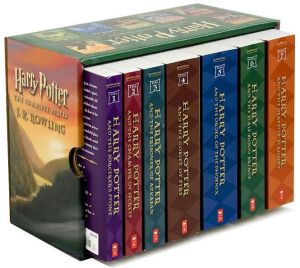
First of all, I promised my daughter, Mallory,  I’d read the complete Harry Potter series, which is 4224 pages. Yikes. I’ve actually read the first book and I’ve seen all the movies multiple times.

9780545162074_p0_v2_s1200x630Here’s a funny thing. The first Harry Potter book came out the year Mal was born and probably when she was about two I started to read it to her and I just couldn’t finish it. I just didn’t like it and she was too young. She was probably in middle school when she started reading the books on her own and I think she’s read the series a half dozen times or so. I subsequently fell in love with J.K. Rowling’s adult books, The Casual Vacancy and the Cormoran Strike books which she wrote as Robert Galbraith. (I’ve only read the first, The Cuckoo’s Calling.) I also think Rowling is an amazing human being – she gives away scads of  money, crazy amounts. Anyway, I will definitely be tackling Harry Potter this summer.

Here’s another book I should have read, but haven’t – A Moveable Feast, Ernest Hemingway’s memoir of the time he spent living in Paris in the 1920s. I would say, generally speaking, that I am not a fan of Hemingway. I understand his place in the literary canon, but just not my cup of tea. Then I read The Paris Wife by Paula McLain. It’s a fictional account of Hemingway’s first wife, Hadley Richardson, and their time spent in Paris surrounded by the literati of the day: Gertude Stein, F. Scott Fitzgerald, Ezra Pound. I mean, you can’t really call yourself a literature lover and not be a little bit intrigued by those people. I highly recommend The Paris Wife and after I finished it,  I bought A Moveable Feast and my friend Karen has chosen Hemingay’s novel For Whom The Bell Tolls as our summer book club on FB. So, looks like I’ll be reading two Hemingways this summer.

Then – on top of all this, I am going to try to make some room to read some fun stuff. I started Martin Short’s memoir I Must Say a couple nights ago. I’ve been a life-long fan and I can hear all his voices – Ed Grimley and Jiminy Glick –  in my head.

I also have a couple thrillers on my bedside table, Christobel Kent’s The Crooked House, for example.

Speaking of thrillers, if anyone out there is looking to read a highly unusual thriller I can recommend M. R. Carey’s The Girl With All the Gifts. It’s a zombie apocalypse novel – not normally my cup of tea, but definitely worth checking out, especially if you like to read the book before you see the movie. Carey is quite a well-known writer of comic books, The X Men and Lucifer. The book takes place in the U.K. and concerns a heavily guarded compound where ten-year-old Melanie and other “hungries” are studied in the hopes of finding a cure for the world’s zombie problem. It’s quite a big problem, actually. Melanie is a wonderful character and the novel is action-packed, smart and kinda sad, too.

What are you planning to read this summer?


Twisted River – Siobhan MacDonald

I was that customer at Indigo a couple weeks ago when I sent  Matt and Jerrod looking25810336 for a book that I described as “blue” and “used to be on the front table.” Yep. So ridiculous, right, thinking that those descriptors would help them locate a book in a store filled with books. Talk about the proverbial needle in a haystack. Strangely enough, I found it on my own in the mystery section – although the book’s cover is definitely not blue.  (And it might have helped if I’d remembered the keys on the cover.)

Kate and Mannix O’Brien and their children Izzy and Fergus, and Hazel and Oscar Harvey and their children Elliot and Jess, are the central characters in Siobhan MacDonald’s novel Twisted River. We meet them separately, the O’Briens in their house in Limerick, Ireland and the Harveys in their Manhattan apartment. Each family has their own domestic rhythms and  difficulties. For example, Fergus is being bullied at school. Hazel is lying to her children – and herself – about her damaged cheekbone and her eye which “had swollen a mix of red and purple.” Mannix and Oscar each have work-related troubles. Then there’s Mannix’s brother Spike, a nightclub owner who’s mixed up with a local crime family.  When the families’ crises reach a boiling point, the moms take matters into their own hands and arrange a vacation. Using a house swap site they connect and swap houses; the O’Briens head to New York and the Harveys to Limerick, Hazel’s place of birth.

And a family vacation sounds great – except the novel starts with Oscar stuffing the body of a woman into the trunk of a car. (Not a spoiler – the novel’s opening line is “She would never have fit as neatly into the trunk of his own car.”) From that compelling opening line, the story weaves past and present, revealing secrets and lies.

Twisted River is twisted, all right. It’s really one of those books where things are not entirely as they seem. MacDonald’s layered narrative reveals characters and their motives with slippery-eel finesse. I didn’t feel duped by MacDonald’s  plot as much as I did by the novel’s kind of fallen souffle ending.  But as  far as being a page-turner, yes, I turned the pages.


The Girl With All The Gifts – M.R Carey

Joss Whedon (Buffy the Vampire Slayer, Angel) called The Girl With All The Gifts “Heartfelt [and] painfully human.”   Without really knowing I was buying a zombie book, I picked up M.R. Carey’s novel  a few weeks ago  and finally settled down to read it.  I am not a huge fan – or even a fan at all really – of zombies. I am, however, a fan of Joss Whedon, and an endorsement from him is enough for me to read outside of my comfort zone. Zombies, unlike vampires (Joss Whedon’s vampires at any rate), are just not sexy, and while I am still not a fan of zombie novels, I did really like this book.

17235026Melanie is ten. She lives at some sort of army base, dubbed ‘Hotel Echo’ in an area of the U.K. known as region 6. The base is about thirty miles north of London, and just beyond that is Beacon. Welcome to life since the Breakdown.
Most of region 6 is clear, but the only thing that keeps it that way is the burn patrols, with their frags and fireballs. This is what the base is for, Melanie is pretty sure. It sends out burn patrols, to clear away the hungries.

Melanie is not an ordinary girl. For one thing, she is kept locked in a cell. For another, she and the other children at Hotel Echo exist on a diet of grubs.  Every morning, she is strapped, wrists, ankles and neck, into a chair and taken, along with the other children,  to the classroom where their teacher – usually Helen Justineau – teaches them. Those are Melanie’s favourite days because when Miss Justineau is teaching “the day is full of amazing things.” The children learn math and spelling; sometimes they are read to. Melanie is keen to learn as much as she can, but it’s difficult to know just what the lessons are for because as Mr. Whitaker (another one of the teachers) explains “None of this stuff matters anymore…it’s irrelevant. It’s ancient history! There’s nothing out there any more. Not a damn thing. The population of Birmingham is zero.”

Dr. Caldwell also lives at Hotel Echo. She’s busily working on a cure for the infection that causes people to become ‘hungries’ (and you’d be right in thinking that what they’re hungry for is humans). She sees the children as test subjects, nothing more. Helen Justineau strenuously disagrees with Caldwell’s methods and the relationship between the two women is fraught with ethical disharmony.

When Hotel Echo is attacked by junkers (violent scavengers taking advantage of the chaotic state of the world) Justineau, Caldwell and Melanie end up on the run with two soldiers, Parks and Gallagher.

I don’t really have a frame of reference for a zombie apocalypse book. I don’t watch The Walking Dead, which I have been told is really good, but really gory. I read and loved Courtney Summers’ This Is Not a Test, but despite the fact that it’s a zombie novel it is zombie-lite compared to The Girl With All The Gifts. So I don’t have any preconceived zombie notions, not like when I read vampire fiction and get all annoyed when they sparkle.

But make no mistake, The Girl With All The Gifts is more than a zombie novel. It’s a novel that asks us to consider what makes us human and whether or not we can be more than our nature allows. Caldwell views Melanie as a test subject, someone with the biological potential to save the world. Justineau views Melanie as a little girl. Parks views Melanie as a monster. They are all right. And wrong. The journey they take together will horrify and break the hearts of any reader prepared to go with them.

Highly recommended.

Read it before the movie comes out!


The Paris Wife – Paula McLain

I wouldn’t consider myself an Ernest Hemingway fan by any stretch. Perhaps I read him when I was too young to appreciate his spare and muscular prose. For some reason I always thought of him as a misogynist, although I couldn’t say how I came to that conclusion. He has been criticized for his portrayal of women in his work, so my opinion has clearly been borrowed from something else I’ve read. I do know, however, that he is a significant figure in American literature even if neither the man nor the myth was all that interesting to me as a reader.

parisNow, after reading Paula McLain’s novel The Paris Wife I have to admit to being quite curious about Hemingway and his writing. I think I might come at it a little differently now compared to the way I approached him as a young university student.

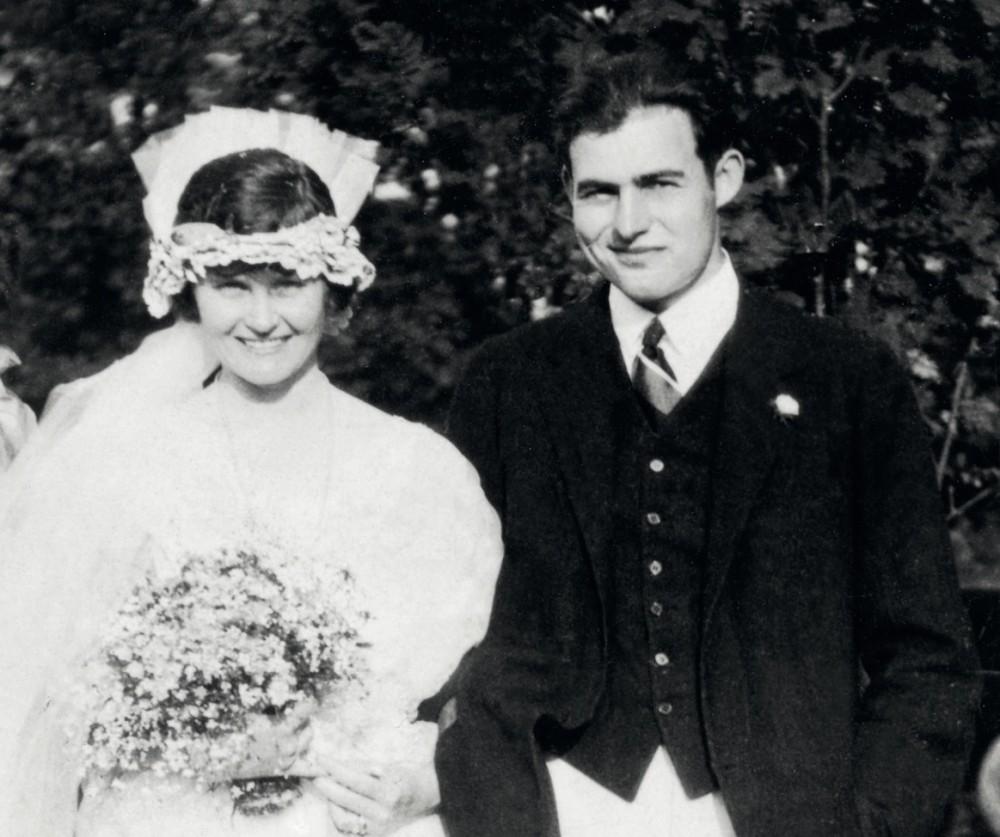
The Paris Wife is a fictional account of the relationship between a young Ernest Hemingway and his first wife, Hadley Richardson. The pair meet through mutual friends in Chicago in 1920. “The very first thing he does,” Hadley says, “is fix me with those wonderfully brown eyes…”

Hadley is 28 and has come to Chicago from St. Louis after the death of her mother. Hemingway is just 20 and “seemed to do happiness all the way up and through. There wasn’t any fear in him…just intensity and aliveness.” For Hadley, who says that her life was “stuck” long before her mother’s death, Hemingway is a revelation. When Hemingway announces that he intends on being an important writer, Hadley remarks “I thought poets were quiet and shrinking and afraid of sunlight.” Hemingway is a force and Hadley has no choice but to be swept along with him.

After Hadley returns to St. Louis, the two begin a correspondence which ends in a wedding proposal.  Once they are married, the two return to Chicago briefly before setting sail for Paris. Why Paris? Sherwood

Hadley and Ernest on their wedding day Sept 3, 1921.

Hadley and Ernest on their wedding day Sept 3, 1921.

Anderson (author of the book Winesburg, Ohio, which I’ve never heard of but apparently both the writer and the book were a big deal back in the day) tells Hemingway “…if you want to do any serious work, Paris is the place to be. That’s where the real writers are now.”

Anderson was right, of course. Paris in the 20’s was a mecca for writers and artists, a literary (and artistic) who’s who. Gertrude Stein, Ezra Pound, F. Scott Fitzgerald,  and Archibald MacLeish are just a few of the celebs who enter the Hemingways’ orbit once they find themselves in the City of Light at the end of 1921. This collection of literati came to be known as “The Lost Generation,” a term coined by Stein but made popular in Hemingway’s novel The Sun Also Rises. The term refers to those who came of age after the First Word War.

McLain’s novel does an exceptional job of capturing the literary scene of the time – its parties and squabbles, jealousies and intrigues – but also the relationship between Ernest and Hadley. There is no question they loved each other deeply and in Hemingway’s own memoir about his time in Paris, A Moveable Feast, he writes “I wish I had died before I loved anyone but her.”

I may have to rethink my position on Hemingway. I may have to read A Moveable Feast. I certainly recommend The Paris Wife especially if you love literary name dropping and Paris. Even if you don’t love those things, McLain’s novel is a delight.

And We Stay – Jenny Hubbard

Sixteen-year-old Emily Beam, the protagonist in Jenny Hubbard’s YA novel And We Stay,  has been whisked away from her home town to attend a boarding school in Massachusetts. It’s midway through Emily’s junior year, an odd time for a student to be starting at The Amherst School for Girls.  Emily just wants to be left alone, though, and she keeps her head down and her cards close to her chest.  It’s clear that she’s suffered some sort of trauma and her parents have decided she will not be returning to her old school to “deal with the whispers and stares and, of course, the memories.”

andwestay

Emily settles into life at Amherst as best she can. Her roommate, K.T. is friendly and not too nosey and that’s good because Emily isn’t willing to talk about her life. The most she is willing to divulge is that she’s come from Boston – which isn’t exactly true.

Although she doesn’t want to talk about why she’s started school half way through the year, her story is revealed to the reader in short order: her boyfriend, Paul, has died. The details of his death are revealed through flashbacks and the poetry Emily begins to write, in part, inspired by Emily Dickinson. As it turns out, Dickinson had been a student at Amherst one hundred years before.

Hubbard is clearly a poet. Poetry figured in her first YA novel, Paper Covers Rock, a book I really loved, too. In And We Stay, Emily uses her poetry as a way to try and make sense of the senseless. In her poem “Ashes” she writes:

The same sky that once

held her dreams has stolen

her story. And the stars

will know just

how to tell it:

night after night

over and over.

Slowly, Emily opens herself up to the possibility of recovery and healing, but the journey is not without its difficulties. Hubbard negotiates Emily’s journey with a keen sense of the teenage heart.  Perhaps one might view Emily Dickinson as a plot device, but it didn’t feel that way to me. Poetry is the art of heightened emotion, of making the unknowable knowable and Emily is trying to do just that: make a horrific act something that she can survive – because she can. Because she must.

And We Stay is all the things I want my YA books to be: beautifully written, smart and engaging, emotionally intelligent and a page-turner. The book won several awards and is, in my opinion, deserving of them all.

Highly recommended.

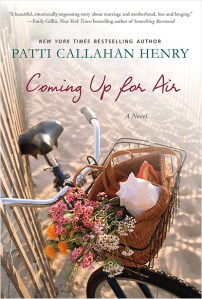
Coming Up For Air – Patti Callahan Henry

Patti Callahan Henry’s heroines all have the same problem: they are women of a certain age at a crossroads in their lives. For Amy, the protagonist in my first Henry novel Losing the Moon, it’s the unexpected reunion with her college boyfriend, Nick. In Where the River Runs  it’s the emotions rekindled by revisiting a tragedy from Meridy’s youth.

Then there’s Ellie Calvin, the main character in Coming Up For Air. Ellie realizes at her coming-up-for-airmother’s funeral that she no longer loves her husband, Rusty. Truth be told, he’s a bit of a douche, a passive aggressive clout from the right side of the tracks. What Ellie really longs for is Hutch, her “bad boy” college boyfriend. Of course, she doesn’t know that just yet. It’s not until he’s suddenly standing in front of her and
…I saw his face. Twenty years later, minutes and hours and days rearranged to allow me to see him again as if time hadn’t passed at all. Mostly I saw his eyes: almond shaped and kind, brown with green underneath, as if the eyes had meant to be the color of forest ferns and then at the last minute changed their mind.

As a reader, you pretty much know what’s going to happen about then – all that remains to be seen is just how meandering the journey. In this instance, Hutch is an historian and he’s been working on an exhibit at the Atlanta History Centre, an exhibit honouring some of the South’s great dames – in which Ellie’s mother, Lillian,  figures prominently. Ellie has had a prickly relationship with her mother. Much of the acrimony,  ironically, involved Hutch.

Then Ellie finds a journal her mother kept. The entries, one a year, reveal that Ellie’s mother wasn’t always the proper and stiff woman Ellie had grown up with. In fact, she’d had a deep and passionate love affair  with a man identified only as Him before she’d married Ellie’s father. (Not sure why Him is capitalized.)  Furthermore, she’d been involved in the Civil Rights Movement.

Obviously, Ellie and Hutch need to find out what all this means and so they head down to the Alabama coast where Lillian’s best friend, Ms. Birdie, lives. Ms. Birdie also happens to be Ellie’s best friend’s mom…so, see how that all works out? Of course, Ms. Birdie is reluctant to tell Ellie anything much. There’s still half a book to get through, after all.

I read the whole thing, of course I did. It’s not because it’s full of hot sex, either. Hutch and Ellie barely exchange a platonic kiss. It’s not because I particularly cared about any of the characters. Even the revelation of who the mysterious Him was is a disappointment. I was hoping Lillian had been really brave.

I guess I didn’t give up on Coming Up For Air because the romantic in me wants to see the potential for love at a certain age. I’m older than Ellie and I don’t have a marriage to walk away from anymore, but I do — sometimes — long for that chemical connection. Of course, I don’t have pots of money allowing me to step away from my life and go live in a magical cottage on the water. I also don’t have a “one-that-got-away” college boyfriend.

If our lives are a story and we are characters in that story, perhaps Ellie’s Uncle Cotton’s question is valid: “What’s the next best thing to happen here?”

Unfortunately, I think Henry took the path most traveled, but I guess if you like happily-ever-after that’s probably okay.

Everything I Never Told You -Celeste Ng

everythingLydia is dead.

It’s been quite a while since I’ve had such a visceral reaction to a book.  I read the bulk of Celeste Ng’s debut novel, Everything I Never Told You, on my snow day (a gift for a teacher, even if it’s only because we get to catch up on  marking/yearbook/planning – and, yeah, reading). I don’t think I will ever  be able to adequately explain how I feel about this book or these characters.

Lydia is just sixteen when she is found at the bottom of the lake across the street from her home in small-town Ohio. It’s the 1970s, the decade in which I, too, was coming-of-age. On the morning she is discovered missing (and it is this “innocuous” fact that sets the story in motion) we see the Lee family dynamic.

As always, next to her cereal bowl, her mother has placed a sharpened pencil and Lydia’s physics homework, six problems flagged with small ticks.

Hannah, Lydia’s younger sister is “hunched[ed] moon-eyed over her cornflakes, sucking them to pieces one by one.” Lydia’s older brother, Nathan, is sitting on the stairs trying to wake up. James, their father, has already left for his job as a professor at the local college.

Lydia is never late. She is never anything but compliant. She is a “yes” girl, the favoured daughter. It is only after her body is found that her story, and that of her family, begins to unravel. And yes, you will want to know what happened to Lydia, but trust me, it’s just one of the many things that will break your heart in this magnificent novel.

While every family has their own secrets and burdens, the Lee family is further set apart because Marilyn is white and James is Chinese. Their story is integral to Lydia’s story. Marilyn herself was a gifted student, earning a scholarship to Radcliff, and there – while she heads towards a degree in medicine – she meets James, a fourth year graduate student in history. She is ‘other’ because she is a woman studying in a field that is dominated by men; he is ‘other’ because he’s Chinese. All Marilyn knows is that “she wanted this man in her life. Something inside her said, He understands. What it’s like to be different.”

Marilyn’s career plans are pre-empted when she gets pregnant. She and James marry and move to Ohio.  Of course, their union wouldn’t be quite so problematic now (I’d like to think, but there are always some people….), but it’s the late 50s when they marry. Another world, another time. And life, fraught as it is, moves on. But why is it fraught? Because James grew up attending private school for free because his mother worked there as the cook and his father the janitor? Because he never fit in anywhere?  Because Marilyn didn’t want the life her mother had? Because of dreams deferred? And what happens when our parents’ lives are complicated and damaged by their own childhoods? Ah, we all know the answer to that question, right? It all trickles down.

Everything I Never Told You is an astounding, complex and heart-breaking look at the secrets we keep, not only from our families but from ourselves. Why we keep them, and the damage caused because of it, is just part of what happens in Ng’s book. The horrible longing we feel to crack ourselves open, the desire for true communication and intimacy, is another part. There wasn’t a single character in this novel I didn’t want to hug – I loved them all. That they were so fabulously human and fragile is a testament to Ng’s talent.

Highly (times a billion) recommended.

What We Lost – Sara Zarr

whatwelost“The whole world is wilting,” says fifteen-year-old Samara (Sam), the protagonist of Sara Zarr’s YA novel What We Lost.

She means the comment literally because it’s so hot that she wakes up every couple of hours “in a puddle of sweat,” but the observation is also figurative. Sam’s life is full of conflict and chaos. Her father, Charlie,  a pastor at the local church, is distracted and every day Sam wakes up to something “ruined or broken or falling apart.”

Part of the problem is that Sam’s mother is currently residing at the New Beginnings Recovery Center in an effort to get sober. Without her mother there, Sam feels adrift. There’s not enough money and Sam is tired of having to pretend that her mom just isn’t feeling well enough to attend church or other social functions. Things get even more complicated when Jody, a thirteen-year-old member of Sam’s church, goes missing  and Sam’s small town suddenly becomes a lens through which she is able to see all the world’s flaws, including her own.

I’ve read Zarr’s fantastic book Story of a Girl and her novel Roomies, which she co-wrote with Tara Altebrando, and which I also loved. Zarr has a real gift when it comes to creating empathetic characters and Samara is no different. Her fifteenth summer is a perfect storm of angst and confusion, suspicion and alienation.

I wish I understood what happened between then and now. I wish there was a way to put your finger on the map of life and trace backwards, to figure out exactly when things had changed so much…

As the town searches for Jody, Sam’s dad spends time with her family, acting as a sort of spokesperson. During this time, Sam grows closer to Jody’s older brother, Nick. He “could probably be a model” Sam observes, studying him the way “every girl who has ever known Nick has studied him.”

The problem with their blossoming friendship is that Nick is a suspect in the disappearance of his sister and Charlie doesn’t want Sam to hang out with him. Charlie also doesn’t want Sam to be alone; the town no longer feels safe. Sam is shuttled back and forth between her house and her best friend Vanessa’s. Sam has suspicions of her own; she wonders why her dad is spending so much time with Erin, the church’s youth group leader.

Zarr manages all these threads beautifully, allowing Sam her questions  about her faith in God,  suspicions about her dad, loneliness for her mom and feelings for Nick to percolate under the hot summer sun.

Great read.


If You Find Me – Emily Murdoch

“Mama says no matter how poor folks are, whether you’re a have, a have-not, or break your mama’s back on the cracks in between, the world gives away the best stuff on the cheap.”

IF-YOU-FIND-METhat’s the first thing fifteen-year-old Carey tells us in Emily Murdoch’s amazing novel If You Find Me. From the moment she speaks, it’s almost impossible not to fall in love with her and as her story unspools, it’ll be even more difficult not to want to want to hug her and her little sister, Jenessa, who is just six.

Carey and Jenessa live in a trailer in  in the middle of Obed Wild and Scenic River National Park or, as the girls call it, “the Hundred Acre Wood.” Their mother, Joelle, is usually gone and has, in fact, been MIA for “over a month, maybe two at this point,” leaving the girls to fend for themselves. Carey does the best she can to look after herself and Jenessa but “when you’re livin’ in the woods…with no runnin’ water or electricity, with Mama gone to town for long stretches of time, leavin’ you in charge of feedin’ a younger sister…with a stomach rumblin’ like a California earthquake” it’s not easy. The girls exist, mostly, on beans fixed in “new and interestin’ ways.”

On this particular day, though, Carey and Jenessa have company. A woman “as thin as chicken bones, her gait uneven as her heels sink into the soft forest floor” and a man stumble into the girls’ campsite.

He hasn’t offered his name, and he isn’t familiar to me. But in that instant, hittin’ like a lightnin’ bolt, I know who he is.

If You Find Me is an amazing story of resilience and family and forgiveness, but it is also a horrific story of abuse and neglect, made all the more powerful because of Carey’s compelling and authentic narration. I fell in love with her the moment she started to tell her story and I know this is fiction, but I also know that children endure atrocities at the hands of their parents and guardians all the time.

Suddenly, Carey finds herself living with a father she doesn’t remember, a new step-mother and a step-sister who clearly resents her, attending school for the first time.  Jenessa seems to thrive in her new surroundings and although Carey contemplates returning to the her life in the woods, her love for her sister prevents her from running. Their journey is one of resilience and hope, but it’s not all smooth sailing.

I loved this book because I loved Carey. I wish the ending hadn’t seemed so rushed, though, because I don’t think Carey’s relationship with Ryan was as fully developed as it might have been and other pieces fell into place just a tad conveniently, but whatever; I haven’t read a YA book with a narrator I’ve loved quite as much as I loved Carey in a long time.

Highly recommended.