30 Day Book Meme – Day 11

A book you hated

I am just going to state upfront that just because I hate a book doesn’t mean the book has no value. That’s a given. Reading is a relatively subjective activity. We all bring our own personalities and sensibilities and biases to the books we are reading. Also, I think it’s only fair that I only consider the books that I’ve finished in this category. My book club awards two prizes at the end of every reading year (usually late June). We give a prize for the book we enjoyed reading the most and one for the book we enjoyed reading least. Clearly if you haven’t actually read the book it’s not fair to say you didn’t enjoy reading it. I make a sincere effort to read every book club book because I want in on the discussion and that’s hard to do if you haven’t read the book. But there have been duds.

My friend, Michelle, who womans the delightful food blog Bite, picked one such book a few years back: The White Iris. The hysterical thing about it was her sheer delight in the book and the fact that she was positive, adamant even, that she was going to walk away with the prize for best loved book that year. She won a prize all right. My short and scathing review of the book can be found here.

Generally speaking, I don’t get rid of books. It’s a thing; don’t judge me. Unfortunately, I don’t have limitless space and so every once and awhile I do have to cull. Usually I get rid of mysteries I won’t read again (Harlen Coben, stuff like that) or books I’ve read, didn’t particularly like and wouldn’t ever pass on (like The White Iris). Sometimes a book I didn’t like remains on my shelf – I like the author or it’s a hardcover (I know, I have weird standards!) So – looking at what’s on my shelves currently:

I hated Dismantled by Jennifer McMahon and it pains me to say it because I LOVED her novel Promise Not to TellPromise Not To Tell was everything Dismantled was not but I kept at the latter because it was Jennifer McMahon and how could it NOT be as amazing as Promise Not to Tell (a dozen copies of which I hand sold when I worked at Indigo.) I talk about Dismantled here. I talk about Promise Not to Tell here. Dismantled remains on my bookshelf out of my loyalty to Promise Not to Tell. I have high hopes for McMahon’s novel Island of Lost Girls which is on my tbr shelf.
30 Day Meme – Day 7

Most underrated book

Wow. This is actually quite difficult. It’s easy to talk about popular books with hype you don’t quite get, but it’s slightly more difficult to talk about an underrated book. Underrated by whom?

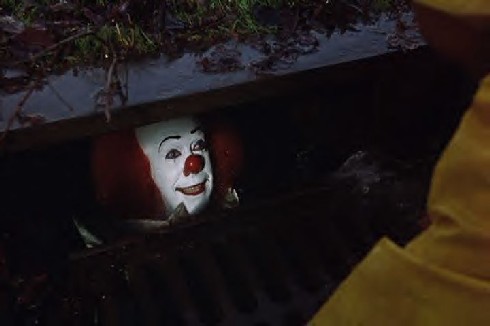
Anyway, I don’t think Stephen King gets the respect he deserves. There. I said it. Sure, he’s a bazillionaire but being a best-selling author doesn’t necessarily mean that people hold your work in high regard. My favourite King book is It. (I’ve read many but not all of King’s novels and short stories and I think his non-fiction book On Writing belongs on every writer’s bookshelf.)

The terror, which did not end for another twenty-eight years – if it ever did end – began, so far as I know or can tell, with a boat made from a sheet of newspaper floating down a gutter swollen with rain.

It (in case you’ve never read it) is the story of seven childhood friends who encounter a horrific evil and then reunite many years later to fight it again. As with many of King’s stories, this one is set in Maine and begins in the 1950’s. The reason I think King is underrated (and why I chose It to illustrate my point) is because I don’t think there is a living writer today who manages to capture the innocence of childhood and the bond of friendship made during those early years quite as well as King does. I think that critics (and readers of lit-er-a-ture) dismiss him because he writes horror fiction. Silly, really. You don’t dismiss Stoker or Shelley because they wrote horror fiction!

It scared the crap out of me – is there a creation more malevolent than Pennywise? If there is, I don’t want to meet him, thanks very much!-but the reason it was so successful as a horror novel was because I cared about the people in the story and the reason I cared about them is because I got to see them as kids. King channels kids. He understands their loyalties and fears and hopes and he gets their rhythms and speech. He  allows them their fears and bravery, their weaknesses and their ability to overcome those weaknesses.

I read this book 20-odd years ago. I was living in NYC at the time and I carried that book (all 1,000 pages of it) around with me everywhere. It creeped me out. It made me laugh. And the denouement was tear-worthy.

Possibly King fans would choose another  title as underrated. I say, read It.

30 Day Book Meme – Day 2

A book that you’ve read more than 3 times.

If you saw my to-be-read shelf (350+ unread books that are physically on my shelf) or flipped through the notebook where I keep an alphabetical never-ending list of the books I’d like to read, you’d laugh at the notion that I have actually read a book three times.  But I have.

The hands-down winner is Kristin McCloy’s 1988 novel, Velocity. I purchased this book around the time it was published at The Strand in New York City. I was really excited to find it because I hadn’t been able to find it at any book store in my hometown and this was before the days of ABE and Bookcloseouts.

Velocity is the story of Ellie, a young woman who leaves her life and boyfriend in NYC and returns to her teensy hometown after a car accident kills her mother. Her father, a local police officer, is lost in his own grief and he and Ellie spend their summer tiptoeing around each other. Ellie doesn’t, however, tiptoe around Jesse, the Hell’s Angel biker who lives down the road; her grief manifests itself in an all-consuming sexual relationship with him.

I tell myself, Once he was mine, and that was enough. But it wasn’t. It was never true, and it was never enough. You hunted down your needs – simple and precise – and in those days it was me.

So, back in the day, Velocity spoke to me because I was madly, crazily, obsessively in love with the quintessential bad-boy. Her story was my story (without the dead mother.) Her crazy, reckless lust for Jesse mirrored my own doomed relationship and I couldn’t get enough. My relationship ended, but my love affair with this book did not. I still read it once a year and have done for over 20 years.

Why? I think it’s the quality of McCloy’s writing and the story’s emotional weight. Ellie’s story has stayed with me all these years because ultimately this is a story about loss and reconciliation and Ellie is intelligent and fragile and so desperate to be strong that she implodes. Jesse is not just her sexual foil; he is not without shades of gray and he’s impossible attractive.

Kristin McCloy, as far as I know, has only written one other book and I haven’t read it. I don’t know this for sure but I’ve always felt that Velocity was a very personal book for her. I have passed it on many times – but only if the borrower promises to return it!

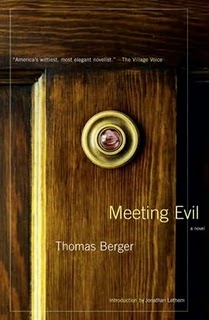
Meeting Evil – Thomas Berger

According to Jonathan Lethem, Thomas Berger is  “one of America’s three or four greatest living novelists.”  I’d never heard of him when I added Meeting Evil to my tbr list, then shelf – where it languished for several years before I fnally got around to reading it. 

Meeting Evil is the story of John Felton, a young real estate agent suffering through the downturn in the American economy. He’s married to Joanie, father to Melanie and Philip and his life is about to get very complicated.  It’s Monday morning when his doorbell rings. Standing there is Richie, a young man of John’s general age. His car has stalled in front of John’s house and Richie asks for assistance. What begins as a an act of good samaritanisim, quickly devolves into a harrowing crime spree – with John along for the ride.

I’ve never  read a book quite like Meeting Evil before. While sometimes John seemed ridiculously naive and stupid to me, the character of Richie is a creation of pure malevolence.  He’s dangerous and unpredictable. Before John even knows what has happened, he’s part prisoner and part co-conspirator in Richie’s road trip from hell.  Although John soon realizes the danger he is in, Richie turns out to be a master manipulator. At one point John even announces “We’re all in this together.”  Try as he might to escape (and he does try) John’s day just keeps getting worse.

Berger is a masterful writer. The book has a propulsive energy and is often wickedly funny. It’s quite unlike anything I’ve read before and I look forward to reading the second Berger title on my tbr shelf, Best Friends.

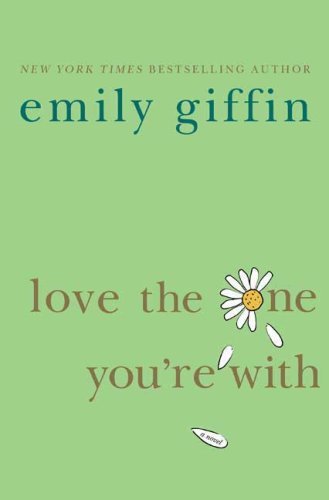
Love the One You’re With – Emily Giffin

Emily Giffin is really popular, I guess, but I’d never read her. I’m a huge consumer of chick flicks, but not much of a reader of chick lit. I tend to like my fiction a little grittier and heroines in these sorts of books almost always settle – at least in my view.

Not even a full year after she’s married upstanding and handsome lawyer, Andy, (who also happens to be the older brother of her best friend, Margot), Ellen runs into Leo crossing a busy Manhattan street. Leo is “the one who got away” although in this instance, it’s more like the one who fizzled away. Ellen is sent into a tailspin of memories and she indulges every one of them, glossing over how Leo was kind of a schmuck at the end of their relationship.

Okay – so far I’m with you Ellen. I mean, seriously, who hasn’t had the same sort of intense relationship – the one where you’re up all night…um…talking? But Ellen has moved on from all that. Now she’s a successful photographer and Andy, he’s a great guy. She hasn’t settled. At least she doesn’t think she’s settled until Leo comes crashing back into her life.

And that’s when my cell phone rang and I heard his voice. A voice I hadn’t hears in eight years and sixteen days.

“Was that really you? he asked me. His voice was even deeper than I remembered, but otherwise it was like stepping back in time. Like finishing a conversation only hours old.

“Yes,” I said.

Oh, Ellen. Don’t go down that road. But we all do. We all wonder about the might have beens and question the choices we make. Ellen’s marital bliss is about to get bumpy as she hides her reunion from her husband and best friend, and then makes all sorts of minor adjustments to the truth so she can sort through her feelings for Leo.

The truth, it turns out, is more complicated than it appears on the surface. And so is the first year of any marriage. When Ellen and Andy move to Atlanta to be closer to Andy’s family, sister Margot included, Ellen is further tested.

I’ll give Giffin props; Love the One You’re With isn’t sheer fluff because Ellen is a character who is deeply conflicted about her feelings even though she never doubts her love for her husband and the life they’re building together. The new improved Leo is worth a second look, but Ellen is also mature enough to know what the consequences of taking that leap of faith might be.

(Re)Making Love – Mary L. Tabor

Tabor has been a journalist, teacher, and business woman. She decided to add blogger to the list after her husband of 20 plus years announced that he wanted to live alone. Tabor rights her upside-down world by blogging about it. Having felt this blogging impulse myself and being closer to her age (60) than I am to my daughter’s age (14), I figured (Re)Making Love would be a worthy and interesting examination of singledom after a long relationship. Especially when the break comes at a certain point in a woman’s life. After all, who is going to consider dating again at 60!? Okay, or 50!?

Tabor’s blog turned memoir recounts the heartbroken days immediately following her husband’s departure. It spills the beans on property division, using your children as  a pseudo psychiatrist’s couch, online dating,   post-marital sex. With another man!  (Clearly though this was a possibility for Tabor; she’s incredibly attractive and doesn’t look  — from the jacket photo at least — a day over 40, even with her silver-gray hair.)

So I sat down with (Re)Making Love one Sunday afternoon — prepared to go on Tabor’s journey a la Eat, Pray, Love (which, yeah, okay, I didn’t like either – but at least I could follow it). Sadly, the book just didn’t do it for me. And I really, really, wanted to like it. I mean, I am sorta where Tabor was. I’m not quite as old; I’m not quite as well-off; my kids aren’t self-sufficient but I am looking ahead at a long, empty stretch of road which was once as crowded with traffic (hopes, companionship, sex, etc) as Tabor’s. I wanted to read the book and feel as though a kindred spirit was guiding me through the potholes.

In many places the book was strangely abstract, convoluted and difficult to understand, peppered with dreams that are meaningless to the reader because they have no context. It is peppered with references to chick flicks, fairy tales, recipes, the Obamas. It is meant to be Tabor’s journey of self-discovery, but despite her dalliances with post-marital romance and despite her son’s admonishment that she “move on. It’s time. It’s way over time” Tabor ends up with the very man who wanted to be alone. Okay, that may be her fairy tale ending, but it’s hard to buy into her happiness when D (as she calls him) is so much a non-entity. Why exactly did she want him back?

I understand that memoirs are someone’s personal story, but there has to be a reason for sharing it with the world. Despite the copious praise on the book’s jacket, I just ever settled in to Tabor’s grief or her journey. What makes her story worthy of sharing? I don’t know.

A Day in the Life of a Used Book Seller

It’s the dream isn’t it? Well, it’s my dream, anyway. Although I do have a job that I really love…I have always wanted to own my own book store. I did work, for a few  months, at Indigo…and I can’t say that I loved it. Too corporate.  My book store would be small, intimate, friendly – a pot of tea always on the go. There’s something appealing about spending the day surrounded by books, talking avidly to the book-lovers who visit. There’s no money in it, though. But I can dream.

Abe Books posted this story about a used book seller in Victoria, BC. So jealous.

A Day in the Life

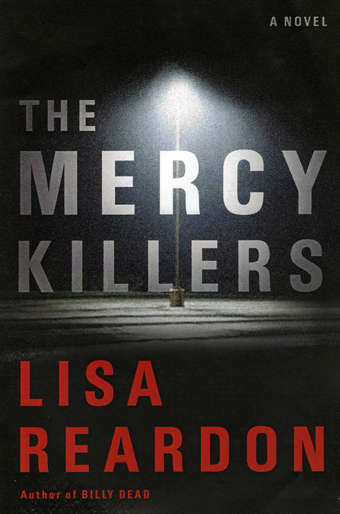
The Mercy Killers – Lisa Reardon

I first discovered Reardon a few years back when I read Billy Dead, a novel that continues to haunt me. The Mercy Killers has been on my tbr shelf for ages but I kept putting off reading it because its subject matter didn’t really appeal to me. Once I started it, though, I couldn’t put it down.

Lisa Reardon writes about characters who live in a world vastly different from my own. They are broken-down people whose lives are messy – filled with violence and alcohol and drugs and hopelessness.

The Mercy Killers concerns the fortunes (and misfortunes) of a group of people who hang out at Gil McGurk’s bar. When the novel opens, one of the regulars, Old Jerry, is complaining about his inability to take a bath. He wants to die.  It’s his birthday.

PT is one of Old Jerry’s grandsons. He’s nineteen and developmentally delayed after suffering one too many beatings at the hands of his father. Charlie, PT’s younger brother, is a petty criminal. He hangs out with Gino whose “bottle blue eyes and falling black hair” make him attractive to Gil’s daughter, Katie. Thing is, Gino’s not interested in women.

When PT decides to grant his grandfather’s wish and smothers him with a pillow, Charlie and Gino decide to cover up the crime. This propels the novel forward; Charlie ends up in Vietnam. Gino, too.

Although these characters weren’t familiar to me – the bonds of family and friendship, the small acts of kindness  in unexpected places certainly were. Charlie is fiercely protective of his older brother, the brother who had put himself in harm’s way to protect him against their violent father as children. Although Charlie is not without his flaws, he has the potential to be decent and it is this inherent goodness on which other characters (Gino in particular) hang their hopes.

Reardon’s writing is propulsive. As with Billy Dead I couldn’t stop turning the pages. I wanted one of these characters to break the cycle of violence and addiction. While there’s no question that Vietnam has a role to play in this book – and that the psychological aftermath of that horrific war adds another layer of despair to the lives of the characters – it is clear that sometimes our own choices cause just as much pain.

As I was surfing around the web looking for a picture of the book, I came across a few stories about Reardon’s personal life. In August 2009, she shot her father. She didn’t kill him, but apparently she meant to. From what I have read, it seems like there was some bad blood between them. When asked whether he knew of any reason Lisa would want to harm him he said “yes,” but wouldn’t elaborate.

Perhaps the marginalized and damaged characters Reardon writes about are cut from personal cloth. I feel badly that she’s had some  trouble. I think she’s an amazing writer.

The Prime of Miss Jean Brodie – Muriel Spark

When I was in grade seven, a million years ago, we watched The Prime of Miss Jean Brodie  on television. I have a clear memory of it.  I distinctly remember  Maggie Smith’s portrayal of the slightly aristocratic, strangely compelling school teacher, Jean Brodie. She’s remained in my memory just as the character herself remained in the memories of the students she taught, the creme de la creme.

Miss Jean Brodie’s class of twelve year olds are impressionable, inquisitive and sensitive.  The ‘Brodie set’ as they are known to the other students at the Marcia Blaine School are enjoying their final year with Miss Brodie before they move to the senior school. Miss Brodie is ‘shaping them’ and her notion of the curriculum isn’t exactly approved of by the other teachers of the school.

If anyone comes along in the course of the following lesson, remember that it is the hour of English grammar. Meantime I will tell you a little of my life when I was younger than I am now…

 Muriel Spark’s novella is interesting because Miss Brodie herself in interesting. Her girls were discovered to have

heard of the Buchmanites and Mussolini, the Italian Renaissance painters, the advantages to the skin of cleansing cream and witch-hazel over honest soap and water…

Of course, one begins to suspect that Miss Brodie might be a little bit of a fake and it is her complcated relationship with the girls who adore her and mock her in equal measure that makes up the bulk of this not altogether easy to read novella.

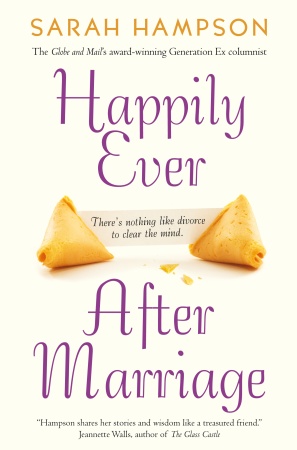
Happily Ever After Marriage – Sarah Hampson

If your marriage is way past the point of no return (aka those save-your-marriage books in the self-help section of your local bookstore aren’t going to cut it), Sarah Hampson’s memoir Happily Ever After Marriage might just be the book for you.  The book’s sub-title is “A reinvention in mid-life” and if the book had nothing else to recommend it — that would probably be enough. I was, however, standing in Hampson’s shoes.

After 18 years of marriage and with three sons, Hampson and her husband called it quits. I wasn’t actually ever convinced that they were a good match to begin with, but then it’s nearly impossible to judge standing on the outside. I know this for a fact.

I liked Hampson immediately because she and I shared (albeit at different times, but not by much) a university and a degree. (We both studied English Literature at UNB.) What I appreciated about Hampson’s story wasn’t so much that it mirrored my own because unlike Hampson I never dreamed of being a bride and I married relatively late, at age 32, not young like she was. Hampson’s situation is different from mine in another important way, too: she was the leaver and I was the leave-ee.

I liked  Hampson self-deprecating humour, her willingness to indulge in the occasional sulk, and her honest accounting of her own part in her marriage’s demise.

Hampson offers her own pithy wisdom on aging and dating post-40, on colouring your hair, on the demise of the body, on letting go. It’s not going to be easy — being over 40– but there are rewards to be had, you just have to be open to them. That’s Hampson’s advice anyway.

When she reflects on the institution, her vision is clear not jaded.

I have lived in a marriage. I have passed through what they are now entering. I would never warn them of its dangers. Why? Its promise is so beautiful, and for many, it is fulfilled.

Reading Happily Ever After Marriage for someone who is in those self-reflective post married days is the equivalent of a cup of tea on a blustery day. Hampson’s book offers a quiet respite from the emotional storm….without milky sentimentality or bitter lemon.