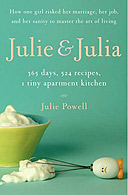
Julie and Julia by Julie Powell

Julie Powell had me at : “we both recognize the genius of Buffy the Vampire Slayer.” That revelation comes early on in her book Julie & Julia, a  memoir that builds upon the “Project” she embarked on just before she was about to turn 30. Disheartened with her life as a government drone in New York City, Powell was, as many of us were, looking for meaning in a post 9/11 world. But further to that- she was looking for meaning in her own life. Or at the very least, she was looking for something meaningful to do.

While visiting her parents in her native Texas, Powell confiscates her mother’s copy of Mastering the Art of French Cooking (MtAoFC) by Julia Child.

“Do you know Mastering the Art of French Cooking? You must, at least, know of it,” Powell says. “It’s a cultural landmark, for Pete’s sake!”

And from this cookbook…and a conversation with Powell’s long-suffering (and incredibly supportive) husband, Eric, springs the Julie/Julia Project. Powell decides to cook every single recipe from the book and blog about it.

Blogging. Ahh, yes. Curious thing, that. You write and people read and the next thing you know you have a book deal. Or something like that.

Julie & Julia follows Powell’s project from beginning to end- and includes everything from her failures in the kitchen to her friend’s extramarital affairs. It is laugh-out-loud funny and occasionally self-indulgent (but what blog isn’t?). It’s peppered with expletives and bits of strange insight.

So this search for meaning (personal meaning, at least) has been done before. Elizabeth Gilbert (whom Powell thanks in her acknowledgments) did it in a little best-seller called Eat, Pray, Love. I liked Powell’s book better and here’s why…

I could relate to Powell. And, no, it’s not just because of her Buffy-love (although that certainly earned her free points.) Where Gilbert took a year off to spend four months each in three different countries, Powell could only afford the occasional day of playing hooky from her crap job while she cooked her way to enlightenment. Her house was unkept, she drank too-much and swore even more. She didn’t set off on the Project for fame and glory- she wanted to find an essential piece of herself that she thought was missing.

And she does…one recipe at a time.

Late Nights on Air by Elizabeth Hay

“Psychologically astute, richly rendered and deftly paced. It’s a pleasure from start to finish.” – Toronto Star

Canadian author Elizabeth Hay won the Giller Prize for her novel, Late Nights on Air. Obviously, you begin a book like this- one with a certain pedigree already attached- with a little trepidation. I mean, what if you hate it?

I am happy to report that this is a beautiful book.

Set in Yellowknife in 1975, the novel tells the story of the intersecting lives of Harry (a CBC radio station manager), Dido (a beautiful announcer who has fled to the North to escape a complicated, but profound, relationship), Eleanor (the station’s secretary), Eddy (the station’s technician), Ralph (a local photographer and on-air book reviewer) and Gwen (a newcomer, who had come to the North inspired by the tragic story of an explorer named John Hornby.) Although Gwen is clearly the central character of the book, Hay deftly manages the interior lives of all the characters and, in doing so, makes us yearn to know more.

The last third of the book takes four of the characters on a tremendous canoe trip, inspired by the life of Hornby. That trip and the consequences of it forever change the lives of these characters.

I have always said that I hate a book that flashes us forward in time and shows us where the characters are now. Hay employs this device, but it seems almost organic. And at the book’s conclusion, I felt truly sad to be parting company with these people.

Ultimately, though, this book is about silence, longing, isolation, community and what love looks like.

I highly recommend it.

The Thirteenth Tale by Diane Setterfield

“The Thirteenth Tale is a cleverly plotted, beautifully written homage to the classic romantic mystery novel… Gothic elements are skilfully re-imagined in a peculiar tale of madness, murder, incest and dark secrets…. It is a remarkable first book, a book about the joy of books, a riveting multi-layered mystery that twists and turns, and weaves a quite magical spell for most of its length.” –The Independent

Diane Setterfield’s first novel is a wonderful accomplishment. This is a book lover’s book- even the book’s cover and the weight of the pages appealed to the bibliophile in me. But beyond the aesthetics of the book, Setterfield tells a rip roarin’ tale, an old-fashioned tale filled with mystery and intrigue and personal ghosts.

Margaret Lea lives a quiet life, working with her father in their little antiquarian bookstore. We know very little about Margaret other than the fact that she is close to her father, but not to her mother. She is unmarried. We don’t know how old she is. We do learn, early on, that she is a surviving twin- a fact she stumbles upon, quite by accident when she is young, a piece of her family history which haunts her throughout her life.

Then Vida Winter, the most celebrated writer of the time, writes to Margaret inviting her to hear the truth of her life- a life which has been largely reclusive. This story is the subject of The Thirteenth Tale. And it is a tale that is Gothic, relying on the conventions of literature from the 18th and 19th centuries: ghosts and secrets and unrequited love abound in its pages. It’s a page-turner in the very best sense.

And as the story’s mystery unravels, you’ll find yourself wondering whether all the clues were there from the very beginning…and want to go back to trace the breadcrumb trail.

Heart-Shaped Box by Joe Hill

I didn’t know who Joe Hill was when I bought Heart-Shaped Box. I read a review, thought it sounded interesting and bought it.  The book sat on my to-read shelf for several months (yes, my to-read shelf is ridiculous!) until I had a conversation one day in the bookstore.

Customer: I’m looking for 20th Century Ghosts by Joe Hill. You probably don’t even have him.

Me: He wrote Heart-Shaped Box.

Customer: (looking surprised) Yeah. Have you read it?

Me: (sheepishly) No. But I’m going to.

Customer: He’s Stephen King’s son.

Me: (my turn to be surprised) Really? Wow.

Customer: I *loved* Heart-Shaped Box. It’s fantastic.

And now,  just this morning,  after my kids left for school and my husband left for work and before I had breakfast or started any of the things I have to do before I go to work…I finished the book. Ironically, the last time I carted a ‘horror’ novel around with me it was King’s book It. That was a long time ago. I loved that book.

I loved Heart-Shaped Box, too. As a matter of fact, before I was even half-way through the book, I hand-sold a copy to a woman who was purusing the Horror section. (I work at Indigo.)

Me: Do you like scary stories?

Customer: (looks sheepish) Yes.

Me: Have you heard of Joe Hill?

Her: No.

Me: I am currently reading Heart-Shaped Box. It’s great. (hand her a copy). He’s Stephen King’s son.

Her: (looking at picture) Only better looking. (laughs and puts book in shopping bag)

I hope Mr. Hill doesn’t think it’s a disservice to draw a comparison between him and his famous Dad. I grew up reading Stephen King. I don’t like everything he’s ever written. For example, even after several attempts I cannot get into The Stand and I know people who love that book. But the thing about King is that he writes books peopled with characters whose fate you actually care about. If you didn’t give a toss about them- the horrible things that happen to them wouldn’t matter. They’d have it coming.

Judas Coyne, the middle-aged, former rock star, slightly misogynistic anti-hero of Heart-Shaped Box, might have had it coming except for this:

“Not my hand! No, Dad, not my hand!”

Any ambivalence I felt about Jude’s fate ended right then and there. Suddenly, he was a character- fully drawn, with an aching past and a boulder the size of Mount Rushmore lodged in his heart. Hill doesn’t go over-the-top with details of Jude’s horrific childhood; I didn’t need to hear anymore anyway. Your imagination always fills in the blanks.

Besides, Heart-Shaped Box operates on a more immediate level. The book has barely begun before Jude buys a dead man’s suit and the ghost that accompanies it. Then all hell breaks loose and Jude and his goth-girlfriend-of-the-moment are running for their lives. And, thanks to Hill, they are lives we actually care about.

Of course there are some horror conventions in this book: radios that intone doom, television news reports that announce horrible endings, creepy people with scribbled out eyes.  There are no cliches here, though.

And I wonder if Jude’s flight- away from the ghost that he’s bought and towards the ghost that has haunted him for the past 34 years was intentional on Hill’s part. It must have been, I know. It adds an extra layer of depth to the book’s denouement, though, that’s for sure

Mr. King must be tremendously proud.

Eat, Pray, Love by Elizabeth Gilbert

Elizabeth Gilbert’s well-received book, Eat, Pray, Love tells the story of the author’s own search for meaning in the world. Personal meaning, that is. In order to find it, she takes a year off from her very successful writing career (she’d have to be successful, wouldn’t she) to spend four months in each: Italy (for pleasure), India (for prayer) and Indonesia (for balance).

This book is huge– practically every woman alive will have read it. or plans to– and don’t let my cynicism dissuade you. Gilbert is a wonderful writer. It’s hard to sustain the perfectly pitched conversational tone her book does and not be a skilled craftsman, but…

But, here’s the thing. Lots of people wish they could stop their hectic, horrible, messy, complicated, screwed up lives in order to find their deeper purpose; in order to mend their broken hearts and psyches, in order examine their place in the world, their connection to the people with whom they share the planet…and their relationship with a higher power (God, in Gilbert’s case, although she says “I could just as easily  use the words Jehovah, Allah, Shiva, Brahma, Vishnu or Zeus.”) Not everyone has the means. Plus, although Gilbert’s journey was preceded by a divorce, she has no children. Trust me, I’d love four child-free months in Italy, too.

That said, the book is so engaging that even though I didn’t internalize Gilbert’s search, I certainly enjoyed listening to her talk about hers.

Off Season by Jack Ketchum

There’s no way to describe Jack Ketchum’s book, Off Season other than to call it torture porn. I was called out for this label, but I stand by it. It’s so gruesome, so over-the-top, it’s impossible to call it straight up horror.

This book caused quite a sensation way back in 1980 when it was first published. It was Ketchum’s debut novel and the editorial team at Ballantine wanted to make substantial changes to the book’s vivid (for lack of a better word) writing and pretty damn depressing denouement. Ketchum was reluctant, but also pretty excited about having his first novel published. Ultimately, he went along with the changes. He tells the whole story in the Afterward of the Leisure Fiction edition  of  Off Season, which is uncut and uncensored (and by this I mean, the story appears as Ketchum had intended it to appear all those years ago.) And, likely for some readers, the book is unpalatable.

I’ve got a pretty strong stomach. Thank God because this book was pretty horrific. It tells the story of a group of six friends who are about to spend a week together in a remote cabin on the coast of Maine. This is Deliverance country, folks, only ten times as nasty. Ketchum does a good job of moving the story along (the whole thing plays out over a couple days), of giving us characters we can root for (although not necessarily keeping them alive) and of grossing us out even as we’re turning the pages.

It’ll only take a couple hours to read the book, but I don’t recommend you do it at night or if you have a queasy stomach.

And, while I’m here: I read Ketchum’s novel The Girl Next Door a couple years ago. Based on true-life events, that book was a riveting story of how people are able to justify extreme cruelty against innocence. It was even scarier, for me, than Off Season because the narrator was, despite his compliance, likable.

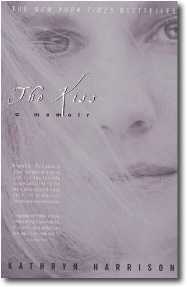
The Kiss by Kathryn Harrison

Appalling but beautifully written…jumping back and forth in time yet drawing you irresistibly toward the heart if a great evil. – Christopher Lehmann Haupt, The New York Times

Memoirs are all the rage these days and I have read a few– but I’ve never read anything like The Kiss by Kathryn Harrison. I’ve read a couple other books by Harrison and I now more fully understand some of the recurring themes in her novels (dysfunctional families, issues of love and the withholding of it, estrangement, emotional blackmail) after finishing The Kiss.

This is a well-known book, I think, despite having been published ten years ago. It received copious praise and, despite its difficult subject matter, I can see why. In fandom, we often write incest fic and consider it to be hot– but Harrison’s story of her affair with her father is never titillating. Instead, it’s a breathtaking and gut-clenching examination of how her seemingly unrequited love for her mother manifested itself into an all consuming and ultimately devastating sexual affair with her estranged father.

Harrison’s father left the family (at his in-law’s request) when the author was six months old. Until she was twenty she only saw him twice. Her father, a well-educated preacher, drew her into an affair with a kiss.

The book is frighteningly honest – Harrison doesn’t spare herself or her part in the relationship. She turns a keen, intelligent (but very emotional) eye on her life, the important relationships she had (or desperately wanted to have) and her father– who is one of the vilest characters I have ever met.

I couldn’t put this book down and when I was done I felt such a great sadness for her.

Shiver by Nikki Gemmell

The first book I read by Australian author Nikki Gemmell was The Bride Stripped Bare. I fell in love with the way she writes and so I found myself looking for other novels by her. Shiver is her first novel and it’s worthy of praise.

I can catalogue Antarctica by touch.

The touch of air sucked dry on my cheek, the fur of a day-old seal pup, the touch of an iceberg, a blizzard, a lover, the touch of sweat at minus twenty-three, of a camera stuck to the skin on my face, of cold like glass cutting into my skin, of a snowflake, of a dead man, of a doctor’s fingers on my inner thigh, of a tongue on my eye.

Fin is a twenty-six year old Sydney-based radio journalist who gets the opportunity to travel to Antarctica to “capture noises.” The trip down and her subsequent stay at the Australian station would be a compelling enough read all on its own  because of how alien the landscape is and the weird subculture of scientists and others who  make the journey. But Fin does something she isn’t supposed to do– she falls in love.

Her relationship with 38-year-old biologist, Max, is – of course- intense because of where they are, their lack of privacy, the rules surrounding fraternization. Fin is buoyed by her feelings– not the first relationship of her adult life, but certainly the most important. She and Max share an unquenchable thirst for each other physically and are, in other ways, perfectly suited.

Of course, something tragic happens and even though you know it’s coming, it’s still horrible.

Gemmell herself spent time in Antarctica and says that this is her most autobiographical novel. Knowing the circumstances of her inspiration adds an extra layer of meaning to the book– but I suggest you wait to read about her real-life experiences until after you’ve finished the novel.

The Lake by Richard Laymon

This almost never happens to me. I couldn’t finish this book. It was CRAP…I mean, crap in the sense that it was poorly written, unbelievable and stupid…not crap in the sense of lots of fun– the sort of entertainment I generally read quickly in between books. Sort of a palate cleaner.

I bought it on the bargain table and paid very little for it…but 100 pages in I wish I’d saved my money.

So, I went looking for book reviews…and strangely, other people seemed to like it.

This totally absorbing crime thriller will have readers enthralled and unable to put it down until the last page is turned
, says one review.

But when one of the characters is chased by a man wearing a chef’s hat carrying a cleaver turns out to be, in fact, a crazy chef her mother recently fired…well, you can see where I’m going with this.

I have no idea what happens…and I don’t care.

Save your money!

The Story of My Face by Kathy Page

An elegantly compelling story of how a young girl’s obsession forever changes the lives of those around her…a disciplined exploration of the complexity of human motivation and our need for redemption. – Lynne Van Luven, Vancouver Sun

Kathy Page’s The Story of My Face is at once compelling and confounding. Page is a skilled enough writer that you are pulled into the mysterious events surrounding Natalie’s disfigurement– the cause and extent of which you learn little about until the book’s final pages– from the beginning. But the central event of Natalie’s life is buried in adult-Natalie’s search for meaning and understanding.

We meet Natalie Baron as an adult on her way to Finland to research Tuomas Envall, the leader of a strict religious sect. Natalie’s own connection to the cult comes in the form of Barbara Hern, her husband, John, and son, Mark. These three people have important roles to play, particularly Barbara for whom Natalie has a possessive affection.

Page weaves past and present together, but for me– the story was at its most compelling during the time Natalie is with the Herns on a retreat with other members of this religious sect.

The story of what happens to her face is actually not as startling as how she impacts the lives of the Hern family, most specifically Barbara.