
Cassie McDowell, the narrator of Jess Lourey’s riveting novel Unspeakable Things, confronts her memories of her thirteenth summer when she returns to her small Minnesota hometown for a funeral. She alludes to writing a novel about a “gravedirt basement”, but now “that cellar stink doubled back with a vengeance.”
It’s the 1980s and Cassie lives with her older sister, Sephie, and her parents on a thirteen acre hobby farm. Her father, Donny, is an artist and her mother, Peg, a teacher. It doesn’t take very long to feel the sense of dread that permeates Cassie’s home life. She “felt a quease leaving [Sephie] up with [her parents] when they’d been drinking” and she sleeps either under her bed, or squirreled away in her bedroom closet. The basement of their farmhouse is off limits. The tension is almost unbearable.
Their town, Lilydale, is full of strange characters, like Sergeant Bauer, the local cop, and Goblin, the creepy guy who lives down the road from the McDowells. And then, boys start disappearing. This causes the town to invoke a 9 p.m. curfew, which does little to alleviate fear.
That sent a shiver up my spine. First, what Betty had said this morning about the boy being raped, and now this. Mom’d told us on the drive over that we didn’t need to worry about anything, but Betty had most definitely seemed concerned. Bauer did, too. He suddenly had our complete attention.
…
“Always travel in pairs. I don’t want to see any of you kids out alone this summer.”
That shushed us all up, every last one of us.
This time it wasn’t the words, or even his tone.
I think it was the first moment we caught a whiff of what was coming for us.
Something is coming for the boys of Lilydale, and when it comes for Gabriel, the cute boy Cassie has a crush on, she decides to do some investigating of her own. But, make no mistake, this isn’t a light-hearted Nancy Drew-esque detective story. There are creepy-crawly things in Lilydale’s underbelly and in Cassie’s own home. In fact, there is so much to be worried about the dread quotient is off-the-charts.
Yes, someone is scooping boys off the streets and when they come back they are changed in ways they seem unable to articulate. But Cassie has to deal with what is going on in her own backyard: her father’s mercurial moods, her parents’ ‘parties’ and the implied sexual abuse going on her home. When her father’s footsteps start up the stairs, the terror Cassie – and surely the reader – feels is palpable.
Unspeakable Things is a mystery and a coming-of-age story, and all of it (and Cassie’s voice) will twine around your heart and squeeze hard. Some might find the end of this novel less-than-satisfactory. Lourey wrote an epilogue, but then left it out of the final version. You can read that here. I liked both versions.
I loved this book. Highly recommended, but potentially triggering.


 specifically when I first watched it, but it came out in 1970 and I probably saw it shortly after that. I have it on VHS somewhere, but no longer have a VHS machine. I did, however, have the book.
 but because Penny has always felt like she’s the parent and her mom’s the kid. Sometimes Penny wanted to “shake Celeste until her fillings came loose.” Now it’s time for Penny to go off to college – University of Texas in Austin, only an hour or so away, but away nonetheless.
 It’s hard to wrap my head around gun violence as it exists in the U.S. My dad had a couple hunting rifles when I was a kid, but I don’t recall ever seeing them. No one I know has a gun in their bedside drawer…just in case. When I wrote a review for
 I couldn’t resist picking up Paperback Crush, a colourful, sometimes snarky look at the Young Adult fiction published in the 1980s and 90s. Author Gabrielle Moss say that the book is “here to honor the young adult lit published after Judy Blume but before J.K. Rowling.” Those decades produced more YA than the previous decades, but the quality, I suspect, wasn’t what we’ve come to expect from modern YA. And I read a lot of YA.
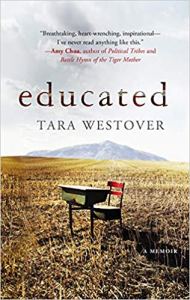 Our first book club pick for 2019 was Tara Westover’s compelling memoir Educated. Born and raised in southern Idaho, Westover tells the remarkable story of living in the shadow of Buck’s Peak, the youngest of seven children. Like virtually everyone else in the nearby town, Tara was raised as a Mormon, but as she says in the author’s notes “This is not a book about Mormonism.”
 late: her parents’ divorce; her father’s quicky marriage to Kathy; their subsequent move from Ashland, Ohio to Jackson, Mississippi. When Mim overhears her father and stepmother talking to the principal, she’s convinced that her biological mother is sick and makes the decision to hop a Greyhound and travel the 947 miles back to Ohio to see her.

