End of Year Book Survey

best-books-2013-1024x862Once again, Jamie over at at The Perpetual Page-Turner offers bloggers the opportunity to  reflect upon their blogging year. Who doesn’t love that?

Best Book You Read In 2013? (If you have to cheat — you can break it down by genre if you want or 2013 release vs. backlist)

I’m going to break this category into three:

Best YA: The Absolutely True Story of a Part-Time Indian by Sherman Alexie was laugh-out-loud funny and, man, I was rooting for Junior all the way.

Best Other: Our Daily Bread – Lauren B. Davis

I pick this one because the characters just really got under my skin and they’re still under there. I just want to save them all.

Other – A Monster Calls – Patrick Ness

I couldn’t really put this in the YA category because I think you could read this at a much younger age. This is a beautifully written and illustrated novel which had my sobbing like a baby even though I knew exactly what was coming.

Book You Were Excited About & Thought You Were Going To Love More But Didn’t?

Helen Dunmore’s The Greatcoat. I am a huge fan, but I just found this slow-moving. Not saying I didn’t like it, but I didn’t LOVE it.

Most surprising (in a good way!) book of 2013?

Never Fall Down – Patricia McCormick surprised me because my son said, “Mom, we tried to read that book in school and even the teacher thought it sucked.” I really liked it.

Book you read in 2013 that you recommended to people most in 2013?

I’ve probably recommended David Levithan’s Every Day the most.

And I still haven’t stopped talking about Our Daily Bread. Read it. Please.

Best series you discovered in 2013?

I’m not really a series reader. I just feel like I’d really have to love the book to want to invest a bunch more time into its sequels. I mean, I will do it if I really have to…but I didn’t find that series this year.

Favorite new author you discovered in 2013?

Tana French. I read In the Woods and I will definitely be reading more.

 Best book that was out of your comfort zone or was a new genre for you?

My comfort zone is pretty big and I stay pretty clear of genres I am not interested in – like straight up sci fi or fantasy.

 Most thrilling, unputdownable book in 2013?

I raced through the first 200 pages of David Bell’s Cemetery Girl but then it all fell apart. I guess if I had to pick a page turner it would have to be Gillian Flynn’s Dark Places (which is, imho, better than Gone Girl) or Andrew Pyper’s The Guardians.

Book You Read In 2013 That You Are Most Likely To Re-Read Next Year?

I won’t be rereading anything. I have WAY too many books on my TBR shelf.

 Favorite cover of a book you read in 2013?

eleanor and parkbellman

YA cover: Eleanor & Park by Rainbow Rowell

I love the clean, simple look of her covers. Loved the book, too – just not the ending.

Other cover: Bellman & Black by Diane Setterfield

 I loved the cover, but I didn’t like the book.

 Most memorable character in 2013?

Hands down – Albert Erskine from Our Daily Bread

Runners up: ‘A’ from Every Day, Auggie from Wonder – R. J. Palacio, Cormoran Strike from Robert Galbraith’s The Cuckoo’s Calling

 Most beautifully written book read in 2013?

A Monster Calls – Patrick Ness

Let my copious tears be a testament to the beauty of the book.

 Book that had the greatest impact on you in 2013?

Our Daily Bread – Lauren B. Davis

It did all the things a great book should do for you – make you think, give you characters to care about, move you.

 Book you can’t believe you waited UNTIL 2013 to finally read?

In the Woods – Tana French

It’s been on my radar (and on my tbr shelf) for a long time. Don’t know why I waited.

Favorite Passage/Quote From A Book You Read In 2013?

Most recently I loved, “When it comes to the past, everyone writes fiction.” from Stephen King’s Joyland

Shortest & Longest Book You Read In 2013?

The World More Full of Weeping – Robert J. Wiersema, 101

With My Body – Nikki Gemmell, 480

Favorite Relationship From A Book You Read In 2013 (be it romantic, friendship, etc).

Albert & Bobby and Ivy & Dorothy from Our Daily Bread

Sophie & Otto from Endangered by Eliot Schrefer

Favorite Book You Read in 2013 From An Author You’ve Read Previously

A Monster Calls – Patrick Ness. Big fan and have read the Chaos Walking trilogy.

  Best Book You Read In 2013 That You Read Based SOLELY On A Recommendation From Somebody Else:

Um, this is sad – but nothing. I’m the person who gives recommendations, but I rarely get them from other people. Sometimes students recommend books, but it doesn’t always end well.

 Genre You Read The Most From in 2013?

Of the 62 books I read in 203, 32 were YA and of those 32, one was non-fic and two were graphic.

 Newest fictional crush from a book you read in 2013?

Park from Eleanor & Park because he just doesn’t give up on the girl, even when she’s prickly.

 Best 2013 debut you read?

The Cuckoo’s Calling – Robert Galbraith – who I admire more and more with each book I read. (It doesn’t even really technically count, though.)

  Most vivid world/imagery in a book you read in 2013?

Never Fall Down by Patricia McCormick dropped me right in the middle of Cambodia and shook my until my teeth rattled.

  Book That Was The Most Fun To Read in 2013?

Why We Broke Up – Daniel handler.

I loved the format…all the drawings.

 Book That Made You Cry Or Nearly Cry in 2013?

A Monster Calls – Patrick Ness. And I cried hard.

 Book You Read in 2013 That You Think Got Overlooked This Year Or When It Came Out?

Our Daily Bread – despite being long-listed for the Giller, I’d never heard of it. It’s not an easy book and the subject matter won’t be palatable for everyone, but it packs a punch that should not be overlooked.

New favorite book blog you discovered in 2013?

Just found this one:

The Unputdownable Book Club

 Favorite review that you wrote in 2013?

Our Town. I loved thinking about this play again.

Best discussion you had on your blog?

::crickets::

Sadly, not many people stop by.

 Best moment of book blogging/your book life in 2013?

Live tweeting with Lauren B. Davis at the book club meeting where we talked about her book.

 Most Popular Post This Year On Your Blog (whether it be by comments or views)?

My Reader’s Table got the most views …but that’s a page that is relatively static.

 Post You Wished Got A Little More Love?

I’d love to have a lot more interaction with readers…hell, I’d love to have a lot more readers.

 Did you complete any reading challenges or goals that you had set for yourself at the beginning of this year?

I set a reading goal of 60 books this year and I had reached it by Dec 13th.  My grand total was 62.
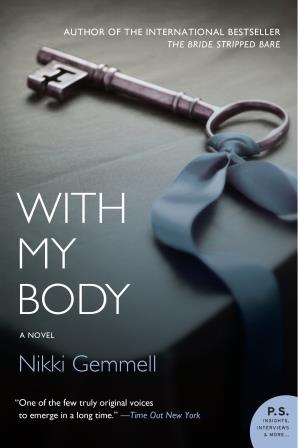
With My Body – Nikki Gemmell

With My Body Full disclosure: I am a Nikki Gemmell fan and have read three of her previous novels including The Bride Stripped Bare, Cleave and Shiver. So when TLC Book Tours offered me the opportunity to review Gemmell’s novel With My Body  I jumped at the chance.

Gemmell is one of those writers who somehow seems to burrow into the very heart of things and her stories – mostly about (at least those I’ve read) complicated, messy, consuming love – always seem to make me nod my head in agreement. Yeah – that’s right, Nikki. It’s just like that.

The unnamed narrator in With My Body is at a cross-roads in her life. Married to Hugh, she’s fallen into a sort of endless to-do list life, a never-ending cycle of  “wellies and Range Rovers, school runs and Sunday church.” Three young sons keep her busy and although she’s grateful for the life she has, she also feels “infected with sourness.”  Motherhood, for her,  is a complex state of being, full of “richness…depletion…incandescence…despair aand loneliness.” I hear you, sister.

She loves her husband, but they haven’t had sex for two years and the truth is, she’d rather be “celibate from now on.” Besides, their marriage is bound by an unspoken agreement that they’ll never split up and are “in this together, for life.”

Sounds like fun, eh?

With Your Body is really two stories. In one, the second person narrator dutifully fulfills her obligations as wife and mother, but the spark is gone. In another, we see her back in Australia first at age 11, coping with adolescence and a single father about to be remarried and then, slightly older, 14 perhaps,  experimenting with sex with a teacher and then slightly older again, 17ish – estranged from her father and the stepmother who turns out not to be all that happy in the role. It’s at this juncture that she meets Tol. He consumes her thoughts:

That night the memory of him, all of it, soaked through you, like smoke; in your hair, your clothes, in the pores of your skin. The memory of his fingers, his desk, his dog, his hand on the gearstick, his waiting house.

The sky has released its payload at last. Rain pummels the tin roof. You open the canvas flaps, fling them up and breathe in the earth as you lie on your stomach on the pillow, and watch.

Your sky, his sky.

The only thing you have in common, and you are caught.

The relationship between the narrator and Tol eventually becomes sexual. She becomes “cracked open into womanhood” under Tol’s patient tutelage. And so the two pass the summer. It is this affair that shapes her and, in some ways, spoils her for the men who come later – including her husband.

While I wouldn’t exactly call With My Body erotica, it is certainly erotically charged. It’s not meant, I don’t think,  to titillate though. The second person narration puts the reader in the driver’s seat, however, and therefore  we experience what the narrator does. Sometimes it had the desired effect.

I was more interested in the older version of the narrator, though – the wistful, dissatisfied, woman who sees the “signs of slippage everywhere.”

Your body thickening after its quicksilver years of slenderness, finally you have lost control of it. Your metabolism is slowing, you cannot keep the weight off. Hair is growing in places it shouldn’t be, with vigour – the only vigour in your life it seems. You are tired, so tired, constantly.

I got this woman. I didn’t have a Tol in my life, but I did have a life filled with abandon and abundant sexual appetite. I understood her longing to recapture the woman she was before she became a wife and mother and her journey felt authentic to me. I mean, who doesn’t wonder “what if?” When the narrator decides to leave England and return to Australia, she can’t resist revisiting the place where she and Tol spent that one incredible summer. She goes there, really, to find him – both literally and metaphorically. The past, it turns out, is not so easy to reclaim.

If I have any quibbles with the book, they are minor. I love the way Gemmell writes, although I wasn’t totally enamoured with the second person narration in this instance. Curious choice and I’d love to know why she made it. (Ms. Gemmell, if you pop by – I’d love to have your thoughts!)

Thanks to TLC for the opportunity to read the book and share my thoughts on this tour. I’ll be talking about another Gemmell novel, I Take You, in January.

WITH MY BODY ebook will be $1.99 from 12/16 – 1/6 

Bookish lists – I want yours

I have a love/hate relationship with the end of the year. On one hand it means I have to reflect on all the ways I have flailed and failed, my squandered opportunities, that 10k I didn’t quite manage, the times I wasted worrying about things and people I can’t change. On the other hand, once 2013 slips into the past, I can start thinking about what I can accomplish in 2014. The places I’ll go, the people I’ll gather close, the ways I can improve my life, the books I’ll read. calendar

And that’s another reason I love this time of year – every book lover/organization on the planet shares their best books lists. I love lists. I love reading about the books that have risen to the top of the heap. I love it that there’s always disagreement and someone’s best book invariably ends up on someone else’s worst list.

It’s easy enough to find fantastic book lists online. Book Riot has a great selection of the Ten Best Top 100 Book Lists . And, of course, at this time of year everyone wants to weigh in on the best books of 2013. Here’s a small sampling.

Good Reads

Publisher’s Weekly

NPR

Huffington Post

Kirkus

Seabury Reads

I, too, always offer a top ten list. I’ll do that in the next few days because although I did meet my reading challenge of 60 books, I am hoping to read a couple more before year’s end and, who knows, perhaps one of those books will be worthy of a place on the list.

In the meantime, I’d love to feature your favourite books of 2013 here at The Ludic Reader. If you’ve posted a list at your blog, link me up. Otherwise, shoot me an email (ludicreader AT rogers.com) and I’ll let you have the floor in an upcoming post. Or leave a comment and tell me about the best or worst book you’ve read this year.

You Against Me – Jenny Downham

youagainstmeI read Jenny Downham’s first novel Before I Die a few years ago and I really like it a lot. I liked You Against Me, too. Downham certainly isn’t afraid to tackle the big stuff.

Eighteen-year-old Mikey McKenzie’s life is far from perfect. His mother is an alcoholic and he has two younger sisters, Karyn, 15, and Holly, 8, for whom he is responsible. He’s doing the best he can, but he’s all too aware that sometimes it’s just not good enough. Especially now. Karyn was recently raped while at a party and she now won’t leave the house. Mikey figures he can make everything right again if he beats the crap out of the guy who did it, Tom Parker. He and his best friend, Jacko, come up with a plan but everyone knows nothing ever goes to plan.

Sixteen-year-old Ellie Parker is every bit as anxious as her parents for her older brother Tom’s homecoming. He’s spent the last couple of weeks detained after having been accused of rape, but now he’s coming home to await the trial. Ellie’s her brother’s star witness; she was home the night Tom brought a bunch of friends back from the pub, Karyn included.  She’s already told the police that she didn’t hear or see anything much and her parents are convinced that Tom will be found not guilty.

And this might have been nothing more than a he said – she said YA novel except that Mikey and Ellie meet and discover…they like each other. Of course it’s more complicated than that, but once the wires are uncrossed and trust has been earned, Ellie and Mikey really do genuinely fall in love.

Downham does a good job of balancing the story of Ellie and Mikey  with everything else that’s going on including Ellie’s doubts about her brother’s innocence, Mikey’s concern for his sisters and frustration with his mother’s lack of responsibility. The novel moves pretty quickly, allowing the reader plenty of time with both Ellie and Mikey so we get a real sense of who they are and how they’re coping with their complicated circumstances. What started as one thing quickly becomes something else for both of them and as Mikey says to Jacko

When I first saw Ellie, I knew it was her – she was my fantasy. I didn’t want it to be true, but every time I met her it was obvious, and the funny thing was that she was better than the fantasy, like I got more stuff than I’d imagined.

You Against Me is about family and friendship and making choices that have far-reaching consequences. Downham offers careful readers lots to think about and has created two young people worth rooting for.


Cemetery Girl – David Bell

cemeteryI read the first 192 pages of David Bell’s novel Cemetery Girl lickety split. I couldn’t put the book down. I wondered – how come I’ve never heard of this book or this author? How come the only positive promotion is from other authors? Where has this author been all my life?

And then it all went to hell in a hand basket.

Cemetery Girl is the story of college professor Tom Stuart and his wife, Abby, and their daughter, Caitlin, who disappeared four years ago when she was twelve.  Now, Abby has decided it’s time to say goodbye to Caitlin and has organized a memorial service for her daughter. It’s caused something of a rift between Tom and Abby because Tom hasn’t given up hope that his daughter will come home to them because her body has never been found.  But Tom and Abby’s marriage is on the slippery slope anyway. Abby has found religion and is spending more and more time with Pastor Chris her new ‘best friend.’ Yeah, right.

For the first half of the book I was totally invested in Tom’s story and the novel’s attempt to make him a somewhat unreliable narrator. For example, he and his half-brother, Buster, have different takes on their childhood. Tom remembers his step-father, Paul, as a mean and abusive drunk; Buster claims it wasn’t like that at all.

There are a bunch of minor characters in the novel – Detective Ryan, the one and only cop still assigned to Caitlin’s case; Susan Goff, a volunteer with the police department (who is not a therapist or professional counsellor, just someone to talk to); Liann Stipes, a lawyer whose own daughter had been murdered and who has acted as an advisor to Tom; Tracy Fairlawn, a stripper who claims she saw Caitlin. Then there’s this mysterious blonde girl who keeps appearing near Caitlin’s tombstone or outside the Stuart house in the middle of the night.

Like I said, Bell kept me turning those pages for quite a long time. Then I just didn’t believe it anymore. I didn’t believe the way characters started to speak to each other. I didn’t believe the resolution of the book’s central mystery. I didn’t believe any of Tom’s interactions with anyone – they just all felt artificial. I’m a parent; I wouldn’t behave this way.

Cemetery Girl had a lot of potential, but a book like this depends on credibility and at the end of the day – it just didn’t have any.


Eleanor & Park – Rainbow Rowell

eleanor and parkEleanor & Park turned up on Kirkus’s list of Top Teen Books in 2013, and rightfully so. Rainbow Rowell is a new-to-me author, although I have been wanting to read Fangirl for a while.

Set in Omaha, Nebraska in the 1980s, Eleanor & Park is a novel about two young people who find each other and themselves despite the many obstacles in their way.

When Eleanor moves to a new house and school she’s already aware of how different she is.  Park notices her right away because she is

…big and awkward. With crazy hair, bright red on top of curly. And she dressed like…like she wanted  people to look at her. Or maybe like she didn’t get what a mess she was. She had on a plaid shirt, a man’s shirt, with half a dozen weird necklaces hanging around her neck and scarves wrapped around her wrists. She reminded Park of a scarecrow or one of the trouble dolls his mom kept on her dresser. Like something that wouldn’t survive in the wild.

Park notices something else, too. He notices that she starts to read his comic books out of the corner of her eye.

At first he thought he was imagining it. He kept getting this feeling that she was looking at him, but whenever he looked over at her, her face was down.

He finally realized that she was staring at his lap. Not in a gross way. She was looking at his comics-he could see her eyes moving.

Eleanor notices Park, too.  (“Stupid, perfect Asian kid.”) And soon, over a shared love of comic books and new wave music, the two teenagers discover a mutual appreciation for each other.

The course of true love doesn’t run smoothly, of course. It never does.

Eleanor lives with her mother, four younger siblings and her step-father, Richie, who is not a nice man. At all. In fact, Eleanor has just returned home after living with family friends for a year. She’d been kicked out and the stay was supposed to be temporary. Now Eleanor lives in a home where everyone is always walking on eggshells, especially her.

Park is half Korean and lives with his parents and younger brother, Josh. Everything about his home life is stable and ‘normal’, but Park still finds it difficult to fit in.

Eleanor is a prickly person and Park is exceedingly patient with her, but that doesn’t always prevent hurt feelings and misunderstandings. It’s impossible not to love her, though. Park, too. They are not nearly as frustrating as other ‘teens in love’ might be. I wanted to shake Eleanor’s mom  though. But then I had to take into consideration the year in which the novel takes place – 1986.

I was a young(er) person in the 1980s and I loved the pop culture references in Eleanor & Park. Setting it then also allows the reader to forgive the lack of  outside agencies (school, Child Protective Services, police) involved in Eleanor’s dreadful home life. Even Park’s dad knows Eleanor’s stepfather and offers Eleanor a safe place to be.

If I have any criticism of the book it’s that I didn’t love the ending. I’m all for ambiguity, but it just seemed a little anti-climactic after everything that happens. It’s a small thing, though. Time with Eleanor and Park is time well spent.

Bellman & Black – Diane Setterfield

bellmanWe were all pretty excited when Marianne chose Bellman & Black as this month’s book club selection. We all loved Diane Setterfield’s first novel The Thirteenth Tale when we read it a few years back. Sadly, this novel lacked that book’s  — well, everything.

As I pointed out when we met last night: “Did you notice that all the praise on the back of the book was for The Thirteenth Tale.”  And true enough – there isn’t a single endorsement for this novel on its cover or inside its pages. Okay, maybe that doesn’t mean much in the whole scheme of things and I know I’m making it sound as though Bellman & Black is horrible and I guess I wouldn’t go so far as to say that, but it isn’t very good, either.

William Bellman is just a kid playing somewhere in the English countryside  when he decides to show off in front of his friends and uses a catapult to shoot a rook (similar to a crow) out of a tree.

It took a long time for the stone to fly along its preordained trajectory. Or so it seemed. Time enough for William to hope that the bird, flapping into life, would rise upwards from the branch. The stone would fall harmlessly to earth and the rook’s granite laughter would taunt them from the sky.

Instead, William hits and kills the bird and thus leaves innocence and childhood behind him and begins  the downward slope towards death. And yes, it’s really this heavy-handed.

Will’s life is marked with great successes and tremendous tragedies. We watch him turn his uncle’s mill into a financial success. We watch him fall in love and have a family. And we watch things start to fall apart. But the thing is — and it is a thing that we talked about last night — none of it mattered all that much because Will was a character we knew or cared little about. He was driven, sure, and haunted, certainly, but not by the rooks which made strange appearances (sort of like encyclopedia entries) throughout the book.

When William suffers a tragic personal loss, he makes a deal with a mysterious stranger, Mr. Black, and he suddenly finds himself building a one-stop funeral emporium. We’re talking Victorian England here, when people mourned for years and spent money (apparently) on all manner of funereal accoutrements. So, just as we watched him build Bellman Mill, we learn all the nooks and crannies of Bellman & Black, but none of it is interesting enough to sustain a 300 plus page narrative. And trust me, the stuff about the rooks doesn’t help.

At the end of the day, Setterfield’s book is a less schmaltzy take on, say, a book like Tuesday’s With Morrie. We’re meant to understand that life must have checks and balances, and that when we care too much about things that don’t matter (wealth, success) we miss out on those things that truly do.

Bellman & Black wasn’t hard to read, but I won’t be recommending it to anyone else.

The Absolutely True Story of a Part-Time Indian – Sherman Alexie

part time indianI can’t remember the last time I rooted for a character the way I rooted for Arnold ‘Junior’ Spirit, the fourteen-year-old narrator of Sherman Alexie’s YA novel, The Absolutely True Story of a Part-Time Indian.

Junior is a member of the Spokane Tribe and lives with his parents, grandmother and older sister on the Rez. Without a drop of self-pity, Junior tells the reader that his “head was so big that little Indian skulls orbited around it” and that “the bullies would pick me up, spin me in circles, put their finger down on my skull, and say, ‘I want to go there.'”

Skinny, born with ten extra teeth, and prone to seizures, Junior is also determined, smart, and really funny. He says, “With my big feet and pencil body, I looked like a capital L walking down the road.” He both stutters and lisps and so everyone calls him a retard. “Do you know what happens to retards on the rez?” he asks the reader. “We get beat up. Yep, I belong to the Black-Eye-of-the-Month-Club.”

As if Junior’s physical problems weren’t bad enough, Junior and his family are also very poor. They’re so poor, Junior often goes hungry. But, as he explains, “It’s not like my mother and father were born into wealth. It’s not like they gambled away their family fortunes. My parents came from poor people who came from poor people who came from poor people, all the way back to the very first poor people.”

His father is an alcoholic who often disappears on benders. His mother is slightly flakey, but also super smart. Junior is perfectly aware of the limitations that come from being an Indian on the rez.

…we reservation Indians don’t get to realize our dreams. We don’t get those chances. Or choices. We’re just poor. That’s all we are.

Strangely, none of this seems like whining coming from Junior’s mouth. It is what it is and he’s found ways to cope. For one thing, his best friend,  Rowdy, is the toughest kid on the reservation. For another thing, his parents are kind and loving and supportive. While it seems like there are too many obstacles in Junior’s way, the reader soon learns not to underestimate him.

An incident at school prompts a visit from one of his teachers and suddenly Junior has left the rez and is traveling 23 miles into a town to attend a white school where he has the chance to make something of himself. (But not without a lot of soul-searching about what it means to have to leave the rez behind and enter the white world.) But make something of himself, he does. I can’t imagine anyone reading this book and not getting a little va-klempt at Junior’s journey.

The back cover of my edition of The Absolutely True Story of a Part-Time Indian  says that the novel is inspired by Sherman Alexie’s own experiences growing up. The book has won numerous awards including the National Book Award. It’s most deserving of the praise.

This is a laugh-out-loud, tear-in-your-eye, 100% uplifting novel about the challenges of growing up and making your own way in the world. Everyone should read it.

Crazy Beautiful – Lauren Baratz-Logsted

crazyMy arm rises toward my face and the pincer touch of cold steel rubs against my jaw.

I chose hooks because they were cheaper.

I chose hooks because I wouldn’t outgrow them so quickly.

I chose hooks so that everyone would know I was different, so I would scare even myself.

That’s Lucius Wolfe. He’s 15 and the new kid at school. He and his younger sister, Misty, and his parents had to move because Lucius got in the middle of a bomb making experiment gone wrong and blew himself — and most of his house — up. Now he’s got hooks for hands. Why was Lucius making a bomb, one might ask? Ask away — you’re not going to get any real insight from Lucius other than a vague “I was practicing to do harm, somewhere, sometime, maybe.”

I hear the dog alarm go off in the same instant I become aware of the first morning light in my room. I like rising early, like sleeping with the blinds open, because I’m scared of the dark.

In the dark, almost anything can happen.

That’s Aurora Belle. She’s 15 and also the new kid at the school. She and her father moved because Aurora’s mom had recently died of cancer and her dad thought it was time to change the scenery. Aurora is beautiful and smart and perfect…and immediately popular at school.

On the bus on the first morning  (and what are the chances, eh?) Aurora and Lucius’s eyes meet and wowza. But it’s even more than that for Lucius; he decides to become Aurora’s Gallowglass. It means ‘foreign soldier’ but to Lucius it is “the greatest personal protection service you can think of all rolled into one person.”

Aurora doesn’t really strike me as the person who actually needs protecting. She’s absorbed almost immediately into the school’s who’s who and soon thereafter wins the lead in Grease (which, unbelievably, Lucius has never even heard of).

Still, there is Jessup Tristan (and by now the names are starting to be as irritating as the characters), school douche-bag, and a couple of superficial girls and Nick Greek, the security guard who frisks Lucius after he sets off the alarm going through the school’s metal detector. It’s an embarrassing moment for Nick, but then it’s all made well when the 15 year old boy and the 22 year old security guard become fast friends and Lucius actually helps Nick reconsider his career path. I kid you not.

If Lucius didn’t have hooks for hands and a slightly suspect psyche, Crazy Beautiful would be nothing more than an adequately written YA novel.  Take away those hooks and Lucius’s raison d’etre and you’ve got…nothing. Seriously. At a mere 193 pages there’s no time to really develop the characters or their relationships.

Boy sees girl on the bus and falls instantly in love.

Girl sees boy on the bus and “there was an instant connection.”

We’re on page 28.

And what are the chances, when the plot twist comes — separating these two ‘damaged kids’ — that Aurora knows exactly what Gallowglass is?

As it turns out, pretty damn good.

Give this one a miss.


I Am Scout – Charles J. Shields

It’s pretty much a rite of passage that every teenager reads To Kill a Mockingbird at some point during their high school career. Published in 1960, Harper Lee’s only book won the Pulitzer Prize and was made into a movie starring Gregory Peck.  I love the book , but even I can see how today’s teens might struggle with it.

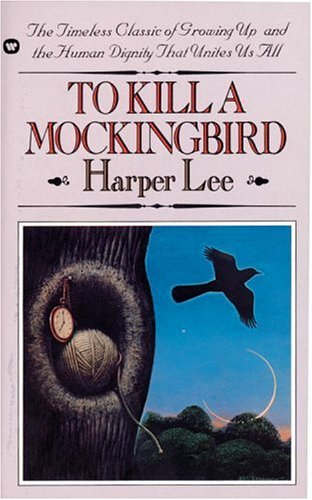
tkamIn case you’ve been living under a rock, To Kill a Mockingbird is the story of Jean Louise (Scout) and Jem Finch and their father, Atticus, a small-town lawyer. Narrated by Scout, the story takes place in Maycomb, Alabama in 1935. Although the action of the story takes place when Scout and her brother are children, the story is narrated from an adult’s vantage point which is how Scout is able to make some very worldly observations about society, childhood, prejudice and evil – all of which are themes in the book.

It’s an English teacher’s dream book, but it’s not without its problems – especially when you teach a generation of students who mostly read about sparkly vampires and cuddly werewolves. Still, I think it’s worthwhile.

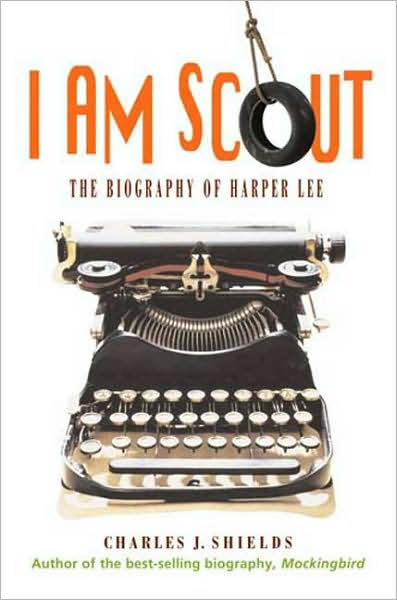
I started reading I Am Scout, Charles J. Shield’s student-friendly autobiography of Harper Lee  ( adapted by Shields from his book, Mockingbird: A Portrait of Harper Lee) just before my students and I began our discussion of To Kill a Mockingbird.  Even though I have probably read To Kill a Mockingbird a half dozen times or more, I’d never read anything about Lee’s life and I was interested.

If you ever wondered why Lee never published another book (and, really, who hasn’t wondered that?) this is the book for you. Shields traces Lee’s childhood, the youngest of four children growing up in Monroeville, Alabama. Almost from the beginning, it’s impossible not to see Scout when you read that Nelle (Ellen spelled backwards) Harper Lee:

had a reputation as a fearsome stomach-puncher, foot-stomper, and hair-puller, who “could talk mean like a boy.” Three boys had tried challenging her once. They came at her, one at a time, bravely galloping toward a dragon. Eithin minutes, each had landed face down, spitting gravel and crying “Uncle!”

Almost everything about Scout’s make-believe life is drawn from Lee’s childhood. Lee did call her father by his first name and he was a lawyer. Her childhood friend, Truman Capote, was the inspiration for the character of Dill. Lee’s mother was virtually absent from her life owing to issues with mental health. Several other characters in To Kill a Mockingbird were inspired by people in Lee’s life including Mrs. Dubose, a cranky morphine addict and Boo Radley, who is based on Alfred Boleware Jr., a Monroeville native who was rumoured to be  “a captive in his own home, tied to a bed frame by his father.”

Shields also tells how Lee helped Truman Capote research (and some say write) In Cold Blood, easily considered one of the quintessential pieces of true-crime writing of the last century. The relationship between Lee and Capote lasted thoughout their lives, but was not without its trials; Capote was, perhaps, jealous of Lee’s success –  even though he was certainly no slouch.

I am scoutSo, why didn’t Harper Lee ever write another novel?  According to Shields:

She reportedly had every intention of writing many novels, but never could have imagined the success To Kill a Mockingbird would enjoy. She became overwhelmed. Every waking hour seemed devoted to the promotion and publicity surrounding the book. Time passed, she said, and she retreated from the spotlight. She claimed to be inherently shy and was never comfortable with too much attention. Fame had never meant anything to her, and she was not prepared for what To Kill a Mockingbird achieved.

I felt after reading Shields’ biography that the reason Lee never wrote another novel was because this was the only story she had to tell. But that’s okay – if you only have one, it may as well be the one that wins the Pulitzer.