Love Falls by Esther Freud

Esther Freud (Sigmund’s great-granddaughter) has written a compelling, if slightly unsatisfying,  coming-of-age tale with her novel, Love Falls. When 17 year old Lara heads to Tuscany with her father (a man who is practically a stranger to her) for a summer holiday, she isn’t quite sure of what to expect. Her father, a slightly distant intellectual historian called Lambert, has been invited to visit an old friend and wants Lara to accompany him. Lara is well-traveled: she and her bohemian mother, Cathy, have been all over together, but Lara has never been to Italy, so she’s excited at the prospect of leaving London for a few weeks.
Italy is transformative for Lara. She has the opportunity to observe her father, his relationship with the woman they are visiting, the elegant and slightly snobbish, Caroline, and observe the complicated and fraught relationships of the adults around her.

At a nearby villa, Lara meets Willoughbys. There are a lot of names and relationships to keep track of but the most important Willoughby is Kip – a boy about Lara’s age who is irreverant and beautiful.

Lara spends her weeks swimming and visiting with the Willoughbys and the days unfold in a sort of dreamy, hot haze. It’s as you imagine a summer in Italy might be…or, at any rate, as I imagine it.

There’s menace, though, in Lara’s world and it’s this menace that speeds the reader along. Even though it doesn’t amount to much in the end, Lara is certainly changed by the events which she experiences. I think Freud does a terrific job of suspending Lara in that particular space between youth and adulthood. Lara is as much an observor as a participant in what happens during those long, hot days. And because we see things only from Lara’s point of view, many of the tangled relationships are never untied; animosities are never explained and wrongs never quite righted.

As a coming-of-age tale, though, it is compelling and well-written.

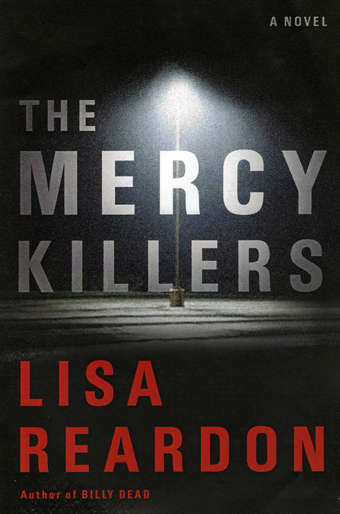
The Mercy Killers – Lisa Reardon

I first discovered Reardon a few years back when I read Billy Dead, a novel that continues to haunt me. The Mercy Killers has been on my tbr shelf for ages but I kept putting off reading it because its subject matter didn’t really appeal to me. Once I started it, though, I couldn’t put it down.

Lisa Reardon writes about characters who live in a world vastly different from my own. They are broken-down people whose lives are messy – filled with violence and alcohol and drugs and hopelessness.

The Mercy Killers concerns the fortunes (and misfortunes) of a group of people who hang out at Gil McGurk’s bar. When the novel opens, one of the regulars, Old Jerry, is complaining about his inability to take a bath. He wants to die.  It’s his birthday.

PT is one of Old Jerry’s grandsons. He’s nineteen and developmentally delayed after suffering one too many beatings at the hands of his father. Charlie, PT’s younger brother, is a petty criminal. He hangs out with Gino whose “bottle blue eyes and falling black hair” make him attractive to Gil’s daughter, Katie. Thing is, Gino’s not interested in women.

When PT decides to grant his grandfather’s wish and smothers him with a pillow, Charlie and Gino decide to cover up the crime. This propels the novel forward; Charlie ends up in Vietnam. Gino, too.

Although these characters weren’t familiar to me – the bonds of family and friendship, the small acts of kindness  in unexpected places certainly were. Charlie is fiercely protective of his older brother, the brother who had put himself in harm’s way to protect him against their violent father as children. Although Charlie is not without his flaws, he has the potential to be decent and it is this inherent goodness on which other characters (Gino in particular) hang their hopes.

Reardon’s writing is propulsive. As with Billy Dead I couldn’t stop turning the pages. I wanted one of these characters to break the cycle of violence and addiction. While there’s no question that Vietnam has a role to play in this book – and that the psychological aftermath of that horrific war adds another layer of despair to the lives of the characters – it is clear that sometimes our own choices cause just as much pain.

As I was surfing around the web looking for a picture of the book, I came across a few stories about Reardon’s personal life. In August 2009, she shot her father. She didn’t kill him, but apparently she meant to. From what I have read, it seems like there was some bad blood between them. When asked whether he knew of any reason Lisa would want to harm him he said “yes,” but wouldn’t elaborate.

Perhaps the marginalized and damaged characters Reardon writes about are cut from personal cloth. I feel badly that she’s had some  trouble. I think she’s an amazing writer.

The Sister by Poppy Adams

It’s ten to two in the afternoon and I’ve been waiting for my little sister, Vivi, since one-thirty. She’s finally coming home, at sixty-seven years old, after an absence of almost fifty years.


Thus begins Poppy Adams’ strange debut novel, The Sister.  Narrated by the incredibly brilliant Ginny, The Sister tells the story of the sisters and their parents, Maud and Clive. They share  a crumbling English estate known as The Red House because of the Virginia Creeper. Whole areas of the house have been shut down because Clive, a moth expert, and Maud can’t afford the estate.

Ginny takes the reader back in time, to the moment that her mother brought Vivi home from the hospital “her fluffy hair sticking up and her big round eyes gazing at me”. She recounts the time Vivi fell off the bell tower, an injury which very nearly cost her her life, but which did make it impossible for her to bear children. Ginny is the keeper of the memories and is in sole possession of the secrets, too.

Why did Vivi leave, never to return? It will be left to the reader to decide whether her homecoming is worth the hype. For me, the book falls short of the opening line’s promise. I was expecting something altogether more suspenseful. Instead, Adams spends a great deal of time instructing the reader on the nature of moths – a subject that holds absolutely no interest for me- and not nearly enough time examining just what keeps two sisters apart for fifty years.

The novel is well-written, certainly, but it moved too slowly and didn’t deliver on its early promise.

Moth lovers will likely be delighted.

The Prime of Miss Jean Brodie – Muriel Spark

When I was in grade seven, a million years ago, we watched The Prime of Miss Jean Brodie  on television. I have a clear memory of it.  I distinctly remember  Maggie Smith’s portrayal of the slightly aristocratic, strangely compelling school teacher, Jean Brodie. She’s remained in my memory just as the character herself remained in the memories of the students she taught, the creme de la creme.

Miss Jean Brodie’s class of twelve year olds are impressionable, inquisitive and sensitive.  The ‘Brodie set’ as they are known to the other students at the Marcia Blaine School are enjoying their final year with Miss Brodie before they move to the senior school. Miss Brodie is ‘shaping them’ and her notion of the curriculum isn’t exactly approved of by the other teachers of the school.

If anyone comes along in the course of the following lesson, remember that it is the hour of English grammar. Meantime I will tell you a little of my life when I was younger than I am now…

 Muriel Spark’s novella is interesting because Miss Brodie herself in interesting. Her girls were discovered to have

heard of the Buchmanites and Mussolini, the Italian Renaissance painters, the advantages to the skin of cleansing cream and witch-hazel over honest soap and water…

Of course, one begins to suspect that Miss Brodie might be a little bit of a fake and it is her complcated relationship with the girls who adore her and mock her in equal measure that makes up the bulk of this not altogether easy to read novella.

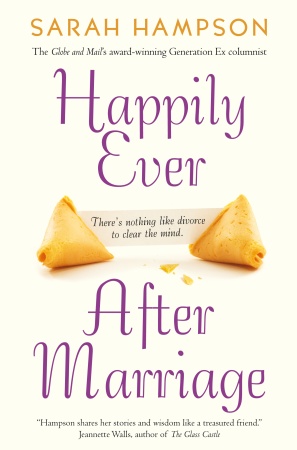
Happily Ever After Marriage – Sarah Hampson

If your marriage is way past the point of no return (aka those save-your-marriage books in the self-help section of your local bookstore aren’t going to cut it), Sarah Hampson’s memoir Happily Ever After Marriage might just be the book for you.  The book’s sub-title is “A reinvention in mid-life” and if the book had nothing else to recommend it — that would probably be enough. I was, however, standing in Hampson’s shoes.

After 18 years of marriage and with three sons, Hampson and her husband called it quits. I wasn’t actually ever convinced that they were a good match to begin with, but then it’s nearly impossible to judge standing on the outside. I know this for a fact.

I liked Hampson immediately because she and I shared (albeit at different times, but not by much) a university and a degree. (We both studied English Literature at UNB.) What I appreciated about Hampson’s story wasn’t so much that it mirrored my own because unlike Hampson I never dreamed of being a bride and I married relatively late, at age 32, not young like she was. Hampson’s situation is different from mine in another important way, too: she was the leaver and I was the leave-ee.

I liked  Hampson self-deprecating humour, her willingness to indulge in the occasional sulk, and her honest accounting of her own part in her marriage’s demise.

Hampson offers her own pithy wisdom on aging and dating post-40, on colouring your hair, on the demise of the body, on letting go. It’s not going to be easy — being over 40– but there are rewards to be had, you just have to be open to them. That’s Hampson’s advice anyway.

When she reflects on the institution, her vision is clear not jaded.

I have lived in a marriage. I have passed through what they are now entering. I would never warn them of its dangers. Why? Its promise is so beautiful, and for many, it is fulfilled.

Reading Happily Ever After Marriage for someone who is in those self-reflective post married days is the equivalent of a cup of tea on a blustery day. Hampson’s book offers a quiet respite from the emotional storm….without milky sentimentality or bitter lemon.

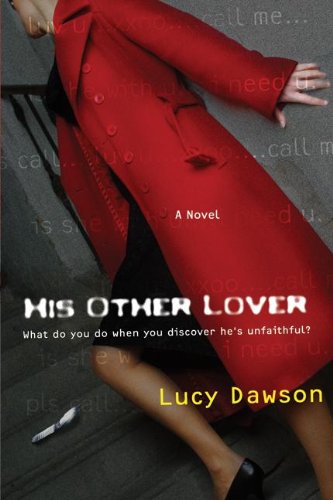
His Other Lover by Lucy Dawson

I seem to be on an infidelity kick lately. I read Lucy Dawson’s debut novel, His Other Lover, over two nights, reading until my eyes burned. In all the ways Love and Other Natural Disasters failed, His Other Lover succeeded.

One night, Mia, a 20-something woman who works for a small advertising firm somewhere near London, discovers a text message on her live-in boyfriend’s phone. Mia thought Pete was the one. Turns out he’s someone else’s one, too. That someone else is an actress named Liz.

The discovery of the text message begins a downward spiral of destructive behviour which upends Mia’s life. But hers is not the only life shattered by the discovery.

It’s interesting, but true, I think: women who are cheated on often blame the other woman. Mia pours all her anger and hatred on top of Liz. She almost makes Pete seem like another victim, someone who fell into Liz’s Black Widow trap and was helpless against her sticky charms.

Of course it’s all much more complicated that that. Mia goes completely off the rails, calling in sick for days on end while she tries to track down Liz. She wants her boyfriend back and the only way to do that is annihilate the enemy.

Dawson does a terrific job of getting inside of Mia’s head. The whole range of emotions are there: grief, anger, the hot desire for revenge. Mia is single-minded in her thirst for getting back her man. The thing is: he’s not worth it.

But the book is.

Love and Other Natural Disasters by Holly Shumas

When Eve, a young mother pregnant with her second child, overhears her husband having what sounds like a very intimate conversation on the phone in the middle of Thanksgiving dinner, her whole neatly ordered world is turned upside down. She overhears her husband say: “Shh, you’re going to be okay” and that’s all it takes to know that something is going on.

Holly Shumas’ novel Love and Other Natural Disasters explores the effects of an affair – not a physical affair, but an  emotional one – on a marriage. I suspect that there are probably some people who would say that if there isn’t any sex, it’s a “no harm, no foul” situation. Shumas does a pretty good job, though, of illustrating that looking outside of your marriage for any sort of fulfillment can have devastating consequences.

Love and Other Natural Disasters traces Eve and Jonathan as they try to put their marriage back together. It’s a push/pull affair as they both try to cope with their own issues and the unresolved issues in their marriage.

Shumas herself is a licensed marriage and family therapist and if I have any niggles with the book it’s that sometimes it seems instructional. The characters each have a part to play to demonstrate the various stages of grief: the disbelief and anger, forgiveness and acceptance. Sometimes their reactions seemed over-the-top or not quite harsh enough. For example, after she discoveres her husband’s relationship, she reads his emails looking to understand what’s gone wrong. Later, in therapy, Jon blows up about her invasion of his privacy. Um, hello, there wouldn’t have been any need for her to go snooping if you hadn’t done something inappropriate. But I know the therapist’s point of view might be to suggest that Jonathan has a right to his anger.

Some of Love and other Natural Disasters resonated with me, but not because the book was beautifully written or original. And even though I sometimes felt as though it was too instructional, and that the characters weren’t particularly nuanced – Love and Other Natural Disasters is topical.

Bad Girls Don’t Die – Katie Alender

So, there’s nothing wrong with Katie Alender’s novel Bad Girls Don’t Die. It’s the story of Alexis, a high school student who takes photos, thinks her doll-loving twelve year old sister, Kasey, is kind of annoying and goes out of her way to distance herself from just about everyone at her school. Alexis is smart and Alender does a terrific job of capturing her voice from the very beginning of the novel. Although like many teens, Alexis takes herself a tad too seriously sometimes, she’s also self-deprecating and intelligent.

Alexis has a lot on her plate. Her parents are generally absent from her life and she is often left in charge of the household and her sister, who starts acting weirder and weirder. Added to all this, Alexis finds herself drawn to a new student at her school.

Bad Girls Don’t Die is a ghost story (think Jane-Emily rather than Stephen King).  It’s not particularly scary, although there’s enough of a  creep-factor to get younger teens huddling together with the lights on. 

I think my reading of it suffered from having recently finished The Hunger Games – which is a kick-ass book. Bad Girls Don’t Die pales by comparison.

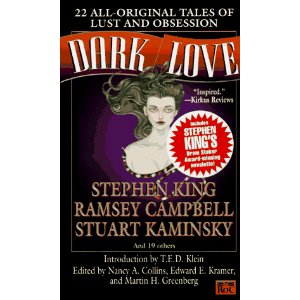
Dark Love by various authors

Dark Love, edited by Nancy Collins, Edward E. Kramer and Martin H Greenberg, was published in 1995 and has been sitting on my tbr shelf for two or three years. This is a collection of short stories where “there’s no love without obsession…and obsession is the underlying theme of every story.”

Given the pedigree of the included authors Ramsey Campbell and Stephen King among them, readers should approach this book with caution. Some of the stories are downright icky. “The Penitent” by John Peyton Cooke I’m looking at you. That one starts out with the line: “Every since I was a young girl  I’ve wanted to torture a beautiful young boy.” Trust me, it goes downhill from there.

The Stephen King story, “Lunch at the Gotham Cafe” was a new original story at the time of this anthology’s publication. I like King and while this story has much to recommend it – mainly a narrator I believed in – the story was kinda silly. For some reason, I kep thinking about the Muppet’s Swedish chef as I was reading.

My favourite story of the bunch was “Hidden” by Stuart Kaminsky. It would make a great episode of Criminal Minds – more creepy than anything else.

Fans of the genre will likely enjoy this volume.

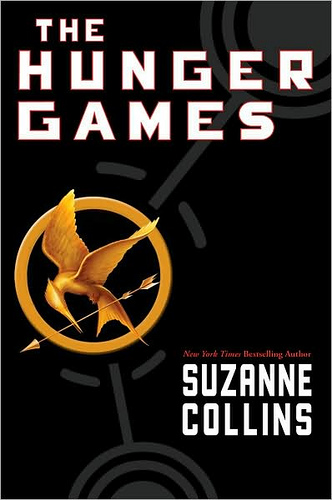
The Hunger Games by Suzanne Collins

There’s been a lot of excitement in the house over Suzanne Collins’ book, The Hunger Games.  Both of my kids have read it and have been harassing me to read it, which I finally did. I have to say – I loved it as much as they did. So we thought we’d talk about the book a little.

Mallory: This book takes place in post-apocalyptic North America. The people of North America had attempted a rebellion against the government, but weren’t successful. So, the government split them into 13 Districts, and each year as a punishment,  every child ages 12-18 in every District has their name put into the Hunger Games. They draw two names from each District and those people must compete against kids from other Districts in an arena. It’s a fight to the death; last one standing wins. Basically, the main character, Katniss Everdeen from poor District 12 takes her sister’s place to go into the Games.

Christie: That’s a great summary, Mallory. It’s a terrific premise for a book, not altogether dissimilar from the 1987 film The Running Man.  Of course the stakes are a little higher in the book especially since the players are just kids.

Mallory: Katniss is 16 when she went to into the Hunger Games, so she was one of the older kids competing. Imagine how hard it would be if you were just 12, trying to kill 17 and 18 year olds. Katniss is such a great character, and Collins did an incredible job building her up. Every moment of the book I was so scared because I loved Katniss and didn’t want her to get hurt.

Christie: I agree, Mallory. I loved Katniss from the very start of the novel. She’s resourceful, mature, and brave. When we first meet her, she demonstrates her willingness to break the rules to provide for her family. She’s a good hunter, she wastes nothing, and you get the sense that she could handle herself in just about any situation. But she’s not the only admirable character in the novel. Who else did you like, Mallory?

Mallory: Well, I must say that I love Gale, Katniss’ best friend, and Prim, her sister (who were introduced at the very beginning of the novel). But as the novel progresses, we meet many more amazing characters, some that we love, and others that we hate. Like, Rue, a contestant in the Games who I adored. What about you?

Christie: I’m with you, Mal. All the characters were really well drawn – even characters you don’t get to know very much about, like Cinna and Thresh. As you get to know some of the other Tributes (contestants), it’s impossible not to get attached and what’s remarkable is that Katniss feels admiration for some of these people too, even though she knows she might have to kill them to stay alive. The Games themselves were very exciting, didn’t you think?

Mallory: Well yeah! They were amazing! What an incredible concept for a book. I wish I had thought of it first, because it’s just so clever. Everything about the Games seems so real, so legitimate. She doesn’t make them seem like a board game, or something you play. Collins really gets it across to you that the Hunger Games are about fear, and death, and despair. The Games are so scary, that you just feel really sad for the Tributes, even if they are merely characters that came out of Collins’ mind.

Christie: Beyond the suspenseful plot and characters, Collins has created an interesting and scary future-world and, for me, the writing was crisp and readable – a nice change from a lot of the Young Adult fiction out there. How does this book compare to other books you’re reading, Mallory?

Mallory: Honestly, The Hunger Games isn’t really comparable to the books I’ve been reading because it’s just so different, and that’s what I love about it. Most YA Fiction out there at the moment is either about vampires or rich girls with dirty secrets. Sure, I like Twilight, and books like Pretty Little Liars, but The Hunger Games sets itself apart from all the generic and boring books.

Christie: A lot of kids I teach are reading it (or have read it) and I’d say 99% of them have loved it. And for my money – this book is heads and tails better than the Twilight series.

Mallory: My school is having the same Hunger Games craze too! Most of my friends (I’d say 85%) hate to read, and will only force themselves to open a book if it’s absolutely necessary. But surprisingly, a ton of them have read The Hunger Games (girls and boys) and they loved it! The book has been passed around the entire grade 8 French immersion population, and instead of gossiping at lunch time, we all discuss our favourite parts. It’s a nice change.

Christie: Well, I guess that makes it unanimous, then. The Hunger Games: loved by boys, girls and moms!