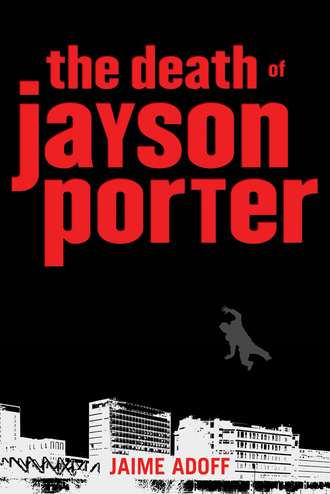
The Death of Jayson Porter – Jaime Adoff

The Death of Jayson Porteris a book that took me way outside of my comfort zone. I don’t mean my reading comfort zone, I mean my human comfort zone. This is a YA novel that packs a significant punch.

Sixteen-year-old Jayson lives with his drug and alcohol addicted mother, Lizzie, in a high rise slum called Sunny Gardens in Bandon, Florida.

Sunny Gardens. The last stop for single moms and their messed-up kids. The last stop before the streets. Sunny Gardens, where the elevators are always broke – but not as broke as the people living here. Where crack is bought and sold like they trade stocks on Wall Street. Shootin’ with needles and guns while I’m tryin’ to do my homework. Babies cryin’ ’cause they hungry.

Jayson takes the reader through hot, hopeless days while he tries to balance school, work and a mother who abuses him physically and emotionally. His father is long gone, although Jayson does visit him a couple times.His life is complicated further by the fact that his mother is white and his father is black, so he isn’t really a part of either world. Jayson is one of those kids you root for, but you also wonder how he’s ever going to survive.

He wonders, too.  In fact, he often contemplates jumping from the railing of his apartment building, imagines what it would be like to be “a bullet screaming to the ground.”

Here’s the bit that was out of my comfort zone. I don’t have any real experience with ‘project’ living. I don’t know any crack addicts or hookers. As a mother, I can’t imagine beating my kids the way Jayson’s mother beats him. And even though I understand that this is fiction, I also know that there are kids out there who live like this. So, the book touched a nerve.

Adoff captures Jayson’s fear and misery. The writing is immediate and unembellished, sometimes even reading like poetry.  There is very little in Jayson’s life that is joyful, but finally and thankfully, there is hope.
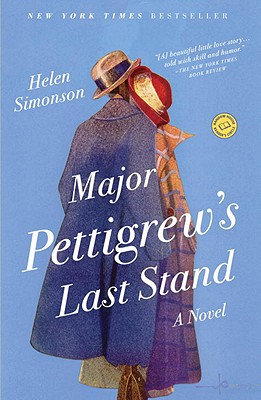
Major Pettigrew’s Last Stand – Helen Simonson

Helen Simonson’s debut novel Major Pettigrew’s Last Stand is the next best thing to spending a holiday in the English countryside. When we meet the title character, Major Ernest Pettigrew (retired), he’s just received the news that his younger brother, Bertie, has died. He’s trying, rather unsuccessfully, to cope with the news when Mrs. Ali, proprietress of the local village shop, appears at his door to collect the paper money. She takes note of his unsteady appearance and  offers to make him a cup of tea. Thus begins their relationship.

Mrs. Ali was, he half suspected, an educated woman, a person of culture. Nancy had been such a rare person, too, fond of her books and of little chamber concerts in village churches. But she had left him alone to endure the blunt tweedy concerns of the other women of their acquaintance. Women who talked horses and raffles at the hunt hall and who delighted in clucking over which unreliable young mother from the council cottages had messed up  arrangements for this week’s play group at the Village Hall. Mrs. Ali was more like Nancy. She was a butterfly to their scuffle of pigeons. He acknowledged a notion that he might wish to see Mrs. Ali again outside of the shop, and wondered whether this might be proof that he was not as ossified as his sixty-eight years, and the limited opportunities of village life, might suggest.

Major Pettigrew’s Last Stand is one of those little gems of a novel – beautifully written, with characters so remarkably authentic they seem to jump off the page. Pettigrew is a widower and Mrs. Ali, too, has lost a spouse. They are drawn together because of a shared love of Kipling, but they live in a small town – everysmalltown, really, where everyone knows your name and your business – and not everyone would have them together. Although Mrs. Ali was born in England, she’s Pakistani and therefore viewed by some as ‘unsuitable.’ I think Pettigrew’s feelings for her take him quite by surprise.  I suspect he thought that at 68, that part of his life was over.

In some ways, Pettigrew is a stuffed shirt. He likes things ‘just so.’ He desires attention and often  believes he’s entitled. The beautiful thing about him, though, is his willingness to change, and he does, too. His relationship with his son, a pompous banker who lives in London, undergoes a transformation. He starts to care less about tangible things, like a pair of shotguns that had once belonged to his father, and more about feelings and people.

To say that nothing much happens in Simonson’s novel is to miss the quiet patina of daily  life – much of which, at least as it’s written here, is laugh out loud funny. As people plan parties that can only go awry, as children squabble over their rightful inheritance, as the battle-lines are drawn between cultures, Major Pettigrew tries to find a way to navigate the messy business of living. He is proof that life does offer second chances, if we are brave enough to open our hearts to receive them.

The Ask and the Answer – Patrick Ness

Oh, Todd. Oh, Viola.  You’re breaking my heart.

Patrick Ness has done it again with the second book in his Chaos Walking trilogy. When we left Todd and Viola in The Knife of Never Letting Go, they were running for their lives into the town of Haven. Well, Todd was running at least; Viola had been shot.

Haven turns out to be exactly the opposite; the pair are captured and separated. When Todd comes to, he is tied to a chair and the Mayor (remember how evil he was in the last book? You ain’t seen nothing yet!) is interrogating him. But all Todd can think about is Viola.

“Where is she?” I spit into the dark, tasting blood, my voice croaking, my Noise rising like a sudden hurricane, high and red and furious. “WHERE IS SHE?”

“I will be the one doing the asking here, Todd.

That voice.

The opening scene in The Ask and the Answer is but a taste of the horrors to come. Ness doesn’t pull any punches: literally.  Haven has been taken by the Mayor and his men and Todd finds himself separated from Viola.  No one is safe and the lines between who is good and who is not are constantly shifting.

The Ask and the Answer is about war. The themes are universal: outsiders rounded up like cattle and branded; a leader crazy for power (or perhaps just plain crazy), and two kids trying desperately to make meaning and find a way to do the least damage.So much comes at them and I often forgot that they were just kids. That was the hardest thing to believe about the whole book: Todd is supposed to have just turned 13 and he seems a lifetime older.  But I am looking at him from my cushy, never-been-in-war, perspective. Who knows what you might be capable of if there was no alternative.

And that question is at the very centre of Ness’ terrific book. If you had no choice – what would you do? If you thought all was lost – what would you do? People constantly surprised me in this book, particularly the Mayor’s son, Davy. It’s a testimony to Ness’ considerable talent that he is able to make Davy sympathetic.

As for Todd and Viola – they continue to be resourceful and bloody amazing and true to each other is ways that are both heart-breaking and inspiring. They’re so brave and so resilient, I hated to leave them again.

Book three, coming up: Monsters of Men

Played – Dana Davidson

I am slowly working my way through all the books I bought for my classroom library. I want to be able to put books into the hands of my students and to be able to say something meaningful about them. Although I am way past my teen years, I have to say that I am pleasantly surprised by the calibre of the teen fiction out there today. I’m not talking about the mega hits like Stephanie Meyer’s Twilight series which, sure, teens read en masse but which I can’t say is quality literature by any stretch.  I’m not talking about better-written fare like The Hunger Games. I’m talking about those quiet, often over-looked, books that speak directly to young adults about things they care about and things they worry about: divorce, illness, love, sex,  abuse, drugs and alcohol. Those sorts of books were few and far between when I was growing up – which is why everyone and their dog read Judy Blume’s novel, Forever or Go Ask Alice by Anonymous.

Dana Davidson’s novel Played tells the story of handsome and talented Ian Striver, a boy who does know the difference between right and wrong, but who also wants – more than anything – to be accepted into an elite group at his school. Ian has made it past the induction phase of FBI (Freaky Boys Incorporated) but now he must pass one final test: he has to bed someone chosen for him by members of the FBI.

Kylie is the girl and it is impossible not to fall in love with her. She’s smart, she’s kind, she values the right things (her family: single mom and her younger brother and sister) and even when a little voice tells her that it can’t be possible that a boy like Ian could fall for a plain girl like her, she allows herself to fall in love with him.

Ian, on the other hand, was so fine and so popular that he could have any girl he wanted. Kylie wasn’t sure what, but she felt that something wasn’t quite right.

But the truth was that she wanted something more to happen to her. She went to school, took care of her siblings, kept their house clean, did her homework and saw her girlfriends from time to time. But that wasn’t enough. It seemed to Kylie that a perfectly healthy, reasonably intelligent teenage girl ought to be able to get into more than that. Kylie felt as if her life was more like that of a thirty-five-year-old than that of a sixteen-year-old. So while she had her suspicions about why Ian was taking time with her, she was going to let it ride and see where it took her.

While Ian does set out to play Kylie for his own gain, Davidson does a terrific job of making him likeable and complicated. Played does not play out exactly as the reader might anticipate and I enjoyed it a great deal.

34/365

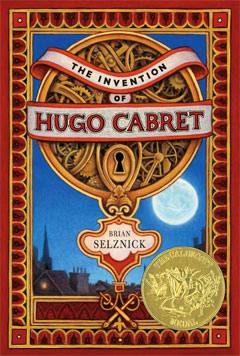
The Invention of Hugo Cabret – Brian Selznick

I bought this book for my 12 year old son for Christmas. He started reading it and then, as boys of his age often are – got distracted and left it on the table in the livingroom – where I picked it up and read it from start to finish.

The Invention of Hugo Cabret is  a straightforward tale, elevated because of its narrative style. Selznick tells the story in words and full page illustrations – 284 pages of them.

Twelve-year-old Hugo lives in the attic of the Paris train station. He lives there because his father has died and an elderly uncle has claimed him. The uncle is responsible for keeping all the clocks in the station running perfectly and he teaches Hugo to do the same. But when the uncle disappears, Hugo is left to fend for himself.

The Invention of Hugo Cabret is a book that perfectly marries text and images. Selznick stops his written narration, often several pages at a time, and lets his black and white drawings take over. The pictures tell the story, not just supplement the words. It’s brilliant really.

The story revolves around an automaton – a self-operating  machine with human actions- a mysterious man who operates a toy store in the train station, a young girl and a famous French film director.  The joy of how these things connect is for the reader to discover. It’s quite magical.

You can read more about the book here.

31/365

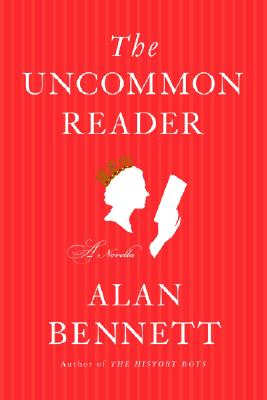
The Uncommon Reader – Alan Bennett

Imagine if the Queen had only discovered reading later in life? That’s the premise of Alan Bennett’s lovely novella, The Uncommon Reader. While taking her corgis for a walk, the Queen happens upon a mobile library parked near Buckingham Palace. Intrigued, she boards the bus and meets Mr. Hutchings, the library’s driver and  Norman, a young man who works in her kitchen.  She feels duty-bound to select a book, but when asked what kind of book she likes her response is, essentially, that she doesn’t know.

She’d never taken much interest in reading. She read, of course, as one did, but liking books was something she left to other people. It was a hobby  and it was in the nature of her job that she didn’t have hobbies.

The Queen casts about, looking for something to borrow and discovers a name she recognizes.

“Ivy Compton-Burnett! I can read that.’ She took the book out and gave it to Mr.  Hutchings to stamp.

“What a treat!” she hugged it unconvincingly before opening it. “Oh. The last time it was taken out was 1989.”

“She’s not a popular author, ma’am.”

“Why, I wonder? I made her a dame.”

The Uncommon Reader is full of laugh out loud moments like this one and is, in fact, an utterly charming book. The Queen, despite a rather rocky beginning, turns into a voracious reader. She promotes Norman from the kitchen to a new position, a sort of personal assistant, and that causes all sorts of problems with other staff members.

For a while nothing comes between the Queen and her books. Like all devoted readers, she’s never without one and dinner party conversations invariably turn to the topic of what people are reading. Instead of being told about the books of authors she  meets, the Queen now wants to read their work.

“But ma’am must have been briefed, surely?”

“Of course, ” said the Queen, “but briefing is not reading. In fact it is the antithesis of reading. Briefing is terse, factual and to the point. Reading is untidy, discursive and perpetually inviting. Briefing closes down a subject, reading opens it up.”

The Uncommon Reader is a love letter to reading.

“Books are not about passing the time,” she admonishes Sir Kevin. “They’re about other lives. Other worlds.”

The Queen proves to be, at the end of the day, just like the rest of us who couldn’t imagine a life without books.

25/365

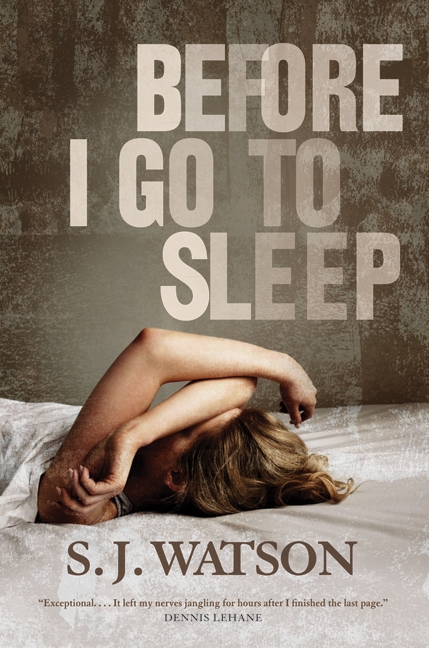
Before I Go To Sleep – SJ Watson

What are we, if not an accumulation of our memories?

Memories are a bit of a problem for the protagonist of SJ Watson’s debut novel Before I Go To Sleep. Twenty years ago, Christine was in a serious accident that left her without the ability to retain memories. That means every morning she wakes up in a room she doesn’t recognize, with a husband she doesn’t remember and in a body she’s troubled to discover is twenty years older than it should be. She muddles through the day, trying to piece her fractured life back together – with the knowledge that she’s going to have to do it all over again the next day. That’s right: she goes to sleep and her brain erases all the memories of the day.

Before I Go To Sleep was my book club’s first read for 2012 and was also my pick. We had a lively discussion about the book’s merits and I am happy to say that with a few minor caveats, the women in my group (except for one) generally enjoyed the book.

The general concensus was that Watson did an admirable job of writing a convincing female – not an easy task, I don’t think. We had a little bit of a debate about the novel’s structure. At least one person was put off by constantly having to re-read the story, rediscovering memories as Christine did. I actually think that it was deftly handled. If I am feeling frustrated by having to hear stuff over and over, imagine how trapped by her circumstances Christine must be feeling. 🙂

I alo think Watson was striving to write something more than just a thriller – although he did that quite handily. I think he was trying to say something about memory and how our memories shape us. It’s a fear of mine, really, to be old and not know my children or the other people who have been important to me. Christine’s situation means that she is forced to learn painful information over and over again – and it’s heartbreaking.

The book had me in its iron grip until the last 50 or so pages- when I have to say that it fell apart for me. It wasn’t that I didn’t buy a certain part of it (and, really, it’s  almost impossible to talk about without giving anything away), let me just say this: too much convenient exposition. Too neat.

That said, Before I Go To Sleep was a great way to kick off our 12th reading year.

SJ Watson talks about the book and his writing here.

21/365


Right Behind You – Gail Giles

On the afternoon on his seventh birthday, I set Bobby Clarke on fire.

I was nine.

It was all about Bobby’s birthday present.

A baseball glove.

Gail Giles YA novel Right Behind You grabbed me from the start. It’s the story of Kip McFarland who lives a hardscrabble life with his father in the Alaskan wilderness. Kip’s mom has recently died of cancer, and you get the impression that Kip and his father aren’t coping too well.

When Bobby Clarke shows up to gloat about his new baseball glove, Kip overreacts and douses him with gasoline. What happens next is shocking and tragic and changes Kip’s life forever.

Kip spends the next five years of his life in a locked down psychiatric facility. The reader has a front row seat to Kip’s therapy, and his own attempts to sabotage his recovery. But life does go on for Kip and his father once Kip is released. Right Behind You drags the reader along with Kip as he struggles to reinvent himself.

This story is successful on a couple fronts. For one thing, the writing is interesting. I loved the line: The hollow inside me filled up with red mean. I liked it so much, I stopped to copy it down when I read it. I also loved Kip and that’s saying something because, let’s face it, what he does to Bobby is inexcusable even if he was only nine. He’s smart and he has the ability to scratch beneath the surface of his own psyche. He doesn’t always like what he finds, but that’s what makes him human.

The story takes us from Alaska to the Texan coast and even though several years transpire, I never felt as though Giles was rushing to the conclusion. And when Kip gets there – to the next part of his story – readers will wish him peace because he’s earned it.

14/365

Graveminder – Melissa Marr

Melissa Marr’s first novel for adults (she’s better known for her YA novel series Wicked Lovely) was my first read in 2012. Actually I started Graveminder  in 2011 and was hoping to get it finished but I just couldn’t manage it. Graveminder was recently voted Best Horror novel at Goodreads, but it’s been on my radar for a few months and I was really looking forward to reading it.

So, so disappointed.

The premise of Graveminder is actually quite intriguing. When Rebekkah Barrow’s grandmother, Maylene, is murdered, Rebekkah comes back to the town where she grew up. Claysville is not like other towns; it has strange traditions, particularly where the dead are concerned.

Matlene was a graveminder.

If anything happens to me, you mind her grave and mine the first three months. Just like when you go with me, you take care of the graves. …Promise me.

Rebekkah, as it turns out, is a graveminder, too. Her job – which she knows nothing about until she returns to Claysville, is to guard the graves of the dead.

Her return to Claysville is complicated by her on again off again relationship with Byron,  the town’s undertaker.  (Graveminder, undertaker – sounds like a couple wresters,eh?) Byron was Rebekkah’s sister’s high school sweetheart until tragedy struck and now Rebekkah just can’t seem to get it together where Byron’s concerned. These unresolved feelings make up a large part of the novel’s energy – but not in a good way.

None of Graveminder actually lives up to the promise of the plot.  The writing is generally clunky, the characters vacillate between annoying and insipid and many promising plot threads are never satisfactorily resolved.  Rebekkah continually pushes Byron away and they have the same conversation over and over – like they are 12 – drove me c-r-a-z-y.  Their interaction was not adult in any way.

Graveminder wasn’t scary, either. The premise was: the dead must be tended or maybe they’ll come back and if they do – watch out. Also, Marr has created an intriguing ‘other’ world, a place where the dead go and live. The thing is, it feels like she’s dropping the reader into the middle of a story – where questions are asked but never answered.

If there’s a sequel coming, I won’t be reading.

11/365