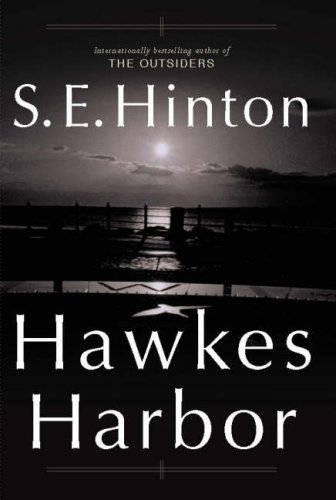
Hawkes Harbor – S.E. Hinton

hawkes

There was a time — perhaps not in recent memory, but in my memory at least — when the Teen section of a book store didn’t offer quite the selection that it does now. Books written specifically for a teen audience were not so readily available; I did most of my book buying from the Scholastic flyer and a great deal of my reading from the stacks of the local library. Perhaps the fact that there weren’t so many ‘teen’ books is the reason why so many people of my vintage have read many of the classics (and all of Trixie Beldon and Nancy Drew!)  But if you had to compile a list of YA fiction from the 70s (which is when I was a teen) S. E. Hinton would surely be at the top of the list. (I also have a very vivid memory of this romance that took place at the beach – an insecure, plain girl falls in love with this Greek Adonis, who just happens to have a prosthetic leg. Can’t remember the book or the author, though. Damn.)

Anyway.

S.E. Hinton is best known for her novel, The Outsiders. Seriously, is there a person on the planet who is not familiar with this book? Hinton was still a teenager when the book was published. (I love to tell my students she was just 16 when she wrote it, but I don’t know that for sure.) The Outsiders is pretty much the slam-dunk book to give to a student who claims he doesn’t like to read. Works for girls, too, by the way. But then I love to tell them that if they enjoyed Ponyboy and Johnny and the rest of the greasers, they’ll love That Was Then, This is Now, which is my favourite Hinton novel. Her characters feel authentic to me and I suspect that’s why teens still love them, even though some of the references feels dated.

Which brings me to Hawkes Harbor. Published in 2004, it was Hinton’s first novel in 15 years. It was also her first adult novel. It’s also really, really strange. And, truthfully, I don’t know if I mean that in a “don’t waste your time” way or in a “I couldn’t stop reading it even though it was really bizarre” way.

Jamie Sommers (not to be confused with the bionic woman) is orphaned at a very young age and sent to live with the nuns.  It is 1950…and that is all you get to know about that. When we catch up with him he’s a mental patient at Terrace View Asylum. Bad stuff has happened and Dr. McDevitt is trying to help him remember. McDevitt can’t decide if Jamie’s tales of derring-do are authentic or the fantasies of an addled brain. In any case, the reader learns that after a stint in the navy, Jamie hooked up with an Irishman named Kell and the two of them sailed around the world looking to make their fortune – mostly illegally. Eventually they ended up in Hawkes Harbor and that’s where things took a turn for the worse.

Um. This is where we meet the vampire. It’s not what I was expecting. At all. And I can’t say that I believed it because it was at this point that Hinton broke her contract with me. Really? A vampire? I just didn’t get it.

The writing is decent, albeit choppy, which might have something to do with the nature of the narrative  and the fact that the story jumps around. Jamie is compelling enough. This is a decidedly adult novel, so I won’t be recommending it to my students.  Sadly, I doubt I’d recommend it to anyone.

No matter. I still love you, Ms. Hinton.

All Unquiet Things – Anna Jarzab

allunquietthingsAnna Jarzab’s first novel All Unquiet Things is  mature and thoughtful. Kirkus called it “a sophisticated teen mystery.” It’s actually hard to believe that this book is written for young adult readers; its prose, while not exactly sophisticated, is a cut above many other books published for young readers.

It was the end of summer, when the hills were bone dry and brown; the sun beating down and shimmering off the pavement was enough to give you heatstroke. One winter came, Empire Valley would be compensated for months of hot misery with three months of torrential rain, the kind of downpours that make the freeways slick and send cars sliding into one another on ribbons of oil.

All Unquiet Things is the story of Carly, Neily and Audrey, students at Brighton Day School, a prestigious private school outside of San Francisco. Through a series of flashbacks – told from Neily and Audrey’s perspective – we learn about how Carly and Neily’s middle school friendship blossomed into something more, and how the arrival of Carly’s cousin Audrey changed the dynamics of their relationship.

These teenagers are smart, but they also have a lot of other issues including deadbeat or overly demanding parents. Neily’s parents are divorced and according to Neily his father “hadn’t really parented me since I was very young and I tended to get away with most things….” The girls have problems of their own.

So what’s the mystery? Well, Carly’s dead. (Don’t worry – her ghost doesn’t speak.)  Someone shot her four times and the circumstantial evidence points to Audrey’s alcoholic/drug addicted father Enzo, so he’s serving time in jail. Audrey is convinced that her father is innocent and even though her relationship with Neily has been strained by events, she seeks him out to help her try to figure out who really ended her cousin’s life.

Their investigation exposes the slimy underbelly of Brighton’s facade, but also allows the reader a glimpse into the messed up lives of students with too much money and not enough parental involvement. As Neily and Audrey try to figure out what really happened to Carly, they become friends, at first united in their search for the truth but then because they grow to genuinely care for each other.

You can’t really see whodunnit early on, which makes this a perfect read for students who like a page-turner. All Unquiet Things works on another level, too. Neily has to consider how he has been shaped by his love for Carly and how that love, no longer sustainable or attainable, is holding him back from living a fulfilling life. Audrey has to own up to her own part in Carly’s story and come to terms with the fact that her father might not be capable of all she hopes for him.

All in all, a terrific book.


A Family Secret – Eric Heuvel

family secretEric Heuvel is a Dutch comic book artist, so A Family Secret, a story which takes place in Amsterdam during the second world war, is perhaps a topic especially close to his heart.

Jeroen is looking for items to sell at a flea market held on Dutch Queen’s Day. He decides to head over to his grandmother’s house, hoping to score some good stuff without actually have to visit with his grandmother. Snooping through the attic, he comes across a scrapbook filled with items marking the German occupation of Holland.

“I”ll tell you why I started this scrapbook,” his grandmother tells him. Jeroen is thinking: I hope this doesn’t take long. It turns out, though, that her story is riveting.

When I was twelve or thirteen I read Anne Frank’s Diary of a Young Girl. It was one of those turning point books for me, as I am sure it was for many other young people. Here was a real teenager, coping with typical teenage problems but under extraordinary circumstances. Decades later, while visiting Amsterdam, I was priviledged to visit the house where she and her family were hidden away. I can’t begin to explain to you the feeling of stepping behind the hidden door and heading up the stairs to the annex where she spent just over two years of her short life.

A Family Secret tells another one of the, I suspect, hundreds of thousands of personal stories about that horrific time in history. Jeoren’s grandmother tells of her father, a Dutch police officer, forced to make choices she doesn’t understand until years later, about her brothers, one who joins the resistance and one who joins the Nazis and of her childhood friend, Esther, a  German Jew who fled with her parents to the safety of the Netherlands…only to discover there was no safe place for them.

The graphic novel format of this particular story makes it a perfect read for reluctant readers, but all readers should get something meaningful out of the personal choices the characters are forced to make in times of great distress.

These atrocities continue to be written about, as they should. We should never be allowed to forget.

Borderline – Allan Stratton

borderlineAllan Stratton’s YA novel Borderline wouldn’t necessarily be something I’d pick up on my own, but I am trying to read more ‘boy’ books, especially those that might appeal to reluctant readers. I’ve inherited a class this semester and the majority of them are boys and many of them wouldn’t exactly put reading at the top of their to-do lists. I always think the key to reading success is to find just one book that they like. Borderline could be that book for someone.

Sami Sabiri is almost sixteen. He’s a pretty average teenager; he lives in an American suburb, crosses swords with his strict father,  and tries to stay out of the way of bullies at the expensive private school he attends. He’s also Muslim.

At first, Borderline doesn’t seem like anything more than the pretty standard YA fare. Sami is likeable and relatable and his life is just ‘other’ enough to be intriguing. The fact that he is Iranian offers plenty of opportunities to discuss today’s headlines, too, because suddenly Sami finds himself in the middle of an FBI investigation.

The agents grill me to a crisp. Questions about Dad, his work, who he knows, what he does. I hardly hear a word….”We’re Americans,” I blurt out. “Mom and Dad – you can’t put them on a plane. You can’t send them off to be tortured.”

Sami’s journey to discover the truth about his father’s supposed terrorist activities is also a journey of self-discovery. Suddenly he has a reason to stand up and be counted. As his loyalty to his father wavers, he finds hidden reserves of strength and courage. If the resolution is, perhaps, a little too convenient, it won’t really matter to the majority of young readers. Sami is a character worth rooting for.

As to whether my reluctant readers would like this book – I think they would. The writing is accessible with a minimum of flowery prose. It’s pretty much straight-up plot and I think most of the boys in my current class would enjoy it.

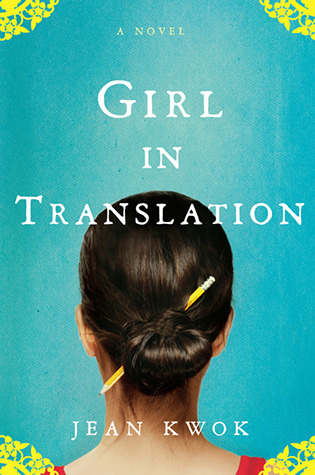
Girl in Translation – Jean Kwok

girlintranslation“I was born with a talent. Not for dance, or comedy, or anything so delightful. I’ve always had a knack for school.”

Kimberly is just eleven when she and her ‘Ma’ emigrate to the States from Hong Kong. It has long been a dream of theirs to live in America and chase that American dream. They arrive in New York with little more than the clothes on their backs and the promise of a new life.

Ma’s older sister, Paula, has been living in New York with Uncle Bob for several years and it is because of her sponsorship that Kimberly and Ma are able to come. But don’t get the idea that Paula is a benevolent soul; she’s not. She puts Ma to work in the clothing factory Bob manages – a sweat shop – and sets her sister and niece up in an apartment so filthy, cold,  and vermin infested that the building has all but been condemned. In fact, every other tenant has moved out in anticipation of the building’s eventual demolition.

Girl in Translation is the story of Kimberly’s adolescence. It’s about her tenacity. If she weren’t so intelligent, her story might have had a different conclusion, but she’s really smart and it’s those smarts that propel her past many of the obstacles poverty throws in her way.

Those of us who live a comfortable existence likely have very little notion of how incredibly difficult it must be for people who come to, let’s say, North America and try to start a new life. Immigrants often don’t speak the language. They don’t understand how anything works. They have no way of advocating for themselves. Kimberly and her mother also have to contend with Aunt Paula who is petty and stingy and jealous of Kimberly’s smarts.

There are moments of kindness in Kimberly’s story. She makes a true friend early on. She finds success academically. She makes her way. But there are significant sacrifices, too.

Like Kimberly, Kwok was born in Hong Kong and immigrated to New York City. She, too, worked at a sweat shop. She, too, was smart. At about the two third mark in the novel I started to feel a bit…I don’t know…disappointed. Kimberly’s story remained interesting, but I really felt as though this was a memoir dressed in a novel’s cloak. I can’t quite explain why, but I didn’t feel like I was living the story anymore, I felt like I was being told the story. And then…that thing I HATE. Flash forward twelve years and let’s see where all the characters are. Nothing about that epilogue – over-wrought and schmaltzy as it was – seemed to fit the rest of the novel.

That’s my own personal niggle, though. The novel has been praised all over the place and I suspect the vast majority of readers will really enjoy it.

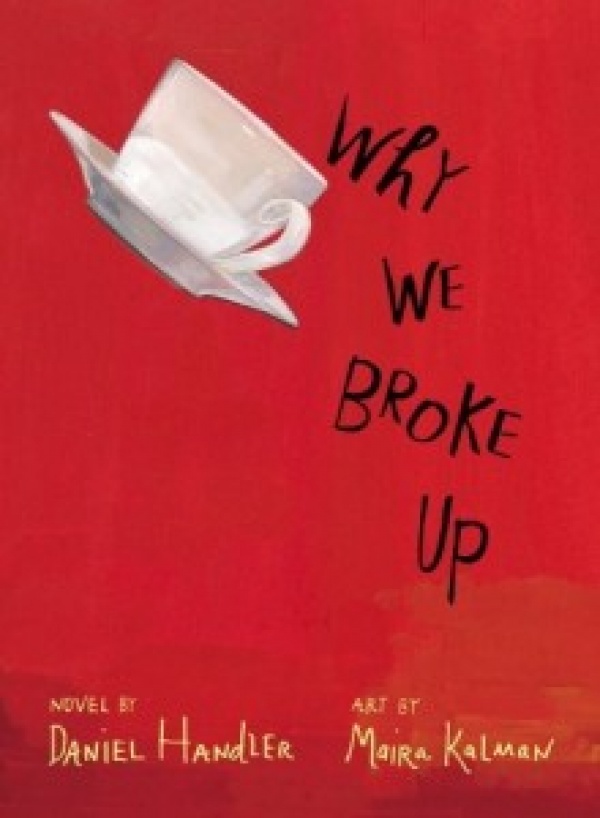
Why We Broke Up – Daniel Handler

whywebrokeup_cover-220x300__span

Daniel Handler has written a book that will resonate with just about anyone – young or old – who has ever had their heart stomped on. Which means YOU will love this book. Yes you.

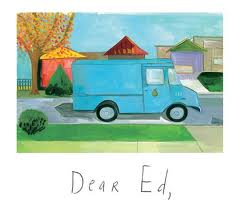
Why We Broke Up is Min Green’s farewell letter to Ed Slaterton, a boy she met at her best friend Al’s Bitter Sweet Sixteenth birthday. As she recounts her brief but meaningful relationship with Ed, hunky co-captain of the basketball team, she also returns to him all the detritus of that relationship.

I’m telling you why we broke up, Ed. I’m writing it in this letter, the whole truth of why it happened. And the truth is that I goddamn loved you so much.

You don’t have to be sixteen to appreciate what’s in Min’s box: the bottle caps and ticket stubs and note on a napkin. Every relationship has its stuff. Min’s relationship with Ed lasted only a few weeks, but as is often the case with the very young, they pronounced their feelings (Ed first) very early on.  They might have seemed, at first glance, totally mismatched. Min, the Jewish girl and movie aficionado and Ed the cool jock with a string of past-girlfriends. But, as Min says: “…the thing with your heart’s desire is that your heart doesn’t even know what it desires until it turns up.”

When I was in grade nine I was madly in love with a boy called Dana. I loved him as only an awkward fourteen-year-old girl can possibly love a much cooler fourteen-year-old boy: from afar. I still have a picture of us taken on our grade nine trip to Prince Edward Island. Me in my Indian cotton shirt and really unfortunate flared jeans, a Bay City Rollers haircut; him in the uniform of the day (and also, perhaps, a Bay City Rollers haircut. Come on, it was the 70s). Anyway. He drank from my coke bottle and I saved that bottle and the inch of pop left at the bottom for years! And I never even got a kiss.

Why We Broke Up is a good bye letter, but it’s also love letter. It’s quirky for sure. (Daniel Handler is perhaps better known as Lemony Snicket, author of the very popular Series of Unfortunate Events books. My 13 year old son is almost through the series and he is constantly reading me bits because he finds them so funny.) The book is illustrated by Maira Kalman and it’s a lovely book – glossy papered and heavy.  brokeupIt’s a clever way to tell an often told story – boy meets girl. Etc.

It’s hard not to feel for Min, though, as she sifts through the mementos, calling up the events associated with them. There’s a story for every artifact and even though she’s giving them all back, the reader understands that her heart will not easily be mended. That’s love for you.

Visit The Why We Broke Up Project


Gone Girl – Gillian Flynn

gonegirl

That I read Gone Girl so soon after finishing Dark Places is a tribute to Gillian Flynn’s talent. With so many books on my tbr shelf, I don’t generally read books by the same author back-to-back. Gone Girl had a few extra things going for it, though. Virtually everyone has been talking about it and I just couldn’t resist its lure any longer.

Nick Dunne and Amy Elliott Dunne are just about to celebrate their fifth wedding anniversary when Amy goes missing. There are signs of a struggle in their rented Missouri home and Nick can’t really account for his whereabouts that morning, so it doesn’t take too long for the police to start treating him like the prime suspect.

Flynn uses a dual narrative approach to tell the story of their courtship and life in New York where Nick was a magazine writer and Amy wrote quizzes for a variety of publications. Life was pretty good for them. They were beautiful, smart and rich. Well, Amy was rich because her parents – Rand and Mary Beth – had written a series of books called Amazing Amy which had, until recently, been a bit of a cash cow. Then Nick and Amy’s fortunes take a turn for the worse and suddenly they find themselves back in Nick’s hometown.

From the start we know that the golden lives of these two protagonists is slightly tarnished. On the morning of the anniversary, Nick’s reaction to his wife’s greeting of “Well, hello, handsome” is one of “bile and dread” inching up his throat. Then: Amy’s missing.

Gone Girl is a supremely entertaining game of cat and mouse. Their married lives had been marked with anniversary treasure hunts and this year is no different. Amy has left the first in a series of clues for her husband. The clues, and the letters which accompany them, seem to indicate Amy’s  awareness of her husband’s unhappiness and her own part in it. But Amy wants to patch things up. The treasure hunt also seems to point to Nick as the person responsible for Amy’s disappearance and slowly the media, Amy’s parents and even his twin sister, Go, start to regard him with suspicion.

But there is more to Gone Girl than a suspenseful mystery. There’s actually quite a damning indictment of the fakery of  relationships; the  potential for infidelity, boredom, entitlement. We want the fairy tale until we don’t. Marriage is hard work. Nick and Amy’s story is extreme, but recognizable nonetheless.

Flynn is a terrific writer. I mean – gifted. She inhabits Nick’s brain as easily as she inhabits Amy’s. They are sympathetic and reprehensible and downright scary in equal measure. To say much more about the plot would be to spoil the novel’s twists. Suffice to say, this is one married couple I wouldn’t be inviting over for dinner any time soon!

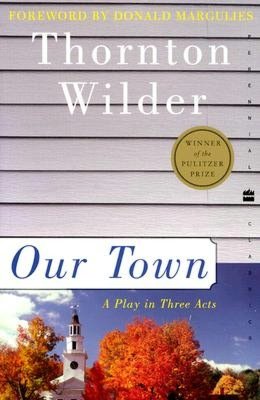
Our Town – Thornton Wilder

ourtownI have loved Thornton Wilder’s Pulitzer Prize winning play, Our Town, since I was fourteen or fifteen. I was trying to figure out how I would have come into contact with it, as I certainly didn’t read it while in school. My best guess is that it was because of Robby Benson, who starred in an adaptation of the play which must have aired on television. If you are a regular visitor to this blog, then you know that Robby and I go way (way) back.

I probably purchased my copy of the play around then – it’s an Avon paperback which, according to the cover, cost $1.75. (I know, eh?) It’s dog-eared and highlighted and marked up and the words contained within still, after all these years, move me.

In the Foreward of the HarperPerennial edition of the play Donald Marguiles, an American playwright and professor, calls Wilder “the first American playwright.” Marguiles further posits that Wilder paved the way for many of the playwrights who came after, and are perhaps better known: Albee, Williams, Miller.

First produced for the stage in 1938, Wilder’s play takes place in Grover’s Corner, New Hampshire. The play is performed on a bare stage. The actors mime their stage business. For theatre goers attending that first production, Wilder’s play must have seemed wildly modern.

“Stripping the stage of fancy artifice, Wilder set himself a formidable challenge,” says Marguiles. “With two ladders, a few pieces of furniture, and a minimum of props, he attempted to “find a value above all price for the smallest events in our daily life.””

Our Town could be any town. That’s the point. The characters on the stage are us. The three act structure of the play mirrors the circle of life: birth, love and marriage, death. One might easily argue that nothing happens. Yet the exact opposite is true: everything happens.

The Stage Manager guides us through the play.  Our Town is a fine example of metadrama; that is a play which draws attention to the fact that it is a play. The Stage Manager acts both as a sort of Greek chorus and bit player. He has the power to alert the audience to events in the future and to allow characters to revisit the past, as he does – famously –  for Emily in Act Three.

The language of the play is simple. Characters speak colloquially. They are just average citizens, concerned with the weather, town gossip, and their children. Even my class of grade ten students were able to see themselves in George and Emily. It is a tribute to the timeless quality of the play that despite the intervening years – from the play’s debut until now –  not much has changed.

DR. GIBBS: Well, George, while I was in my office today I heard a funny sound…and what do you think it was? It was your mother chopping wood. There you see your mother – getting up early; cooking meals all day; washing and ironing  – and still she has to go out in the backyard and chop wood. I suppose she just got tired of asking you. And you eat her meals, and put on the clothes she keeps nice for you., and you run off and play baseball, – like she’s some hired girl we keep around the house but that we don’t like very much.

As a teenager I would have certainly seen myself in that passage. Now, I see my own children.

We are all the same: we are born, we live and we die. The Stage Manager remarks  that even in Babylon “all those families sat down to supper, and the father came home from his work, and the smoke went up the chimney, – same as here.”  It underscores one of the play’s motifs: time and its passing. What do we know of those people? “…all we know about the real life of the people is what we can piece together out of the joking poems and the comedies they wrote for the theatre back then,” remarks the Stage Manager.

In the Joss Whedon’s landmark television show Angel, the title character says “If there’s no great glorious end to all this, if nothing we do matters… , then all that matters is what we do. ‘Cause that’s all there is. What we do. Now. Today.” (Epiphany, 2001)

In Our Town‘s final act Emily comes to the same realization, albeit too late. “Do human beings ever realize life while they live it? – every, every minute?” she cries.

The Stage Manager replies: “No. (pause) The saints and poets, maybe – they do some.”

Perhaps my students aren’t quite ready to acknowledge life’s brevity. I know, for sure, they don’t live “every, every minute.” Why should they? I didn’t. I don’t.

Wilder’s play is a powerful reminder, though, that we should. And that message is as meaningful now in 2013 as it was in 1938.

Bliss – Lauren Myracle

blissBliss Inthemorningdew (no, I’m not joking!) is new at Crestview Academy. It’s tough enough to be the new girl, but Bliss’s life is further complicated by her unusual last name and the fact that her parents are hippies. Bliss has spent her entire fourteen years living in unusual places: a tent, the basement of a college and, most recently, a commune. Now she lives with her very formal maternal grandmother in Atlanta, dumped there by her parents who have run off to Canada to protest the Vietnam War. Or Nixon. Something, anyway. They’re sort of non-entities, in a very strange way.

This is a situation neither Grandmother not I would have chosen, but Grandmother is nothing if not morally upright, which made it impossible for her to turn me away. She’s also uptight, and it seems that often the two go together.

Although life with her Grandmother is odd (at least in the beginning), Bliss is looking forward to having something she hasn’t ever had before: a friend. Soon is she is navigating the impossibly complicated world of teenage drama and it’s a world about which she knows very little.

Lauren Myracle’s novel Bliss isn’t really a coming-of-age story, though. It’s sort of part mystery, part ghost story, part thriller. On some levels it works very nicely; I had no trouble turning the pages as I raced along to the book’s conclusion. In other ways, the book is perhaps a bit bloated. There’s commentary on racism, mentions of the Klan and many of the characters in this book are concerned with Charles Manson and the now infamous murders which took place during the summer of 1969.  Myracle opens chapters with quotes from Manson and quotes from the Andy Griffith Show, perhaps as a way of balancing extreme good and extreme evil. For my money, Bliss might have benefited from a little judicious editing and more of a focus on what was really intriguing:  new girl tries to fit in and gets caught up in creepy hi-jinx.

Bliss is a likable character. I’m not sure I understand why her parents dumped her. She’s smart and kind and open-minded. It was easy to be with her and to fear for her safety. I’m certain teens will find lots to like about this book

The Guardians – @andrewpyper

guardiansAndrew Pyper’s been on my literary radar for a few years now – ever since I read his first novel, Lost Girls. (This was well before I blogged, or even knew what blogging was, so I have no review. I do remember that I thought it was smart, well-written and creepy.) A couple years ago I read Pyper’s novel. The Trade Mission, a book I had some trouble with. Not because of the writing, more because I felt like I was in way over my head.  The Guardians was a much easier read, well, perhaps not easier, but more accessible.

Carl, Ben, Randy and Trevor, the novel’s narrator, grow up in Grimshaw, Ontario. It’s a one-horse town, a place they can’t wait to leave. They are solid friends and have been since they were kids. They play hockey for the Grimshaw Guardians, smoke up in Carl’s car before class and fantasize about Ms. Langham, their young and beautiful music teacher. On one level, The Guardians is about this friendship. But there’s more to this story than four boys making out with their girls and smoking dope.

Because there’s this house which just happens to be across the street from Ben’s house and as Trevor recalls: “it alone is waiting for us. Ready to see us stand on the presumed safety of weed-cracked sidewalk as we had as schoolchildren, daring each other to see who could look longest through its windows without blinking or running away.”

The Guardians opens with Ben’s suicide in the present. Trevor must return to his old stomping grounds to attend the funeral. He’s at a bit of a crossroads, Trevor. He’s recently been diagnosed with Parkinson’s and he’s a man of a certain age (40) and he’s feeling the full force of death’s lingering gaze. Pretty much the last place he wants to be is back in Grimshaw, where he’ll have no choice but to remember certain events from his youth that he has sworn a pact with his buddies to never talk about.

I hope Mr. Pyper will consider it a compliment when I say that The Guardians reminded me a little bit of Stephen King’s brilliant novel, It. I loved that book, not just because it scared the bejeesus out of me  (which, frankly, seems silly now given that the monster was a giant girl spider that lived in a cave) but because of the friendships between the characters – which King always handles so deftly. Pyper does a fine job, too, of giving us characters to care about even when they make bad decisions. And they do; they’re kids.

The house has a part to play, too. It’s long abandoned and creepy as hell and bad things happen there, both real and imagined. Their relationship with the house drives the narrative both in the past and now, present day.

The strength of the story, though, is that it taps into that very human feeling of helplessness, and frailty. Trevor’s feeling it as his body begins to betray him. There’s also this notion of “you can’t go home again.” I’m not a 40 year-old-man, but I understand perfectly that idea of returning to the place of your youth but no longer being young. Trevor feels it when he is reunited with Randy. “That’s what we see in each other’s eyes, what we silently share in the pause between recognition and brotherly embrace.”  Their youth is gone, but they are haunted by it nonetheless.

The Guardians is a sad tale, well told.