Based on Actual Events – Robert Moore

Writing a review of a collection of poetry is not the same as writing a book review. I tried the last time Robert Moore released a collection of poems, The Golden Book of Bovinities. Poetry is a pricklier proposition. (See what I did there with the alliteration and all – just so you know I do get some of those poetic bells and whistles.)

567 Bob and I have known each other for twenty-five years. I met him back in 1991, when I returned to university to finish my Arts degree. He’s only a handful of years older than I am and one of the benefits of being a mature student is getting to know your profs on another level. I loved being in Bob’s class and was thrilled when he agreed to be my honours thesis advisor. We’ve stayed friends over the years and I have always found our conversations entertaining and hard work in equal measure. (Hard in the sense that Bob is off-the-charts smart and has a vocabulary that keeps mere mortals on their toes.)

Based on Actual Events is Moore’s fifth volume of poetry. I’ve got all his poetry collections, but to be honest he started to lose me a little in 2012 with The Golden Book of Bovinities.

The blurb on the back of Based on Actual Events says

Robert Moore gives us a book-length sequence of sleek, fiercely comic, colloquial poems whose aphoristic storytelling is pegged to nostalgia for sublimity. His project is to find frames of reference for our estrangement from the world.

That may very well be what Bob’s trying to do with these poems, but I didn’t get it. (Geesh, I barely got the blurb!) His earlier poems dealt with relationships and his parents and art and, you know, stuff I could mostly relate to. Based on Actual Events is for wicked-smart people, which generally counts me out. That said, poetry in general is often layered and mysterious and requires fortitude.  However,  if you take Billy Collins’ advice and “press an ear against its hive” or “walk inside the poem’s rooms”, a poem will always reward you.

So, that’s kind of my approach reading this collection. I listen for what I like; I walk around in the bizarre rooms Bob’s constructed. I make my own meaning.

25.

Even under enhanced interrogation the vampire

refused to give us anything. And we tried it all,

shit we didn’t even know we could do and still call

yourself human. Nihilo. Zilch. If anything, his smirk

got smirkier, his ass even wiser. And those fangs!

Growing back each time; pellucid as milk,

alert as metal against skin.


So we waited until high noon – both hands reaching for God –

then shoved him out of the van in the Sears parking lot.

It was like you’d lit a gasoline fart. It was like wings

opening inside you.


Over before you could swallow. Seen more ash

at the end of a Virginia Slim. “Holy screaming fuckballs,”

sighed the captain, as much to himself as to the assembled,

we who’d done things we couldn’t even share

with ourselves, never mind over breakfast

or lost weekends, in earshot of our televisions,

which knew every lie in the book.


Anyone who knows me will know why I liked this poem. 🙂

These poems are ironic, often funny (I think) and use a lot of words I had to look up in a dictionary. Whatever, my vocabulary could use some work.


The Dead House – Dawn Kurtagich

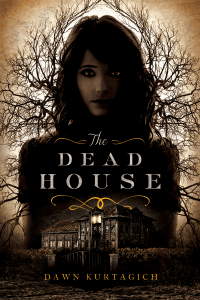
I cannot resist a book with a creepy cover – especially if there’s a  creepy house or building on it and so even though I’d heard nothing about this book and had never heard of its author, I took  a chance on Dawn Kurtagich’s debut novel, The Dead House.

deadhouseThe premise is that investigators are looking into the death of three students at Elmbridge High, a boarding school in Somerset,  England. The school was destroyed by fire.  In order to unravel the story they have gathered police interviews, personal diaries, notes and video tape footage which has been transcribed (although it might have been cool to include links to a site to watch the tape). The incident happened over twenty years ago and as the report statement reveals “little was revealed about the tragedy.”

The incident has been something of an urban legend  connecting Kaitlyn Johnson, “the girl of nowhere” to the blaze. When her diary is found in the rubble, it spurs a new investigation into what actually happened in the days leading up to the fire.

Readers will know they’re not in Kansas anymore from the book’s opening pages. First of all,  we’re at the Claydon Mental Hospital. Kaitlyn has written in her diary:

I am myself again.

Carly has disappeared into the umbra, and I am alone. Ink on my fingers – she’s been writing  in the Message Book.

Good night, sis! she writes. We’ll be back at school soon. I can’t wait.

Turns out Kaitlyn and Carly  are one and the same. Carly, sweet and shy, inhabits the day and Kaitlyn, a little tougher around the edges, inhabits the night. Dr. Lansing, their psychotherapist, says that Kaitlyn is a product of trauma, a personality born of a personal tragedy. The two personalities communicate via a message book. They remind each other of people they’ve met, food they’ve eaten and the minutiae of daily life. Their separate lives happily co-exist.

But then Carly seems to go ‘missing’ and that’s when things take a decided turn into the weirder.  Dr. Lansing considers the disappearance of one personality a breakthrough. She tells Kaitlyn, “Carly is letting you go. It has to happen. It will feel like abandonment, it will be so hard. But, eventually, you’ll find peace. You’ll integrate. Absorb.”

Kaitlyn is convinced that that is not what is happening. She thinks Carly is trapped in the “dead house” and she has to rescue her. Kaitlyn isn’t alone. Naida, Carly’s best friend, is also sure that something sinister is going on – something to do with powerful dark magic.

Whichever way you read The Dark House, as a novel about mental illness or a supernatural horror story, Kurtagich’s novel is unusual and compelling, if not always comprehensible.

The Great Gatsby – F. Scott Fitzgerald

gatsbymal.png

It took me four reads before I finally fell in love with F. Scott Fitzgerald’s Great American novel, The Great Gatsby. I might not have ever read it again after the last time (a couple years ago my book club had a ‘year of classics’) had it not been for the fact that I am teaching grade twelve this year. Often referred to as the quintessential American novel, its place in literary canon is certainly undeniable, but I just never bought in. The Great Gatsby  is my daughter Mallory’s favourite novel and she was understandably flummoxed as to why her English teacher geek of a mother never really liked the book. Now we’re on the same page. If you believe that a classic is a book that never runs out of things to say, this book certainly qualifies. I guess I’m just late to the party.

how-whimsical-2006-great-gatsby-book-coverNick Carraway, the novel’s narrator, moves from the mid-west to Long Island’s West Egg to take a job on Wall Street. Across the bay in East Egg lives his cousin, Daisy Buchanan, and her husband, Tom, an old Yale classmate of Nick’s, a man so “enormously wealthy” he’d brought  “down a string of polo ponies from Lake Forest.”  Nick comments “It was hard to imagine that a man in my own generation was wealthy enough to do that.”

Despite their wealth, Daisy and Tom don’t seem particularly happy and on his first visit with them Nick discovers that Tom is having an affair.  When it comes to the Buchanans, all that glitters is not gold.

Next door to Nick’s little house, and directly across the bay from the Buchanans,  lives Gatsby. His mansion is “a colossal affair by any standard.” Gatsby throws lavish parties every weekend  – huge glittering affairs attended by the who’s who of New York and “In his blue gardens men and girls came and went like moths among the whisperings and the champagne and the stars.”  On the first night Nick attends a party at Gatsby’s he is “one of the few guests who had actually been invited.” Soon after meeting his charming and enigmatic host, Nick finds himself drawn into a compelling love affair between Daisy and Gatsby, a love affair that had actually begun five years earlier.

The Great Gatsby operates on two very distinct levels: as a love story and a social commentary on the decadence and decay at the heart of the American Dream.

Gatsby’s single-minded devotion to Daisy, his desire to wipe out the present and reclaim their shared past drives him to create a sort of fantasy life. Everything Gatsby does is for Daisy and Nick remarks on his “extraordinary gift for hope,” his “romantic readiness such as I have never found in another person and which it is not likely I shall ever find again.” But Nick also acknowledges that perhaps Gatsby wants “too much” of Daisy and cautions him  that “You can’t repeat the past.”

On another level, Fitzgerald’s novel captures the glittery, frenetic 20s. A generation of young men had returned from the Great War, Wall Street was booming and in Fitzgerald’s version, anyway, people cared about little else except having fun.   Underneath the façade, though, there is rot and corruption. No one works except for Nick. They just drink and laze about. Nick sees it and when the veil is pulled back he tells Gatsby, “They’re a rotten crowd….You’re worth the whole damn bunch put together.”

The Great Gatsby is a beautiful novel, I see that now. I am sorry it took so long to believe in the dream.


Coventry – Helen Humphreys

On November 14, 1940, Coventry, a city in England’s West Midlands, was devastated by a German bombing raid that  leveled two thirds of the city, including the city’s cathedral, which was built in the 14th century.

coventry-cathedral-is-extensively-damaged-in-german-bombing-raids-136394373067803901-151113164642.jpg

This event is the backdrop of Helen Humphrey’s 2008 novel, Coventry. The novel captures the horror and chaos of that night as seen through the eyes of Harriet Marsh, a 44-year-old woman who is acting as a fire-watcher on the cathedral rooftop and Maeve, an artist whose 22-year-old son, Jeremy,  is also acting as a fire-watcher the evening the Germans dropped 500 tonnes of explosives on the city.

coventryWith the exception of a flashback to introduce us to Harriet’s husband, Owen, and to allow Harriet and Maeve to briefly meet, the novel spends its time during the ten-hour raid. Although it might be hard to imagine the scene, Humphreys does capture the horrible chaos of that night in simple, unembellished prose.
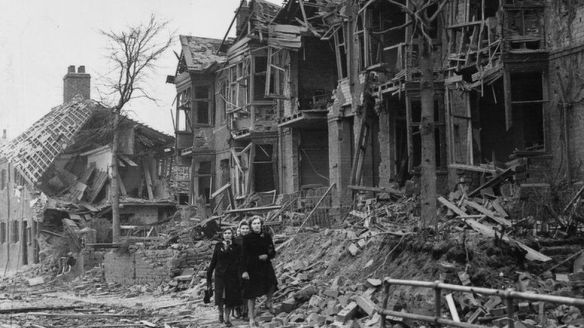
The bombing shakes the ground so that people fleeing through the streets stumble as though drunk. The trembling earth shifts them one way, and then the other, and Harriet finds herself reaching out to steady herself on walls that are no longer standing. She falls in the street, picks herself up from the shaking ground, and falls again.

Nearly 600 people were killed on that night; over 1000 more were injured. It’s perhaps not easy to imagine the chaos, but Humphreys does manage to capture it as Harriet and Jeremy make their way through the city to their respective homes. The horrors of war are all around them: people who have been fatally wounded, people buried under rubble, animals wandering aimlessly. Maeve leaves the shelter of the pub and heads home, but she and Jeremy miss each other.

_86655454_gettyimages-3356152

The British were known for their stoic resilience during the Second World War. Some of that resilience is seen on display in Coventry. In one particular scene, Harriet and Jeremy happen upon a makeshift first aid station and while Jeremy jumps in to help, Harriet wanders off to see if she can’t rustle up some tea. C’mon! It doesn’t get any more British than that.

How did these people cope? They just did what they had to do and when it seemed like they couldn’t go on, they did that, too.

I am a fan of Helen Humphreys. I loved her novel The Lost Garden  which I talked about here.  I also really enjoyed Afterimage, which I read before I started this blog. What I admire about her writing is her ability to capture moments so perfectly. Perhaps that ability comes from having started her writing career as a poet.  I just know that she is one of those rare writers who make you pause and nod your head in agreement.

Coventry is a short novel that, nevertheless, captures the horror and the unexpected beauty to be found amidst  chaos.

To Be Sung Underwater – Tom McNeal

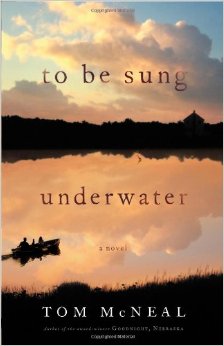
Judith Toomey’s life “swerved” (her word) when she was forty-four. At the time she is a  Los Angeles film editor, married to a successful banker, Malcolm, and mother to a teenage daughter, Camille. Life is okay. Sometimes better than okay.underwater

…there were  whole hours and even days when Judith was visited by a dull ace that in spite of its unspecific origin seemed symptomatic of yearning, but there were also whole hours and days of productivity, good cheer, and reasonable warm fellow-feeling that she presumed she should, to be fair about it, call happiness, or something within inches of it.

But then one day, the “bird’s-eye maple bedroom set, handed down to Judith’s father by his grandparents, and by Judith’s father to Judith, and by Judith to Camille” ends up in a heap by the pool, ready to be collected and disposed of, and something in Judith unfolds, “a slow blossoming of resentment.”

To Be Sung Underwater is the story of a woman who suddenly finds herself in a life she doesn’t understand anymore. It’s not that she doesn’t love Malcolm or Camille, it’s just that a choice she’d made twenty-seven years earlier is something she can no longer ignore. Instead of allowing the furniture to be taken to the dump, Judith rents a storage facility and recreates her teenage bedroom. The space becomes an oasis for Judith –  a place where she can dream and sleep and remember.

And what Judith remembers is her time living with her father in Nebraska. Judith’s parents are separated because, as her father says “Our marriage, like all marriages, was happy until it wasn’t.” Judith’s mother is a free-spirited woman and her lifestyle irks Judith, so she eventually joins her father, an English professor at a small college. They live a quiet existence, sharing music and literature and stories from her father’s past.

Then, when Judith is sixteen, she meets Willy Blunt. He calls her “dangerous” and “his eyes, reaching in, exerted on Judith what felt like a subtle but actual pull, which alarmed her.” A year later, when they meet again, there is no denying their connection.

To Be Sung Underwater resonated with me in ways I am not sure I will be able to articulate. Judith makes her living piecing frames of film together to make a coherent whole, but the pieces of her own life no longer make sense to her. She wants to go back, but as Thomas Wolfe famously said, “You can’t go home again.” She wants to see Willy, and we know from the prologue that she does.

It has been a long time since he has seen her, a very long time, but he would have known her in a second. A fraction of a second. For a moment he feels he might soon waken from a dream, but for once, at last and after all, it is not a dream.

Reading that again, after having spent a few hours with Judith and Willy, is deeply moving. I loved everything about Willy. I loved his wry sense of humour and his deep and abiding love for Judith. I loved Judith, too. She’s smart and thoughtful; she cares about the past. I loved how McNeal’s book  tapped into the everyday moments that make up a life: eating and reading and sleeping and falling in love.

To Be Sung Underwater magnificently captures that very human impulse to revisit what we have lost and to try, where possible, to make ourselves whole again. This is a beautiful novel and I highly recommend it.

Mercury- Margot Livesey

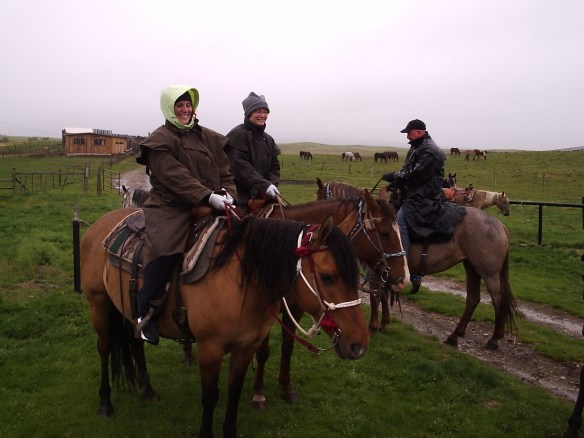
When I was about twelve,  I wanted a horse. Don’t ask me why; I certainly couldn’t tell you now. I’ve had three horseback riding experiences in my life – none of them involved me racing along a forest path or a stretch of beach, one with the horse. The one common theme of those riding experiences is me being terrified. In two instances, the horse decided to run (trot? gallop?) and I was unable to stop the bloody beast. In my 40s, while working for The Canadian Antiques Roadshow, I spent a freezing May afternoon  with some of my colleagues at a ranch outside of Lethbridge. A two-hour trail ride left me with bruises on the inside of my legs. I couldn’t sit comfortably for a week. So horses, after all, not my thing.

OLYMPUS DIGITAL CAMERA

That’s me in the middle. I am only smiling because we haven’t started our journey.

I tell you these stories so you’ll understand why I didn’t relate at all to Viv, one of the two narrators in Margot Livesey’s novel Mercury. Viv and her husband, Donald (the second, and predominate, narrator) live in a rural community outside Boston. Don is an optometrist; Viv runs a stable with her best friend, Claudia. They have two children.

28446368The first section of the novel is narrated by Don, a somewhat stoic Scotsman, who is still grieving over the loss of his father whom he admits he missed “in every way imaginable.” Perhaps this is meant to explain how things at home start to shift without him noticing: finances, his son’s trouble at school, his wife’s growing obsession with Mercury, a new horse being boarded at the stable.
Mercury, true to his name, was unmistakably hot-blooded. The lines of his body, the arch of his neck, the rise and fall of his stride, were, I agreed with Viv reluctantly, beautiful.

And obsession just about sums it up, too, as Viv tries to jumpstart her dream of competing with Mercury. Even though the horse doesn’t belong to her, Viv feels a kinship with him.

At the gate Mercury fixed his large dark eyes on me a nickered softly.  Then he scraped the ground, twice, with his right front hoof, choosing me.

Sadly, for me, I didn’t feel this kinship. Mercury is a novel with a billion things going on and a cast that, even though I read the book over the course of a handful of days, had me flipping back to figure out who they were. And all these characters have stories, too. There’s Don’s mom, feisty widow ready to love again; Jack, a blind (literally) professor who takes up with Hilary, owner of Mercury;  there’s Charlie, stable-girl who also covets the horse; Bonnie, a blip on Don’s devoted husband radar. The only thing keeping all these threads pulled together is Livesey’s prose. I’ve been a fan since Eva Moves the Furniture.

And, yeah, I get the whole Don’s an optometrist (irony!) but doesn’t actually see his wife. And I get that Viv’s devotion to Mercury blinkers her to everything else. And I also understand that Viv feels that Don’s grief over his father is isolating. But for me, there  wasn’t any emotional center in Mercury. I just didn’t buy that a horse could cause such a fuss.

I thank HarperCollins for providing me with my review copy and TLC Book Tours for inviting me to participate in this book tour.


The House at the Edge of the World – Julia Rochester

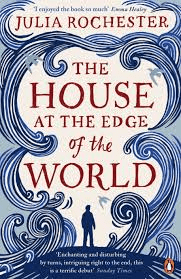
Twins Morwenna and Corwin have grown up on the Devon coast with their unhappy parents, John and Valerie, and their paternal grandfather, Matthew. They are eighteen when the novel begins and their father has just fallen off a cliff to his death. Morwenna, the narrator of Julia Rochester’s compelling novel The House at the Edge of the World says “He was pissing into the brine at Brock Tor on his way home from the pub and fell headlong drunk into the spring tide with his flies open.”

house-edge-worldMorwenna draws us into a gothic landscape where people use language with scalpel-like precision and the characters are not particularly sympathetic.
Take Morwenna herself. I can’t remember the last time I read a book with a first-person narrator that I didn’t really like. Morwenna is prickly and often cruel. Her employer that eighteenth summer tells her she is “a bad-tempered, foul-mouthed little smartarse.” He’s not wrong. The only person she seems to even remotely care about is Corwin, her beautiful and enigmatic twin.

After the death of their father, Corwin leaves Thornton and heads to India where he says he is going to “move water.” Morwenna goes to London, first to school and then to a job as a book-binder. It’s incongruous to her personality – the care she takes to make these beautiful hand-crafted books with their embossed leather covers and beautiful end-papers.

Then Morwenna tells us “For seventeen years after my father’s death nothing much happened and then a pigeon flew through my window.” It’s a sign, surely. Corwin comes home and the siblings, again in each other’s orbit, start to pull at the thread of their family history.

Much of this history is captured in the map their grandfather, Matthew, has been painting for as long as they can remember. The map captures both the landscape and the history of their ancestral home and soon becomes an important clue in the mystery of Morwenna’s father’s life and death.

Even more intriguing to me is the relationship between Morwenna and her brother. To say it’s complicated would be the understatement of the year. His arrival back in England after a long absence offers Morwenna only “one last  lazy unspoiled afternoon” before Matthew’s map and their childhood home spills its secrets.

I really liked The House at the Edge of the World. The language is beautiful. There is an element of idioglossia between Morwenna and Corwin.  They are endlessly compelling even if you don’t particularly like them. The same is true for the rest of the characters. Only Valerie, when she finally moves away from Thornton, seems to manage a modicum of happiness.

I am not satisfied with the way I am talking about this novel. Gah! It’s probably because I don’t want to give anything away and I also have all these conflicting emotions about it. So let me just say this:

Highly recommended.


The Dogs – Allan Stratton

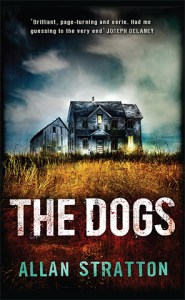
Cameron and his mom have been on the run for as long as Cameron can remember. the_dogs_uk_cover_med_frontCameron’s dad is dangerous and they’ve never been able to stay in one place for very long. This last move takes them to a farmhouse in the middle of nowhere, outside of a small town called Wolf Hollow.

“Whoa! Somebody! Put this place out of its misery.” That’s how Cameron describes the two-storey, ramshackle building he and his mom are going to call home. Mom notes the two staircases and says “It’s good to have more than one escape route…in case of fire.” Mr. Sinclair, the old farmer who owns the house, is secretive and slightly menacing.

But Cameron’s creepy father isn’t the only creepy thing going on in Allan Stratton’s YA novel The Dogs. Cameron discovers some drawings and a photograph in the coal room and the discovery connects him to a strange mystery that has haunted the farmhouse for decades. One of the drawings depicts “a pack of wild dogs ripping things apart.” Further investigation reveals that the previous owner, Mr. McTavish, was ripped apart by his dogs after his wife and son, Jacky, ran off with another man.

The clever things about The Dogs is that it operates on many different levels. As Cameron spends more and more time trying to figure out what really happened in the farmhouse all those years ago, he also begins to question his own memories of his father. Is his mother telling him the whole truth or is she leaving out essential details? Is his dad really as bad as his mother says?

Cameron’s traumatic childhood makes him especially suggestible and readers will share every spooky bump-in-the-night incident with him as he tries to reconcile his memories with what is happening in the house. Is he crazy, as his mother worries he might be, or are the things he sees and hears really happening?

“It’s not my fault I picture things, or talk to myself. If I try to keep all the stuff in my head inside, I’ll explode,” Cameron explains to his mother.

The Dogs is written in straight-forward prose, which will appeal to many young readers particularly reluctant readers. I think any reader will enjoy the book’s eeriness and honest portrayal of a teenage boy who despite his own difficulties shows tremendous resilience. I know I did.


All The Rage – Courtney Summers

Courtney Summers is Canadian – let’s just get that out of the way– and I am extra disposed to courtney-summers-all-the-ragelove her because she’s, you know, Canadian. Like Ryan Gosling is Canadian. And ketchup chips. Okay, now I am just putting off talking about All The Rage because reading Summers isn’t like reading other YA writers. She hits you hard right in the solar plexus. Every. Time.
Romy Grey used to be on the inside — until a party  changes everything.  Now she finds herself navigating the shark-infested waters of her high school and her small town, Grebe, where everyone knows everyone and all those everyones are subservient to the Turners — the town sheriff and his business-owner wife.

When Romy wakes up in a ditch, disoriented and with no memory of what’s happened to her, it brings her back to another night when a beautiful boy  — a boy she wanted — rapes her in the back of his pick-up truck.

…how do you get a girl to stop crying?

You cover her mouth.

Romy never tells anyone what this beautiful boy, Kellan Turner (one and the same) did to her. Instead, she pushes the trauma of it as far down inside as she can and protects herself by painting her nails and lips red. But this second incident  — the waking up on the side of the road – starts to unravel Romy. Things are further complicated by the fact that another girl, Penny, is missing. Penny and Romy used to be friends, but are no longer.

There is so much going on in All The Rage. And, frankly, Summers’ timing couldn’t be any better. We live in a world that blames the girl and, regretfully, never really holds the boy accountable. One need only recall the circumstances surrounding the victim in the Brock Turner rape case to realize how inadequate society’s reaction to these horrific events is. (The link will take you to the victim statement, which should be required reading.)  And almost more problematic is the fact that often women don’t stand with women in these cases. Romy finds herself isolated and bullied mercilessly by other girls, which I find incredibly disturbing.

Girls are told what they can and can’t wear — an ongoing issue in every single high school, I am sure — because a visible bra strap or a too-short skirt is clearly an invitation to be assaulted. The victim-blaming is insidious.

It’s all too easy for Romy to be victimized. She was never really part of the gang. Her father was the town drunk. She’s from the wrong side of town. Now everyone blames her for Penny’s disappearance. It’s no wonder that Romy starts to come apart.

At the checkout, it’s just boys at the registers and I can’t stand the idea of them knowing what I wear underneath my shirt. I tell Mom I have a headache, give her my wallet,  and wait in the car while she pays for it all. I wish I didn’t have a body, sometimes.

There are some good things in Romy’s life. She lives with her mother, who is awesome, and her mother’s new boyfriend, Todd – whom I LOVED, btw. He’s one of the good guys. Leon, the cook at the diner where Romy waitresses, genuinely seems to care for her.

All The Rage tackles a difficult subject with respect and tremendous insight. Romy is a beautifully drawn character, fragile and tremendously brave in equal measure. If I wasn’t already a huge fan of Summers’, I certainly would be after reading this book.

Highly recommended.

Also read: Some Girls Are, This Is Not a Test

The Wicked Girls – Alex Marwood

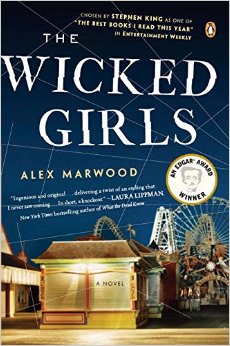
wicked.jpgIt’s 1986 when eleven-year-olds Jade and Bel meet in the village store. Their paths weren’t likely to have crossed before because Jade is one of the notorious Walkers – a family from the far side of the tracks – and Bel lives in a fancy house with servants. This fateful meeting is to change the course of the girls’ lives forever because by the end of it another little girl will be dead and Jade and Bel will be arrested for the murder.

This isn’t the only thing happening in Alex Marwood’s novel The Wicked Girls, though.

There’s Amber, head cleaner of Funnland, a boardwalk amusement park in the seaside town of Whitmouth (I imagined Blackpool only smaller and seedier). She lives with Vic, a handsome but slightly passive-aggressive carny. Amber lives a quiet, tidy life. She takes pleasure in overseeing her crew of cleaners and helping them when she can. When Amber discovers a dead girl in the park’s  hall of mirrors, her life becomes significantly more complicated.

Then there’s Kirsty , a freelance journalist married to Jim, an out of work  IT guy, and mother to a couple children. When the body is found at Funnland, Kirsty finds herself on assignment and inevitably comes face-to-face with Amber, the last person she’d ever expected to see again.

The reason: after their release from prison,  Jade and Bel were given new identities and cautioned about ever making contact with each other again. Not that the girls were likely to meet; they barely knew each other to begin with.

Marwood balances the story of Jade and Bel, unspooling the narrative of what happened that long ago day with the present day  Amber and Kirsty, two women who have made a desperate attempt to reinvent their lives.

As if that weren’t enough, let’s not forget Martin, creepy Whitmouth resident. He’s been rebuffed by Jackie, one of the Funnland cleaners. He’s clearly deranged and

the rage of rejection crawls beneath his skin; invisible, unscratchable. All she needs to do is text him back. He doesn’t want to go out, but if she refuses to respond he’s going to have to. As his mother was always assuring him, persistence is the most important quality in life. And he knows he is the most persistent of all.

The seemingly disparate threads of Marwood’s novel do come together, but whether you find the ending satisfying or not will depend on how you like your mysteries. There were a few super tense moments in The Wicked Girls, but there were also moments I found really slow going – not superfluous exactly. I guess I just like a little more ass-kicking and a little less naval-gazing in my thrillers. That said, the characters were definitely nuanced and sympathetic and the writing was good, but over-all I would have to say  The Wicked Girls is more slow burn than page-turner. That’s not necessarily a bad thing, though.