The Burning Air – Erin Kelly

burning airI was a big fan of Erin Kelly’s novel The Dark Rose and so I was very much looking forward to reading The Burning Air. Kelly is a terrific writer, which is what saved The Burning Air for me because while the writing was great and I certainly had no trouble turning the pages, I just thought it was a lot of fuss for nothing.

The MacBrides have it all. Dad, Rowan, is the headmaster at a prestigious school; mom, Lydia, is a magistrate, and then there are three adult children: Sophie, Tara, and Felix. The novel opens with a deathbed confession. Lydia writes:

Of course it was love for my children, love for my son, that caused me to act as I did. It was a lapse of judgment. If I could have foreseen the rippling aftershocks that followed I would have acted differently, but by the time I realized the extent of the consequences, it was too late.

When Sophie, Tara and Felix and their families arrive to spend a weekend with their father at the family’s special getaway, Far Barn in Devon, it’s clear that the death of their mother has caused some collateral damage. But there were cracks in the family’s perfect façade anyway. And they aren’t the only ones with secrets.

Darcy also has a connection to the MacBride family. I am carefully going to avoid saying too much about Darcy, other than to say that they are filled with vitriol for the MacBride family. Their lives intersect when Darcy interviews for a place at Rowan’s school and fails to make the grade, so to speak. What happens next sets the course for all their lives.

The novel flips back and forth between present day and back when Darcy and Sophie, Tara and Felix were children, mostly concentrating on Sophie’s 3rd person and Darcy’s first person narrative.

There is a lot of stuff happening in The Burning Air, complicated resentments and personal trauma. Darcy’s revenge plot seems over-the-top considering its impetus, but the thing about Kelly is that she can manage to make just about anything believable. I believed in Darcy’s hatred towards the MacBrides, but I felt that underneath all that pent up anger was little more than hot air and when the denouement finally arrived, it felt rather like a fallen soufflé.

That said – The Burning Air is way better than a lot of books in the genre and I will definitely be checking out the third Erin Kelly book on my TBR shelf: The Poison Tree.
Look For Her – Emily Winslow

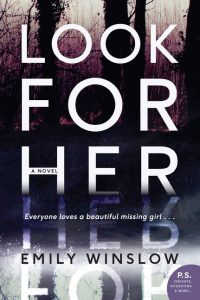
Look-for-Her-cover-200x300I have a feeling that I am going to be in the minority here, but I didn’t really groove to Emily Winslow’s Look For Her. This is the fourth book in a series featuring British detectives Morris Keene and Chloe Frohmann, but I didn’t know that going in and I don’t think it really matters in terms of your enjoyment (or in my case lack of) when reading the novel.

Back in 1976, Annalise Wood disappeared. Years later, another Annalise brings her up in a therapy session with Dr. Laurie Ambrose.

…she went missing when she was sixteen. My mother was the same age when it happened. Annalise was lovely, much prettier than my sister and I ever became. She was the kind of girl you look at and think, Of course someone would want to take her.

The body wasn’t found until 1992 and DNA didn’t yield any results at the time, but now there’s been a break in the case.  Keene (who is no longer an active detective) and Frohmann (who has recently had a baby) reunite to follow the trail of new evidence. The pair are prickly with one another; they have clearly had a falling out in a previous installment of the series.

You’d think that all the elements for a compelling mystery would be there, right? Decades old mystery. New evidence. Unreliable narration. So what didn’t work?

Look For Me lacked momentum. Told through transcribed therapy sessions and multiple points of view (the detectives, the therapist, e-mails), I just couldn’t settle into the narrative. (Trust me, multiple narratives aren’t usually a problem for me.)  There are a lot of characters to keep track of (also generally not a problem), and complicated family relationships. Perhaps I would have been more inclined to try to untangle the threads if I had cared one iota for any of the characters, but I didn’t.

So it’s weird that I didn’t like this book because it had all the right ingredients and it should have added up to a big win for me. To be fair, because I didn’t read it in one breathless gulp (as is often the case with books like this) I found the story way too convoluted. Part of what was unsatisfying to me was how neatly all these disparate threads were woven together at the end: perhaps just a little too neatly.

My dissatisfaction aside, Winslow can certainly write and I suspect that fans of the series and the majority of the readers who enjoy twisty mysteries will like this book.

Thanks to TLC Book Tours and Harper Collins for the opportunity to review this book.


My Sunshine Away – M.O. Walsh

My-Sunshine-AwayJust when I thought my reading slump was never going to end, I read M.O. Walsh’s compelling debut novel My Sunshine Away. I can’t even begin to tell you how much I loved this book – start to finish.
The unnamed adult narrator is recalling the time between ages 14 and 16, when he lived with his mother on Piney Creek Road, in an affluent area outside Baton Rouge, Louisiana. He’s obsessively in love with Lindy Simpson, the beautiful fifteen-year-old track star who lives across the street. After Lindy is raped, our narrator’s life is irrevocably changed. Through his eyes we try to unravel the mystery of who hurt Lindy and so, in that respect, My Sunshine Away is a total page-turner. But it is so, so much more than that.

First of all, Walsh evokes a sense of time and place that is both exotic (I have never been to Louisiana, although I would love to visit once Trump is no longer in office) and familiar. Set in 1989, the book’s sense of time and place is practically nostalgia now. The children on the street get together and play football, go fishing, wander the woods, gather piles of moss. It’s pre-Internet and so reminiscent of my own childhood despite the fact that it’s 20 years later. You know, back when kids played outside. With each other.

The main character is completely authentic. From his vantage point as an adult, he spills both the varnished and unvarnished truth about those two turbulent years when he watched Lindy so closely that readers might actually believe he could have had something to do with her attack. He even admits that  he was “one of the suspects”,  but then begs the reader to “Hear me out. Let me explain.”

There was something about My Sunshine Away that reminded me of Thomas H. Cook.  This is a compliment. Really. At his best, Cook writes literate mysteries that often plumb the complicated depths of family and memory. I couldn’t help but think of Cook while reading Walsh because Cook’s characters are never stereotypes. They are so fully realized that his novels always feel like  much more than just a straight-up mystery. This was true of My Sunshine Away, also. Like our narrator, we want to find out who had hurt Lindy, but we also want to come to terms with the narrator’s relationship with his father who has left the family home, and his wife and son bereft. We want to see him work his way through his awkward adolescence. This is  a bildungsroman done so well that your breath will literally catch in your throat.

The narrator’s self-awareness is so profound that it takes My Sunshine Away to another level entirely.

And it is not until times like these, when there are years between myself and the events, that I feel even close to understanding my memories and how the people I’ve known have affected me. And I am often impressed and overwhelmed by the beautiful ways the heart and mind work without cease to create this feeling of connection.

I highly and wholeheartedly recommend this book.


Turtles All the Way Down – John Green

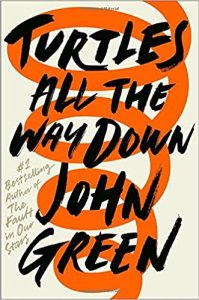
turtlesI have a deep and abiding love for John Green. He’s a passionate advocate for reading and learning. He makes nerdish pursuits cool and I think he’s a terrific writer. Lord knows, I was a sobbing, snotty mess at 2 a.m. finishing The Fault in Our Stars. I was pretty excited, then, to get my hands on Green’s latest book, Turtles All the Way Down.

Aza is sixteen and suffers from almost debilitating mental illness. She has no control of her thoughts and her thoughts take her to some pretty unusual and scary places. Even the simple act of eating is problematic for Aza who finds “the whole process of masticating plants and animals and then shoving them down my esophagus kind of disgusting, so I was trying not to think about the fact that I was eating, which is a form of thinking about it.”

Still, she finds ways of coping. Daisy, for example, “played the role of my Best and Most Fearless Friend.” And then there’s Davis Pickett, a childhood friend with whom Aza reconnects after she reads in the paper that his billionaire father, Russell, has disappeared.

There’s not really a plot, but that’s not to say that nothing happens in the novel. Aza and Daisy decide they are going to play detective and figure out what happened to Russell. That leads to Aza and Davis picking up their friendship and discovering that they might have feelings for each other, which is complicated by the fact that Aza has spiraling thoughts. She fixates on things and can’t seem to stop, which leads her down a rabbit hole of worry. I suspect that anyone who suffers from anxiety or mental health issues will totally get Aza’s erratic thoughts. I didn’t, especially, but I thought Green did a tremendous job of illustrating how Aza gets trapped in her own head.

The sting of the hand sanitizer was gone now, which meant the bacteria were back to breeding, spreading though my finger into the bloodstream. Why did I ever crack open the callus anyway? Why couldn’t I just leave it alone? Why did I have to give myself a constant, gaping open wound on, of all places, my finger. The hands are the dirtiest parts of the body. Why couldn’t I pinch my earlobe or my belly or my ankle? I’d probably killed myself with sepsis because of some stupid childhood ritual that didn’t even prove what I wanted it to prove, because what I wanted to know was unknowable, because there was no way to be sure about anything.

Green has spoken quite openly about his own struggles with mental health. In an article with Time he said: “I still can’t really talk directly about my own obsessions. The word triggering has become so broadly used in popular culture, but anyone who has experienced an anxiety attack knows how badly they want to avoid it. It was really hard, especially at first, to write about this thing that’s been such a big part of my life. But in another way, it was really empowering because I felt like if I could give it form or expression I could look at it and I could talk about it directly rather than being scared of it. And one of the main things I wanted to do in the book was to get at how isolating it can be to live with mental illness and also how difficult it can be for the people who are around you because you’re so isolated.”

Turtles All the Way Down does not simplify Aza’s problems and there are no happy endings here, but I do believe this is a hopeful novel. And while it didn’t leave me a sobbing mess like The Fault in Our Stars there is much to admire here. Green remains one of my favourite YA writers.

That Was Then, This Is Now – S.E. Hinton

that was thenBack in the day, there probably wasn’t a teenager alive who hadn’t read The Outsiders, S.E. Hinton’s first novel. Written when Hinton was just sixteen and published around the time she graduated from high school, The Outsiders tells the story of the Curtis brothers Darry, Soda, and Ponyboy. It’s considered the seminal young adult novel and remains a classroom favourite almost 50 years after its publication.

I read it as a teenager, of course. Then I read Hinton’s second novel, That Was Then, This is Now and I remember that it had a profound impact on me. So, when it came time to choose the novel I wanted to begin my first ever Young Adult Literature class with, I chose Hinton’s second book – mostly because I knew that although many students would be familiar with The Outsiders, they might not know this book. Plus, it gave me an excuse to read it 40 odd years later after my first go-around.

That Was The, This is Now treads familiar ground (and in fact Ponyboy even makes an appearance in this book). It concerns the fates of Bryon, the novel’s sixteen-year-old narrator and his boyhood best friend and de facto brother, Mark.

I had been friends with Mark long before he came to live with us. He had lived down the street and it seemed to me that we had always been together. We had never had a fight. We had never even had an argument…He was my best friend and we were like brothers.

The two boys live a relatively hard-scrabble life with Bryon’s single mother mom. They hustle pool, chase ‘chicks’ and generally get up to no good. Occasionally, they meet up with M&M, a younger kid from their neighbourhood.

M&M was the most serious guy I knew. He always had this wide-eyed, intent, trusting look on his face, but sometimes he smiled and when he did it was really great. He was an awful nice kid even if he was a little strange.

That Was Then, This Is Now  is a coming of age story. The catalyst for Bryon’s transformation from dime-store hood to responsible young adult is his blossoming relationship with M&M’s older sister, Cathy, and an incident which puts M&M in harm’s way.

There’s no question that some of the references are dated. It was kind of funny to read about hippies and parents who are cross with their kids because their hair is too long. On the other hand, although styles come and go, some things remain the same. Parents and their children still have disagreements. Lots of teenagers are left to their own devices, as Bryon and Mark often are. There were several moments in the book that felt as relevant and fresh to me now as I am sure they did then.

Ultimately, Bryon must make a decision that changes the course of his life. It’s a hard epiphany to swallow, but it’s one that makes That Was Then, This Is Now as relevant as it was when it was first published.

Off the shelf – looking ahead to 2018

I am not one to make New Year’s resolutions because it just makes you feel more miserable when you fail, but I do resolve to be a better reader in 2018. I am outing myself here, but 2017 was not a good reading year for me. If I look back at the titles I read in 2017 – there are really only a handful of memorable books, and I think I sort of got into a reading rut. My expectations were really high, but after a few bad reads I just sort of lost the plot, so to speak. So – as I look ahead to 2018 I am going to make a few changes in my reading life, not only in an effort to read more, but just in an effort to waste less of my precious free time. (Candy Crush – I’m looking at you!)

According to an article by Charles Chu at Better Humans, it is actually possible to read 200 books per year. 200! He did the math and that’s helpful for those of us who are mathematically challenged. Apparently, it would take the average reader about 417 hours to read roughly 10 million words at 400 wpm. And where are these hours coming from? Um – the average American, so let’s just say North American – wastes 608 hours a year on social media and 1642 hours per year on TV. Talk about a time suck. So, if you want to read more – put down your electronic devices and pick up a book

There are all sorts of reading challenges out there – something for book lovers of every stripe –  some that encourage you to Read Harder (as Book Riot’s challenge encourages you to do); or  PopSugar’s 2018 Reading Challenge. These sorts of challenges just give you a list of categories  and your job is to read a book that fits. Categories include things like “A book set at sea” or  “A  book with an ugly cover”. The one challenge I do every year is on GoodReads – which requires  nothing more from me than to decide how many books I am going to read over the course of  the year. I guess that’s 200 this year, right?

I think reading challenges can be good motivators – even just as a way to remind yourself to read (and no, Facebook doesn’t count!) – or as a way to help you decide what to read next if you get stuck. Also – if you tend to  read the same sort of book over and over, a reading challenge might encourage you to read outside of your comfort zone and that’s never a bad thing.

Book clubs are another great way to guarantee you’ll read this year. My book club has been at it over 20 years and although we have certainly read our fair share of duds – we’ve read a lot of great books, too. Book clubs are easy to start and can be as simple as meeting at a local coffee shop/ bar to discuss the book to hosting elaborate meals at members’ houses to discuss the book. All you need are a handful of people willing to read and meet on a regular basis and a few ground rules. I think the best way to find a book club is to ask around, but there is also a local chapter of Girly Book Club  – which is an international reading group started in the UK in 2014 and now boasts clubs in 6 countries. Kinda cool.

As for my own reading list for 2018? Oh dear. The list she is long.

At the top is John Green’s Turtles All the Way Down.

turtlesI love John Green and I bought this book pretty much as soon as it came out…and it’s been on my bedside table ever since. I know it’s easy to hate on John Green – but I kind of love him and he totally loves teenagers and writes them so well. Turtles all the Way Down is the story of Aza, her best friend Daisy, and Davis, the son of a missing millionaire who has disappeared. Aza is determined to find him to claim the reward.

I am also most anxious to read Celeste Ng’s second novel Little Fires Everywhere.

 You might recall that I was in love with her debut novel Everything I Never Told You alittlefires couple years back. Little Fires is set in the late 1990s in Shaker Heights, Ohio and is a story of  both a literal fire (one of the main characters watches as her house burns down in the novel’s opening pages) and figurative fires: race, rebellion, family tensions. By all accounts it is a literary page-turner. So I am looking forward to that,

I am also really looking forward to reading Gabriel Tallent’s My Absolute Darling

myabsolutedarlingThis is Tallent’s debut novel and despite the tricky subject matter – sexual abuse – the reviews have been uniformly fantastic. Stephen King called it a ‘masterpiece’ if you care about that sort of thing. It’s probably helpful to know going in that this is the story of Martin, a survivalist, and his fourteen-year-old daughter, Turtle and that – from the sounds of things – there is plenty to make readers super uncomfortable, but it’s also been called “a devastating and powerful debut.” So I have to read it.

Then of course, I will be adding scads of new titles to my reading queue courtesy of Litsy and the dozens of Best Of and Most Anticipated lists out there. I’m pretty certain my 2018 reading year is all booked.