The Black Flamingo – Dean Atta

Although I do not know this for sure, Dean Atta’s novel-in-verse The Black Flamingo feels like a very personal story. Atta tells the story of Michael, born in London to a Greek Cypriot mom and a Jamaican dad who exits the family shortly after Michael is born.

“…six days before the millennium,/ she burned their Christmas dinner/ and he shouted, “You’re useless!”/ before throwing his plate down, turkey/ stuck to the kitchen floor. and I cried,/ startled by early indoor fireworks./ That was the end for them. The beginning/ for Mummy and me.”

Atta unspools Michael’s story, which is the story of someone who isn’t quite Greek enough or Jamaican enough, and definitely not straight enough, a fact he seems to realize relatively early on. When he is just six he tells his mother “If you only get me one present/ this year, please can it be/ a Barbie?”

I can relate to that. My son was totally enamoured with Bratz dolls when he was a kid. And long hair; he desperately wanted long hair, so eventually we got him a hat with all these long braids sewn along the edges. He wore that thing constantly.

The next year Michael tells his mother he wants to change his last name to hers, a request that earns him “the longest hug I’ve ever had.” (Nineteen seconds!)

The novel traces Michael’s adolescence, his friendship with Daisy, and finally his journey to attend university in Brighton. It is here that he finds his people at Drag Society, and ultimately himself.

“I’m just a man and I want/ to wear a dress and makeup on stage./ I want to know how it feels to publicly/ express a side of me I’ve only felt privately/ when playing with my Barbie as a boy.”

The Black Flamingo is a coming-of-age story, a story about identity and family, and it is lovely and lyrical and hopeful, too.
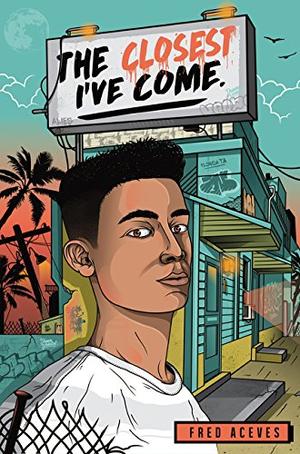
The Closest I’ve Come – Fred Aceves

This year in my grade ten English class we’ve decided to try something new: podcasts. I have never made one and have only recently started to listen to them, but one of my colleagues and I thought it might be a great, non-traditional way for students to show their learning. We hooked up with a local organization called Brilliant Labs for the tech-y stuff and paired students up to read books that dealt with the topic of coming of age, which is this term’s big idea. Then, my colleague and I decided that we should give it a go, too.

We read Fred Aceves debut novel The Closest I’ve Come which tells the story of fifteen-year-old Marcos Rivas who lives in Tampa, but not in the part of Tampa tourists see. His mother seems sort of checked out and her boyfriend, Brian, is a bully. Marcos notes “With every step home my bones are getting shakier.”

He moved in last summer, just before the worst heatwave in a decade, but the strangling humidity didn’t faze him none. The douche sat in the armchair (my armchair when my mom’s between boyfriends) with the fan pointed at himself. Even with me and my mom also watching TV, even though the fan has an oscillating setting, it forever pointed his way.

Things are pretty grim for Marcos. They’re poor, he struggles in school, some of his friends are borderline criminals and although he dreams of getting out of the hood, he doesn’t really know how he’s going to accomplish this. Then an opportunity lands in his lap.

Congratulations! You’ve been selected to take part in a new, exciting program.

The exciting program is an after-school group which is meant to provide enrichment to students with potential. One of those students is a take-no-prisoners girl named Amy who Marcos has admired from afar for many months. Marcos muses: “Me and Amy got something in common, even if it’s only this. Us together ain’t crazy. It might be fate.”

Marcos’s experiences in the class and interacting with students he might not normally interact with helps him realize his potential. He learns that while it might be nice to figure out how to fit in, it’s also important to remain true to one’s self. Watching him struggle to play the crappy hand he’s been dealt is inspiring, especially because nothing comes easy for him.

I really enjoyed The Closest I’ve Come.

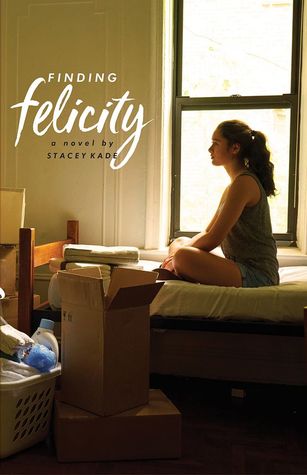
Finding Felicity – Stacey Kade

Although I was much older than the show’s target audience, I fell madly in love with the J.J. Abrams/Matt Reeves coming-of-age drama Felicity (1998-2002). In the show, Felicity Porter gets the boy she’s loved from afar, Ben Covington, to sign her yearbook on graduation day, and what he writes causes her to abandon her post-secondary plans and enroll at NYU, which is where Ben is going to university. The series’ four years follow Felicity through her friendships and relationships and decisions, both good and bad, and it is all must-watch television. I still love the show and rewatch it start to finish every couple of years.

In Stacey Kade’s YA novel Finding Felicity, eighteen-year-old Caroline Sands has just graduated from high school, meaning she’s leaving the mess of the last few years behind and hoping for a fresh start when she starts at Ashmore, a small liberal arts college in Iowa, in the fall.

After her parents’ divorce, Caroline and her mom moved to Arizona, and she just never really found her people. Instead, she found Felicity, so when her mom asked her about school and her friends, she just told them about the characters from the show. What could go wrong with that?

Ashmore is supposed to be Caroline’s new beginning, a chance to reinvent herself and make new friends. She neglects to tell her mother that part of the reason she wants, no needs, to go to this school is because Liam Fanshaw — her Ben-equivalent — is going there, too. What could go wrong with that?

Finding Felicity will speak to anyone who has ever felt uncomfortable in their own skin and desperately just wants to fit in. Caroline is awkward, for sure, but mostly she lacks confidence. That’s relatable, I think. Common wisdom would suggest that a new place doesn’t equal a new you and sometimes figuring it out is hard, but not impossible. Caroline makes a few missteps, but ultimately starts to craft the life she has wished for, and many teens will enjoy the journey.

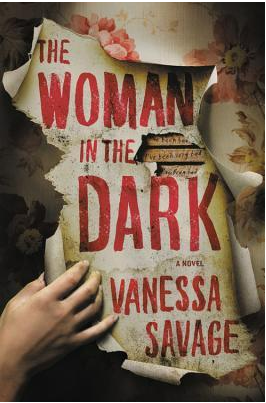
The Woman in the Dark – Vanessa Savage

Sarah and Patrick are “happily” married and have two teenage children, Mia and Joe. Sarah is just starting to emerge from a long depression, brought on by her mother’s death. She’s still fragile. Patrick thinks what they need is a fresh start and he announces that the house where he grew up is available for sale and they should buy it and move. Just one tiny problem: fifteen years ago, the family who was living in that house — all but one survivor — was stabbed to death by a crazy person. What could go wrong?

Turns out, quite a lot does go wrong in Vanessa Savage’s debut The Woman in the Dark. And, unfortunately, that’s part of the problem with the book. It’s too bad because the book had a lot of promise. If you were playing a drinking game and had to take a drink for every trope, you’d be sloshed by the novel’s halfway mark.

I don’t want to step inside that house, but Patrick doesn’t see what I see when I look at the picture. He sees the beautiful Victorian house he grew up in, with its pitched roof and gabled ends – a fairy-tale house before it became a country House of Horrors. He sees happy memories of a childhood lived by the sea. He doesn’t imagine blood on the walls or whispering ghosts. He doesn’t see the Murder House, but I do.

Unfortunately for Sarah, that early intuitive insight doesn’t sustain her. She’s an unreliable narrator surrounded by people who keep secrets. And instead of a classic haunted house story, which might have been a more successful route, Savage chucks everything she could think of at the story, hoping that some of it would stick. It’s too much and not all of it lands successfully.

There’s Sarah’s mental health issues, gaslighting, isolation, creepy gifts left on the doorstep of their new home, people who are not who they seem, people who are who they seem, and you should have known it, secrets galore — some of them which inform the story’s narrative, but should have been spilled long ago, teen angst, writing on the walls (literally), domestic violence, a creepy basement…the list goes on. I kind of felt like the book didn’t really know what it wanted to be, which was too bad because I think the writing was pretty decent, and I was certainly hopeful when I started reading, especially because the book garnered copious praise.

It was a miss for me, but I would certainly be opening to reading more from this author.

Every Exquisite Thing – Matthew Quick

Nanette O’Hare is trying to figure stuff out in Matthew Quick’s (Forgive Me, Leonard Peacock) YA novel Every Exquisite Thing. She’s a straight-A senior, and a super-star soccer player from an affluent family, so on the surface one might assume that Nanette has got it all going on. But it’s not true. Since mid-way through her junior year she’s been eating lunch with her English teacher, Mr. Graves, and avoiding her bestie, Shannon, whose questionable sexual escapades had started bothering Nanette back in middle school.

One day Mr. Graves hands her a tattered copy of Nigel Booker’s novel The Bubblegum Reaper, a book that Mr. Graves claims changed his life.

It’s maybe not the most literary work in the world. Probably a bit dated. But it’s a cult classic and I have a feeling that it might be the perfect read for you. Maybe even a rite of passage for people like us.

The Bubblegum Reaper does, in fact, have a tremendous impact on Nanette’s life. The book’s author lives in her home town, and Mr. Graves arranges for the two to meet.

Spending time with Booker was becoming an addiction, mostly because it was the only part of my day when I felt like I could be myself – or maybe like there was one person in the world who didn’t want me to be something I didn’t want to be or to act a certain way or to go along with everything that others pushed into my life.

Through Mr. Booker she meets Alex, a boy her age who writes poetry. The bond between the two teens is cemented as they talk about the book and share their own feelings of isolation and disenfranchisement.

It is through these relationships that Nanette is able to shake off some of the personas she’s adopted over the years. She starts to say no when she might have just said yes and, ultimately, though certainly not without some heartache, Nanette is able to forge her own path and become the person she really wants to be.

Every Exquisite Thing is a philosophical, quirky, and thoughtful coming-of-age story.

Odd One Out – Nic Stone

One of the topics the students in my Young Adult Literature class discussed this semester was the importance of diversity in fiction. Nic Stone wrote a wonderful opinion piece called “Don’t Just Read About Racism—Read Stories About Black People Living” where she expressed her own experiences with books featuring Black characters and the problem of having every single ‘diverse’ text tackle issues of police brutality and racism or simply featuring characters she didn’t recognize. Tokens or sidekicks.

“I met three African-American characters in books between 8th and 12th grade,” she writes. “The first was a Black man falsely accused of a horrific crime—literally because of #WhiteWomanTears—who despite his innocence suffers a horrific fate (Tom Robinson in To Kill a Mockingbird). The second was a Black man with a role so minor, most people don’t remember he was Black or don’t remember him at all (Crooks from Of Mice and Men). And the third was an escaped Black slave written (by a white man) in vernacular so dense that half the time, I had zero idea what homie was trying to tell me (Jim from The Adventures of Huckleberry Finn).

I hated all of it.”

Why was it, Stone wonders, that growing up she never read about Black kids going on adventures, solving mysteries, falling in love? “What if we’d seen Black people in books just being human?” she writes.

Cue her 2018 YA novel Odd One Out, the story of seventeen-year-old besties Courtney “Coop” Cooper and Jupiter “Jupe” Charity-Sanchez. Coop has been in love with Jupe for as long as he can remember, but Jupe likes girls. At least she’s pretty sure she likes girls. She hasn’t really had any experience with them. Then Rae Chin moves to town. Suddenly Jupe and Coop find themselves part of a very complicated triangle.

This is exactly the sort of book Stone was talking about when she described the sort of stories that were unavailable to her when she was growing up. The characters in Odd One Out are just trying to navigate family stuff (Jupe has two dads; Coop’s father was killed in a car accident; Rae’s mom took off, but all the parents in this book are professional, loving, sane parents — not a gang banger among them), school and what turns out to be very complicated feelings for each other.

All three main characters get a turn to tell their story (Coop was my favourite; I found him funny, loyal, and charming) and I loved every second I spent with them. The drama is all self-made, but these smart and sensitive teens are trying to figure it out and that sometimes makes for hurt feelings, which Stone doesn’t shy away from. Odd One Out is a coming-of-age story which will appeal to any teen who has ever been in love or questioned their sexuality. The fact that I adored this book proves Stone’s point that “the more we see Black people living—loving and doing and being and feeling and going on adventures and solving mysteries and being the heroes—the more we come to recognize our shared humanity.”

Amen.

Highly recommended.

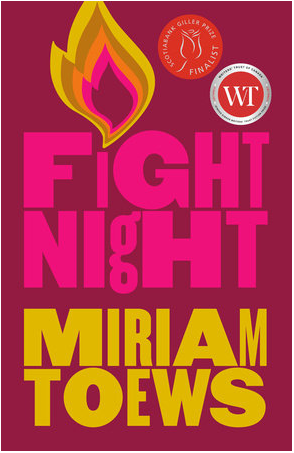
Fight Night – Miriam Toews

I have mixed feelings about Canadian writer Miriam Toews’ eighth novel Fight Night, which was a 2021 Giller prize finalist. On the one hand, it irked me and on the other hand, I could appreciate its charms.

Nine-year-old Swiv (although she certainly doesn’t seem like any nine-year-old that I’ve ever encountered), lives with her pregnant mother (the fetus has already been named Gord) and her grandmother, Elvira. Precocious doesn’t begin to describe Swiv. She’s been expelled from school and demonstrates no interest in going back. Instead her grandmother homeschools her; her lessons include things like suduko, Boggle, “How to dig a winter grave”, and letter writing. (The novel is actually Swiv’s letter to her absent father.)

Swiv’s mother is an actress who seems to always be in trouble with a stage manager or director. Elvira is the stabilizing influence and even she seems half crazy.

Grandma says fragments are the only truth. Fragments of what? I asked her. Exactly! she said. She asked me what my dream was last night. I told her I dreamt that I had to write a goodbye letter using the words one and blue. Na oba! Grandma said. That’ll be your assignment for today, Swivchen. She has a secret language.

Swiv recounts her families’ idiosyncrasies with a matter-of-factness that seems beyond her years. She is responsible for bathing her grandmother, and putting on her compression socks, for picking up the pills and conchigliette her grandmother drops on the floor yelling “Bombs away!” and, when the two of them travel to Fresno to see Elvira’s nephews, being her travel companion.

Elvira’s open-heartedness is contagious. She sees the dual nature of life, that it is both hilarious and devastating. “Do you know the story of Romeo and Juliet?” she asks Swiv. “Well, I mean in a nutshell. It was a tragedy. Do you know Shakespeare’s tragedies? People like to separate his plays into tragedies and comedies. Well, jeepers creepers! Aren’t they all one and the same.”

Toews mines her personal history here – as she has on past occasions – and it makes for fascinating reading, for sure, but maybe this is just a case of the right book/wrong time or maybe I was distracted while reading it. Fight Night worked for me in some ways. Swiv’s voice is singular. The way she relays the things she hears, her mimicry, charming. But the novel is written without quotation marks, and the paragraphs are often long with multiple speakers and I found it hard-slogging sometimes. Some things that happened at the end just seemed sort of over-the-top ridiculous and undermined that novel’s potential emotional impact. Or maybe tragicomedy is what Toews was after all along.

Life certainly can be ridiculous.

Nothing – Janne Teller

Translated from the Danish, Janne Teller’s award-winning YA novel Nothing is pretty dang bleak. When fourteen-year-old Pierre Anthon announces on the first day of school that “Nothing matters”, he sets off a chain reaction of events that runs the gamut from the childish to the horrific to the ridiculous.

Pierre Anthon and his hippie father live in a commune, so his classmates figure it makes sense for him to take the position that “It’s all a waste of time. […] Everything begins only to end. The moment you were born you begin to die. That’s how it is with everything.”

Pierre Anthon takes his belongings, leaves school and proceeds to climb the plum tree in front of his house. As his classmates pass by he slings hard plums and his dismal world view at them. His friends decide that they have no choice but to coax him out of the tree and the only way to do that is to prove that life is worth something.

The kids come up with a plan. They’ll create a sort of installation at the old saw mill. The will collect things that matter. At first, they ask their neighbours to make a contribution and the items start to accumulate: old crockery, a rose from a bridal bouquet, photographs. Then, feeling that they didn’t have enough skin in the game and that Pierre Anthon would see straight through them, they decided they needed to pony up and make a personal contribution to the cause. That’s when things start getting tricky.

Pierre Anthon’s view is decidedly nihilistic: religious and moral principles don’t matter, and life is meaningless. As the teens push each other to contribute things that are deeply personal, they cross more than one line. They soon lose sight of what they set out to do and their whole experiment becomes less about trying to help their friend see the value in life and more an exercise in horror.

Translation aside (and you know how I generally feel about them), Nothing is a surprisingly complex book. At first I thought it was going to be juvenile; the characters are barely teens and they sound young; the ideas and the themes in this novel, however, are anything but. The novel starts out quite innocently, but it goes down a very dark path, invites the reader to consider some equally dark ideas and you won’t come out the other end feeling even remotely hopeful about life.

Lies You Never Told Me – Jennifer Donaldson

Ohhh. This one got me.

Jennifer Donaldson’s YA mystery Lies You Never Told Me is a dual perspective narrative that should keep readers guessing until the end. I couldn’t for the life of me figure out how Gabe’s story intertwined with Elyse’s.

Gabe and Sasha are their school’s power couple. Sasha is one of the Austin elite and Gabe is a Chicano skateboarder he knows Sasha’s parents don’t approve of even though he “grew up in the same bougie neighborhood [and] my mom’s family has been in the U.S. for generations. They’re old money. They could find any of a hundred reasons not to like me.”

But Gabe is actually a good guy. He’s a great big brother to his six-year-old sister, Vivi, who was born with Down syndrome. He does well enough in school, has a couple great friends and puts up with a lot from Sasha, who seems stuck up and high maintenance from the get go.

One night, leaving Sasha’s house on his skateboard, Gabe is hit by a car. The girl who finds him and calls 911 is a new girl at their school, Catherine, and Gabe is drawn to her in a way he can’t explain. When he can no longer deny his growing attraction to Catherine, he breaks up with Sasha, but she’s not having it. Sasha mounts a full on campaign to get Gabe back.

The other narrator is Elyse, a girl with her own troubles. Her mother is an addict and Elyse is just barely holding it together. She does her best to pay the bills and look after her mother, but she’s just fifteen and it’s hard.

When her best friend Brynn convinces her to try out for the school’s production of Romeo & Juliet, Elyse barely hesitates.

I can feel the change come over me as I recite the words. It always happens – or it happens when I’m focused, when I’ve found something in the role to love. My shoulders round forward, my mouth quirks upward into a wistful grin, and I slide into character with ease.

Elyse is convinced that Brynn is going to snag the lead, but when the new drama teacher, Mr. Hunter, awards the role of Juliet to Elyse, her life explodes with possibilities.

Donaldson skillfully weaves these two stories together, and even though none of the four main characters (Gabe, Sasha, Elyse and Catherine) necessarily interact with each other, your brain will work overtime trying to figure out what links them together. Lies You Never Told Me is a well-written YA mystery with lots of twists and characters you will like and loathe in equal measure.

If I Knew Then – Jann Arden

Jann Arden is a Canadian singer-songwriter, actress, writer, animal rights activist, vegan and all around kick-ass human being. I have been a fan of hers for at least thirty years, which is why when she made a cameo in the 60th birthday video my daughter, Mallory, made for me I was speechless. She sang a little of “Good Mother”, offered a book recommendation (The Overstory by Richard Powers) and was charming as all get out.

Her non-fiction book If I Knew Then is a memoir about aging and is written with Jann’s trademark honesty and humour. She calls a spade a spade and I appreciate that about her.

One morning a few months after I turned fifty, I remember stopping dead in the middle of my usual routine

[…]

Suddenly it was as though I was staring at the most beautiful map of the world. I saw all the places I had been, all the things I had done, all the strength and service my arms and legs and shoulders and feet had given me for so many years, even though I had put this body through such bullshit and abuse and neglect and shame and loathing. All of that crap.

Jann tells stories about her complicated relationship with her father (who died in 2015), her devotion to her mother (who died of Alzheimer’s disease, which Jann recounts in her book Feeding My Mother) and the personal mistakes she made on her way to becoming, as she puts it, a “crone.”

The Crone is remarkably wise and unapologetic. She is fierce and forward-thinking – someone who is at the pinnacle of her own belonging. Okay, I’m not entering the time of the Crone. I am a Crone. I am at the beginning of a new chapter in my life – a whole new book, really. And it’s one that’s going to read and unfold exactly the way I want it to.

If I Knew Then has lots to offer a woman of any age. Although Jann is talking about herself in her 50s, maybe a younger woman could use some of her hard-won wisdom. For instance, if only I had appreciated my body a little more when I was 30. I didn’t think I was skinny enough or fit enough back then, pre-kids, but now when I see pictures of myself from that era, I am whoa! I also had a complicated relationship with my alcoholic father and I adored my mother. I don’t think I ever appreciated how difficult it was to be a parent though until I was a parent myself. My parents were never young to me; they were always just my parents. Both are gone now, too, and there are so many things I wish I could ask them. And apologies I’d like to make.

Jann’s book gives you permission to acknowledge your mistakes, and to move beyond them. She stresses the point that it is our failures that make us better human beings, that failing is, in fact, “a necessity.” Sometimes we need to be reminded that true learning comes from not getting it right the first or fourteenth time around and that “Good things come out of bad things.”

Fans of Jann Arden will certainly enjoy If I Knew Then, but even if you’re not familiar with her, this book is an enjoyable, personal (but universal) examination of a life lived, wrinkles and all.