
A Beautiful, Terrible Thing – Jen Waite

a-beautiful-terrible-thingEven though my marriage ended seven plus years ago – well, it actually ended way before that, although not formally – I am still drawn to books about broken marriages and I just finished Jen Waite’s memoir  A Beautiful, Terrible Thing. It was an impulse buy and I read it in three sittings.

Waite is a struggling New York actress when she starts training as a waitress at a trendy new restaurant and meets Marco, the head bartender, who is “tall and Latin with black, slicked-back hair and mocha skin [and] a quick, easy smile.” Despite the fact that she has a boyfriend back home in Maine, she is smitten and before you can say Argentina (which is where Marco is from), she is head-over-heels in love. It’s easy to see why, too. Marco is self-deprecating, sensitive and Waite believes that he really sees her for who she is. Throw in the chemistry and it’s an intoxicating and irresistible combination.

But, of course, it’s all fake. Five years into the relationship, shortly after Waite gives birth to their daughter, Louisa, she discovers a suspicious e-mail. It’s like a house of cards: the email is one card and when Waite removes it, the whole structure of her life starts to crumble.

Marriages break down, everyone knows this. It’s a devastating thing that happens to many couples. But there is an extra layer of horror in the dissolution of Waite’s marriage to Marco because he goes from being suave and loving to a blank stranger almost overnight. When Marco tells her that “For around a year now, I haven’t been happy. I lost all my feelings….Like right now, I’m looking at you, and I feel nothing. I feel numb,”  Waite’s reaction is one of disbelief. She thinks “There is something very, very wrong  with my husband. He is sitting across from me, it is his body, but he is not my husband.”

Waite tries to explain away Marco’s admission: they’ve just had a baby, he’s over-worked, tired.  But no amount of rationalizing explains Marco’s increasingly disconcerting behavior. Although Marco adamantly denies having an affair, and even though her parents are inclined to believe that he’s telling the truth, Waite finds it almost impossible to stop obsessing over Marco’s email and social media accounts. When she finally leaves him, he begins a campaign of emotional abuse towards her, employing every trick up his sociopathic sleeve.

Because – as it turns out – that’s exactly what Marco is.

Waite hits Google and starts researching.

I did the same thing. I wasn’t exactly blind-sided when my husband of 17 years told me in a parked car, in the pouring rain, that he didn’t love me. Things had been rocky for a while, although I’d kept telling myself that we’d weather the storm, that it was just a rough period, that despite the problems we were having he still loved me.  But from that moment on, the guy I’d known for 25 plus years, the father of my two children, became a complete stranger. I knew exactly what Waite was talking about.

Her research is a desperate attempt to explain behavior that makes no sense to her. Reading about pathological lying leads her to an article about sociopaths and suddenly the alarm bells start to go off in her head.

My eyes quickly scan to find the criteria, or red flags, of a sociopath. As I read each trait, my hear beats faster, and the hair on my arms rises. Charming. Check. Impulsive. Check. No remorse, guilt, or shame. Check. Invents lies. Speaks poetically. Incapable of apologizing. Check. Check. Check.

I remember my brother calling me and saying, “I am going to read you these qualities of a sociopath and you tell me which of these apply to M.” It was both horrifying and hilarious to discover that I could ‘checkcheckcheck’ my way through the list. Before I even knew what a narcissist was, I’d been describing M. as a vampire. He had taken everything he could from me and then discarded me; overnight the person I had built a life with became a complete stranger.  As all sociopaths are narcissists it’s no wonder – upon reflection – that so much of what I was reading at the time was ticking all the boxes. All of them.

One piece of information that Waite discovers was particularly interesting: narcissistic supply.

If a target is providing a constant stream of supply, they may be overvalued and idealized by the sociopath for many years. However, when their supply eventually decreases, they will quickly be devalued and discarded.

Things started to go south – really south – when my mother was diagnosed with lung cancer. Her illness was brief – diagnosed in July, gone in November – but during that time, M. was carrying on an affair (probably one of many.) I remember when I found out, instead of an apology he said “You weren’t paying any attention to me.” And I remember thinking “My mother was fucking dying!” Then three short years later, I lost my dad and then M. was gone.

I did everything humanly possible to facilitate an amicable relationship for the sake of our kids (who were 13 and 11 at the time). I took a class in co-parenting. I tried to encourage a regular schedule for him to see his children, but the horrible truth of the matter is – he really wasn’t all that interested. Once he cut me out of his life, he began the process of detaching himself from his kids.  He always had an excuse as to why he couldn’t see them and when he did see them, the visits often ended abruptly with the kids calling me and telling me to come get them. Neither of them have had any contact with him in several years.

I struggled for a long time – a torturous time for which I give my dearest friends and immediate family lots of credit for not throttling me – to come to terms with what had happened to my marriage and to the person I thought I knew. Eventually, I began to suspect that I had been conned, but even still it hurt. And it hurt my kids. We live in a small city and it was almost impossible to avoid hearing about or seeing M. live his new life. A life which was bizarrely hipster and one we would have laughed at ten years prior. But of course, he was simply creating a new reality for himself, something he found exceedingly easy to do because like Marco he “lack[ed] empathy and  an inner moral compass.”

A Beautiful, Terrible Thing must have been a difficult story for Waite to tell.  I  always say now that M. leaving was the best thing that could have ever happened to me and my kids. He did us a favour. Truly. I have no doubt Waite will be feeling that way at some point, if she isn’t already.


The Quiet Child – John Burley

20170423-QUIET-CHILD-cover-rev-11-18-16John Burley’s novel The Quiet Child asks some compelling questions: ‘How far would you go to protect the people you love?’ chief among them.

It’s 1954 in Cottonwood, California and high school Science teacher Michael McCray and his wife Kate had it all. Had being the operative word. Things have been different for them for a while now, ever since their younger son Danny was born six years ago. That’s when Kate started to get sick; now she is practically bedridden. The people of their small town started to pull away from the McCrays because it seemed that coming into close contact with them meant that you, too, would become ill and maybe even die. Danny is an odd child, mostly because he is silent. He doesn’t say a word. Sean, 10, is protective of his younger brother and that’s part of the reason both boys are kidnapped outside of a convenience store on the night their dad takes them for ice cream.

The man in the tan jacket crossing the street, heading in the direction of the parking lot. Danny in the back seat of the car, gazing out the window as he waited for them to return. The engine starting. The spin of tires on gravel. And Sean, standing there less than a minute ago. But now…

After the boys go missing, readers follow local Sherriff Jim Kent and two detectives from Shasta County as they try to piece together what happened and where the boys might be. Don’t forget – it’s the early 50s and sussing out what happened is a lot more time consuming and difficult without the aid of technology.

Kate insists that Michael do “whatever it takes” to bring back  her sons and so Michael sets off on his own. It takes a little bit before the police figure out that the kidnapper has made contact with Michael, but soon they are hot on the trail.

The Quiet Child is certainly a page-turner; I read it in a couple of sittings. Burley provides just the right amount of backstory about the key players so that we care about them and minor characters are fleshed out so that their fate is also important to us.

The interesting thing about this book is that it works on a bunch of different levels. Partly it’s a thriller: will Michael find his sons? Will they be alive? Will everyone survive? Partly it’s sort of supernatural, but I don’t think that’s even the right word. Why is Kate sick? Why is Michael starting to experience tremors in his arm? Are people right to be suspicious of Danny? Is he really able to make people ill? And then, the book is strangely philosophical. Do we really have the right to make decisions that affect the lives of others if they benefit the greater good?

Even if you think you know where The Quiet Child is heading, I suspect you’ll be surprised and I guarantee you’ll be thinking about this book for a while after you’ve read the last page.

Dark Saturday – Nicci French

Dark Saturday is the sixth book in Nicci French’s mystery series featuring London- darksatbased psychotherapist Frieda Klein. Although I was at a (slight) disadvantage having not read any of the previous novels in this series, I have read (and enjoyed) several other novels by French (actually the husband/wife writing team of Sean French and Nicci Gerrard) so I knew what I was in for.
There will always be a slight disconnect when reading a single  book from a series, but I didn’t find it particularly problematic. It was clear that I was missing some back story, but there were enough salient details to aid my understanding and allow me to get on with the business at hand – which is the case of Hannah Docherty.

Hannah was just eighteen when she was arrested for brutally murdering her mother, stepfather and thirteen-year-old brother, Rory. Since then she’s been incarcerated at Chelsworth Hospital which was “not a prison [but an institution where] its inmates were patients and the doctors’ job was to treat them and make them better.” However, when Frieda goes to visit Hannah for the first time “it felt like all the other high-security prisons she’d been to over the course of her career.”

Hannah has been incarcerated for 13 years and it’s immediately clear to Frieda that there has been no attempt to help her during that time. And why is Frieda visiting Hannah? She’s been asked by the police (who have clearly had five books’ worth of dealings with her) to look into Hannah’s case to see if, perhaps, there’s the possibility that she is innocent. The lead investigator on the case has recently had another conviction overturned and the police department simply want to cross their T’s and dot their I’s. They aren’t really expecting Frieda to find anything because Hannah is clearly crazy and the evidence against her is compelling.

I suspect that readers who have been reading along with Frieda over the series will already know what I quickly discovered: Frieda is tenacious. She isn’t satisfied with one meeting with Hannah. She asks for the case files and pores through documents and photographs in an effort to better understand Hannah’s story. If Hannah didn’t kill her family, who did and why?

That’s pretty much the main story in Dark Saturday. As a straight-up mystery, there’s plenty to keep readers turning the pages. For someone who isn’t familiar with all the back-story, I found some of it to be a distraction. Was I really interested in sitting in on her therapy sessions with a middle-aged woman who is suffering from panic attacks? Um. No. Did I especially care about a colleague’s cancer diagnosis? Not really because I haven’t had the chance to really know him or understand his relationship with Frieda.

I don’t know how this novel stacks up to the others in the series. Frieda isn’t the most compelling sleuth I’ve ever encountered, but I will chalk that up to having missed out getting to know her in previous novels. She’s smart and careful…although I often wondered how safe it was for her to be walking around London alone in the middle of the night.  Still, I enjoyed watching her attempt to create a new narrative for Hannah. Whether the re-written story is ultimately satisfying will likely depend on how it compares to Frieda’s previous cases. I wasn’t wholly satisfied, but I suspect that fans of this series will be anxiously awaiting the next book.

Visit Harper Collins for more info about this and other excellent titles.

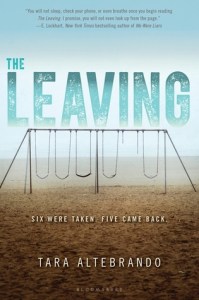
The Leaving – Tara Altebrando

leavingTara Altebrando’s YA novel, The Leaving, will give readers lots to chew on. It’s the story of six kindergarten-aged kids who disappear from their small Florida town only to turn up – minus one – eleven years later.  The kids are dropped off at a playground with maps tucked into their pockets to help them find their way home. They have no memory of where they were and their arrival back home sends ripples through their lives, the lives of their families and the community.
The narrative is shared between two of the returned, Lucas and Scarlett, and Avery, the younger sister of Max, the one child who doesn’t come back.  Avery was just four when her brother disappeared and her memories are vague. When her mother gets the call that the children have returned, Avery ” certainly hadn’t pictured it happening this way.”

It’s actually hard to imagine how any of these characters might have envisioned this moment – to have their sons and daughters returned to them without any memory of where they’ve been or what’s happened to them. And for Avery, she could already anticipate “the endless news coverage, the weird-sad looks she’d get from neighbors and everyone at school…she’d be famous, but not in the right way.”

As for Lucas and Scarlett, they feel a pull towards each other that seems more than survivor’s guilt. They discover they can do things they don’t remember being taught: Scarlett can drive a car; Lucas can load a gun. They also have strange elliptical flashes of memory: a carousel, a man carrying wrapping paper, hot air balloons. They are determined to solve the mystery of the missing eleven years and that makes for pretty compelling reading.

But the part of the book that was especially intriguing to me was this notion of memory and how our memories shape who we are and how, without them, we would certainly feel unmoored. Also worth consideration – and something I certainly thought about as I read Altebrando’s book – was what it would mean if we could actually cherry pick our memories. Lucas considers this notion, wondering:

“Why not forget?

Why not just black out something awful?

Like a shooting.

Or war.

Childhood, even.

Sure!

Oh.

Forgetting meant not knowing, meant ignorance, meant making the same mistakes again and again.”

The Leaving offers lots of food for thought, but even if young readers aren’t ready to consider the value of holding tight to the memories which animate their lives, there’s lots to keep them turning the pages. For my money, the last few lines of the book are worth the bits I didn’t quite buy.

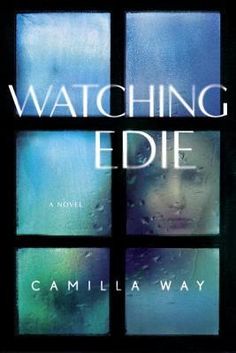
Watching Edie – Camilla Way

Camilla Way is a new-to-me author,  but after reading Watching Edie I would definitely watchingediebe amenable to reading more. Told by two characters Heather (who narrates ‘Before’) and Edie (who narrates ‘After’), Watching Edie is about the adolescent friendship between the two girls, their subsequent estrangement and what happens when Heather re-enters Edie’s life many years later.

Edie, 33, is living in London when the literal knock on her door comes.

I’m entirely unprepared for what’s waiting for me beyond the heavy, wide front door and when I open it the world seems to tilt and I have to grip the doorframe to stop myself from falling. Because there she is, standing on my doorstep, staring back at me. There, after all this time, is Heather.

It’s clear that whatever happened between the two girls has taken its emotional toll; however,  Edie invites Heather in for tea and they make polite conversation. Nevertheless, Edie is suspicious of Heather’s re-appearance in her life even though she has “imagined this, dreamed of this, dreaded this, so many hundreds of  times for so many years.”

Heather’s narrative fills in the back story of how the two girls met at the end of Year 11. (In England, students would be sixteen at this point, destined to move on to A-levels or employment.) Heather is a bit of a loner at school, so while she is outside with her peers, she’s not joining in on the fun. That’s when she first sees Edie.

As I watch, her facing appearing and then disappearing  behind others in the crowd, she stops, her eyes squinting up at the building before darting around herself again and then finally landing upon me. I hold my breath. I don’t think I’ve ever seen anyone so pretty before, not in real life.

The girls, despite their differences, bond over their shared fraught parental relationships and their hatred of their hometown, Fremton, which Heather describes as “horrible.”  And then, Edie meets Connor. Heather doesn’t like him on sight, although he’s “very handsome.” She doesn’t understand “this strange heat that’s there in the crackling, held-breath space between them; I only know that it has no place for me.”

Heather makes another present-day appearance in Edie’s life after the first reunion. And this time, Edie is grateful. She’s just given birth to her daughter, Maya, product of a one-night-stand with a co-worker and she’s sunk into a horrible post-partum depression. Heather arrives — one can only imagine she’s been nearby, watching — and takes over, looking after the baby, letting Edie sleep for hours at a time, but also cutting Edie off from her Uncle Geoff, her closest relation. When Edie befriends a new neighbor and starts to come out of her funk, she sends Heather away again.

It’s clear that something traumatic has happened between the two girls, but Way doesn’t give up the secret easily. Heather is actually, especially in her sixteen-year-old incarnation, a very sympathetic character. Edie has many redeeming qualities, but her life is seriously derailed when she meets Connor. The girls’ story is both heartbreaking and horrific and it makes for riveting reading.


Commonwealth – Ann Patchett

Ann Patchett is one of those writers who can maneuver a huge cast of characters so commonwealthdeftly that you hardly notice the machinations.  Her novel Commonwealth, the story of the intersecting lives of two families, might have crashed and burned in less talented hands, but Patchett moves these people backwards and forwards in time without seeming to  break a sweat.
Fix and Beverly Keating are hosting a christening party for their daughter when Bert Cousins shows up with a bottle of gin. Of the dozens of people invited to celebrate baby Franny, police officer Fix “struggled to make the connection” when he opened the door to the district attorney. Bert’s arrival was precipitated by the fact that “he hated Sundays.” By Sunday, Bert had had all he could stand of his three children and pregnant wife, Teresa: “he couldn’t play with them and he didn’t want to play with them and didn’t want to get up  and get the baby…”. Trapped in a life he clearly doesn’t want, he latches on to Fix’s party as a momentary escape hatch. By the end of the afternoon – perhaps lubricated by the gin, Bert has kissed Beverly and set off a chain of events that reverberates through the years.

After Beverly and Bert leave their marriages and form a new relationship, the five children (Franny and Caroline Keating and Cal, Holly, Jeanette and Albie Cousins) form a lasting bond. They navigate their lives – sharing confidences and allegiances, tragedies and achievements. Central to this story is Franny, who as an adult begins a love affair with Leon Posen, a celebrated writer looking for his next commercial success. He finds it in Franny’s family and the novel he writes exposes fault lines, mends fences, rights wrongs and assuages guilt.

As happened with her novel Bel Canto, I found myself falling madly in love with these characters and their very human-ness. The novel twists around itself, moving backwards and forwards in time – jumping years and characters. Sometimes we get just a taste of a character and their life, sometimes we are fully immersed. I never felt short-changed because I didn’t know everything about everyone; I didn’t mind the novel’s elliptical narrative. That’s life, isn’t it? Days and days of sameness marked by little heartbeats of pain or sorrow or happiness. Patchett manages to capture those heartbeats beautifully and there are moments in this book that took my breath away.

Commonwealth made me consider how we are our memories and the stories we tell ourselves and each other. And sometimes, as Franny remarks, there are stories we need to keep for ourselves.

Highly recommended.


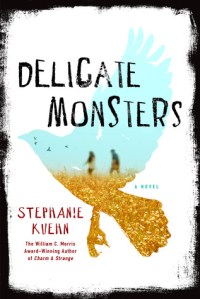
Delicate Monsters – Stephanie Kuehn

The three central characters in Stephanie Kuehn’s darkdarkdark YA novel Delicatedelicate Monsters are hard to spend time with. From the moment we meet  Sadie, and Emerson  and his  brother, Miles, we embark on a journey that is both awful and strangely – redemptive. In any case, these train-wreck teens are hard to look away from.

Sadie has just returned to her home from a camp where the girls were “all supposed to be “troubled”” Sadie’s far tougher than these girls who are “wide-eyed and tragic, fragile herd-like things, brimming with stories of Painful Childhoods.” Sadie can’t relate because she is not like them. She has “no interest in introspection” and “she found threats a curious thing because she didn’t respond to them the way she was meant to…threats made Sadie’s skin grow cold and her brain grow mean.” Mean is exactly what Sadie is, too.

At first eighteen-year-old Emerson seems like an uncomplicated lug of a guy. He lives with his widowed mother and younger brother, Miles, 15. Miles is sickly and has been diagnosed – or misdiagnosed –  with a variety of ailments: night terrors, separation anxiety, rashes, fever, celiac. Despite his health concerns and the fact that Miles “didn’t like other people,” Emerson was convinced that his younger brother is “destined for…something. Greatness?” Miles is peculiar and although Emerson seems to care about Miles, he doesn’t defend him against the constant barrage of abuse – both physical and verbal – Miles takes from the thugs at school.

Kuehn dances these three teens together when Sadie returns to her hometown. She’s been expelled from boarding school (again) for almost getting someone killed. (The details of that are revealed through email exchanges between Sadie and her ‘victim’, Roman Bender.) The aforementioned camp was clearly a placeholder because her father is M.I.A. and her mother seems to have no real interest in her daughter. She’s been out of the hometown loop for a while, but she remembers Emerson. She specifically remembers the things they used to do together when they were kids and his mother, a nurse, would bring them out to Sadie’s family’s vineyard to care for Sadie’s grandfather.

Sadie doesn’t remember Miles, though. They meet during fencing and if she has any redeeming qualities, she shows them in her interactions with him. For a kid who tries to blend into the shadows, Miles seems to respond to Sadie’s “I don’t give a shit, but here, eat this sandwich” approach to friendship.

I love the way Kuehn writes her characters. This is my third book by her and although I didn’t love it as much as I loved Charm & Strange, I still couldn’t stop turning the pages. We’d be naïve to think there aren’t lost, damaged kids like Sadie, Emerson and Miles in the world. Kuehn doesn’t mince words or tread lightly in Delicate Monsters, and as prickly as these three are – the mother in me just wanted to hug them and try to right their scarily off-kilter worlds.

The Girl in the Red Coat – Kate Hamer

Until about the midway point, I couldn’t put Kate Hamer’s novel The Girl in the Red Coat down. When eight-year-old Carmel Wakefield disappears, her mother, Beth,  is unhinged by her grief. Hamer’s novel follows Beth’s narrative as well as Carmel’s and until the reader understands the reasons for Carmel’s abduction, the novel is propulsive and riveting.

red coatBeth is sort of a hippie. She and her ex-husband, Paul, had “run a business together buying and selling ginseng and specialty teas.” Paul, after leaving the marriage, has been a relatively absent father and his relationship with Beth is strained mostly because he has a new, much-younger girlfriend.

Carmel is a precocious child. At a parent teacher meeting, the headmaster  explains to Beth that Carmel’s “vocabulary is extremely advanced. Her imagination is amazing, I don’t think she quite sees the world like the rest of us.”

On the fateful day that Carmel disappears, Beth has taken her to children’s story festival. She has decided that she needs to set aside the grief of her crumbled marriage and “start afresh.”

The festival is a treat and Carmel “can feel words come shooting out of the tent doors and [she] just want[s] to stand there at the openings and let them fizz on [her] brain.” It’s a hot, crowded day and pretty soon Beth is getting cross and Carmel, in an act of defiance, ducks under a table to read a book. When she reappears, ages later, the fog has rolled in and her mother is gone. That’s when the man appears. He tells her that he is her grandfather and that her mother has been in a terrible accident.

Carmel has no reason to doubt the man. Her mother has been estranged from her parents for her whole life – it’s one of the things that has plagued Carmel’s young mind. Why doesn’t she have grandparents to bring her treats like her friends do?  So, fearful and clearly alone, Carmel goes with the man who promises to take her to the hospital to see her mother. Of course, that’s not what happens.

The Girl in the Red Coat is suspenseful until Granddad’s motives are revealed and then it started to feel like a different book to me. In the first part, when Carmel is taken to a strange house where she meets her grandfather’s partner, Dorothy, Hamer does a wonderful job of stringing the reader (and Carmel) along. Why can’t she see her mom? Why can’t they contact her dad? Where are they?

Beth’s journey is also heart-wrenching. She counts the days Carmel has been gone. She searches for her daughter. She goes through the motions. But the time goes by and it’s like Carmel has dropped off the face of the earth.

Those early days are compelling for Beth, Carmel, and the reader. For me, though, the novel’s suspense is spoiled by its key secret — and once that’s out I found myself caring less about all the players, which is too bad, because the book is beautifully written and had a lot of potential.

Behind Her Eyes – Sarah Pinborough

Louise is a single mom to six-year-old Adam. She has a penchant for wine, smokes (although not in front of her son) and could stand to lose a few pounds.

My life is a blur of endless routine. I get Adam up and get him to school. If I’m working and want to get in early, he goes to breakfast club. If I’m not working, I may spend an hour or so browsing charity shops for designer castoffs that will fit the clinic’s subtly expensive look. Then it’s just cooking, cleaning, shopping until Adam comes home and then it’s homework, tea, bath, story, bed for him, and wine and bad sleep for me.

Adele is the wife of David, a doctor. Their marriage is clearly rocky, The new house, David’s new practice, the fact that Adele is beautiful, none of it seems to make any difference.

Why can’t he still love me? Why can’t our life been as I’d hoped, as I’d wanted, after everything I’ve done for him? We have plenty of money. He has the career he’d dreamed of. I have only ever tried to be the perfect wife and give him the perfect life.

Adele and Louise take turns narrating in Sarah Pinborough’s novel Behind Her Eyes. behindTheir lives intersect when Louise meets David at a bar and they share a ‘moment’ and then she discovers he’s her new boss and then she bumps into Adele (literally) in the street. Louise is charmed by Adele who seems wholly glamorous and somehow innocent. Adele takes Louise on as a project, encouraging her to quit smoking and join the gym. Soon the women are sharing a close friendship which is complicated by the fact that Louise is in love with David and pretty soon the two have moved from the ‘moment’ to a full-on relationship.

Behind Her Eyes is full of conveniences. Louise’s ex-husband takes Adam away to France for a month leaving Louise the freedom to sleep with David and have coffee with Adele. She is bereft of friends except for Sophie, an unemployed actress married to a music exec. Despite the fact that Sophie continually sleeps around on her husband, she turns sanctimonious when discussing Louise’s affair with David, telling her that “having an affair is a big enough secret and not one you’re really cut out for.” Louise and Adele bond over the fact that they both suffer from night terrors.

The novel drops a breadcrumb trail of then, which allows the reader a glimpse into Adele’s murky past — parents killed a fire that destroyed part of the estate where she grew up, a stint in some sort of care facility, a close friendship with a fellow patient, Rob. In the now, Adele is less transparent. She is clearly duplicitous, we’re just not sure how or why.

Behind Her Eyes was a book club pick and although some of the women in my group enjoyed reading the book –even I did to a point — I don’t think any of us would say we loved it. I definitely didn’t. Perhaps you could argue that the clues were there all along and I know all the BIG NAME  readers out there loved the novel’s twist, but for me – I just felt cheated. Way too deus ex machina for me.

That said — I am in the minority for sure and if nothing else, Behind Her Eyes will get you turning the pages.

This Gorgeous Game – Donna Freitas

Olivia Peters, the protagonist in Donna Freitas’ YA novel This Gorgeous Game,  is a seventeen-year-old aspiring writer who lives with her single mom and older sister in a close knit Catholic community in Boston. How Catholic? Let’s just say that the Peters’ have lots of priests and nuns for dinner and Olivia attends a high school where the principal is a nun.

gorgeousOlivia is beautiful and outgoing, but she’s one of those girls who doesn’t really know it – or, if she knows it, she doesn’t flaunt it. She’s a good girl. She’s obedient. All she wants-  all she can ever remember wanting – is to be a writer. When she wins the first annual Emerging Writers High School Fiction Prize  she admits “I’ve always loved writing but I didn’t really think it would amount to anything.” The prize is substantial: a ten thousand dollar scholarship towards the college of Olivia’s choice, publication of her story and a spot in Father Mark Brendan’s prestigious summer fiction seminar.

Yeah, that  Mark Brendan. Olivia knows him – by reputation, at least.

I am struck by the tiny lines that web from his smiling eyes, the gleam from his perfect white teeth, his thick salt-and-pepper hair, the size of his hands, so large, the hands of a strong man. Everything about him seems to glow from within and soon I am aware that I am not the only person in the room who finds this visitor striking.

This priest is a celebrity, and also super-creepy. I mean, c’mon, the first thing he does is invite Olivia for a drink. She shows up in her school uniform and drinks hot chocolate while he drinks scotch and holds court.

I probably shouldn’t say this, but the moment I first saw you, I wondered to myself: how did so much talent, such insight and imagination, come from a girl so young, and with such startling beauty? What a beauty! I thought. God must have such extraordinary plans for such a creation as this.

In the beginning, Olivia basks in the glow of Father Mark’s attention: the private meetings to (ostensibly, at least) work on editing her story, the notes he leaves for her, the packages he sends. But soon Olivia is feeling isolated from her friends and family and Mark’s enthusiasm for her talent starts to feel like a yoke around her neck. He turns up unexpectedly in places he shouldn’t be, waits for her outside the school, gives her inappropriate gifts, calls her incessantly.

Turns out, Father Mark is not only a talented writer, but a talented stalker, too. Is it because of his celebrity status that the adults in Olivia’s life don’t see the change in her demeanor: she stops eating, her hair is listless, the spark is gone. She makes excuses until she can’t anymore, but I was really disappointed in her mother and in Sister June, the school principal, who seemed to have some misgivings early on, but didn’t intervene.

This Gorgeous Game is a page-turner that highlights the ways  in which someone in a position of power takes advantage of someone vulnerable. There is nothing graphic here and Olivia is a likeable narrator, if a little sheltered and naïve – which is, of course, completely understandable given her upbringing.