
Brooklyn – Colm Tóibín

colmbrooklynMy fabulous book club kicked off 2016 by discussing Colm Tóibín‘s award winning novel Brooklyn. After our Christmas hiatus, we all enjoy getting back together for some yummy food, wine and great conversation.

Tóibín‘s novel, the story of Eilis Lacey’s coming-of-age in 1950’s Ireland and Brooklyn, NY, was a lovely way to start our new reading year, even if we didn’t all agree about the book’s merits.

Eilis is (I think – it’s never explicitly stated) a young woman in her early twenties who lives with her widowed mother and thirty-year-old sister, Rose. Rose is glamorous and independent. Times are tough in Eilis’s little town and so when an old friend of the family, Father Flood, arrives home for a visit from America and suggests he could help Eilis find work there, and perhaps further opportunities to improve her life, it’s decided that she make the journey across the Atlantic to settle in Brooklyn. Eilis’s story is actually quite common for the time period; however, one has to venture a little further back to fully understand the Irish immigration to America.

At Time.com, “Irish-American historian and novelist Peter Quinn explains, “The country wasn’t in the Second World War, it had been kind of cut off from the rest of the world, and it wasn’t part of the Marshall Plan. So it was still a very rural country.” The economy was at a standstill, while the U.S. was booming. Some 50,000 immigrants left Ireland for America in the ’50s, about a quarter of them settling in New York.

Women played an important role in that immigration process. Quinn explains “during the 19th century, the wave of Irish was “the only immigration where there were a majority of women.” And, thanks to a culture that supported nuns and teachers, those women were often able to delay marriage and look for jobs. By the mid 20th century, many Irish women—who also benefited from the ability to speak English—were working in supermarkets, utility companies, restaurants and, like Eilis, department stores. The fact that Eilis finds her job through her priest is also typical. “[The Catholic Church] was an employment agency. It was the great transatlantic organization,” Quinn says. “If you came from Ireland, everything seemed different, but the church didn’t. It was a comfort that way, and it was a connection.””

So here is Eilis, alone in the big city. Whether you like her or not (I’m sort of in the “indifferent” camp), Eilis’s story is certainly compelling. She begins a job at Bartocci’s, a department story run by Italians. Her goal is to make her way through the ranks and end up, hopefully, as a bookkeeper in the office, rather than a shop girl. Father Flood arranges for her to take a bookkeeping course at Brooklyn College. She’s a diligent and conscientious worker.

She lives in a boarding house run by an Irish lady called Mrs. Kehoe. She shares living space with a variety of other young women, some Irish, some American. We learn very little about any of them; Eilis tends to keep to herself.

And there you have it – Eilis in Brooklyn. Oh…then she meets Tony.

Eilis slowly became aware of a young man looking at her. He was smiling warmly, amused at her efforts to learn the dance steps. He was not much taller than she was, but looked strong, with blonde hair and clear blue eyes. He seemed to think there was something funny happening as he swayed to the music.

It’s almost impossible not to like Tony and his family. He courts her and they fall in love, but then personal tragedy strikes and Eilis has to return to Ireland.

Brooklyn does have something to say about the choices we make in life and why we make them – sometimes, it seems, we aren’t really sure; we’re just swept along by the tide. Some readers might be put off with the way ideas/characters/themes are introduced and then dropped without resolution. While it’s true that life often happens in this manner, I might have enjoyed just a teensy more follow-through.

Tóibín‘s prose is straight-forward, unembellished and allows his reader to fill in the gaps. Many readers will likely take issue with the novel’s conclusion, but I liked it – even if I didn’t particularly like Eilis.


Between Shades of Gray – Ruta Sepetys

between-shades-of-grayWe all know about the atrocities of the Holocaust, but until I decided to read Ruta Sepetys’ novel Between Shades of Gray with my grade nine class I knew nothing (shamefully) about what happened in Lithuania during the same time period. During that time Stalin’s Soviet Union invaded the Baltic states of Lithuania, Latvia and Estonia. They rounded up doctors, teachers, musicians, artists and government officials and their families – anyone whom they considered a threat – and shipped them off to work camps. Sepetys’ father was the son of a Lithuanian military officer. He and his family managed to escape to a German refugee camp (the irony is not lost on me). It is the author’s personal connection to this devastating blot on human history that inspired her to tackle telling the story. And what a story it is!

Lina is just fifteen when the NKVD (Russian Secret Police) burst into her home and demand that she, her ten-year-old brother, Jonas, and their mother, pack a suitcase and come with them. It is June 14, 1941 and the world Lina has known – one of art and intellect, of safety and family – is forever shattered. Their father is not home.

The first question I asked my students when we started the book was what they would take if they only had twenty minutes to decide. Lina was getting ready for bed and she remarks “They took me in my nightgown.” What is important when you have no time to think?

I put on my sandals and grabbed two books, hair ribbons and my hairbrush. Where was my sketchbook? I took the writing tablet, the case of pens and pencils and the bundle of rubles off my desk and placed them amongst the heap of items we had thrown into my case.

From the minute Between Shades of Gray starts until the final pages, the reader is living in a world that is almost impossible to comprehend. My students have no frame of reference. Even those who do not live privileged lives have never had to face this kind of terror. As I read the book out loud to my rapt students, I often found myself on the verge of tears imagining the fear, pain and plight of these people who were forced from their homes for no reason. What would I be capable of if I had to protect my family?

Lina’s mother, Elena, is a remarkable character. She is an educated woman who speaks Russian, a handy skill in these circumstances. She does whatever she has to do in an effort to keep her family together, trading items she has sewn into her coat in advance (foreshadowing  the events to come) for food, favour and, in one particularly poignant trade, for the life of her son. Her strength of character, her resiliency (which is mirrored in her children) sustains them all through the long, hard days ahead.

Eventually Lina and her family find themselves at a labour camp in Siberia. I can remember joking about Siberian labour camps as a kid. I didn’t know anything about them; I would have just made a throwaway comment about sending someone to Siberia. Sheer ignorance on my part because the conditions are unimaginable.

It was completely uninhabited, not a single bush or tree, just barren dirt to a shore of endless water. We were surrounded by nothing but polar tundra and the Laptev Sea. The wind whipped. Sand blew into my mouth and stung my eyes.

Worse – they have nowhere to live. The only two buildings are for the Soviets. It’s cold and soon it will be dark 24 hours a day.

I can say this about the book: my students loved it. Although I had promised to read it out loud to them, many read on their own, racing to finish. That’s high praise, especially since many of students would identify themselves as reluctant readers. I had several boys finish way before we did.

Sepetys talks about her novel here and it’s worth watching the video before you read the book. Sepetys talked to survivors and some of their stories find their way into this novel. I wish that the ending hadn’t seemed quite so rushed, but that’s a small niggle and may have something to do with the fact that I wasn’t quite ready to say good bye to these remarkable characters. Overall, Between Shades of Gray is a miracle of a book, a life-affirming novel of resiliency and love and a sober reminder of the terrible things we do to each other.

Highly recommended.

Bystander – James Preller

bystanderJames Preller’s middle grade novel Bystander does a good job of illustrating the school-yard bully.  Wikipedia describes that bystander effect, or bystander apathy, as “a social psychological phenomenon that refers to cases in which individuals do not offer any means of help to a victim when other people are present.”

When thirteen-year-old Eric moves to a new town with his mother and younger brother Rudy, he meets Griffin, a boy with “soft features … thick lips and long eyelashes…pretty.”  Griffin travels with a pack and when the boys arrive at the basketball court where Eric is practicing foul shots, Eric wonders “if something bad was about to happen.” It doesn’t take him long to figure out that despite Griffin’s alluring charisma, there is something off about him, a fact reinforced when Griffin tells Eric “I’m a good guy to be friends with…but I’m a lousy enemy.”

Truer words. When Eric starts his new school he wants nothing more than to get along. He’s a decent kid, a little sheltered, perhaps (he doesn’t have a cell phone and his mother won’t let him use Instant Messenger). I’ve been the new kid and I know what it’s like to start a new school, so I felt for Eric as he surveyed the cafeteria that first day, wondering where to sit.

In a month, he assured himself, everything would be fine. He’d make new friends, sit with them, eat, joke, laugh. But right now, today, the first day of school, it all kind of sucked. But on another level, none of it really mattered. Eric could smell his meatball sub and he felt hungry. He wanted to eat.

When Griffin stops at his table, chagrined that Eric is alone and invites Eric to eat with him and his friends, Eric accepts. In some ways, it’s a bit like making a date with the devil and we all know what they say about the devil you know, right. It doesn’t take long for Eric, who is a smart kid, to figure out that Griffin just isn’t the kind of friend he wants to have, even if it means that he’s going to suffer for it.

Bystander is a straightforward novel about making choices. Bullying is a hot topic these days and something we talk about even at the high school level. Published in 2009, Bystander doesn’t really address the problem of cyber bullying; Griffin is a garden-variety thug (if you can actually be a thug at 13.) The thing about Griff, though,  is that he’s sort of sympathetic; Preller doesn’t paint him with a simple black stroke.

Despite the fact that the book is intended for a younger audience, I think I have some grade nine students who would enjoy this story. They are not so far removed from middle school that they won’t remember characters just like Griff and his ilk.

What We Lost – Sara Zarr

whatwelost“The whole world is wilting,” says fifteen-year-old Samara (Sam), the protagonist of Sara Zarr’s YA novel What We Lost.

She means the comment literally because it’s so hot that she wakes up every couple of hours “in a puddle of sweat,” but the observation is also figurative. Sam’s life is full of conflict and chaos. Her father, Charlie,  a pastor at the local church, is distracted and every day Sam wakes up to something “ruined or broken or falling apart.”

Part of the problem is that Sam’s mother is currently residing at the New Beginnings Recovery Center in an effort to get sober. Without her mother there, Sam feels adrift. There’s not enough money and Sam is tired of having to pretend that her mom just isn’t feeling well enough to attend church or other social functions. Things get even more complicated when Jody, a thirteen-year-old member of Sam’s church, goes missing  and Sam’s small town suddenly becomes a lens through which she is able to see all the world’s flaws, including her own.

I’ve read Zarr’s fantastic book Story of a Girl and her novel Roomies, which she co-wrote with Tara Altebrando, and which I also loved. Zarr has a real gift when it comes to creating empathetic characters and Samara is no different. Her fifteenth summer is a perfect storm of angst and confusion, suspicion and alienation.

I wish I understood what happened between then and now. I wish there was a way to put your finger on the map of life and trace backwards, to figure out exactly when things had changed so much…

As the town searches for Jody, Sam’s dad spends time with her family, acting as a sort of spokesperson. During this time, Sam grows closer to Jody’s older brother, Nick. He “could probably be a model” Sam observes, studying him the way “every girl who has ever known Nick has studied him.”

The problem with their blossoming friendship is that Nick is a suspect in the disappearance of his sister and Charlie doesn’t want Sam to hang out with him. Charlie also doesn’t want Sam to be alone; the town no longer feels safe. Sam is shuttled back and forth between her house and her best friend Vanessa’s. Sam has suspicions of her own; she wonders why her dad is spending so much time with Erin, the church’s youth group leader.

Zarr manages all these threads beautifully, allowing Sam her questions  about her faith in God,  suspicions about her dad, loneliness for her mom and feelings for Nick to percolate under the hot summer sun.

Great read.


The House – Christina Lauren

Okay, there’s suspension of disbelief and then there’s, well, just disbelief. I so wanted to like Christina Lauren’s (the co-writing team of Christina Hobbs and Lauren Billings) YA novel The House, but I didn’t. Actually, my feelings are more conflicted than that: I liked some things about the book and really, really disliked others.

the houseThe good: The writing in The House is actually pretty decent. At least decent enough that I wasn’t groaning over clunky sentences. In particular, the spooky scenes were well-written – propulsive and skin-crawlingly descriptive.

The two main characters, Delilah and Gavin are likeable teens. The story is told in alternating chapters labeled ‘Him’ and ‘Her’ so the reader is privy to the thoughts of both characters. Delilah has recently started high school in her hometown in Kansas after leaving a  school on the east coast. Gavin has lived his whole life in “the House,” an odd patchwork house hidden behind a fence. The two knew each other as children, before Delilah had been sent to live with her grandmother. Now she is intent on rekindling her friendship with Gavin.  It would seem that he is the proverbial bad boy and that Delilah is smitten.

The bad: There is no long burn here, no smolder – which is unfortunate because these stories work so much better when there is. Gavin and Delilah fall pretty much in love almost immediately. Of course, their relationship is not without its problems and that’s the part of the story that was the most problematic for me.

Things inside House can come alive in a way that I don’t think things anywhere else can. When an object is inside House…it can be alive….

*

Things in the house move….They take care of me. They always have. They would never leave….It’s a bit like having a really big family, but no one speaks.

Yep, Gavin’s house is alive. His parents are gone, but House has always taken care of him, anticipating his every desire, making his food, taking care of his needs. He doesn’t see it as particularly strange because, of course, it’s all he’s ever known. For most young adult readers this likely won’t seem like much of an imaginative stretch. They’ve grown up reading books where teens fight to the death, have other-worldly powers and fall in love with vampires and werewolves, but for me, I just found it sort of goofy.

As it turns out, House isn’t all that benevolent when it seems like Delilah might steal Gavin away. The novel gives new meaning to the notion of playing house, that’s for sure.

Kindness for Weakness – Shawn Goodman

One of my students recently read Shawn Goodman’s novel Kindness for KindnessWeakness and when she returned it to my classroom library, she told me that she loved it so much that she’d asked for her own copy for Christmas. Her endorsement encouraged me to read the book and I am so glad I did even though it broke my heart. Seriously.

James is fifteen. He lives with his drug-addicted mother and her scummy, drug-addicted boyfriend, Ron, in a one-bedroom trailer. His older brother, Louis, moved out two years ago. James is adrift; he hasn’t got one positive thing going for him. He is  “just a lonely kid loping along the street with [his] head down.”

Then his brother offers him a job and James, desperate to be a part of Louis’ life, accepts. Problem is, the job is dealing drugs and James gets caught. He won’t rat out his brother, so he’s thrown into Morton, a juvenile facility.

There is nothing good about his new reality. James thinks

I am a loser, I am scared and weak. I want to call Mr. Pfeffer and ask him what I’m supposed to do. I want to talk to him over cold root beers, and have him tell me that everything will be okay. I want him to give me new books, enough to last twelve months, so I can disappear into the pages and not have to deal with this place. I could read one book after the other, stopping only to eat, sleep, and do school or chores or whatever it is they do here.

But James does learns the rules and in some ways he comes into his own at Morton.  There are a couple of guards who are compassionate and make an effort to teach the young men in their charge that there is always an alternative.  Despite his circumstances, James starts to consider what his future might look like.

I want to go to college…I want to live in a dorm where no one will know where I came from or who I was at my old high school. I want to start over and see the world outside of Dunkirk. I want to take writing classes.

James also reaches out to his old English teacher, Mr. Pfeffer, and the two exchange letters. James takes comfort in literature, and I have a soft spot for any character who loves books. James strives to stay out of trouble because he wants to get out and make something of his life.

Shawn Goodman actually worked in New York’s juvenile justice system and this experience gives Kindness for Weakness a real feeling of authenticity, but it is James that is the emotional center of this book.  He is a believable, sympathetic character. I fell in love with him at the very beginning and rooted for him until the book’s devastating conclusion.

Highly recommended.


The Catcher in the Rye – J.D. Salinger

catcher-in-the-rye-cover-imageSo I recently re-read The Catcher in the Rye for the first time in about twenty years (or maybe longer, although I shudder to think) because I am teaching Grade 11 this year and Salinger’s classic coming-of-age story is on the reading list. Now I have to figure out what I really think about this book – not just what I want the kids to think I think about it.  It’s a problem because I believe that Holden Caulfield is definitely a character adolescents should encounter, if only because he (and this novel) is alluded to in so much of the literature, music, and films that followed.

If you’re out of the loop, The Catcher in the Rye was published in 1951 and concerns almost-17-year-old Holden Caulfield, a smart but disenchanted student who has just been kicked out of Pencey Prep, a fancy boarding school in Pennsylvania. “You’ve probably heard of it,” Holden tells us. “They advertise in about a thousand magazines, always showing some hot-shot guy on a horse jumping over a fence. Like as if all you ever did at Pencey was play polo all the time.” Holden is flunking all his courses except for English (he’s a voracious reader) and so he’s being sent home.

When the novel opens though, Holden is recounting “this madman stuff that happened to me around last Christmas just before I got pretty rundown” from a rest home in California. Once he establishes where he is, Holden starts to tell his story – embellishments (by his own admission, Holden is “the most terrific liar”) and all.

There is no question that The Catcher in the Rye is dated. Holden peppers his speech with “goddam” (a rather tame expletive by today’s standards), he smokes and drinks (not that today’s teenagers don’t, but there is something old-fashioned about the way he treats these vices) and he’s able to spend an extended amount of time in New York City without breaking the bank (I wish!). Everyone Holden encounters is a “phony” and despite his obsession with sex, Holden is still a virgin. That said, there is something thoroughly modern in Holden’s quest to make sense of  his life, which has gone seriously off the rails.

At its heart, The Catcher in the Rye is a novel about growing up. Holden doesn’t want to, not really. It is perhaps the reason why he’s still a virgin and why he thinks the Museum of Natural History is a perfect place.

The best thing, though, in that museum was that everything always stayed right where it was. Nobody’d move. You could go there a hundred thousand times, and that Eskimo would still just be finished catching those two fish, the birds would still be on their way south, the deers would still be drinking out of that water hole, with their pretty antlers and their pretty, skinny legs, and that squaw with the naked bosom would still be weaving that same blanket. Nobody’d be different. The only thing that would be different would be you.

Holden can’t stop time, although I think he would desperately like to. He also can’t undo the fact that his beloved brother, Allie, is dead. “You’d have liked him,” Holden tells us. He is preoccupied with the loss of innocence that precipitates the headlong fall into adulthood. He tells his little sister, Phoebe, that he would like to be a “catcher in the rye,”

…I keep picturing all these little kids playing some game in this big field of rye and all. Thousands of little kids, and nobody’s around – nobody big, I mean – except me. And I’m standing on the edge of some crazy cliff. What I have to do, I have to catch everybody if they start to go over the cliff…

Holden’s narrative amounts to a desperate cry for help, for someone to listen to him, for someone to answer his questions, questions which, on the surface (like, where do the ducks in Central Park go when the pond freezes over) seem innocent, but which really demonstrate Holden’s search for meaning.

In Holden, Salinger has created a timeless character who will always have something to say to anyone who cares to listen.

If You Find Me – Emily Murdoch

“Mama says no matter how poor folks are, whether you’re a have, a have-not, or break your mama’s back on the cracks in between, the world gives away the best stuff on the cheap.”

IF-YOU-FIND-METhat’s the first thing fifteen-year-old Carey tells us in Emily Murdoch’s amazing novel If You Find Me. From the moment she speaks, it’s almost impossible not to fall in love with her and as her story unspools, it’ll be even more difficult not to want to want to hug her and her little sister, Jenessa, who is just six.
Carey and Jenessa live in a trailer in  in the middle of Obed Wild and Scenic River National Park or, as the girls call it, “the Hundred Acre Wood.” Their mother, Joelle, is usually gone and has, in fact, been MIA for “over a month, maybe two at this point,” leaving the girls to fend for themselves. Carey does the best she can to look after herself and Jenessa but “when you’re livin’ in the woods…with no runnin’ water or electricity, with Mama gone to town for long stretches of time, leavin’ you in charge of feedin’ a younger sister…with a stomach rumblin’ like a California earthquake” it’s not easy. The girls exist, mostly, on beans fixed in “new and interestin’ ways.”

On this particular day, though, Carey and Jenessa have company. A woman “as thin as chicken bones, her gait uneven as her heels sink into the soft forest floor” and a man stumble into the girls’ campsite.

He hasn’t offered his name, and he isn’t familiar to me. But in that instant, hittin’ like a lightnin’ bolt, I know who he is.

If You Find Me is an amazing story of resilience and family and forgiveness, but it is also a horrific story of abuse and neglect, made all the more powerful because of Carey’s compelling and authentic narration. I fell in love with her the moment she started to tell her story and I know this is fiction, but I also know that children endure atrocities at the hands of their parents and guardians all the time.

Suddenly, Carey finds herself living with a father she doesn’t remember, a new step-mother and a step-sister who clearly resents her, attending school for the first time.  Jenessa seems to thrive in her new surroundings and although Carey contemplates returning to the her life in the woods, her love for her sister prevents her from running. Their journey is one of resilience and hope, but it’s not all smooth sailing.

I loved this book because I loved Carey. I wish the ending hadn’t seemed so rushed, though, because I don’t think Carey’s relationship with Ryan was as fully developed as it might have been and other pieces fell into place just a tad conveniently, but whatever; I haven’t read a YA book with a narrator I’ve loved quite as much as I loved Carey in a long time.

Highly recommended.

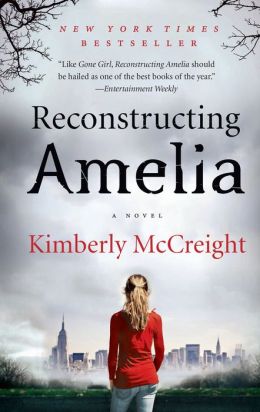
Reconstructing Amelia – Kimberly McCreight

reconstructingI’m sure all the mothers out there can appreciate how difficult it is to really know what is happening in our children’s lives these days. I mean, on the surface, it seems like it would be easier, right? We have phones that connect us immediately — but the flip side of that is that, because of this technology,  our kids can live lives very separate from us, too. When I was a teenager there was one phone and it was in the kitchen. If you got a call, you took it in full view of your parents and siblings; there were ears everywhere. Hardly anyone calls my house phone anymore – and certainly not the friends of my kids.

It is this very private world that is central to Kimberly McCreight’s suspenseful and timely novel Reconstructing Amelia.

Kate Baron is a high-powered lawyer and single mom. She and her  fifteen-year-old daughter, Amelia, live in Brooklyn, where Amelia attends Grace Hall, a hoity-toity private school. Despite Kate’s busy job, she and Amelia share a close bond, likely forged because it’s always been just the two of them. There have been a few bumps in the road recently: Kate chalks it up to teenage moodiness. Then she gets a call from the school: Amelia is being suspended, for plagiarizing an essay. The suspension is a shock to Kate because

Amelia had never been in trouble in her entire life. Her teachers called her a delight – bright, creative, thoughtful, focused. She excelled in athletics and was involved in every extracurricular activity under the sun. She volunteered once a month at CHIPS, a local soup kitchen, and regularly helped out at school events.

The accusation of cheating is clearly a mistake. However, when Kate arrives at Grace Hall she is devastated to discover that her daughter is dead (not a spoiler: it’s on the book jacket). Apparently, Amelia jumped from the roof of the school. Although Kate can’t quite believe her daughter would do such a thing, the police rule Amelia’s death a suicide and the case is closed.

That is until Kate gets an anonymous text: Amelia didn’t jump.

With the help of Lew, a crusty police detective, Kate begins reconstructing Amelia’s life only to discover that there were many things she didn’t know about her daughter.

There are dual narratives in McCreight’s book. Kate’s limited third person narrative allows us to take her journey, but we also have Amelia’s first person narration – which gives the reader a glimpse into a life Kate could never be privy to. There are also text conversations, Facebook posts, and an anonymous blog called ‘gRaCeFULLY,’ which tracks the comings and goings of Grace Hall students. All the bits fit together to create a picture of entitled girlhood and head-in-the-sand adulthood.

There are some bits of the book which didn’t necessarily belong (Rowan) and I am not 100% sure I bought some of the twists, (I won’t say which because, hello, spoilers) but that doesn’t mean I didn’t turn those pages at breakneck speed to find out what happened to Amelia and why.

I would like to think that the girls in Reconstructing Amelia are just fictional, but I know that’s naïve. Sometimes, even when we love our kids and feel close to them, we don’t always know what is really happening in their worlds. That’s the sad truth.

Great book.

Hausfrau – Jill Alexander Essbaum

hausfrauPoor Anna. Her life sucks. She’s the protagonist in Jill Alexander Essbaum’s novel Hausfrau,  an American living in Dietlikon, a suburb of Zurich, with Bruno, her Swiss banker husband and her children: Victor, 8, Charles, 6, and baby Polly. She doesn’t work. She’s barely even learned to speak the language despite having lived in Switzerland for almost a decade. Her mother-in-law seems wholly unimpressed with her– and no wonder: Anna disappears for hours, taking language classes and having sex with random men.

It’s hard to really like Anna very much. She’s not the effusive American one might expect. Instead of joining the other mothers when she meets her sons at school she “scuffed the  sole of a brown clog  against the sidewalk’s curb…fiddled with her hair and pretended to watch an invisible bird flying overheard.”  She claims she is “shy and cannot talk to strangers.”  That may be true, but she speaks the universal language just fine.

Yep – Anna is a serial cheater. The reader meets Archie Sutherland first, an expat Scotsman.

Archie and Anna shared a plate of cheese, some greengage plums, a bottle of mineral water. Then they set everything aside and fucked again. Archie came in her mouth. It tasted like school paste, starchy and thick. This is a good thing I am doing, Anna said inside of herself, though “good” was hardly the right word. Anna knew this. What she meant was expedient. What she meant was convenient. What she meant was wrong in nearly every way but justifiable as it makes me feel better, and for so very long I have felt so very, very bad.

Oh, well, that’s all right then. You just go ahead and fuck whomever you please without any regard for anyone else but yourself because, clearly, life is rough for you. Oh please.

I am not a prude. I think everyone deserves a chance to be happy. The problem with Hausfrau is that I didn’t care one bit about Anna and by the time Essbaum actually gave me a reason to care about her it was too late. Anna is a hot mess and for no good reason that I can see.  She’s whiney and self-centered and in one instance, treats her adored younger son, Charles, so deplorably that there was just no way for me to like her after that.

Okay — maybe I am being too harsh. I mean, it’s tough to be a modern woman. Like, she’s got three kids and she lives in a foreign country and her husband is a stoic workaholic. Oh, wait, she comes and goes as she pleases. She doesn’t have to worry about money. She recognizes that her affairs are a product of her “longing for diversion…and from boredom particular habits were born.” No Netflix in Switzerland, eh? How about knitting or a good book, Anna?

Not even her psychoanalyst, Doktor Messerli, is able to offer any real useful advice. Instead, she imparts pithy gems like “Shame lies. Shame a woman and she will believe she is fundamentally wrong, organically delinquent.” And when it is clear Anna is desperate, the good doctor tells her to stop ringing her bell and leave immediately. Okay, then.

Critics loved this book. I did not.