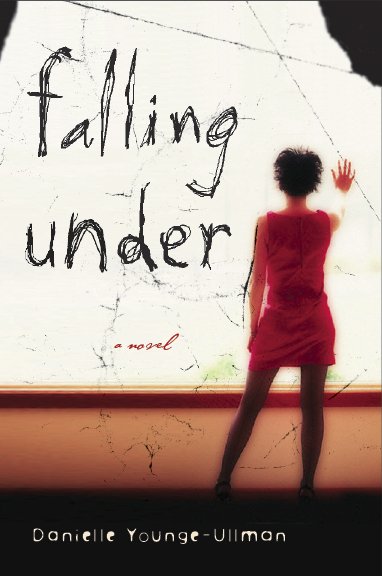
Falling Under – Danielle Younge-Ullman

fallingunderMara, the twenty-something narrator of Danielle Younge-Ullman’s debut novel, Falling Under,  is a hot mess.  An artist who can barely leave the house except to have violent sex with a guy called Erik, Mara is clearly suffering from the cumulative effects of a troubled childhood, a stalled career and a tragic love affair.

Love always starts out well. There’s the chemistry, the lust, the gushy, dizzy, cuddly, branch-eating phase, the wonder, the miracle of togetherness. And then familiarity creeps in, followed by disappointment, disillusionment, fear. Inevitably there is silence, screaming, betrayal, the wrenching ugly truth when you look at each other and know that your love has turned to disgust, despair, boredom, hate.  All happiness gone, all rotten, all rotting.

Good times.

Younge-Ullman employs two narrative perspectives in the novel. When Mara is reliving her childhood, her parents’ messy divorce and its fallout, she speaks in the second person: “When you reach out to touch your shiny new bike, Mommy might start yelling at Daddy about how dare he spend their money and how you’re only five and what do you  need a new bike for anyway?”  The second person works really well here because Mara’s childhood, although not abusive per se, scars her emotionally and clearly hinders her ability to form healthy attachments to people as she grows up.  The second person narration is both intensely personal and somehow distancing at the same time.

The rest of the novel is first person narration and Mara’s black humour, self-doubt and neurosis is on full display. The reader will traipse though Mara’s life, often unwillingly, as she negotiates the thorny relationship with her mom, her co-dependent relationship with her dad and, miraculously, a new relationship with Hugo. But none of it is easy for Mara. She just doesn’t have the skills. She is sure, as was Chicken Little, that the sky is about to fall.

He would never understand how being happy makes you sad. How the happier you are the more you know the sky is about to explode into tiny, sparkling shards of glass that will pick up speed as they fall to the earth and slice right through you leaving your skin with little holes in it, leaving your heart bleeding.

Mara is, despite her quirks, a likable character. And Falling Under is a good book. But I can’t say that I finished it feeling wholly satisfied. Was it really necessary to make all the dangling and complicated threads of Mara’s life into a beautiful cat’s cradle in the end? Maybe – but given her problems, I wouldn’t have minded a little less happily-ever-after.

The Painted Girls – Cathy Marie Buchanan

paintedgirlsCathy Marie Buchanan has taken French Impressionist Edgar Degas’  famous statue, Little Dancer Aged Fourteen, and spun it into a piece of historical fiction that will probably really appeal to some people, but with which I had a love/hate relationship. The Painted Girls is the story of sisters Marie and Antoinette van Goethem, who live with their widowed, absinthe addicted mother and younger sister, Charlotte, in Paris in 1878.

The novel alternates between elder sister Antoinette’s story and Marie’s as they struggle to survive extreme poverty and a mother who just doesn’t seem capable of taking care of them. The only way out of their dire situation is if Marie makes it into the Paris Opera (Antoinette tried, but didn’t have the talent) as a ballet dancer.

With the news that Maman is sending us to the dance school, Charlotte threads her fingers together, knuckles whitening as she works to hide her joy. I keep my face still, my dismay to myself. The petit rats – the scrawny, hopeful girls, vying for the quickest feet, the lightest leap, the prettiest arms – are babies, like Charlotte, some as young as six. It puts my nerves jumping, the idea of me – a thirteen-year-old –  lost among them at the barre, rats who earn their name by scurrying along the Opera corridors, hungry and dirty and sniffing out crumbs of charity.

It is here that she comes to the attention of Mr. Degas, who hires her to model for him. Marie wants something more for her life and she is willing to do whatever it takes to achieve it. That is not to say that she consistently makes wise choices, only that the desire for a better life is what drives her.

Antoinette’s journey is slightly more bumpy. She has already been turned out of the ballet as she is too old and not talented enough. She understands Marie’s talents, though, and works to ensure she has the lessons she needs to progress and food in her belly. Then she meets Emile Abadie, a shifty boy who  “is not much to look at …with that scrub-brushy hair of his creeping low on his forehead and his black eyes sinking too deep beneath the weighty ridge of his brow and his jaw looking like the sort of those on dogs it is best to steer away from in the streets.” Emile is a charmer though and even when he abuses Antoinette, she stays by his side.

The Painted Girls evokes the Belle Époque  period in Paris, a period which is, ironically, characterized by optimism. Art, music, literature and scientific discoveries all flourished during the period and Buchanan makes the most of them including bringing Zola’s masterpiece L’Assommoir to the stage.

Despite the novel’s merits (and there are many) I found the book overwritten. Not badly written, the language is often quite beautiful, just over-written. The sisters’ journey was intriguing, I am a fan of both the ballet and Degas, but at times I have to admit that it was a bit of a slog.

The World More Full of Weeping – Robert J. Wiersema

worldCanadian writer Robert J. Wiersema packs a punch with his novella, The World More Full of Weeping. On the day before going to spend a week with his mother in the city, eleven-year-old Brian disappears in the woods behind his father’s house. Wiersema manages to capture both the frantic search, and Brian’s journey in the forest in 77 short pages.

Part of the novella’s success can be attributed to Wiersema’s split narrative. Beginning in present day, Brian shares breakfast with his father who explains to him that his mother will be picking him up at four. Brian clearly doesn’t want to go, but lacks the ability, it seems, to articulate his feelings. Instead, he tells his father, Jeff, that “Carly said you wouldn’t understand.”

Carly’s true identity is just one of the mysteries of The World More Full of Weeping. Who is  Carly? At first she just seems like a girl Brian meets in the woods. But after Brian goes missing  and Jeff calls over to his neighbour John’s to see if he’s seen him, the mention of her name causes John to encourage Jeff to call “Chuck Minette at the Search and Recuse…call him right now.”

Many years ago, Jeff also went missing in the woods only to turn up the next day. When men from the community come to help look for Brian, it’s clear everyone thinks his disappearance might be a case of “like father, like son,” with the same happy outcome.

While the search for Brian continues, we see him in the woods with Carly, who is always in the same thin dress despite the uncertain March weather, her cheeks “pink and rosy.” Carly knows secret places in the woods, places Brian has not ever seen.  She asks him if he wants to “see more hidden things” and promises she can show him “a whole hidden world in the forest.”

There are no concrete answers in The World More Full of Weeping. The only certainty is that when given the opportunity Jeff and Brian made different choices. Perhaps some readers will take comfort in Brian’s decision, but for me I can’t quite get the picture of Jeff on his knees, crying for what is lost,  out of my head.

A magical and profoundly moving story.

The Guardians – @andrewpyper

guardiansAndrew Pyper’s been on my literary radar for a few years now – ever since I read his first novel, Lost Girls. (This was well before I blogged, or even knew what blogging was, so I have no review. I do remember that I thought it was smart, well-written and creepy.) A couple years ago I read Pyper’s novel. The Trade Mission, a book I had some trouble with. Not because of the writing, more because I felt like I was in way over my head.  The Guardians was a much easier read, well, perhaps not easier, but more accessible.

Carl, Ben, Randy and Trevor, the novel’s narrator, grow up in Grimshaw, Ontario. It’s a one-horse town, a place they can’t wait to leave. They are solid friends and have been since they were kids. They play hockey for the Grimshaw Guardians, smoke up in Carl’s car before class and fantasize about Ms. Langham, their young and beautiful music teacher. On one level, The Guardians is about this friendship. But there’s more to this story than four boys making out with their girls and smoking dope.

Because there’s this house which just happens to be across the street from Ben’s house and as Trevor recalls: “it alone is waiting for us. Ready to see us stand on the presumed safety of weed-cracked sidewalk as we had as schoolchildren, daring each other to see who could look longest through its windows without blinking or running away.”

The Guardians opens with Ben’s suicide in the present. Trevor must return to his old stomping grounds to attend the funeral. He’s at a bit of a crossroads, Trevor. He’s recently been diagnosed with Parkinson’s and he’s a man of a certain age (40) and he’s feeling the full force of death’s lingering gaze. Pretty much the last place he wants to be is back in Grimshaw, where he’ll have no choice but to remember certain events from his youth that he has sworn a pact with his buddies to never talk about.

I hope Mr. Pyper will consider it a compliment when I say that The Guardians reminded me a little bit of Stephen King’s brilliant novel, It. I loved that book, not just because it scared the bejeesus out of me  (which, frankly, seems silly now given that the monster was a giant girl spider that lived in a cave) but because of the friendships between the characters – which King always handles so deftly. Pyper does a fine job, too, of giving us characters to care about even when they make bad decisions. And they do; they’re kids.

The house has a part to play, too. It’s long abandoned and creepy as hell and bad things happen there, both real and imagined. Their relationship with the house drives the narrative both in the past and now, present day.

The strength of the story, though, is that it taps into that very human feeling of helplessness, and frailty. Trevor’s feeling it as his body begins to betray him. There’s also this notion of “you can’t go home again.” I’m not a 40 year-old-man, but I understand perfectly that idea of returning to the place of your youth but no longer being young. Trevor feels it when he is reunited with Randy. “That’s what we see in each other’s eyes, what we silently share in the pause between recognition and brotherly embrace.”  Their youth is gone, but they are haunted by it nonetheless.

The Guardians is a sad tale, well told.


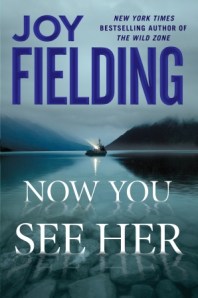
Now You See Her – Joy Fielding

now you see her

Well, there’s a few hours I’m never getting back.

I am not a book snob. I like a fast-paced, plot-driven suspense thriller as much as the next girl. Now You See Her, on the surface at least, seems like a book that would be right down my dark alley. Marcy Taggert is on holiday in Ireland. It was supposed to be a second honeymoon, but her husband, Peter, has run off with the golf pro from his country club and so Marcy has gone solo. While enjoying a cup of tea with a man she’s met on her day-trip to Cork, Marcy sees her daughter, Devon. Which isn’t possible because Devon is dead. (cue music)

I really wanted to like Now You See Her. For one thing it’s written by Canadian Joy Fielding (who has had a great deal of success in this genre). For another, I felt like I should be able to relate to Marcy. We’re of the same vintage, at any rate. But nothing about this book spoke to me.

So Marcy sees Devon and tears off looking for her. Of course, she doesn’t find her. But she returns to Cork and sets up camp and becomes more and more convinced that Devon is not dead. Marcy’s supposition might, in fact, be possible because Devon’s body was never found. She meets various characters along the way, some of whom have nefarious motives, some who want to help her. Some who think she’s crazy and as the book plods along it’s possible that crazy is exactly what Marcy is.

Here’s why the book didn’t work for me:

1. Marcy is stoo-pid. She actually meets a man in a pub and goes off with him after he tells her that, yes, miraculously, he knows her daughter. Really? Really?

2. The writing is clun-ky. Sometimes,  apropos of nothing, we get a little history lesson.  No one sounds Irish. The transitions are often confusing.

3. There are characters who just appear – out of nowhere – conveniently. Fresh baked muffins, anyone? Also, the characters are not believable. Seriously, wait until the lacklustre denouement, see who plays a part in it and then see how you’ve been mislead all along.  But not in a plausible way. Peripheral characters, Marcy’s son, for example, are footnotes.

4. If you are going to weave a tangled web, the spider at the center wants to be believable. Um. Just no.

I don’t know where Now You See Her comes in Fielding’s canon, but I won’t be rushing to read any more of her work.

Room – Emma Donoghue

Today I am five. I was four last night going to sleep in Wardrobe, but when I woke up in Bed in the dark I am changed to five abracadabra. Before that I was three, then two, then one, then zero. “Was I minus numbers?”

Jack is the narrator of Emma Donoghue’s stunning novel, Room. (Yes, I am late to the bandwagon; everyone and their dog was talking about this book when it first came out. But you all know I buy more books than it will ever be possible for me to read, right?)

From the book’s opening scene until I closed the novel a few hours later I was totally mesmerized by Jack and his Ma and the eleven by eleven world they lived in, their ‘Room.’  Jack and Ma live in this Room because of Old Nick, a predator who kidnapped Ma when she was 19 and has held her captive for seven years. Room is a prison, but it’s also the only home Jack has ever known. He doesn’t understand Outside, but he’s curious and  Ma knows that time is running out. They must find a way to escape.

Jack is a mesmerizing character and although it was risky to allow the story be told entirely through him, it’s a risk that pays off.  His worldview is so naive. He has no real concept of time (his sixth birthday will happen next week, his birthday cake takes hours and hours to make) and he believes that the people in TV “are made just of colors.”  His world is structured: sleep, eat, exercise, watch TV, read. His only playmate is his mother, but even through his innocent eyes he can see that Ma is struggling. Sometimes she spends entire days “Gone.” Sometimes she displays emotions Jack is unable to understand.

What wakes me up is a noise over and over. Ma’s not in bed. There’s a bit of light, the air’s still icy. I look over the edge, she’s in the middle of Floor going thump thump thump with her hand. “What did Floor do?”

Ma stops, she puffs out a long breath. “I need to hit something,” she says, but I don’t want to break anything.”

“Why not?”

“Actually, I’d love to break something. I’d love to break everything.”

“I don’t like her like this. “What’s for breakfast?”

Room is a remarkable achievement. It reads like a thriller; I couldn’t turn the pages fast enough. But it is also a beautiful testament to the power of love. What wouldn’t Ma do for Jack? Even more amazing, is what Jack is willing and able to do for Ma. I’ll be thinking about this book for a long time.

Highly recommended.

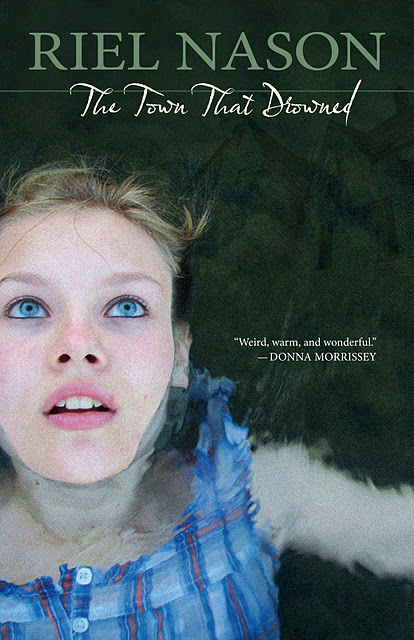
The Town That Drowned – Riel Nason

In all our years together, my book club has never been joined by the author of our chosen book. This month, as we met to discuss The Town That Drowned, we were fortunate to have the novel’s author, Riel Nason, with us. Riel and one of the members of my book club have known each other since university, so it made sense for Chrissy to choose this book and to invite Riel to join us while we discussed it.

The Town That Drowned is Riel’s first novel, but she has honed her skills writing a regular column on antiques and collectibles for the Telegraph Journal, is the author of a collection of short stories, some of which have been published, and blogs about quilting here. For the women who gathered for a discussion of the book, it was a real treat to get the inside scoop on the book’s development.

Narrated by 14-year-old Ruby, The Town That Drowned tells the story of what happens to a town when the government decides to build a dam. The narrative of the story is actually based on a true event, as Riel explained at our meeting and on her blog:

“In the late 1960s, before my friends and I were born, the area had been flooded when the Mactaquac Dam was built about 15 miles downstream. As a kid, I thought it was all pretty neat information.  Lots of great trivia. But, now if we fast forward to just a few years ago when I was possessed with the idea that I-Must-Write-A-Novel, I immediately knew that the flooding would be the background event.”

The Town That Drowned is a quiet story. Riel might have even admitted that nothing much happens, but I would disagree. I think Riel actually did a very nice job of capturing rural New Brunswick during the 1960s. My dad grew up just a few clicks further up the river from Riel’s fictional Haventon, in a small town called Perth-Andover and I spent a fair amount of time there as a kid, so I am intimately familiar with towns like that. You know the kind: everyone knows everyone, meaning everyone knows your business and there’s no escape from the town bullies. Ruby observes her neighbours and the events that transpire over the course of a couple of years through remarkably mature eyes.

My favourite character in the novel is Ruby’s younger brother, Percy. Although it’s never overtly stated, Percy has Asperger’s, a high-functioning form of autism. Every time he opens his mouth, he is a delight.

“Our mother says we should give you the message of her love,” he says to Mr. Cole – a much loved neighbour – on the occasion of a picnic he and Ruby share with him.

Percy thrives on structure and order and routine and the thought that his house might be moved is kept a secret from him for as long as possible. Ruby adores him and is embarrassed by him in equal measure. I just adored him.

The Town That Drowned will have special meaning to those readers familiar with the St. John River Valley and those who remember the Mactaquac Dam being built. But even if you aren’t from around here, the story offers up plenty of  treasures: first love, the importance of family, and what it means to have a place to call home.

Still Missing – Chevy Stevens

Beautiful real estate agent Annie O’Sullivan is just finishing up an open house when her world comes crashing down. That’s when David arrives, begging for an opportunity to see the house before she packs up. David, however, isn’t what he seems and Annie’s life is about to get ugly. David abducts Annie and holds her captive for  many months in an isolated cabin in the woods.

This is Chevy Stevens’ ( who is very beautiful, btw – not that it matters, but she is) first novel and in many ways, it’s a doozy. The first person narrative alternates between sessions with Annie’s shrink where she recounts the details of her horrific captivity and the  details of her arduous journey back to emotional health.

I found Still Missing quite a gripping book. Annie is no shrinking violet. During her time in the cabin she is constantly trying to outmanoeuvre David – not an easy task because he’s batshit crazy. Annie’s fear is palpable, but equally convincing is her desire to stay alive and it’s that motivation that keeps the story humming along.

What didn’t work so well for me was the novel’s resolution.  I’m one of those people who doesn’t need the neat and tidy ending, loose ends gathered into a orderly bow. Likely most readers won’t be bothered by how it all ties up because the mystery of who orchestrated Annie’s abduction isn’t really what’s facinating about Still Missing.

Freedom to Read…

Freedom to Read Week is an annual event that encourages Canadians to think about and reaffirm their commitment to intellectual freedom, which is guaranteed them under the Charter of Rights and Freedoms. – from the Freedom to Read site

I personally don’t believe in censorship; I’m a pro-choice chick all the way. I agree – there’s a lot of abhorrent crap out there, but my problem with censorship is who gets to decide whether it is or isn’t abhorrent crap. The closest I’ve come to questioning the merit of a book was reading about Karla Homolka and Paul Bernardo, a married couple responsible for the death of three young girls including Homolka’s sister.

Freedom to Read has a wonderful list of writing that has been banned over the ages including:

“George Eliot’s novel Adam Bede was attacked as the “vile outpourings of a lewd woman’s mind,” and the book was withdrawn from circulation libraries in Britain.

Walt Whitman’s Leaves of Grass (published in 1833) was threatened with banning by Boston’s district attorney unless the book was expurgated. The public uproar brought such sales of his books that Whitman was able to buy a house with the proceeds.

Alice in Wonderland by Lewis Carroll was banned by the governor of Hunan province in China because, he said, animals should not use human language and it was disastrous to put animals and humans on the same level.

D.H. Lawrence’s novel Lady Chatterley’s Lover was the subject of a trial in England, in which Penguin Books was prosecuted for publishing an obscene book. During the proceedings, the prosecutor asked: “Is it a book you would wish your wife or servant to read?” Penguin won the case, and the book was allowed to be sold in England. A year earlier, the U.S. Post Office had declared the novel obscene and non-mailable. But a federal judge overturned the Post Office’s decision and questioned the right of the postmaster general to decide what was or was not obscene.”

And here’s a real shocker…”The U.S.A. PATRIOT Act, 2001,  passed by the American Congress in response to terrorist attacks on New York and Washington on September 11, gave the FBI power to collect information about the library borrowings of any U.S. citizen. The act also empowered the federal agency to gain access to library patrons’ log-ons to Internet Web sites—and protected the FBI from disclosing the identities of individuals being investigated.”

Read more about censored books here.

Here in Canada, the following books have been challenged at one point or another:

  • Margaret Laurence, The Diviners
  • J.D. Salinger, Catcher in the Rye
  • Rosamund Elwin, Asha’s Mums
  • Alice Munro, Lives of Girls and Women
  • Elizabeth Laird, A Little Piece of Ground
  • Mordecai Richler, The Apprenticeship of Duddy Kravitz
  • John Steinbeck, Of Mice and Men
  • Harper Lee, To Kill a Mockingbird
  • J.K. Rowling, Harry Potter
  • Mark Twain, Huckleberry Finn
  • Margaret Atwood, The Handmaid’s Tale

A full list of  material challenged in Canada can be found here.

Do you have personal feelings about censorship?