Wildman – J.C. Geiger

Eighteen-year-old Lance Hendricks is on his way home after auditioning for a spot at a prestigious music school when his ’93 Buick breaks down. Lance is really anxious to get home to a party where he and his long-time girlfriend, Miriam, are finally going to do the deed, but his car is towed off and it looks like he’s going to be stranded in the middle of nowhere because he is not leaving his car behind. Not the car his father left for him.

J.C. Geiger’s YA novel Wildman is essentially the story of what happens when a person whose life is all figured out discovers that maybe that buttoned-up life isn’t the one he wants after all.

Lance takes a room at the Trainsong – a dumpy roadside motel – and heads over to The Float, the only spot for miles where someone can get something to eat (and drink, even if you are underage). There he meets Mason, Rocco, and Meebs. And Dakota.

She was watching him.

A girl in the darkness. In possession of perfect stillness. Her stillness made him stop, and because he stopped, it came. The feeling he’d been aching for. Toes in ice water. feathers up his calves. A hair-prickling, teeth rattling rush of a shiver so good it made his eyes sting.

As Lance waits for his car, he gets caught up in a world vastly different from his own. Lance was on the fast track to success: valedictorian of his graduating class, a full-ride scholarship, a summer internship at the bank. The future is all mapped out. Until he loses his way or, maybe, finds a different more appealing way.

I enjoyed my time with Lance and the people he meets on this journey. The book is well-written, often laugh-out-loud funny and asks some big questions at a pivotal time in a young person’s life.

Shiner – Amy Jo Burns

Amy Jo Burns’ debut novel Shiner is my first five-star read of the year. It is the story of Wren Bird who lives with her parents Briar and Ruby in West Virginia outside of the aptly named no-where town of Trap. Wren tells us

The story of a snake handler’s daughter began when I’d just turned fifteen. I knew little then of the outside world my father kept from me. Ours is an oral civilization, I used to hear him say, and it’s dying. He blamed coal, he blamed heroin. He never blamed himself.

Briar is a preacher. As a young man, so the story goes, he’d been struck by lightning, causing one of his irises to go milky white and apparently giving him the power to heal and handle venomous snakes.

My father obeyed the rituals of snake-handling law, which meant he pretended we still lived in the 1940s instead of the age of the internet and all the things people did on their cell phones that I couldn’t understand. […] Daily my father lifted his serpents to the sky and uttered a prayer in tongues that no one could interpret.

Wren has never known any other life. Briar has kept her and her mother isolated on the “mountain’s western ridge.” Their only visitor is Ivy, Ruby’s childhood best friend, and her sons. When they visit, Briar hides in his snake shed because “He couldn’t bear to share my mother mother with anyone – not with Ivy, not even with me.”

A terrible accident sets off a summer of discovery for Wren and it is a breathtaking journey, where secrets are revealed and new relationships are forged.

There are so many things to admire about Shiner, not the least of which is the writing. But you can have great writing that is somehow distancing and impedes the plot. I loved the way this book was written, but I also loved the characters, particularly Wren and Flynn, the local ‘shiner’ (someone who makes moonshine) who is connected to Wren in a meaningful way, although she doesn’t know it.

Shiner is about the way “mountain men steered their own stories, and women were their oars.” It’s about finding your voice and making choices. It is about family. I loved every single second of it.

Highly recommended.

The Yonahlossee Riding Camp for Girls – Anton DiSclafani

From a vantage point some time in the future, Thea Atwell looks back at the year she was fifteen in Anton DiSclafani’s debut novel The Yonahlossee Riding Camp for Girls. It is only with this hindsight that Thea is able to make sense of the events which led up to her parents banishing her to North Carolina. She has only ever known her home in rural Florida, where her father is the only doctor for miles and the family’s wealth is buoyed by citrus. There, she and her twin brother Sam spend their days doing exactly what they want: for Thea this means riding her horse, Sasi; for Sam it means examining the natural world. The outside world consists of her aunt and uncle and her two-years-older cousin, Georgie, but they live in Gainesville.

Thea hints at the reasons why she has been sent away. She says early on that her parents were sending her to Yonahlossee so they “wouldn’t have to see me.” When she thinks of home she “wanted to weep, but I would not let myself. I had wept enough for a lifetime. Two lifetimes. Three.”

It doesn’t take her long to settle in to life at Yonahlossee, partly because one of the camp’s more popular girls, Sissy, befriends her and partly because Thea is an exceptional horsewoman. Life here is so different from life back home and the people back home seem to have forgotten her; her parents take turns writing and she hears nothing from Sam, once her closest companion.

The novel moves seamlessly between days at Yonahlossee and the days leading up to the “event” which caused her exile. In the meantime, she begins to understand her power when begins a relationship with an adult at the camp.

One of the students in my Young Adult Literature class read this book and called it “disgusting.” I wholeheartedly disagree. This is a coming-of-age story featuring a young woman trying to figure out what society and her parents expect from her and what she wants for herself. The fact that the novel is set in 1930 makes this all the more problematic. Thea has been sheltered by her parents’ money, but out in the world she comes to understand that everyone has not lived as she has. She is often selfish and petty, but she is also smart and free-spirited. Does she make some bad choices? Certainly. Are her choices “disgusting”? Certainly not.

At Yonahlossee I learned the lesson I had started to teach myself at home: my life was mine. And I had to lay claim to it.

This is a fabulous debut.

Penpal – Dathan Auerbach

Dathan Auerbach’s novel Penpal began life as a series of interconnected stories on an online horror forum, which probably accounts for some of the repetitiveness, wonky timeline issues, and disjointedness.

In the novel, a young boy starts to receive a series of blurry polaroid photos in the mail after his kindergarten class participates in a balloon activity. Each student writes a letter, ties it to a balloon and sets them free. The hope is that whoever finds the balloon will write back and include a photo of where they live. These photos will then be pinned to a map.

The unnamed narrator doesn’t think much of the first photo, but over the coming weeks he receives dozens more and upon closer inspection he discovers that he is in every single one of them. Creepy, right? Well, sure…if it had actually led somewhere.

In many ways, Penpal is a coming-of-age story. The narrator and his best friend Josh spend a lot of time in the woods, a place that is both magical and menacing. Once, the boy wakes up and finds him in the middle of the woods, lost. Once, he and Josh go looking for the narrator’s missing cat and that leads to a heart-pounding segment under a house. Then there’s the crazy denouement, which seems to come out of nowhere. And that was one of my issues with this book. It skips around and twists back on itself and although the narrator tells the reader that “the story I am about to tell you is the product of my own mental archaeology [and] like all great digs, how the artifacts fit together in a timeline is about as immediately clear as which things are important and which are not” I kept waiting for some sort of satisfying resolution.

I think Penpal had a lot of potential. There was a lot of hype surrounding this book – perhaps too much for a self-published debut. Lots of people put it in the extreme horror category. Can’t see that, really. Was I wowed by this book? No. Were there some bits that I enjoyed. Yes. Would I read something else by this author? Probably not.

Wilder – Andrew Simonet

Jason Wilder is a high school senior who doesn’t actually attend classes. Instead, he spends his time in the Rubber Room…for his own protection.

Officially, it was In-School Suspension, but kids called it the Rubber Room. It wasn’t covered in rubber, but it was delinquent proof. […] The Rubber Room was set up to prevent tragedies like school shootings, or at least to make it look like you could prevent them.

Jason set a fire that hurt someone and now he’s a target. The thing about Jason is that he’s big and tough and, according to Meili, “a danger because [he] wants to be.”

Meili is in the Rubber Room because, according to the story that’s been passed around and likely exaggerated, she broke someone’s finger. She’s not afraid of Jason or his reputation for violence; she is fearless, mysterious, and just a tad crazy.

These are the characters in Andrew Simonet’s debut YA novel, Wilder.

Despite his propensity for violence, Jason is a sympathetic character. He has a distinctive voice and a troubling backstory. He lives alone; his mother and her boyfriend, Al, have moved to Florida, apparently to dry out. He lives in their crappy house existing on the little bit of money they send home to him. Because he is on probation for setting the fire, he can’t let anyone know that he lives alone. It’s not that hard to keep it a secret; Jason doesn’t really have any friends. Until Meili.

It is clear from early on in the story that something happens to Jason and Meili. Jason informs us

I have lots of time now to think about what happened. I’m straightening out how one thing led to the next, how I got drawn in, how things became inevitable.

Other people have their ideas, what should have happened, what I did and didn’t do. Meili has her version. This is my story, what it’s like inside my skin.

It is no wonder Jason and Meili are drawn to each other. It is also no wonder why things end up going horribly wrong.

I never want Meili – or anyone – to be so betrayed and broken. But if we’re gonna live in a world where that happens, I want this. I want her thrashing sobs and gut screams. I want to clench my body to hers and tumble. I want this velocity. I want my share.

Wilder is full of forward momentum. I found it a compelling read, by it’s definitely for mature readers. There is violence, lots of swearing and some fairly explicit sex.

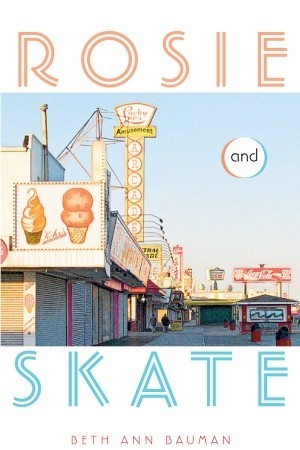
Rosie & Skate – Beth Ann Bauman

Sisters Rosie, 15 and Skate, 16, share the narrative in Beth Ann Bauman’s YA novel Rosie & Skate. They live in a crumbling house on the Jersey Shore. Well, Rosie lives there with her cousin, Angie. Skate lives at her boyfriend’s house with his mother, Julia. The sisters’ father is currently in jail for committing petty crimes while under the influence. although Rosie insists that her father is “a nice drunk.”

Bauman’s novel follows the sisters as they navigate their relationship with their father (Rosie is hopeful and forgiving; Skate has given up on her father and doesn’t believe he will ever get better), and each other. Skate is clearly the more worldly of the two: her older boyfriend, Perry, is in his first year at Rutgers and Rosie hasn’t even been kissed. Over the course of a few weeks, though, each of the girls will encounter unforeseen challenges that will push them along the path to adulthood.

Rosie & Skate is one of those quiet books where not much happens, but it still feels packed. I suppose that’s because when you are a teenager everything feels momentous. Who is guiding these girls? Who can they turn to but each other when things go off the rails – as they so often have in their lives.

There are no bad actors in this novel, even Rosie and Skate’s dad is searching for answers as to why he can’t seem to stop drinking. Rosie and Skate have their own way of coping and they certainly make mistakes, but anyone who was ever a teenager will recognize themselves in some of the questionable decisions the sisters make.

Ultimately, though, Rosie & Skate is a hopeful book about family, particularly found family, and spending time with these sisters is time well-spent.