The Drift – C.J. Tudor

Although I am posting this review on Jan 9, 2025, C.J. Tudor’s (The Chalk Man, The Hiding Place) novel The Drift was actually my last read of 2024. I finished it up poolside while on a family vacation in Florida. It’s a cheat that it’s ending up in my book count for 2025, but who cares?

Told from three different perspectives, The Drift is a dystopian horror novel that concerns three different groups of people, all of whom seem to be stranded.

There’s Hannah, a medical student who had been on her way to the Retreat, when the bus she was on crashed. That’s not all. “Snowstorm outside, coach tipped over and half buried in a drift.” And Hannah figures abut half the passengers are dead.

Meg wakes up in a cable car suspended a thousand feet in the air. She’s not alone, but nobody can really remember how they got into this situation. Worse, no one is really sure how they’re going to get out of it. It’s a blizzard out there.

Finally, there’s Carter, one of a group pf people holed up at The Retreat.

…the Retreat was large. And luxurious. The living room was all polished wooden floors, thick shaggy rugs and worn leather sofas. There was a massive flatscreen TV and DVD player, games consoles and a stereo. A wooden sideboard housed stacks of CDs, dog-eared novels and a collection of board games. The kitchen was modern and sleek with a huge American fridge freezer and a polished granite island.

Residents at the Retreat were well looked after.

What these three groups of people (and our narrators) have in common is part of the fun of this locked room, puzzle box of a novel. There’s a mysterious virus (C.J. Tudor came up with the idea in 2019, just before Covid slammed its way into our lives), a creepy group of people called Whistlers, some gross body horror and lots of wondering who can be trusted. The voices of the three characters aren’t necessarily distinct, but the pages will practically turn themselves as you try to figure just how everything fits together.

Hell Followed With Us – Andrew Joseph White

Andrew Joseph White claims his debut novel Hell Followed With Us was written because he was angry. On his website, we’re told “His work focuses on the intersection of transgender and autistic identity through the lens of horror, monstrosity, violence, and rage.” Got that right.

Benji is on the run. His father has just been killed and the Angels and their Graces are hunting him down, except that there is not really any place to go. That’s because these people – part of the cult that raised Benji – have unleased Armageddon via The Flood, decimating the world’s population.

The hellscape of the world White imagines is unlike anything I have ever read before. This is a world devoid of humanity, where goods are bartered with the exchange of human ears, where the monsters are

made of corpses and the Flood – sharpened ribs lining its back in a row of spines, eyeballs blinking between sinew, muscles so swollen they split the skin

At the beginning of the novel, when Benji is recaptured by the Angels, it is not so they can kill him: he’s important to the cult because he is a Seraph, or about to become one anyway. He has the power to control the Graces and The Flood and also, his mother is kind of a big deal at New Nazareth. Before they can get Benji back to New Nazareth, though, he is rescued by a ragtag group of teen resistors from the local Acheson LGBTQ+ Centre (ALC). It is his relationship with these people, specifically the handsome sharp-shooter, Nick, that propels Benji on a dangerous mission to take down New Nazareth once and for all.

Hell Followed With Us is an allegorical tale. Before Benji was Benji, he was Esther, betrothed to Theo. At their engagement ceremony, Benji’s mother tries to find a passage about marriage, something that would “hammer home” Benji’s role as a wife, something that could “beat the boy” out of him. Throughout the novel, Benji struggles to find acceptance and while the monsters might be dreamt from Whites very scary imagination, the big ideas- of acceptance, or personal autonomy, of the dangers of blindly following are anything but fiction.

Great read.

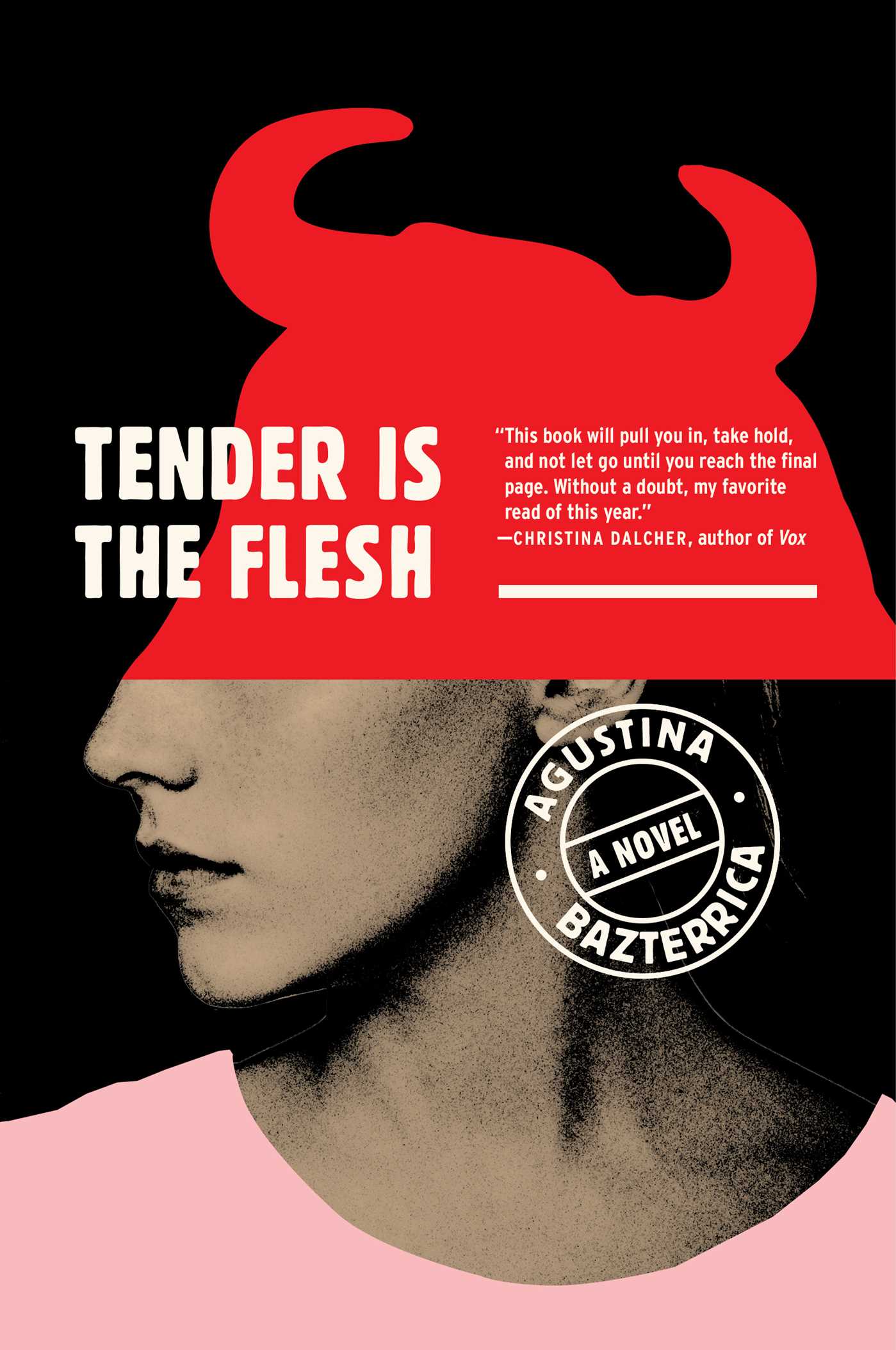
Tender is the Flesh – Augustina Bazterrica

I mean, there are dystopian novels and then there’s Tender is the Flesh.

Marcos Tejo’s life has fallen apart. His father has dementia and is existing in assisted living. His wife has had an emotional breakdown and has left to stay with her mother after the death of their infant son. Oh, yeah, and a deadly virus – well, that’s what the government claims anyway – has made it impossible to eat animals, so everyone now eats humans. That, of course, helps with population growth too, so it’s a win win.

People are specially bred as meat and Marcos works at one of the country’s best slaughterhouses.

No one can call them human because that would mean giving them an identity. They call them product, or meat, or food. Except for him; he would prefer not to have to call them by any name.

Bazterrica’s book is all kinds of ick. In scene after scene, we are treated to graphic descriptions of how this “special meat” is treated. And trust me when I say, it’s not good. It will be impossible not to imagine how the animals we eat every day are treated, and if there ever was a case for veganism, this book would be it. But, according to the scientists in Tender is the Flesh,

animal protein [is] necessary to live [and] doctors confirmed that plant protein didn’t contain all the essential amino acids, [and] experts assured that methane emissions from cattle had been reduced but malnutrition was on the rise, [and] magazines published articles on the dark side of vegetables.

When Marcos is gifted an F.G.P. (First Generation Pure) “head” to consume, his ambivalent feelings – which he mostly keeps buried – come to the surface. Once he cleans her up and discovers she’s beautiful he moves her from the barn to the house and one thing leads to another. The head can’t talk, of course; their vocal chords are removed – the killing is less noisy that way – so I guess their relationship is based on a needs must basis.

I mean, sure, I guess Tender is the Flesh has stuff to say, but Marcos is a hard character to warm up to. And you have to wade through a bucket of entrails and other gruesome stuff to get there. You’d kind of hope that Marcos would have some sort of epiphany or something, but this book is bleak start to finish.

And also. Yuck.

Off the Shelf – Dystopian Fiction

tbr

So, we’re all trapped inside for the foreseeable future and I have been preparing for this for many years by hoarding books. I have enough unread books on my shelves to keep me reading for the next decade.

If you haven’t already dipped your toes into dystopian literature – maybe now’s the time to start since we seem to be living in a dystopia.

Dystopian literature is a form of speculative fiction (a genre of fiction that encompasses works in which the setting is other than the real world, involving supernatural, futuristic, or other imagined elements) that began as a response to utopian fiction, which is a term coined by Sir Thomas More in 1516 with his book Utopia (Greek for no place). So we have come to understand a utopia as a perfect world – clearly not the world we are currently living in.  Dystopian literature explores the dangerous effects of political and social structures on humanity’s future. When the structures that are meant to keep us safe start to break down, we are heading into dystopian territory.

According to Masterclass.com, the central themes of dystopian novels generally fall under these topics:

  1. Government control
  2. Environmental destruction
  3. Technological control
  4. Survival
  5. Loss of individualism

If you are interested in seeing how authors imagine a future world, there’s lots of great titles out there.

Margaret Atwood is considered one of the very best writers of dystopian literature and her novel The Handmaid’s Tale is widely regarded as one of the great dystopian novels. After  some sort of environmental disaster, America has reorganized itself into a patriarchy where women are basically used as baby-makers. This novel is 35 years old, but it certainly rings true today and although I can’t say that I am huge Atwood fan, this novel is probably required reading. The sequel The Testaments was co-winner of the Booker prize last year. One Atwood book I did enjoy was Oryx and Crake, which is another book that makes you think Atwood must have had a crystal ball. It’s the first book in a trilogy about a guy named Snowman who is – seemingly – the last person alive on earth. The landscape has been devastated, there’s no food and scientists have created scary genetic mutations.

Another masterpiece of dystopian literature is Stephen King’s novel The Stand. The National Post just published an article titled “Stephen King’s The Stand (1978) is either the perfect distraction from COVID-19 or too eerily accurate to consider” The article’s author, Calum Marsh says The Stand is “an engrossing, sweat-inducing, eerily plausible 1,400-page epic about the inception and spread of an extremely deadly global pandemic, kick-started inside an underground biological testing facility in the Mojave desert and sent hurtling in all directions across the world with irrepressible speed.”

The Stand is about  a deadly strain of influenza has ravaged America killing most of the population. The American government tries to cover it all up…and the fun begins.

The Stand is considered King’s masterpiece, but I have never been able to finish it – and I would consider myself a King fan…just there’s a lot of characters to keep track of in the beginning, but maybe now’s the time to give it another go because from all accounts it’s totally worth it…and hey, I’ve got the time.

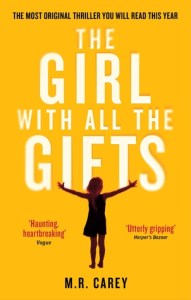
The Girl With All the Gifts– M.R. Carey is a great book if zombies are your thing…and,17235026 really, what’s more dystopian than a zombie novel. In this book ten-year-old Melanie is kept caged up with a bunch of other kids because they are flesh eaters. This is happens after some horrific event in England. This is actually quite a philosophical novel which asks questions about what makes us human…and how we react to catastrophe. I am not a zombie girl, but I really liked this book. Total page-turner.
And then I have a couple titles for young adult readers:

Monument 14 – Emmy Laybourne – an environmental disaster forces brothers Dean and Alex to hole up with the other kids on their school bus in a huge superstore.

The Knife of Never Letting Go– Patrick Ness – one of my absolute favourite series about a kid named Todd who lives in a world without women and where everyone can hear everyone else’s thoughts.

Ashes– Ilsa Bick 17-year-old encounters a post environmental disaster world filled with flesh eating teens and blurred morality

These are all first books in a series, which would definitely keep your teens reading.

I wonder if  part of the appeal of  reading dystopian fiction doesn’t have to do with the extreme nature of the stories? I mean, did you ever imagine you’d be confined to your house or have to follow arrows when you go to the grocery store? I don’t miss shopping; I miss my friends and my family. Dystopian fiction capitalizes on the fears of the characters and the readers and encourages them to make choices that will benefit the whole community. Perhaps some really good things will come out of Covid 19.

Looking for more great reads in the dystopian category?

Vulture’s Pandemic Reading List

Oprah’s List of the Best 20 Dystopian Novels of All-Time

Happy reading.

Stay safe.