Land of Milk and Honey – William Taylor

As a result of two world wars, thousands of children from Britain were sent to live in Canada, the United States, South Africa, Australia and new Zealand. While many of these children were war orphans, many were not. Their parents merely decided to send them away in the hopes that they would have a better life. About 750 children ended up in New Zealand.

William Taylor’s ironically titled novel Land of Milk and Honey follows the fortunes of one such boy, Jake Neill, aged 14. When he arrives with his younger sister, Janice, in Wellington  in 1947 he is told he’s ‘lucky’ because he’s going to be shipped off to a farm where he’ll have access to “milk and butter and cream and eggs. Fresh meat.” Jake isn’t actually an orphan; his mother has been killed in an air raid and his father has lost a leg and doesn’t feel able to look after his children.

Jake’s first trauma comes when he is separated from his sister. While Jake knows he is bound for the Pearson farm, the authorities don’t know where they are sending Janice and Jake leaves her without knowing whether or not he will ever see her again. Turns out, this is the least of his worries.

The Pearsons – mother, father and 16-year-old son, Darcy, are about as far away from warm and welcoming as you can get. It doesn’t take him long to figure out that he’s nothing more than slave labour and worse, that Darcy is a sadist. The evidence comes early on when Darcy tortures a calf taunting Jake by saying: “Useless bastard. Look….See its nuts? Deserves everything it’s getting.” Darcy proceeds to slowly twist the calf’s leg until it cries out.

Darcy’s cruelty escalates and I found some of the scenes almost impossible to read about. I seriously felt sick to my stomach, but in that way where I knew I was reading something authentic not gratuitous.

William Taylor is a well-known and prolific New Zealand author. He’s written over 30 novels, including books for adults and children. Land of Milk and Honey, while not easy to read, should be read. It is a novel that deals with themes like resilience and determination which should resonate with its readers. Jake’s time on the Pearson farm is difficult to read about, but he is a remarkable character and his story reminds us of how it is possible to overcome tremendous odds.

In Search of Adam – Caroline Smailes

“Jude, I have gone in search of Adam. I love you baby.

I didn’t understand. But I took the note. It was mine. I shoved it into the pocket of my grey school skirt. I crumpled it in. Then.”

Jude is just six years old (four months and two days) when she discovers the lifeless body of her mother. It shatters her young life and the hurt train keeps on coming.

Her father farms Jude off to various neighbours after the death of his wife while he begins a new relationship with Rita. One of these neighbours is Aunt Maggie at Number 30. It is here that Aunt Maggie’s brother, Eddie, sexually assaults Jude. And it is here that Jude begins a journey that twists her life in ways that are often impossible to read about.

Jude is desperate for attention – and it’s completely understandable since her father virtually ignores her. At school, one of her teachers takes a special interest in her, but it isn’t enough to save her from the hurt that is gnawing away at her insides; big girls don’t cry is Jude’s mantra.

Smailes writing is often beautiful, but unlike anything I’ve ever read before. Sentences are fractured and stagger across the page, perhaps to mimic Jude’s own thoughts. This isn’t one of those novels where a child endures horrors only to bounce back, more resilient than ever. In Search of Adam is almost relentlessly dark and as a mom, it was often extremely difficult to read.

But I couldn’t put it down.

What Love Mean to You People – NancyKay Shapiro

I started to read NancyKay Shapiro’s debut novel a couple years ago, got about 40 pages in and put it aside. I’m not really sure why I stopped, I just wasn’t groovin’ to the story. And I desperately wanted to like it. See, NancyKay Shapiro was something of a Big Fandom Name back in my days in a certain fandom (which shall not be named so I don’t out her). She wrote a different pairing than I did and I didn’t always agree with her characterization, but there was no question that she could turn a phrase.

In a way, What Love Means to You People is sort of like reading her fanfiction. The writing is smart and often quite beautiful, but I had serious problems with the characterizations of her three main characters: Jim, a widowed gay man in his early 40s; Seth, Jim’s new beautiful, troubled, much younger lover and Cassie, Seth’s sister who shows up and causes all sorts of trouble for the men.

Jim is a rich advertising guy. He’s been single ever since the love of his life, Zak, died. One day, he meets Seth McKenna:

Rippled nose with a slender ring in one nostril. Cheekbones and a clean jaw. Shorty bleached hair in trailing bangs, pointy sideburns. Silver rings climbing one earlobe, small, smaller, smallest. An appealing athletic body, too, in white chinos and a tank shirt. Quite nice, despite the trivializing modifications.

Jim is smitten. They have dinner. Seth tells a lie. Or two. Seth, it seems, has a past from which he has tried desperately to distance himself. It looks like none of it will matter, until his younger sister, Cassie, shows up with her small-minded attitudes about gay men and the key that opens the door to Seth’s past.

There are lots of plot twists, relationships fractured and pieced back together. Lots of graphic gay sex, too, if that’s your thing. I think Shapiro was aiming for a story that examines families, and how sometimes the ones we choose are better than the ones biology gives us but, ultimately, for me, What Love Means to You People wasn’t really much more than a well-written soap opera, complete with stock characters and a neatly tied bow of an ending.

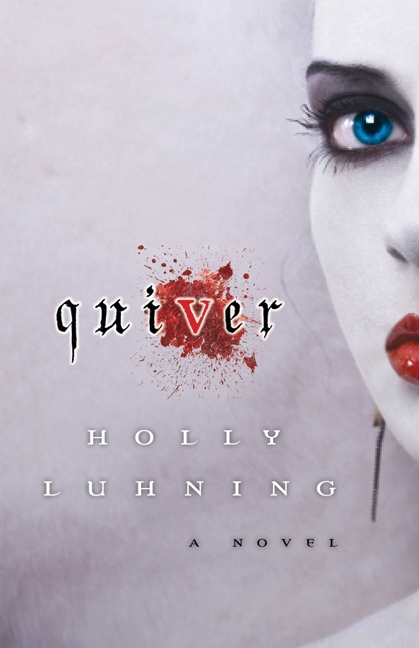
Quiver – Holly Luhning

Saskatchewan native Holly Luhning  has written a compelling novel based on the shocking life of the Hungarian Countess, Elizabeth Bathory.  Bathory, who was born in 1560, earned her shocking reputation for having tortured and killed over 600 young girls so that she might bathe in their blood and thus retain her youthful beauty.

Luhning’s novel, Quiver, is a creepy crawly book that follows Danica, a young foresnic psychologist, who has moved to London with her artist boyfriend, Henry, to work at Stowmoor, a Victorian hospital for the criminally insane. Danica’s patient is Martin Foster, a young man incarcerated for murdering a young girl as a tribute to Bathory.

Danica’s fascination with Bathory grows when a woman from her past, the  beautiful and duplicitous Maria, comes back into her life. Maria, it seems, has discovered Bathory’s private diaries and as she translates them and begins sending the horrific snippets to Danica, Danica’s life starts to shift.

We’re all, to some degree at least, train-wreck fascinated by the heart of darkness.  Danica’s morbid curiousity about Bathory (and the translated diary entries are not for the weak-stomached, believe me!) is complicated by her attraction/repulsion to Maria. Maria is impossibly beautiful and crazy-cool. I didn’t trust her at all, but I could see Danica’s attraction. There was something sinister about her and always an undercurrent of sexual attraction, too.

Quiver races along like the best thrillers, but it also has something compelling to say about art and that 15 minutes of fame so many of us seem to desperately crave.

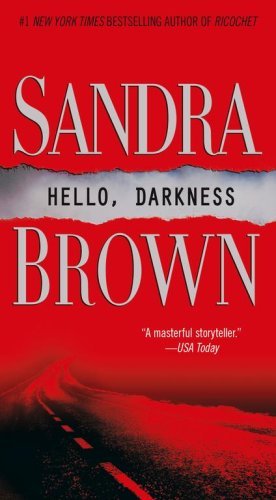
hello, darkness – Sandra Brown

For many years I subscribed to Entertainment Weekly and for a while Stephen King contributed a monthly column called ‘Pop of King’ where he rattled on about pop culture – movies and music and such. I love King; I love the way he writes and I love his ‘every man’ sensibilities when it comes to popular culture. Every year he did a book round up – sort of a top ten books list and I would avidly copy down the names of books I found interesting. That’s how Sandra Brown’s novel hello, darkness came to be on my tbr shelf. Actually, although the book was on my tbr list for a few years, I only just purchased it in May when I discovered it at the annual library book sale. I was familiar with Brown’s name, but hadn’t ever read anything by her.

hello, darkness is the story of reclusive radio host Paris Gibson. Every night she listens to people tell their tales of woe and plays them a song to cheer them up. And then she gets a call from a man called Valentino who tells her that his girlfriend had acted on some advice she’d given her and dumped him and now Paris is going to pay.  “I’m going to make you sorry that you gave her that advice,” he warns her. He vows to hold her, torture her and kill her within 72 hours.

The girl in question is the wild child daughter of a local judge and once the authorities know she’s missing, they bring in police psychologist Dean Malloy to help solve her disappearance and her connection to Valentino. This isn’t exactly good news for Paris. She and Dean have a history. You know what that means, right? All sorts of unfulfilled lust and crossed wires and missteps until they finally get it…um…together.

In the meantime, there are red herring subplots galore  to keep the reader guessing about Valentino’s true identity. It comes right down to the wire, and then all is resolved. I have no doubt that  fans of the genre (romantic suspense thriller) will be wildy satisfied with both the suspense and the romance. As for me – I was wondering why it made King’s top ten. Sure, it was a  decent thriller and Brown is a capable writer – but  it felt  formulaic for me.

Still, chuck it in your beach bag. It’ll kill a satisfying hour or two.

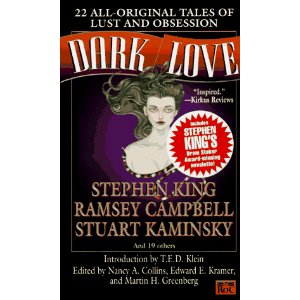
Dark Love by various authors

Dark Love, edited by Nancy Collins, Edward E. Kramer and Martin H Greenberg, was published in 1995 and has been sitting on my tbr shelf for two or three years. This is a collection of short stories where “there’s no love without obsession…and obsession is the underlying theme of every story.”

Given the pedigree of the included authors Ramsey Campbell and Stephen King among them, readers should approach this book with caution. Some of the stories are downright icky. “The Penitent” by John Peyton Cooke I’m looking at you. That one starts out with the line: “Every since I was a young girl  I’ve wanted to torture a beautiful young boy.” Trust me, it goes downhill from there.

The Stephen King story, “Lunch at the Gotham Cafe” was a new original story at the time of this anthology’s publication. I like King and while this story has much to recommend it – mainly a narrator I believed in – the story was kinda silly. For some reason, I kep thinking about the Muppet’s Swedish chef as I was reading.

My favourite story of the bunch was “Hidden” by Stuart Kaminsky. It would make a great episode of Criminal Minds – more creepy than anything else.

Fans of the genre will likely enjoy this volume.

Breaking the Girl by Kim Corum

I’m not going to lie – I enjoyreading erotica. But I have standards, people. And Kim Corum’s ridiculous novella, Breaking the Girl doesn’t meet any of them.

Kristine is a stripper in New Orleans. She didn’t set out to be a stripper. She’d gone on holiday with her friend to escape her recent marital break up and suddenly she and her friend found themselves bumping and grinding on stage at a strip club. The money was good so Kristine – who doesn’t have any other talents besides sex – stuck with it.

Enter Frank. Handsome and rich (although we never find out what he does), he takes a shine to Kristine and invites her to come live with him. Yeah – it really is that simple.

Thus begins her training. To the untrained eye beating someone with a belt until they’re so disoriented they fall down the stairs might be considered abuse, but everything Frank does is for Kristine’s own good.

Breaking the Girl is meant to be a novel about domination and submission. Okay, I’m down with that. But this book just doesn’t have anything to recommend it. The sex was pretty tame (and let’s face it, isn’t that why we read this stuff?), the characters were cardboard cut-outs and Corum tries to add heft to the story with a bunch of hooey about why Frank needs to “break the girl”.

So, so mediocre.

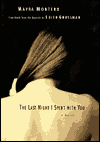
The Last Night I Spent With You by Mayra Montero

The Last Night I Spent With You is a slim volume, only 115 pages. Translated from the Spanish, Montero’s novel tells the story of Celia and Fernando – a middle-aged couple on a cruise. Their only daughter has just been married and Fernando’s friend, Bermudez, has sagely offered this advice: “women lose their inhibitions on ships.”

Actually, it seems as though everyone does.

Both Fernando and Celia are trying to come to terms with suddenly being cut loose from the strings that tied them to their daughter and each other. Fernando, too, seems to be experiencing a bit of a midlife crisis: death is looming. As their ship sails and docks, Fernando falls into an affair with Julieta, a middle-aged passenger.  For her part, Celia reminisces about an affair she’d had several years ago, when she’d been taking care of her ailing father.

Everything about this voyage is sexually charged in a way, one gathers, things haven’t been for several years between this married couple.

At last we were alone, it was true, after almost twenty-three years of winters and vacations, springs and birthdays, when Elena had been the axis of our lives. Elena growing up, becoming pretty, becoming taller than Celia, much more slender, infinitely more flirtatious. Our daughter Elena.

The Last Night I Spent With You is graphic and the writing is – despite it being a translation – good. The characters are selfish and often  behave inappropriately. It’s hard to say what they are searching for. It’s even harder to say whether, by the novel’s end, they’ve found it.

Cleave by Nikki Gemmell

I am not a Nikki Gemmell newbie. I first discovered her a few years ago when I stumbled across her book The Bride Stripped Bare. I liked that book enough to track down more of Gemmell’s work. Cleave is the third novel I’ve read by her.

Cleave is the story of Snip Freeman, a 30 year old Australian artist. The novel opens with Snip making a long journey from Sydney to Alice Springs in Central Australia.  Snip’s  grandmother has died and left Snip enough money to buy a ute (which I gather is the Australian version of a pick up truck), but she has one request: Snip has to return to Alice and find Bud. Bud, as it turns out, is Snip’s father. Finding him isn’t a problem: Snip knows where he is.

Alice (and Bud) have an emotional hold on Snip. Well, lots of things have an emotional hold on Snip. She’s prickly and needy and in desperate need of the answers to some of the big questions of her life.

The distance between Sydney and Alice Springs is roughly 2700km and Snip doesn’t want to make the journey alone so she puts an ad in the paper: Girl plans ute, Sydney to Alice, share the lot, now. Dave is intrigued by the ad and ends up sharing the journey with Snip. Dave becomes a major player in Snip’s life. She’s always reckoned herself a free spirit, bouncing between friends, setting up makeshift studios wherever she lands. Although he’s slightly younger, Dave is settled and he wants Snip to settle, too.

Cleave means to break or come apart. Cleave is a story about fathers and daughters, mothers and daughters, husbands and wives, lovers. Although that might be familiar territory, Gemmell’s story is made new by her original and fresh prose and, for this Canadian at least, the unfamiliar terrain. Gemmell’s characters are intriguing, particularly Snip and her father. I think Gemmell’s a brave writer, too. She takes chances with her words and pushes the reader along ground that is often uncomfortable, but all the more rewarding because of it.

I am happy to say that I have now completed the first book in the Aussie Author Challenge.

The Wheat Field by Steve Thayer

So, cutting back on the television really does promote reading. On Sunday I started and finished Steve Thayer’s book The Wheat Field. Mostly I read in the evening, after the kids had gone to bed and my husband had gone to work. Blissful silence!

The Wheat Field, as it turns out, is one of those lightweight page turners. I am particularly conscious of this because I’ve just finished reading Cook’s Instruments of Night, a book that has all the bells and whistles of literary fiction.

The Wheat Field is the tale of small-town Wisconsin, 1960. The naked bodies of married couple Mike and Maggie Butler are found in a crop circle and it’s up to Deputy Pennington to discover just what happened. Just what happened turns out to be a sordid tale of sex, politics and guns.

Deputy Pennington has  been in love with Maggie his whole life, so solving the mystery surrounding her death is personal to him. Leaving no stone unturned, however, turns out to be dangerous in Kickapoo Falls and Pennington often finds his own life in danger.

The book is straightforward in every way.

Labor Day came and went. The kids went back to school. The tourists went back home. The valley returned to what passed as normal. The September days stayed sunny and warm. But the nights cooled. And so did my investigation.

Thayer doesn’t make much of an attempt to examine the interior lives of his characters, not even our (anti)hero, Pennington. Still, it doesn’t matter. The book races along to its conclusion – a pleasant enough journey if you’ve got a few hours to kill.