Off Season by Jack Ketchum

There’s no way to describe Jack Ketchum’s book, Off Season other than to call it torture porn. I was called out for this label, but I stand by it. It’s so gruesome, so over-the-top, it’s impossible to call it straight up horror.
This book caused quite a sensation way back in 1980 when it was first published. It was Ketchum’s debut novel and the editorial team at Ballantine wanted to make substantial changes to the book’s vivid (for lack of a better word) writing and pretty damn depressing denouement. Ketchum was reluctant, but also pretty excited about having his first novel published. Ultimately, he went along with the changes. He tells the whole story in the Afterward of the Leisure Fiction edition  of  Off Season, which is uncut and uncensored (and by this I mean, the story appears as Ketchum had intended it to appear all those years ago.) And, likely for some readers, the book is unpalatable.

I’ve got a pretty strong stomach. Thank God because this book was pretty horrific. It tells the story of a group of six friends who are about to spend a week together in a remote cabin on the coast of Maine. This is Deliverance country, folks, only ten times as nasty. Ketchum does a good job of moving the story along (the whole thing plays out over a couple days), of giving us characters we can root for (although not necessarily keeping them alive) and of grossing us out even as we’re turning the pages.

It’ll only take a couple hours to read the book, but I don’t recommend you do it at night or if you have a queasy stomach.

And, while I’m here: I read Ketchum’s novel The Girl Next Door a couple years ago. Based on true-life events, that book was a riveting story of how people are able to justify extreme cruelty against innocence. It was even scarier, for me, than Off Season because the narrator was, despite his compliance, likable.

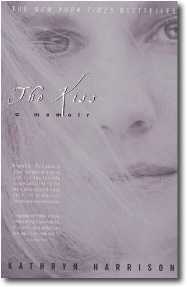
The Kiss by Kathryn Harrison

Appalling but beautifully written…jumping back and forth in time yet drawing you irresistibly toward the heart if a great evil. – Christopher Lehmann Haupt, The New York Times

Memoirs are all the rage these days and I have read a few– but I’ve never read anything like The Kiss by Kathryn Harrison. I’ve read a couple other books by Harrison and I now more fully understand some of the recurring themes in her novels (dysfunctional families, issues of love and the withholding of it, estrangement, emotional blackmail) after finishing The Kiss.

This is a well-known book, I think, despite having been published ten years ago. It received copious praise and, despite its difficult subject matter, I can see why. In fandom, we often write incest fic and consider it to be hot– but Harrison’s story of her affair with her father is never titillating. Instead, it’s a breathtaking and gut-clenching examination of how her seemingly unrequited love for her mother manifested itself into an all consuming and ultimately devastating sexual affair with her estranged father.

Harrison’s father left the family (at his in-law’s request) when the author was six months old. Until she was twenty she only saw him twice. Her father, a well-educated preacher, drew her into an affair with a kiss.

The book is frighteningly honest – Harrison doesn’t spare herself or her part in the relationship. She turns a keen, intelligent (but very emotional) eye on her life, the important relationships she had (or desperately wanted to have) and her father– who is one of the vilest characters I have ever met.

I couldn’t put this book down and when I was done I felt such a great sadness for her.

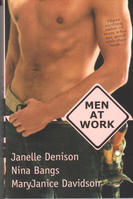
Men at Work by Denison, Bangs, Davidson

So this book was on the display of books that have been reduced; I can never walk by that display. I always have to buy something. Sometimes I luck out. I found Denise Mina that way. All I can say about Men at Work is that it only cost $4.99– and it was worth about one third of that because the second and third stories were so bad, I couldn’t even finish them.

So, yeah, this book is supposed to be “three sizzling tales of men who are good with their hands.” Okay– what?

If you can believe it, there’s actually a review.

Trust me– if you’re looking for smut I can recommend some great stuff. I can’t recommend this.

Taming the Beast by Emily Maguire

A thought-provoking and searing first novel. -The Age

Sarah Clark is a smart kid. That’s what we’re told, anyway. By the time she turns fourteen she’s read every one of Shakespeare’s plays and sonnets, and then the works of Donne, Marlowe, Pope and Marvell. At fourteen she meets the English teacher, Daniel Carr, who will change her life.

“For the entire forty minutes of his first class he spoke about why Yeats was relevant to Australian teenagers in the year 1995. In the second class, Sarah put up her hand to make a comment on something he said about ‘Hamlet’. When he called on her to speak, she started and could not stop. She stayed in the classroom all through lunch, and when she re-emerged into the sunlight and the condescending stares of the schoolyard cliques, she was utterly changed.”

It’s not a huge leap to believe that a meeting of the minds turns to a meeting of the flesh. But their sexual affair is not quite the same as the poetry they’ve discussed– it’s raw, aggressive often brutal. The obvious questions to ask would be: is this abuse? (Clearly he’s breaking the law based on his position and the difference in their ages.) But Sarah has a penchant for this sort of sex, it seems.

And when Carr is forced to choose between Sarah and his wife and children, he chooses the latter– leaving Sarah to drift through the next eight years of her life in a haze of alcohol, drugs, and sex with hundreds of men.

Until Carr re-enters her life.

This is not a love story. Watching Sarah move through her days (and nights) is like peering through the windows of a car wreck. The characters are almost despicable– and so as I was reading, even when things were particularly horrible, I kept thinking –you know what, you guys deserve each other.

Carrie’s Story by Molly Weatherfield

Man, it’s hard to find good porn. And I was hopeful about this book, I truly was. Apparently I have been spoiled by the Internet, though. Or perhaps I am just more perverse than I thought I was. Perhaps, five years ago this book would have shocked me…or made me hot. But…now?

Carrie’s Story is exactly what the title says it is: Carrie’s account of being a sexual slave to Jonathan, a rich, good-looking guy with a penchant for having his shoes licked and beating Carrie’s perfect ass.

Carrie’s a smart cookie. She analyzes every little thing that happens to her and makes no apology for the fact that s/m turns her on. And, to her credit, Weatherfield doesn’t make any apology for it either. She acknowledges that whatever floats the boat between consenting adults– even if that means acting like a pony– is fine by her. And she writes about it intelligently.

But for me it was just so-so in the erotic department. I guess I just like my porn to be, well, pornier.

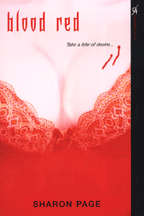
Blood Red by Sharon Page

Sharon Page’s book Blood Red is basically 347 pages of sex scenes linked together by a plot that is so nonsensical, I stopped paying attention to it.

Althea Yates is a vampire hunter in England circa 1818. For a while now she’s been having these strange and highly erotic dreams and she is shocked when, one night at the inn where she and her father are staying, one of the men in her dreams (there’s two, naturally) shows up.

He’s Yannick. A perfect specimen. But drat, he’s a vampire.

His brother, Sebastien (known as Bastien in the novel) is also a vampire. Together they are known as The Demon Twins. And once Althea and her father release Bastien from his tomb, where he’s been languishing these last ten years, he and Yannick set about introducing virginal (but up for just about anything) Althea to the delights of the flesh.

Yannick and Bastien aren’t like any vampires I’ve ever encountered. Soulless they may be, but they never kill for food, they can shoot bolts of coloured energy from their hands and they have a reflection. Apparently they have a few other vampire tricks up their sleeves, too.

Reading Blood Red was like eating a bowl of chips– absolutely no redeeming nutritional value, but tasty enough.

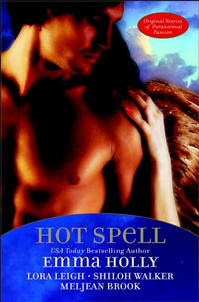
Hot Spell by Leigh, Walker, Brook

Oh dear. I bought Hot Spell on a whim, intrigued by the promise of ‘paranormal passion’. What I got were four rather tame novellas rife with cliched descriptions of sex with four perfect men.

In the first story, “The Countess’s Pleasure”, the heroine Georgiana DuBarry hooks up with an indentured demon, Sawai. Recently widowed, Georgiana hires Sawai to deflower her, because although she had positive feelings for her husband– theirs was a sexless marriage. Sawai is hot!hot!hot! and brings Georgiana to the pleasure of the title many times over…and in less time than it takes for you to say ‘multiple orgasms’, they’ve fallen in love.

In Leigh’s story, “The Breed Next Door”, Tarek Jordan is a member of the Feline Breed on an undercover stakeout. One might think he’s scouting for coffee and fresh-baked bread because he does quite a bit of drooling over the smells coming from his neighbour, Lyra’s, kitchen. There’s a convoluted plot, of course, but it turns out that Lyra is Tarek’s mate. So, there’s sex…and a happy ending.

In “Falling for Anthony” by Meljean Brook, a young doctor is granted the opportunity to come back from the dead as a Guardian, to help the sister of his childhood friend recover from a vampire’s bite. (And when he does recover, he’s one of those sweet vampire types, apparently.)

And finally, werewolves battle vampires in “The Blood Kiss” by Shiloh Walker. The prize, Julianna Capriet (um- obvious much? Why not call her Capulet – she may as well have been, the story is a total rip off of Shakespeare’s play) is the daughter of the Vampire King…but her heart belongs to Roman, the Wolf King. La la la.

Three of the women in these stories are virgins, ripe for the taking. The men are all perfect specimens. There are lots of sighs and moans and breaching of virgin tissue. I might have loved this book 20 years ago, but for my money fanfiction is a hundred times better.

A good book for the beach because you won’t be heartbroken if you leave it in the sand.

Swimming Sweet Arrow by Maureen Gibbon

Maureen Gibbon’s novel, Swimming Sweet Arrow, is something of a surprise. The first surprise might be the very graphic sex. But the second surprise will most definitely be how affecting the novel’s narrator, 18 year old Vangie is.

“When I was eighteen, I went parking with  my boyfriend Del, my best friend June, and her boyfriend Ray. What I  mean is that June fucked Ray and I fucked Del in the  same car, at the same time.”

Gibbon establishes Vangie’s voice– at once innocent and experienced– from the novel’s opening lines and from that moment on it’s hard to stop turning the pages as a year in Vangie’s life unfolds.

Vangie graduates from high school, moves in with Del, parties incessantly and slowly begins climbing out of her youth and into her adulthood. The success of the book is the way in which Gibbon writes Vangie, a character who never shies away from who she is or what she wants. And even when she makes horrible mistakes in judgment, Vangie never passes the buck.

Despite the subject matter, which might be potentially too-graphic for some, Vangie’s search for meaning, for love, and for a place to belong is a thing of beauty.

Billy Dead by Lisa Reardon

Lisa Reardon’s book, Billy Dead, earned copious praise when it was published in 1998 and it deserves the honors. Years after I first read it, I keep thinking about the story’s flawed and difficult characters, siblings Billy, Ray and Jean. The story is narrated by Ray and it’s a story of poverty, abuse, and redemption. It’s unflinching, too; Reardon doesn’t gloss over any of the details and it is for perhaps this reason that the book was highly regarded by critics. Alice Munro (perhaps the greatest writer of short stories ever) said: “Billy Dead is a brave, heart-wrenching debut. I couldn’t look away.”

I chose it for my book club several years ago… and no one liked it. Truthfully, the book probably isn’t for everyone: it’s graphic and violent. But the characters are so compellingly real and their journey is so honest, they’ll make an indelible impression on you. Really.

To save you from signing up, here’s a review from the NY Times

Lisa Reardon’s first novel, Billy Dead, instantly brings to mind Dorothy Allison’s Bastard Out of Carolina. Both depict poor, rural white families in which innocent lives are ravaged by brutality and incest. But Billy Dead, if you can believe it, is even more harrowing, and while Reardon possesses enough skill to render any awful act believable, she does so at the expense of the book’s frail beauty. When you finish reading it, you’re left with a crowd of horrific images that overwhelm what the story is finally about: the redemptive power of love, no matter how unconventional.

Unlike Allison’s child narrator, the speaker in Billy Dead, Ray, is an adult who has the language and sexual knowledge to describe the family’s heinous history in graphic detail. Of the three Johnson children, who grew up in Michigan, Ray was clearly the least equipped to shoulder abuse; as a man, he is helpless and dazed, given to hallucinations and physical self-torture. He lives in a perpetual cringe, shrinking from memories that constantly threaten to unravel him. But when he learns that his beastly older brother, Billy, has been sadistically murdered, Ray can’t help flashing back to his freakish family life, a three-ring circus of savagery in which the siblings all take turns in the spotlight.

Ray and Billy have a little sister, Jean, who not only suffers her father’s beatings as they do but also endures sexual abuse at the hands of all her menfolk. But she is a mean, tough kid — qualities that meek, sensitive Ray admires. When Jean is only 7, Billy and Ray force her to perform fellatio on them, an act that belies Ray’s affection for Jean and underscores his fear of Billy. A few years later, she pounces on her opportunity for revenge: as Ray, now 14, lies weak in bed with chickenpox, she burns his sores with a cigarette while bringing him to orgasm with her other hand. ”Do you love me?” she asks, grinding the hot cigarette into his wounds. ”Are you sorry?” He appears relieved to submit to Jean’s punishment; he is also in awe of her spitefulness.

Ray and Jean remain allies in their house of horrors. After his senior year, Ray spends the summer working in another town; Jean, now 16, joins him. Away from their tormentors, they become lovers, and, impossibly, you find yourself actually rooting for them. It’s a credit to Reardon’s writing that their romance seems right and tender. But everything goes wrong when they return home to find that the whole town knows about them. In a flash of possessiveness, Ray turns on Jean, and the two remain estranged until Billy’s death years later — an event that prompts Ray to seek her out again. Whoever got Billy ”must have been even meaner than him. Only one person I know like that,” Ray says as he begins a delirious search for the love of his life, his baby sister.

Billy Dead is quite well written, but its literary merits are diminished by the relentlessness and intensity of its atrocities. Billy throws a cat against a wall for fun, breaking its neck, and his father then chops the dying pet’s head off with a shovel; after Billy molests her, Jean hangs his dog from a tree and beats it to death with a baseball bat; during one particularly violent episode of rape, Jean nearly bites her father’s penis off. Still, all this excess isn’t just sensationalism, and most of these scenes seem warranted by the larger story. Indeed, this is an extremely powerful novel, but whether you want to read it depends on your stomach for human — or, better said, subhuman — ugliness.
-By LAURA JAMISON