Everything I Never Told You -Celeste Ng

everythingLydia is dead.

It’s been quite a while since I’ve had such a visceral reaction to a book.  I read the bulk of Celeste Ng’s debut novel, Everything I Never Told You, on my snow day (a gift for a teacher, even if it’s only because we get to catch up on  marking/yearbook/planning – and, yeah, reading). I don’t think I will ever  be able to adequately explain how I feel about this book or these characters.

Lydia is just sixteen when she is found at the bottom of the lake across the street from her home in small-town Ohio. It’s the 1970s, the decade in which I, too, was coming-of-age. On the morning she is discovered missing (and it is this “innocuous” fact that sets the story in motion) we see the Lee family dynamic.

As always, next to her cereal bowl, her mother has placed a sharpened pencil and Lydia’s physics homework, six problems flagged with small ticks.

Hannah, Lydia’s younger sister is “hunched[ed] moon-eyed over her cornflakes, sucking them to pieces one by one.” Lydia’s older brother, Nathan, is sitting on the stairs trying to wake up. James, their father, has already left for his job as a professor at the local college.

Lydia is never late. She is never anything but compliant. She is a “yes” girl, the favoured daughter. It is only after her body is found that her story, and that of her family, begins to unravel. And yes, you will want to know what happened to Lydia, but trust me, it’s just one of the many things that will break your heart in this magnificent novel.

While every family has their own secrets and burdens, the Lee family is further set apart because Marilyn is white and James is Chinese. Their story is integral to Lydia’s story. Marilyn herself was a gifted student, earning a scholarship to Radcliff, and there – while she heads towards a degree in medicine – she meets James, a fourth year graduate student in history. She is ‘other’ because she is a woman studying in a field that is dominated by men; he is ‘other’ because he’s Chinese. All Marilyn knows is that “she wanted this man in her life. Something inside her said, He understands. What it’s like to be different.”

Marilyn’s career plans are pre-empted when she gets pregnant. She and James marry and move to Ohio.  Of course, their union wouldn’t be quite so problematic now (I’d like to think, but there are always some people….), but it’s the late 50s when they marry. Another world, another time. And life, fraught as it is, moves on. But why is it fraught? Because James grew up attending private school for free because his mother worked there as the cook and his father the janitor? Because he never fit in anywhere?  Because Marilyn didn’t want the life her mother had? Because of dreams deferred? And what happens when our parents’ lives are complicated and damaged by their own childhoods? Ah, we all know the answer to that question, right? It all trickles down.

Everything I Never Told You is an astounding, complex and heart-breaking look at the secrets we keep, not only from our families but from ourselves. Why we keep them, and the damage caused because of it, is just part of what happens in Ng’s book. The horrible longing we feel to crack ourselves open, the desire for true communication and intimacy, is another part. There wasn’t a single character in this novel I didn’t want to hug – I loved them all. That they were so fabulously human and fragile is a testament to Ng’s talent.

Highly (times a billion) recommended.
Pass it on

Listen here.

Pass it on.

One of the questions that we often ask at book club is “would you pass this book on?” That got me thinking about my own personal criteria for recommending a book. I know that that’s what I do here with you…but who am I, really, to be making recommendations to anyone, right? Book love is so subjective.

I read a lot of books, but not many of them would fall into the “here – you gotta read this” category. So I started to think about my own litmus test for books…what books have I read that I would definitely press into the hands of someone else?

I think a book has to be well written. But that doesn’t mean that every single book I’ve loved has to be Shakespearean. Sometimes a book can be just super fun to read without all the literary bells and whistles, I am thinking about a book like …oh, who am I kidding? I took a look through the highly recommended section of my blog and really, all the books I’ve really loved have had that beautiful combination of story and character and writing. That is not to say that I haven’t read my share of books that have been fun to read, but would I insistently pass them into the hands of other readers? Do I think about them long after I’ve closed the pages? Probably not – so maybe that’s actually the test for me. Do I think about these books when I’m finished? Do I want other people to read them so we can share our thoughts? That’s the book I want to pass on. So – I’ve got three for you today, two adult and one YA read that I would heartily recommend to readers of all stripes.

Let’s start with the book I just finished and which I mentioned the last time I was here as a book that I hoped would be a page-turner and man, was it ever.

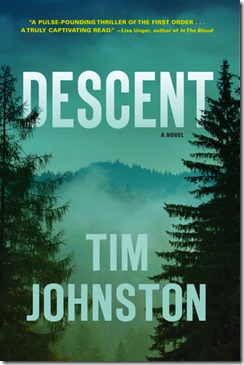
Descent by Tim Johnston descent_thumb

So, this is the story about the Courtland family, mom and dad, Grant and Angela, their 18 year old daughter, Caitlin and their 15 year old son. Sean. They are in the Rocky Mountains on a little family getaway before Caitlin heads off to college on a track scholarship. Early in the morning, Caitlin and Sean head out so Caitlin can run up the mountain with Sean following on his bike. Then, Sean gets hit by a jeep – strange first of all because they are literally in the middle of nowhere. He’s really badly hurt and when his parents get the call from the hospital they are also informed that Caitlin is missing. Fast forward a year and the Courtlands are still fractured. Dad has moved to the town where Caitlin disappeared; Sean is driving around the country aimlessly; Angela is back on the east coast living with her sister. They are all damaged. Johnston’s novel is the perfect combination of style and substance. The writing is sharp and lyrical, but it never slows the action down and – trust me – this novel has some pulse-pounding action sequences that were just so good. I would definitely hand this one over…like, not to keep, of course!

Our Daily Bread – Lauren B. Davis ourdailybread

This one I actually touched on a while back when I talked about starting a book club. I couldn’t stop thinking about this book for days and days after I read it. Despite the controversial subject matter, Davis’s book is so compelling, the writing so good and the characters so broken…it’s impossible not to read this book without feeling something.

Our Daily Bread concerns the fortunes of two families: the Erskines who live up on North Mountain and the Evanses who live down in Gideon. Albert Erskine is different from the crack-smoking/dealing relatives with whom he lives on a sort of compound. He’s smart and he wants more from his life, but life has dealt him a particularly rough hand. Bobby Evans has it tough in another way – as he watches helplessly as his parents’ marriage deteriorates he looks for a place to belong and, strangely, he and Albert become friends. The intersection of these two young lives makes for some compelling reading, I’ll tell you that. This book is, at turns, horrific and heartbreaking, but you will fall in love with these characters – I promise.

Our Daily Bread was long-listed for the Giller in 2012.

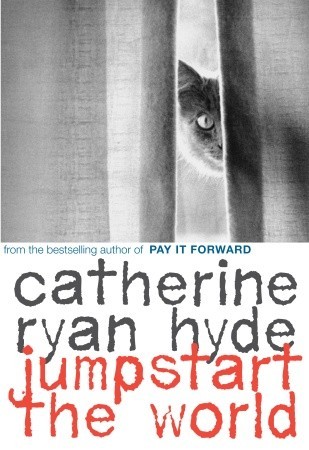
jumpstartFinally, a YA novel that I would definitely pass on is Catherine Ryan Hyde’s Jumpstart the World, which I just finished last week. It’s the story of Elle, a fifteen-year-old girl whose mother sets her up in an apartment across town because her new boyfriend doesn’t get along with her. Yep – mom chooses the guy over her daughter. So, here’s Elle living on her own, starting a new school. She meets her next door neighbours Frank and Molly and is immediately taken with Frank, who seems really kind and nurturing…clearly traits her mother doesn’t possess. She also makes some friends at school – outsiders all…

Then she discovers that Frank is transgender and it forces Elle to really examine herself as a human being. What I liked about Jumpstart the World is that it never preaches. It will offer young people an opportunity to examine their own prejudices, for sure, but it also has a lot of really amazing things to say about love and family and accepting who you are. It’s really a lovely book and I would certainly press it into the hands of my students.

Catherine Ryan Hyde is probably best known for her novel Pay It Forward, a book I haven’t read – but I did read her YA novel The Day I Killed James and it was also excellent.


Descent – Tim Johnston

descent_thumbI love it when a book lives up to its hype…and if you believed the accolades plastering the back cover and the first three pages of Tim Johnston’s novel Descent, you’d certainly be expecting great things. The Washington Post said “Read this astonishing novel. The magic of his prose equals the horror of Johnston’s story.” Esquire called it “Outstanding” adding that “the days when you had to choose between a great story and a great piece of writing” are “gone.”

I don’t even know how this book came to be on my radar – I just know that I had a picture of it on my phone and a couple weekends ago I was pleased to discover that Indigo had topped up my Plum Points and I had $100 to spend…but only that weekend to spend it. So, I flipped through the pictures of covers and chose five, Descent being one of them. A couple of weeks ago, I mentioned the book on Information Morning and decided that since I had, I should probably read it. Once I started, I couldn’t stop.

The Courtlands are spending a little family time in the Rocky Mountains – a holiday before Caitlin, 18, heads off for her first semester of college. Her mom and dad, Angela and Grant, are clearly in crisis and then there’s Sean, Caitlin’s 15-year-old brother.

Caitlin is a runner and on the morning the story opens, she and her brother are heading up a mountain trail – Caitlin on her feet, Sean on his bike. Johnston meanders up the mountain with the pair as they bicker and share confidences. Then the unthinkable happens: Sean is hit by a jeep

…it came, monstering through the trees at an incredible speed, crushing deadfall, the whip and scream of branches dragged on sheet metal and then the suddenly unobstructed roar that made her wrap her head in her arms, the sound of tires locking and skidding and the thing slamming into what sounded like the sad tin post of a stop sign and then the meaty whump and the woof of air which was in fact the boy’s airborne body coming to a stop against the trunk of a tree.

When Grant and Angela get a call from the local police, they learn Sean’s been badly injured;  Caitlin is missing.

Fast forward a year or so. Grant has moved to the area and is living on the property owned by the local sheriff’s father, Emmet. Sean is on the road, driving from place to place picking up odd jobs. Angela is living with her sister when she isn’t hospitalized for depression/mental health issues. Caitlin’s disappearance has fractured the Courtland family.  It’s mostly the men that Johnston spends time with, allowing the reader a glimpse into their own personal hells: the father who can’t and won’t give up hope that Caitlin will be found and the son who can’t forget what happened that morning on the mountain.

The characters in Descent are trying to get on with it, but their personal pain is palpable. Grant works around Emmet’s property, sometimes pausing to “stare into the hills beyond the ranch, up into the climbing green mountains.” He hears his daughter’s voice and  “take[s] his skull in his hands and clench[es] his teeth until he [feels] the roots giving way.”

As for Sean, he is closed off from the world. In one particularly horrific scene, he puts himself in harm’s way in an effort to save a young girl – perhaps in an effort to atone for the ultimate crime of not being able to save his sister. It’s not the only time he does something selfless, albeit, foolish.  I just wanted to hug him.

We do spend less time with Angela, but that doesn’t mean that we know less about her. She moves through her much diminished world like a whisper. Only a parent who has suffered the loss of a child could truly understand Angela’s debilitating sadness.

The girls’ heartbeat still played in her arms. In her chest. She remembered the hour, the minute, she was born: precious small head, the known, perfect-formed weight of it. All her fears of motherhood – of unreadiness, of unfitness– vanishing at the sight of that plum-colored face mewling in outrage. My child, my life.

Secondary characters, Emmet’s  black-sheep son, Billy, for example, are equally well-drawn. Billy arrives back in town, much to the chagrin of his father and older brother, and swaggers his way into everyone’s bad graces. But even Billy is allowed his shades of gray – there are no stock characters here.

Into these complicated interior lives, Johnston deftly weaves the mystery of Caitlin’s disappearance. She is not a footnote, trust me. The story of her disappearance is unraveled with excruciating care and her story is definitely one of the things that will speed your journey through this book.

Descent is fantastic on every level and I highly recommend it.


Jumpstart the World – Catherine Ryan Hyde

When Elle’s mother’s boyfriend decides he doesn’t like her, Elle’s mother sets her up in an apartment across town. The town happens to be New York and Elle is just 16.  Catherine Ryan Hyde takes an almost unbelievable premise (like, what mother turns her kid out because she wants to placate her boyfriend?) and spins it into the beautiful and moving coming-of-age story Jumpstart the World.

jumpstartOn moving-in day, Elle meets Frank Killborne, her next door neighbour.

He had a big, friendly smile and there was something cute about him, but in a soft sort of way. Hard to explain what I mean by soft. Gentle, I guess I mean. He made you try not to find fault with him for some reason. The kind of guy it’s hard not to like.

Frank lives with his girlfriend, Molly, and it doesn’t take long for them to become Elle’s de facto family. It also doesn’t take long for Elle to develop more complicated feelings about Frank.

Jumpstart the World is populated with other interesting and sympathetic characters, too, particularly the group of friends Elle makes at her new school. There’s Shane aka Larissa, blue-haired and gay; the Two Bobs – a gay couple; there’s Wilbur, a quiet guy who wears make-up.  These friends have varying degrees of influence on Elle’s life and are also responsible for the novel’s conflict. When they meet Frank,  they point out what is not obvious to Elle: Frank is transgender.

It’s pretty remarkable that there’s a book like this available for teens. It’s the first book I’ve ever read featuring a transgender character, but the fact that Frank is doesn’t mean that Ryan Hyde starts to get all preachy. We might expect that since this story takes place in NYC, the world is filled with individuals ready to embrace everyone’s differences, but – of course – the world isn’t quite so open-minded and, as it turns out, Elle has some reconciling of her own to do.

Jumpstart the World actually tackles the questions of trust and family and what it means to give your friendship and love to another human being, regardless of their sexual orientation. There aren’t any easy answers in life and it might be a bit much to expect a teenager to figure them out, but each of the characters in this book have had their own life-altering experiences. And interestingly, Elle’s journey – painful as it is – also helps her to make a kind of peace with her mother.

I enjoyed this book. I liked spending time with Elle. I appreciated that her journey was a little left of center, but that she discovered – as she does with her cat, Toto, that sometimes “you just have to take a deep breath and let somebody love you.”

Highly recommended.


Pulse Pounding Thrillers

There’s nothing I like better than a thriller; it’s my go-to genre when I want to jumpstart my reading. I love a good mystery, a page-turning, heart-pounding, protagonist in peril book that I can’t put down. I know I am not the only one who likes suspense, just look at how popular books like The Girl on the Train by Paula Hawkins and Gillian Flynn’s Gone Girl are. I love it when you find a book with the perfect combination of creepy thrills and stellar writing, so I thought I would share five books for any readers out there who are looking for something to curl up with while the weather is crappy.

 Intensity – Dean Koontz

So, I rintensityead this book about twenty years ago. Koontz is a very prolific writer of supernatural fiction. I’ve read a few of his book, but this one was totally propulsive. It’s about a Chyna Shephard, a young woman who is visiting a with her best friend’s family when really bad luck arrives in the form of serial killer Edgler Forman Vess. What follows is a thrill ride that will have you turning the pages super fast.
Instruments of Night – Thomas H. Cook instruments

You might have to order books by American mystery writer Thomas H. Cook online because it’s rare to find him on the shelves of our local book stores-which I don’t get because he’s fabulous. The first book I ever read by Cook was called Breakheart Hill and it had a killer opening line: “This is the darkest story I ever heard and all my life I have labored not to tell it.” I had to buy it…and I’ve probably read seven or eight books by him now. One of my favourites by Cook is Instruments of Night.

It’s the story of writer Paul Graves, a man who has spent his career writing about the horrible dance between serial killer and sadist Kessler (and his accomplice, Sykes) and the man who has spent his career chasing him, Detective Slovak. Instruments of Night operates on more than one level, though. Graves has almost completed the 14th installment of his series when he is invited to upstate New York to meet with Allison Davies, mistress of an estate known as Riverwood. Fifty years ago, Allison’s best friend, Faye, was murdered on the grounds and now Allison wants Paul to “imagine what happened to Faye. And why.” Couldn’t put it down

If you like literary mysteries- you’d be hard pressed to find anyone better than Cook.
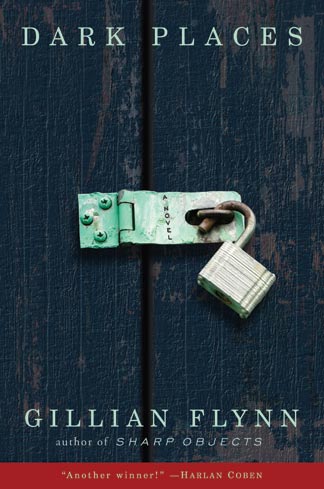
dark-places-book-coverDark Places – Gillian Flynn

So everyone knows Flynn for her novel Gone Girl, but I actually read her book Dark Places first. It’s her second novel, her first is Sharp Objects…also really good, but Dark Places is – I think – her best. It’s about Libby Day, this rather unlikeable woman who has – no question – survived a lot of hardship. Her mother and two older sisters were murdered when she was a kid and her testimony helped convict her older brother Ben – who was fifteen at the time – for the crime. Flynn weaves the past and present together as Libby finds herself confronted with the truth of the crime that changed her life. Fantastic book.
End of Story – Peter Abrahams endofstory

You could polish off End of Story in an afternoon – because once you get going you won’t be able to put it down. It’s the story of tells the compelling tale of Ivy Siedel, an aspiring writer, who takes a job teaching writing to a small group of inmates at Dannemora Prison, in Upstate New York. When one of her students, Vance Harrow, turns out to be a talented writer, Ivy decides to take a closer look at his history and discovers something about him that both shocks and excites her…and changes her life forever.
descent_thumbAnd my last pick is a book I just purchased this weekend and I haven’t read it, but I am expecting great things because it’s been given copious praise by everyone and their dog. It’s called Descent and it’s by a new-to-me author, Tim Johnston. A family is on vacation. The college age daughter and her brother go out for a run and only the brother returns.

I’ll let you know how that one turns out.


Have you read any good thrillers? I’d love to hear about them.

Between Shades of Gray – Ruta Sepetys

between-shades-of-grayWe all know about the atrocities of the Holocaust, but until I decided to read Ruta Sepetys’ novel Between Shades of Gray with my grade nine class I knew nothing (shamefully) about what happened in Lithuania during the same time period. During that time Stalin’s Soviet Union invaded the Baltic states of Lithuania, Latvia and Estonia. They rounded up doctors, teachers, musicians, artists and government officials and their families – anyone whom they considered a threat – and shipped them off to work camps. Sepetys’ father was the son of a Lithuanian military officer. He and his family managed to escape to a German refugee camp (the irony is not lost on me). It is the author’s personal connection to this devastating blot on human history that inspired her to tackle telling the story. And what a story it is!

Lina is just fifteen when the NKVD (Russian Secret Police) burst into her home and demand that she, her ten-year-old brother, Jonas, and their mother, pack a suitcase and come with them. It is June 14, 1941 and the world Lina has known – one of art and intellect, of safety and family – is forever shattered. Their father is not home.

The first question I asked my students when we started the book was what they would take if they only had twenty minutes to decide. Lina was getting ready for bed and she remarks “They took me in my nightgown.” What is important when you have no time to think?

I put on my sandals and grabbed two books, hair ribbons and my hairbrush. Where was my sketchbook? I took the writing tablet, the case of pens and pencils and the bundle of rubles off my desk and placed them amongst the heap of items we had thrown into my case.

From the minute Between Shades of Gray starts until the final pages, the reader is living in a world that is almost impossible to comprehend. My students have no frame of reference. Even those who do not live privileged lives have never had to face this kind of terror. As I read the book out loud to my rapt students, I often found myself on the verge of tears imagining the fear, pain and plight of these people who were forced from their homes for no reason. What would I be capable of if I had to protect my family?

Lina’s mother, Elena, is a remarkable character. She is an educated woman who speaks Russian, a handy skill in these circumstances. She does whatever she has to do in an effort to keep her family together, trading items she has sewn into her coat in advance (foreshadowing  the events to come) for food, favour and, in one particularly poignant trade, for the life of her son. Her strength of character, her resiliency (which is mirrored in her children) sustains them all through the long, hard days ahead.

Eventually Lina and her family find themselves at a labour camp in Siberia. I can remember joking about Siberian labour camps as a kid. I didn’t know anything about them; I would have just made a throwaway comment about sending someone to Siberia. Sheer ignorance on my part because the conditions are unimaginable.

It was completely uninhabited, not a single bush or tree, just barren dirt to a shore of endless water. We were surrounded by nothing but polar tundra and the Laptev Sea. The wind whipped. Sand blew into my mouth and stung my eyes.

Worse – they have nowhere to live. The only two buildings are for the Soviets. It’s cold and soon it will be dark 24 hours a day.

I can say this about the book: my students loved it. Although I had promised to read it out loud to them, many read on their own, racing to finish. That’s high praise, especially since many of students would identify themselves as reluctant readers. I had several boys finish way before we did.

Sepetys talks about her novel here and it’s worth watching the video before you read the book. Sepetys talked to survivors and some of their stories find their way into this novel. I wish that the ending hadn’t seemed quite so rushed, but that’s a small niggle and may have something to do with the fact that I wasn’t quite ready to say good bye to these remarkable characters. Overall, Between Shades of Gray is a miracle of a book, a life-affirming novel of resiliency and love and a sober reminder of the terrible things we do to each other.

Highly recommended.

Kindness for Weakness – Shawn Goodman

One of my students recently read Shawn Goodman’s novel Kindness for KindnessWeakness and when she returned it to my classroom library, she told me that she loved it so much that she’d asked for her own copy for Christmas. Her endorsement encouraged me to read the book and I am so glad I did even though it broke my heart. Seriously.

James is fifteen. He lives with his drug-addicted mother and her scummy, drug-addicted boyfriend, Ron, in a one-bedroom trailer. His older brother, Louis, moved out two years ago. James is adrift; he hasn’t got one positive thing going for him. He is  “just a lonely kid loping along the street with [his] head down.”

Then his brother offers him a job and James, desperate to be a part of Louis’ life, accepts. Problem is, the job is dealing drugs and James gets caught. He won’t rat out his brother, so he’s thrown into Morton, a juvenile facility.

There is nothing good about his new reality. James thinks

I am a loser, I am scared and weak. I want to call Mr. Pfeffer and ask him what I’m supposed to do. I want to talk to him over cold root beers, and have him tell me that everything will be okay. I want him to give me new books, enough to last twelve months, so I can disappear into the pages and not have to deal with this place. I could read one book after the other, stopping only to eat, sleep, and do school or chores or whatever it is they do here.

But James does learns the rules and in some ways he comes into his own at Morton.  There are a couple of guards who are compassionate and make an effort to teach the young men in their charge that there is always an alternative.  Despite his circumstances, James starts to consider what his future might look like.

I want to go to college…I want to live in a dorm where no one will know where I came from or who I was at my old high school. I want to start over and see the world outside of Dunkirk. I want to take writing classes.

James also reaches out to his old English teacher, Mr. Pfeffer, and the two exchange letters. James takes comfort in literature, and I have a soft spot for any character who loves books. James strives to stay out of trouble because he wants to get out and make something of his life.

Shawn Goodman actually worked in New York’s juvenile justice system and this experience gives Kindness for Weakness a real feeling of authenticity, but it is James that is the emotional center of this book.  He is a believable, sympathetic character. I fell in love with him at the very beginning and rooted for him until the book’s devastating conclusion.

Highly recommended.


If You Find Me – Emily Murdoch

“Mama says no matter how poor folks are, whether you’re a have, a have-not, or break your mama’s back on the cracks in between, the world gives away the best stuff on the cheap.”

IF-YOU-FIND-METhat’s the first thing fifteen-year-old Carey tells us in Emily Murdoch’s amazing novel If You Find Me. From the moment she speaks, it’s almost impossible not to fall in love with her and as her story unspools, it’ll be even more difficult not to want to want to hug her and her little sister, Jenessa, who is just six.
Carey and Jenessa live in a trailer in  in the middle of Obed Wild and Scenic River National Park or, as the girls call it, “the Hundred Acre Wood.” Their mother, Joelle, is usually gone and has, in fact, been MIA for “over a month, maybe two at this point,” leaving the girls to fend for themselves. Carey does the best she can to look after herself and Jenessa but “when you’re livin’ in the woods…with no runnin’ water or electricity, with Mama gone to town for long stretches of time, leavin’ you in charge of feedin’ a younger sister…with a stomach rumblin’ like a California earthquake” it’s not easy. The girls exist, mostly, on beans fixed in “new and interestin’ ways.”

On this particular day, though, Carey and Jenessa have company. A woman “as thin as chicken bones, her gait uneven as her heels sink into the soft forest floor” and a man stumble into the girls’ campsite.

He hasn’t offered his name, and he isn’t familiar to me. But in that instant, hittin’ like a lightnin’ bolt, I know who he is.

If You Find Me is an amazing story of resilience and family and forgiveness, but it is also a horrific story of abuse and neglect, made all the more powerful because of Carey’s compelling and authentic narration. I fell in love with her the moment she started to tell her story and I know this is fiction, but I also know that children endure atrocities at the hands of their parents and guardians all the time.

Suddenly, Carey finds herself living with a father she doesn’t remember, a new step-mother and a step-sister who clearly resents her, attending school for the first time.  Jenessa seems to thrive in her new surroundings and although Carey contemplates returning to the her life in the woods, her love for her sister prevents her from running. Their journey is one of resilience and hope, but it’s not all smooth sailing.

I loved this book because I loved Carey. I wish the ending hadn’t seemed so rushed, though, because I don’t think Carey’s relationship with Ryan was as fully developed as it might have been and other pieces fell into place just a tad conveniently, but whatever; I haven’t read a YA book with a narrator I’ve loved quite as much as I loved Carey in a long time.

Highly recommended.

The End of Everything – Megan Abbott

endofeverythingA few months back I read Megan Abbott’s YA novel Dare Me and despite the novel’s caustic depiction of teenage girls, I really loved that book. The End of Everything also tackles the secret lives of girls and, once again, Abbott’s writing is compelling.

Thirteen-year-old Lizzie and Evie are besties. They’ve lived next door to each other their whole lives – swapping bathing suits and secrets. On a bright afternoon, just before school breaks for the summer, Evie disappears. Lizzie remembers

It was long ago, centuries. A quivery mirage of a thirteen-year-old’s summer, like a million other girl summers, were it not for Evie, were it not for Evie’s thumping heart and all those twisting things untwisting.

Thirteen seems incredibly young to me now, but I don’t suppose it did when I was that age – a  million years ago. For Evie and Lizzie it is a time of curious longing, especially because Evie has an older sister, Dusty, “a deeply glamorous seventeen.”  Compared to Dusty, Evie and Lizzie “were all snips and snails, and when permitted into her candied interior, we were like furtive intruders.”

For Evie and Lizzie, thirteen is an age precariously close to the edge of experience – and both girls seem to want to topple, headlong, over the cliff. After Evie’s disappearance, Lizzie finds herself particularly drawn to Evie’s dad, Mr. Verner. He

could throw a football fifty yards and build princess vanity tables for his daughters and take us roller-skating or bowling, who smelled of fresh air and limes and Christmas nutmeg all at once…I couldn’t remember a time when I wasn’t craning my neck to look up at him, forever waiting to hear more, hungry for the moments he would shine his attentions on me

It doesn’t take long for Lizzie to remember a car that she’d seen driving past them on the day Evie disappeared. The suspect is identified and Lizzie makes it her mission to figure out where Evie is. All this makes for page-turning suspense, but that’s not what The End of Everything is really about.

This is a novel about power, sexual power, really, in the hands of girls too young to wield it. It is about an  impossible longing girls feel, but don’t wholly understand. It asks the questions for which there are no satisfactory answers. Lizzie  wonders why the man took Evie “if he didn’t mean to touch her, to do things to her?” and those thoughts send her to her room where she pulls “out a stack of old, gold-spined horse books, and read[s] them for hours.”

When the truth is finally revealed to Lizzie it is “a dark tunnel I stare down, like I might follow it, like it might swallow me whole and I would let it willingly.”

Abbott’s books are like that – but you have to be fearless to read them.

Highly recommended.

Velocity – Kristin McCloy

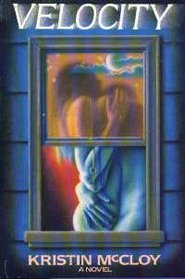
velocityA couple of days ago on Information Morning, I talked about how I wished that I could carve out some time to revisit some of my favourite books. I mentioned three in particular: A Tree Grows in Brooklyn by Betty Smith, Jane Eyre by Charlotte Bronte and Kristin McCloy’s Velocity. All three of these books had a profound impact on me, the first two when I was much younger and McCloy’s book when I first read it as a twenty-something. Of those three, I have actually already re-read Velocity numerous times and I just finished reading it again.

I think I am going to have a difficult time articulating exactly why I continue to find Velocity so compelling, but I do want to honour the book and its place in my personal canon here, especially because I recently had the very good fortune of exchanging a couple emails with the novel’s author, Kristin McCloy. (Insert fangirl squee here.)

When it was first published in 1988, Velocity caused quite a stir and earned copious praise. I am not sure what year I picked up my copy, perhaps 1989, but I definitely purchased it at The Strand in NYC. I devoured the book then for reasons that will surely become apparent a little further on.

So, what’s the book about?

Twenty-five-year-old Ellie Lowell has returned to her backwater North Carolina hometown to scatter her mother’s ashes. Ellie’s an only child and she’s been living in New York City for the past six years, so she’s finding it difficult to connect with her taciturn father, a local cop. They share the family home like two strangers might share a taxi ride to the airport – making small talk, but never really connecting.

Despite the awkwardness, Ellie decides to stay home for the summer, leaving her fledgling career in the film business and her boyfriend, Dec, back in the Big Apple. She gets a job at a local diner and before you can say two eggs over easy, she’s hooked up with Jesse, the half-Cherokee biker who lives down the road. Ellie knows he’s trouble. She says

…it occurs to me, a thousand woman, he’s had a thousand women, and every one of them has fed him everything she had.

Even though Jesse isn’t much for talking, Ellie finds herself pulled into his orbit. The attraction is sexual, of course, and she remarks that his “crazy height and that straight hair down to [his] shoulders, even from the shadows of [his] porch, the way [he] stared at me would’ve burned a hole in a blind woman’s side…”

When she’s with Jesse, she doesn’t think about anything else and that’s a good thing because what Ellie doesn’t want to think about is that her mother is dead. She can’t avoid the knowledge that “Everything crumbles. The walls, the rooftop…every structure will fall. Everything known, all that is so familiar, will vanish. Including myself.” What she can do, however, is push that knowledge away and although she is “aware of [her] grief waiting for [her], patient and thick,…right now it is remote.” Jesse is in its path.

At her age I was doing much the same thing, which is, I suppose, why Velocity struck a chord with me when I first read it all those years ago. I don’t recall what I was running from, but I sure knew what I thought I was running to. My guy, let’s call him S., was crazy tall, mostly silent, beautiful, at least to me, and he’d often disappear for days at a time, throwing me into a frenzy of longing, and then reappearing like an apparition. Like Ellie, I read into the smallest of gestures – a moment of tenderness could sustain me for weeks. S. wasn’t a criminal, but he definitely had his own demons and he was in no position to give me what I so desperately wanted. Our relationship was doomed from the start, but that didn’t prevent me from showing up where I’d know or hope he’d be or using sex as a bargaining chip. Our whole relationship was just fraught. And the weird thing is, 30 years later, I still feel that little electric charge on the rare occasion that I see him around.

When I read this book back in the day it was ALL about Jesse and Ellie’s relationship. I believed that Jesse did, in his own way, care for Ellie. I excused his bad behavior because Ellie excused it. I wasn’t blind to Ellie’s grief, but I hadn’t experienced real grief yet and so, although I could sympathize, I couldn’t personally relate to that part of her story. I knew exactly how she felt with Jesse, though. I knew that “electrical current” and the “pleasure like mercury.”

So, how does the book hold up upon rereading? Um – it’s still freaking fantastic. And here’s why. McCloy is a beautiful writer. That has always mattered to me. From the book’s opening line:

Sometimes in my dreams you rise up as if from a swamp, whole, younger than I remember, dazzling, jagged, and I follow you into smoky rooms, overwhelmed by the sense of being in the presence of an untamed thing, full of light, impossible to control.

…until the final pages, McCloy’s writing is fluid and evocative and painfully honest. But we readers know that beautiful writing only goes so far; we have to care about the characters, too. From this vantage point (on the slippery downward slope), I want to tell Ellie what I’m sure she already knows: he’s not the right guy. But I never wanted to shake her and say “Ellie, you’re acting like an idiot.” Her grief is palpable. I feel it like she feels it “a fist, hard-knuckled and small.”

She is so clearly out of control and there is no one able to ease her pain. Her father is caught in his own. Dec is helpless in New York and when he arrives unexpectedly, his presence just muddies the waters. It’s easy to see why Jesse becomes the center of her universe. He doesn’t ask questions that she can’t answer. He doesn’t ask anything of her at all, he simply “hunted down [his] needs – simple and precise – and in those days, it was me.”

Velocity is a novel about loss. And grief. It just so happens that it also has some incredibly erotic sex scenes; trust me, you’ll feel it in your knees. But here’s something interesting about my reread: this time, for the first time ever, I cried.

Now I understand. Since the last time I read this book – and it’s been a few years – both my parents have passed away, my mom in 2006 and my dad in 2009. I get Ellie’s frantic desire to sublimate her grief. Everything about her journey seemed organic and honest to me. I ached for her. I missed my parents. I also missed, strangely, that feeling of being so crazy in love with someone that you can’t think straight. All those things are lost to me now.

Velocity is a special book. Thanks, Kristin, for writing it.