The Girl With All The Gifts – M.R Carey

Joss Whedon (Buffy the Vampire Slayer, Angel) called The Girl With All The Gifts “Heartfelt [and] painfully human.”   Without really knowing I was buying a zombie book, I picked up M.R. Carey’s novel  a few weeks ago  and finally settled down to read it.  I am not a huge fan – or even a fan at all really – of zombies. I am, however, a fan of Joss Whedon, and an endorsement from him is enough for me to read outside of my comfort zone. Zombies, unlike vampires (Joss Whedon’s vampires at any rate), are just not sexy, and while I am still not a fan of zombie novels, I did really like this book.

17235026Melanie is ten. She lives at some sort of army base, dubbed ‘Hotel Echo’ in an area of the U.K. known as region 6. The base is about thirty miles north of London, and just beyond that is Beacon. Welcome to life since the Breakdown.

Most of region 6 is clear, but the only thing that keeps it that way is the burn patrols, with their frags and fireballs. This is what the base is for, Melanie is pretty sure. It sends out burn patrols, to clear away the hungries.

Melanie is not an ordinary girl. For one thing, she is kept locked in a cell. For another, she and the other children at Hotel Echo exist on a diet of grubs.  Every morning, she is strapped, wrists, ankles and neck, into a chair and taken, along with the other children,  to the classroom where their teacher – usually Helen Justineau – teaches them. Those are Melanie’s favourite days because when Miss Justineau is teaching “the day is full of amazing things.” The children learn math and spelling; sometimes they are read to. Melanie is keen to learn as much as she can, but it’s difficult to know just what the lessons are for because as Mr. Whitaker (another one of the teachers) explains “None of this stuff matters anymore…it’s irrelevant. It’s ancient history! There’s nothing out there any more. Not a damn thing. The population of Birmingham is zero.”

Dr. Caldwell also lives at Hotel Echo. She’s busily working on a cure for the infection that causes people to become ‘hungries’ (and you’d be right in thinking that what they’re hungry for is humans). She sees the children as test subjects, nothing more. Helen Justineau strenuously disagrees with Caldwell’s methods and the relationship between the two women is fraught with ethical disharmony.

When Hotel Echo is attacked by junkers (violent scavengers taking advantage of the chaotic state of the world) Justineau, Caldwell and Melanie end up on the run with two soldiers, Parks and Gallagher.

I don’t really have a frame of reference for a zombie apocalypse book. I don’t watch The Walking Dead, which I have been told is really good, but really gory. I read and loved Courtney Summers’ This Is Not a Test, but despite the fact that it’s a zombie novel it is zombie-lite compared to The Girl With All The Gifts. So I don’t have any preconceived zombie notions, not like when I read vampire fiction and get all annoyed when they sparkle.

But make no mistake, The Girl With All The Gifts is more than a zombie novel. It’s a novel that asks us to consider what makes us human and whether or not we can be more than our nature allows. Caldwell views Melanie as a test subject, someone with the biological potential to save the world. Justineau views Melanie as a little girl. Parks views Melanie as a monster. They are all right. And wrong. The journey they take together will horrify and break the hearts of any reader prepared to go with them.

Highly recommended.

Read it before the movie comes out!


The Paris Wife – Paula McLain

I wouldn’t consider myself an Ernest Hemingway fan by any stretch. Perhaps I read him when I was too young to appreciate his spare and muscular prose. For some reason I always thought of him as a misogynist, although I couldn’t say how I came to that conclusion. He has been criticized for his portrayal of women in his work, so my opinion has clearly been borrowed from something else I’ve read. I do know, however, that he is a significant figure in American literature even if neither the man nor the myth was all that interesting to me as a reader.

parisNow, after reading Paula McLain’s novel The Paris Wife I have to admit to being quite curious about Hemingway and his writing. I think I might come at it a little differently now compared to the way I approached him as a young university student.

The Paris Wife is a fictional account of the relationship between a young Ernest Hemingway and his first wife, Hadley Richardson. The pair meet through mutual friends in Chicago in 1920. “The very first thing he does,” Hadley says, “is fix me with those wonderfully brown eyes…”

Hadley is 28 and has come to Chicago from St. Louis after the death of her mother. Hemingway is just 20 and “seemed to do happiness all the way up and through. There wasn’t any fear in him…just intensity and aliveness.” For Hadley, who says that her life was “stuck” long before her mother’s death, Hemingway is a revelation. When Hemingway announces that he intends on being an important writer, Hadley remarks “I thought poets were quiet and shrinking and afraid of sunlight.” Hemingway is a force and Hadley has no choice but to be swept along with him.

After Hadley returns to St. Louis, the two begin a correspondence which ends in a wedding proposal.  Once they are married, the two return to Chicago briefly before setting sail for Paris. Why Paris? Sherwood

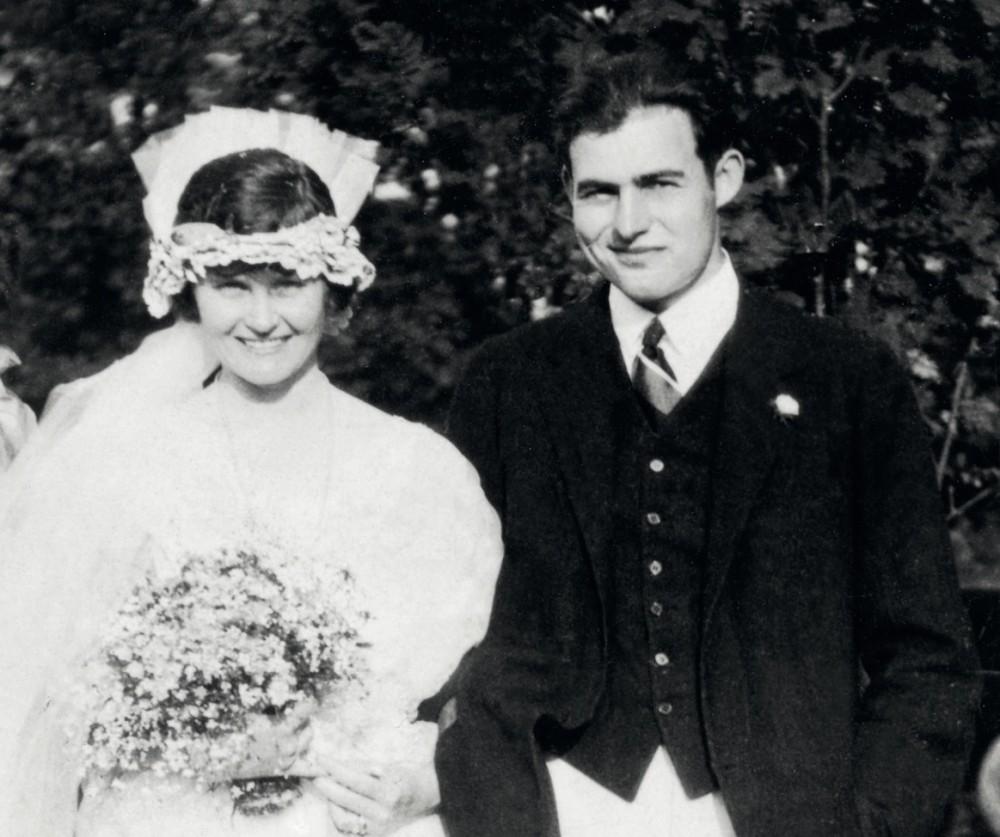
Hadley and Ernest on their wedding day Sept 3, 1921.

Hadley and Ernest on their wedding day Sept 3, 1921.

Anderson (author of the book Winesburg, Ohio, which I’ve never heard of but apparently both the writer and the book were a big deal back in the day) tells Hemingway “…if you want to do any serious work, Paris is the place to be. That’s where the real writers are now.”

Anderson was right, of course. Paris in the 20’s was a mecca for writers and artists, a literary (and artistic) who’s who. Gertrude Stein, Ezra Pound, F. Scott Fitzgerald,  and Archibald MacLeish are just a few of the celebs who enter the Hemingways’ orbit once they find themselves in the City of Light at the end of 1921. This collection of literati came to be known as “The Lost Generation,” a term coined by Stein but made popular in Hemingway’s novel The Sun Also Rises. The term refers to those who came of age after the First Word War.

McLain’s novel does an exceptional job of capturing the literary scene of the time – its parties and squabbles, jealousies and intrigues – but also the relationship between Ernest and Hadley. There is no question they loved each other deeply and in Hemingway’s own memoir about his time in Paris, A Moveable Feast, he writes “I wish I had died before I loved anyone but her.”

I may have to rethink my position on Hemingway. I may have to read A Moveable Feast. I certainly recommend The Paris Wife especially if you love literary name dropping and Paris. Even if you don’t love those things, McLain’s novel is a delight.

And We Stay – Jenny Hubbard

Sixteen-year-old Emily Beam, the protagonist in Jenny Hubbard’s YA novel And We Stay,  has been whisked away from her home town to attend a boarding school in Massachusetts. It’s midway through Emily’s junior year, an odd time for a student to be starting at The Amherst School for Girls.  Emily just wants to be left alone, though, and she keeps her head down and her cards close to her chest.  It’s clear that she’s suffered some sort of trauma and her parents have decided she will not be returning to her old school to “deal with the whispers and stares and, of course, the memories.”

andwestay

Emily settles into life at Amherst as best she can. Her roommate, K.T. is friendly and not too nosey and that’s good because Emily isn’t willing to talk about her life. The most she is willing to divulge is that she’s come from Boston – which isn’t exactly true.

Although she doesn’t want to talk about why she’s started school half way through the year, her story is revealed to the reader in short order: her boyfriend, Paul, has died. The details of his death are revealed through flashbacks and the poetry Emily begins to write, in part, inspired by Emily Dickinson. As it turns out, Dickinson had been a student at Amherst one hundred years before.

Hubbard is clearly a poet. Poetry figured in her first YA novel, Paper Covers Rock, a book I really loved, too. In And We Stay, Emily uses her poetry as a way to try and make sense of the senseless. In her poem “Ashes” she writes:

The same sky that once

held her dreams has stolen

her story. And the stars

will know just

how to tell it:

night after night

over and over.

Slowly, Emily opens herself up to the possibility of recovery and healing, but the journey is not without its difficulties. Hubbard negotiates Emily’s journey with a keen sense of the teenage heart.  Perhaps one might view Emily Dickinson as a plot device, but it didn’t feel that way to me. Poetry is the art of heightened emotion, of making the unknowable knowable and Emily is trying to do just that: make a horrific act something that she can survive – because she can. Because she must.

And We Stay is all the things I want my YA books to be: beautifully written, smart and engaging, emotionally intelligent and a page-turner. The book won several awards and is, in my opinion, deserving of them all.

Highly recommended.

Night School – C.J. Daugherty

Over 400 pages and I read them all lickety-split. C.J. Daugherty’s YA novel Night School is so much fun! Even when I discovered – about half way in – that the book is the first in a series (and you know how I feel about series), even then…I had to keep reading. (I don’t really have anything personal against series. It’s just that it’s such a commitment of reading time and that’s in short supply in my reading world. Still, as soon as I finished the book, I had to go online to see whether the sequel(s) was out. Um. There are four more books, people!)

Sixteen-year-old Allie Sheridan is always in trouble these days. She used to be a good kid, but then her older brother, Christopher, disappeared under extremely mysterious circumstances, and Allie’s been hanging with losers, defacing school property and just generally getting into trouble ever since. Finally her parents can’t take it anymore and decide to send her to Cimmeria Academy, an elite private school in the middle of the English countryside.

Night_SchoolThere – cut off from the outside world (no technology allowed) – she meets Isabelle, the school’s headmistress, and a cast of intriguing teenagers, among them Sylvain, gorgeous and French; Katie, the snotty rich girl; down-to-earth, Jo and Carter West, he of the endless brown eyes and bad reputation. They are all staying on at Cimmeria for the summer term. (School breaks up about mid-July in England and then goes back after Labour Day, early September…so about a six week break.)

Allie soon falls into the school’s rhythms and discovers that she kind of likes it at Cimmeria. Jo is nice and Sylvain is paying special attention to her. The food is great and the school is beautiful.  What’s not to like?

Well, first of all there’s ‘Night School’, but like ‘fight club’ – you’re not supposed to talk about it.

Students in certain advanced areas of study take part in Night School to prepare them for life after Cimmeria so you will sometimes hear them working late in the evening. Only very few select students are offered this opportunity; if you are not among them, you must not attempt to interfere with or observe Night School, and the fourth floor of the class-room wing is off limits.

Then there’s the woods though, according to Jo,  “we don’t actually do much in the woods, and they kind of discourage it because of, I dunno, health and safety or something.”  Then there’s Carter’s cryptic warning: “You haven’t been at Cimmeria long enough to understand how things are here. So be careful, okay? Things are not what they seem. People aren’t always who they seem to be.”

And I still had 200 pages to go!

There are creepy moments aplenty in Night School. Intrigue galore. And even if the payoff isn’t quite there, there’s more than enough to keep readers turning the pages. I would definitely be interested in reading the next book in the series, Legacy, to see how Allie makes out.

My only other niggle is that the characters don’t sound British. The occasional ‘blimey’ thrown into their dialogue does not a British accent make. They sounded decidedly American to me, which stands to reason: Daugherty is from New Orleans, though she now lives in England. That’s a small thing, though, and in no way undermined my overall reading experience.

Fun, fun, fun!

The Replacement – Brenna Yovanoff

Brenna Yovanoff’s YA novel The Replacement is quite unlike anything I have read before, which is a good thing. It was well-reviewed when it debuted in 2010 and I have been wanting to read it for a while. I was particularly intrigued by the cover, which is creepy, although I try not to chose books based on their cover alone – that has lead me down a few crap book paths.

Gentry isn’t like other places and Mackie isn’t like other 16-year-olds. He’s a replacement,  left in the crib of a human baby who was spirited away by the strange inhabitants of the the labyrinthine world beneath Gentry.

7507908Mackie lives with his older sister, Emma and his parents. He has a best friend, Roswell. He has a crush on a pretty girl, Alice. But he also can’t abide blood. Or get close to anything made of stainless steel. Or go to church, even though his father is a preacher.
Mackie knows he is different. “I dream of fields,” he says, “dark tunnels, but nothing is clear. I dream that a dark shape puts me in the crib, puts a hand over my mouth, and whispers in my ear. Shh, it says. And, Wait. “

The way his sister tells it, someone took her real brother in the middle of the night when she was four years old.

When she reaches her hand between the bars, the thing in the crib moves closer. It tries to bite her and she takes her hand out again but doesn’t back away. They spend all night looking at each other in the dark. In the morning, the thing is still crouched on the lamb-and-duckling mattress pad, staring at her. It isn’t her brother.

When the little sister of Mackie’s classmate, Tate,  goes missing, Mackie is forced to confront his own origin story and this leads him the The House of Mayhem and The Morrigan, a girl who rules there and whose “jagged teeth and tiny size made her seem more implausible, more impossible than all the rest.” All the rest of what, you might ask? Yeah, that would be the living dead girls. The Morrigan  tells him “We were so pleased that you survived childhood. Castoffs generally don’t.”

When Tate asks for Mackie’s help, he is reluctant; he’s got his own problems. But when The Morrigan offers to help Mackie feel better even he can’t resist. There is a strange barter system between Mayhem and Gentry: Mayhem thrives on adulation. But Mayhem isn’t the only world beneath the town. The Morrigan has a sister, and she thrives on blood sacrifice.

Mackie doesn’t fit in, but  whether or not Yovanoff meant for his journey to be a metaphor (like Joss Whedon’s monsters in Buffy the Vampire Slayer) hardly matters because The Replacement is a thrill ride.

Great book.

The Book of You – Claire Kendal

You know how sometimes you start a book and you just can’t put it down – that’s what happened when I started reading Claire Kendal’s debut novel The Book of You. I mean, it’s not an original story – woman sleeps with guy after a bad break up and guy turns out to be a psychopathic stalker – but Kendal’s novel had an extra layer of creep, plus some interesting things to say about victim-blaming.

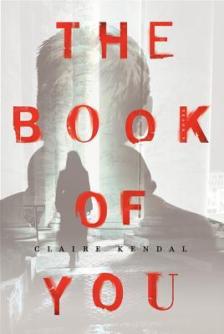
Thirty-eight-year-old Clarissa works as an administrator at the university in Bath. Her book of youaffair with Henry, a professor, has recently ended. Rafe also works at the university and has just published a new book on fairy tales and it is at his book launch that Clarissa drinks too much. She hadn’t really wanted to go, but he’d sent her three invitations. Hello, alarm bells.
“It is the night that I make the very big mistake of sleeping with you,” she writes in her journal. She has decided to follow the advice from the literature on stalkers and document everything. Clarissa knows she has to build a case before she can even consider going to the police.

I am trying to piece it all together. I am trying to fill in the gaps. I am trying to recollect the things you did before this morning, when I started to record it all. I don’t want to miss out a single bit of evidence – I can’t afford to. But doing this forces me to relive it. Doing this keeps you with me, which is exactly where I don’t want to be.

Everything about Rafe is skin-crawlingly-creepy.

“It makes me want to scream, the way you say my name all the time,” Clarissa writes. And Rafe has plenty of opportunities to say it. He is everywhere: outside her apartment, lurking at train stations, waiting for her outside the court room where she is on jury duty. He sends her things: chocolates, notes, flowers. He calls and texts her dozens of times. He rallies her friends against her, isolates her further. He makes Clarissa question her own sanity.

If there is a bright spot in Clarissa’s day, it is the time she spends in court, listening to the rather horrific details of a violent drug-related rape. It is here where she meets fellow-juror, Robert, a firefighter who recently lost his wife. As she and Robert become closer, Rafe becomes more aggressive.

The Book of You is an edge-of-your-seat thriller which also happens to be well-written. Clarissa refuses to let herself be a victim, but she is human and doesn’t always make the right choices. I never once thought “What?! Don’t do that!” though – which is certainly due to Kendal’s skill.

It’s a bit graphic, so if that’s not your thing perhaps this isn’t the book for you. However, I couldn’t put it down and highly recommend it.


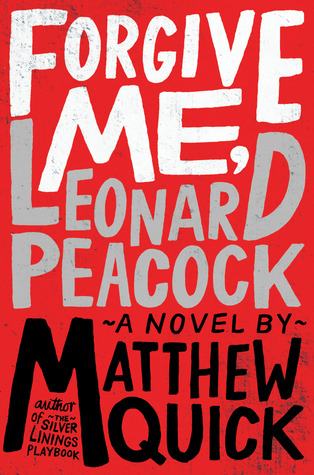
Forgive Me, Leonard Peacock – Matthew Quick

forgive meToday is Leonard Peacock’s 18th birthday. It’s also the day he has elected to kill himself – but first he has to kill his former best friend, Asher Beal.  Before he can do that, though, he has some gifts to deliver, gifts he’s wrapped in pink paper and packed in his knapsack along with his grandfather’s P-38 WWII handgun.

I want to give them each something to remember me by. To let them know I really cared about them and I’m sorry I couldn’t be more than I was  – that I couldn’t stick around – and that what’s going to happen today isn’t their fault.

Forgive Me, Leonard Peacock is a smart, funny, heartbreaking novel by Matthew Quick, perhaps better known for Silver Linings Playbook. I was immediately enchanted by Leonard’s charming, wry and honest narrative — he is immediately believable and sympathetic.

Leonard isn’t your run-of-the-mill teenager. He’s a thinker. He’s also in real emotional distress. It’s no wonder. His father, a former rock star currently on the run from the IRS, and his mother, a fashion designer who lives in NYC with her French boyfriend, are clearly terrible parents.

As Leonard makes his way through his day and we meet the four people he deems worthy of parting gifts, it’s easy to see how lonely and isolated he is.

First there’s Walt, the old man who lives next door. “I met Walt during a blizzard” Leonard tells us in one of the novel’s frequent (and often caustic) footnotes. Leonard’s mother, Linda, had asked him to go “shovel the driveway, even though it was still snowing, because she had to go out to meet another fake designer or some bulimic model.” Walt is an old movie aficionado and soon enough he and Leonard are quoting Bogart and Bacall back and forth at each other.

Then there’s Baback, a kid Leonard has known since grade nine. When Leonard discovers that Baback is an extremely talented violinist, he bribes Baback to let him sit and listen because listening to Baback play is “by far the best part of my day.”

Then there’s Lauren, the home-schooled Christian who hands out pamphlets at the train station. (Sometimes Leonard rides the train into the city, following random adults to see whether there is, in fact, any potential for happiness once you’re out of high school.) That’s where he first sees Lauren and he dreams of kissing her, although they can’t seem to overcome the obstacle in their way: Jesus.

Finally, there’s Herr Silverman, Leonard’s favourite teacher. Herr Silverman encourages his students to think for themselves, a quality Leonard feels is lacking in other faculty members. Also,

There have been days when Herr Silverman was the only person to look me in the eye.

The only person all day long.

It’s a simple thing, but simple things matter.

I’m a teacher; that hit me in the gut.

Leonard goes through his day, hinting at something horrible that happened between him and Asher, the something that necessitates his rash decision to end both their lives. With each gift, he half hopes someone will notice that something is wrong and, thankfully, someone does.

For anyone who has ever felt ‘other’, for anyone who ever considered ending their own life, for anyone who has ever felt neglected, unseen, or desperate, Forgive Me, Leonard Peacock is the book for you.

Highly recommended.

Everything I Never Told You -Celeste Ng

everythingLydia is dead.

It’s been quite a while since I’ve had such a visceral reaction to a book.  I read the bulk of Celeste Ng’s debut novel, Everything I Never Told You, on my snow day (a gift for a teacher, even if it’s only because we get to catch up on  marking/yearbook/planning – and, yeah, reading). I don’t think I will ever  be able to adequately explain how I feel about this book or these characters.

Lydia is just sixteen when she is found at the bottom of the lake across the street from her home in small-town Ohio. It’s the 1970s, the decade in which I, too, was coming-of-age. On the morning she is discovered missing (and it is this “innocuous” fact that sets the story in motion) we see the Lee family dynamic.

As always, next to her cereal bowl, her mother has placed a sharpened pencil and Lydia’s physics homework, six problems flagged with small ticks.

Hannah, Lydia’s younger sister is “hunched[ed] moon-eyed over her cornflakes, sucking them to pieces one by one.” Lydia’s older brother, Nathan, is sitting on the stairs trying to wake up. James, their father, has already left for his job as a professor at the local college.

Lydia is never late. She is never anything but compliant. She is a “yes” girl, the favoured daughter. It is only after her body is found that her story, and that of her family, begins to unravel. And yes, you will want to know what happened to Lydia, but trust me, it’s just one of the many things that will break your heart in this magnificent novel.

While every family has their own secrets and burdens, the Lee family is further set apart because Marilyn is white and James is Chinese. Their story is integral to Lydia’s story. Marilyn herself was a gifted student, earning a scholarship to Radcliff, and there – while she heads towards a degree in medicine – she meets James, a fourth year graduate student in history. She is ‘other’ because she is a woman studying in a field that is dominated by men; he is ‘other’ because he’s Chinese. All Marilyn knows is that “she wanted this man in her life. Something inside her said, He understands. What it’s like to be different.”

Marilyn’s career plans are pre-empted when she gets pregnant. She and James marry and move to Ohio.  Of course, their union wouldn’t be quite so problematic now (I’d like to think, but there are always some people….), but it’s the late 50s when they marry. Another world, another time. And life, fraught as it is, moves on. But why is it fraught? Because James grew up attending private school for free because his mother worked there as the cook and his father the janitor? Because he never fit in anywhere?  Because Marilyn didn’t want the life her mother had? Because of dreams deferred? And what happens when our parents’ lives are complicated and damaged by their own childhoods? Ah, we all know the answer to that question, right? It all trickles down.

Everything I Never Told You is an astounding, complex and heart-breaking look at the secrets we keep, not only from our families but from ourselves. Why we keep them, and the damage caused because of it, is just part of what happens in Ng’s book. The horrible longing we feel to crack ourselves open, the desire for true communication and intimacy, is another part. There wasn’t a single character in this novel I didn’t want to hug – I loved them all. That they were so fabulously human and fragile is a testament to Ng’s talent.

Highly (times a billion) recommended.

Pass it on

Listen here.

Pass it on.

One of the questions that we often ask at book club is “would you pass this book on?” That got me thinking about my own personal criteria for recommending a book. I know that that’s what I do here with you…but who am I, really, to be making recommendations to anyone, right? Book love is so subjective.

I read a lot of books, but not many of them would fall into the “here – you gotta read this” category. So I started to think about my own litmus test for books…what books have I read that I would definitely press into the hands of someone else?

I think a book has to be well written. But that doesn’t mean that every single book I’ve loved has to be Shakespearean. Sometimes a book can be just super fun to read without all the literary bells and whistles, I am thinking about a book like …oh, who am I kidding? I took a look through the highly recommended section of my blog and really, all the books I’ve really loved have had that beautiful combination of story and character and writing. That is not to say that I haven’t read my share of books that have been fun to read, but would I insistently pass them into the hands of other readers? Do I think about them long after I’ve closed the pages? Probably not – so maybe that’s actually the test for me. Do I think about these books when I’m finished? Do I want other people to read them so we can share our thoughts? That’s the book I want to pass on. So – I’ve got three for you today, two adult and one YA read that I would heartily recommend to readers of all stripes.

Let’s start with the book I just finished and which I mentioned the last time I was here as a book that I hoped would be a page-turner and man, was it ever.

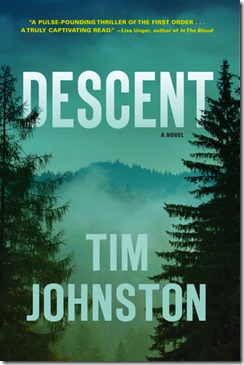
Descent by Tim Johnston descent_thumb

So, this is the story about the Courtland family, mom and dad, Grant and Angela, their 18 year old daughter, Caitlin and their 15 year old son. Sean. They are in the Rocky Mountains on a little family getaway before Caitlin heads off to college on a track scholarship. Early in the morning, Caitlin and Sean head out so Caitlin can run up the mountain with Sean following on his bike. Then, Sean gets hit by a jeep – strange first of all because they are literally in the middle of nowhere. He’s really badly hurt and when his parents get the call from the hospital they are also informed that Caitlin is missing. Fast forward a year and the Courtlands are still fractured. Dad has moved to the town where Caitlin disappeared; Sean is driving around the country aimlessly; Angela is back on the east coast living with her sister. They are all damaged. Johnston’s novel is the perfect combination of style and substance. The writing is sharp and lyrical, but it never slows the action down and – trust me – this novel has some pulse-pounding action sequences that were just so good. I would definitely hand this one over…like, not to keep, of course!

Our Daily Bread – Lauren B. Davis ourdailybread

This one I actually touched on a while back when I talked about starting a book club. I couldn’t stop thinking about this book for days and days after I read it. Despite the controversial subject matter, Davis’s book is so compelling, the writing so good and the characters so broken…it’s impossible not to read this book without feeling something.

Our Daily Bread concerns the fortunes of two families: the Erskines who live up on North Mountain and the Evanses who live down in Gideon. Albert Erskine is different from the crack-smoking/dealing relatives with whom he lives on a sort of compound. He’s smart and he wants more from his life, but life has dealt him a particularly rough hand. Bobby Evans has it tough in another way – as he watches helplessly as his parents’ marriage deteriorates he looks for a place to belong and, strangely, he and Albert become friends. The intersection of these two young lives makes for some compelling reading, I’ll tell you that. This book is, at turns, horrific and heartbreaking, but you will fall in love with these characters – I promise.

Our Daily Bread was long-listed for the Giller in 2012.

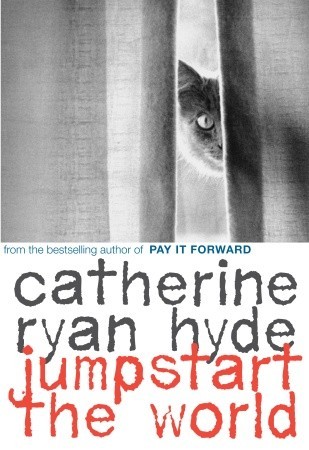
jumpstartFinally, a YA novel that I would definitely pass on is Catherine Ryan Hyde’s Jumpstart the World, which I just finished last week. It’s the story of Elle, a fifteen-year-old girl whose mother sets her up in an apartment across town because her new boyfriend doesn’t get along with her. Yep – mom chooses the guy over her daughter. So, here’s Elle living on her own, starting a new school. She meets her next door neighbours Frank and Molly and is immediately taken with Frank, who seems really kind and nurturing…clearly traits her mother doesn’t possess. She also makes some friends at school – outsiders all…

Then she discovers that Frank is transgender and it forces Elle to really examine herself as a human being. What I liked about Jumpstart the World is that it never preaches. It will offer young people an opportunity to examine their own prejudices, for sure, but it also has a lot of really amazing things to say about love and family and accepting who you are. It’s really a lovely book and I would certainly press it into the hands of my students.

Catherine Ryan Hyde is probably best known for her novel Pay It Forward, a book I haven’t read – but I did read her YA novel The Day I Killed James and it was also excellent.


Descent – Tim Johnston

descent_thumbI love it when a book lives up to its hype…and if you believed the accolades plastering the back cover and the first three pages of Tim Johnston’s novel Descent, you’d certainly be expecting great things. The Washington Post said “Read this astonishing novel. The magic of his prose equals the horror of Johnston’s story.” Esquire called it “Outstanding” adding that “the days when you had to choose between a great story and a great piece of writing” are “gone.”

I don’t even know how this book came to be on my radar – I just know that I had a picture of it on my phone and a couple weekends ago I was pleased to discover that Indigo had topped up my Plum Points and I had $100 to spend…but only that weekend to spend it. So, I flipped through the pictures of covers and chose five, Descent being one of them. A couple of weeks ago, I mentioned the book on Information Morning and decided that since I had, I should probably read it. Once I started, I couldn’t stop.

The Courtlands are spending a little family time in the Rocky Mountains – a holiday before Caitlin, 18, heads off for her first semester of college. Her mom and dad, Angela and Grant, are clearly in crisis and then there’s Sean, Caitlin’s 15-year-old brother.

Caitlin is a runner and on the morning the story opens, she and her brother are heading up a mountain trail – Caitlin on her feet, Sean on his bike. Johnston meanders up the mountain with the pair as they bicker and share confidences. Then the unthinkable happens: Sean is hit by a jeep

…it came, monstering through the trees at an incredible speed, crushing deadfall, the whip and scream of branches dragged on sheet metal and then the suddenly unobstructed roar that made her wrap her head in her arms, the sound of tires locking and skidding and the thing slamming into what sounded like the sad tin post of a stop sign and then the meaty whump and the woof of air which was in fact the boy’s airborne body coming to a stop against the trunk of a tree.

When Grant and Angela get a call from the local police, they learn Sean’s been badly injured;  Caitlin is missing.

Fast forward a year or so. Grant has moved to the area and is living on the property owned by the local sheriff’s father, Emmet. Sean is on the road, driving from place to place picking up odd jobs. Angela is living with her sister when she isn’t hospitalized for depression/mental health issues. Caitlin’s disappearance has fractured the Courtland family.  It’s mostly the men that Johnston spends time with, allowing the reader a glimpse into their own personal hells: the father who can’t and won’t give up hope that Caitlin will be found and the son who can’t forget what happened that morning on the mountain.

The characters in Descent are trying to get on with it, but their personal pain is palpable. Grant works around Emmet’s property, sometimes pausing to “stare into the hills beyond the ranch, up into the climbing green mountains.” He hears his daughter’s voice and  “take[s] his skull in his hands and clench[es] his teeth until he [feels] the roots giving way.”

As for Sean, he is closed off from the world. In one particularly horrific scene, he puts himself in harm’s way in an effort to save a young girl – perhaps in an effort to atone for the ultimate crime of not being able to save his sister. It’s not the only time he does something selfless, albeit, foolish.  I just wanted to hug him.

We do spend less time with Angela, but that doesn’t mean that we know less about her. She moves through her much diminished world like a whisper. Only a parent who has suffered the loss of a child could truly understand Angela’s debilitating sadness.

The girls’ heartbeat still played in her arms. In her chest. She remembered the hour, the minute, she was born: precious small head, the known, perfect-formed weight of it. All her fears of motherhood – of unreadiness, of unfitness– vanishing at the sight of that plum-colored face mewling in outrage. My child, my life.

Secondary characters, Emmet’s  black-sheep son, Billy, for example, are equally well-drawn. Billy arrives back in town, much to the chagrin of his father and older brother, and swaggers his way into everyone’s bad graces. But even Billy is allowed his shades of gray – there are no stock characters here.

Into these complicated interior lives, Johnston deftly weaves the mystery of Caitlin’s disappearance. She is not a footnote, trust me. The story of her disappearance is unraveled with excruciating care and her story is definitely one of the things that will speed your journey through this book.

Descent is fantastic on every level and I highly recommend it.