Standing Still by Kelly Simmons

standing

I loved pretty much everything about Kelly Simmons’  novel Standing Still. It’s always a relief to read something you can be excited about after a couple of mediocre books. Standing Still is just a terrific book: part page-turner (there’s an intriguing mystery at this book’s core) and part meditation on marriage and family and the lives women leave behind in order to have those things.

Claire Cooper, mother of three young daughters, spends a lot of time alone because her husband, Sam, travels for business. One night someone breaks into her house and Claire finds him about to make off with one of her daughters. “Take me,” she tells the man. “Take me instead.”

The man does take Claire and over the week of her captivity the reader has access to   Claire’s thoughts about her children and husband, as well as to her growing relationship with her captor, a relationship that proves to be far more profound and moving than you might expect. Their relationship becomes one of intimacy and, dare I say it, friendship and I know there is probably some psychological explanation for what happens between kidnap victims and their abductors, but I don’t think that explanation would actually suffice in this case. Claire is carrying a lot of emotional baggage and for the first time in her life she is forced to confront some of it. It is her time with this unlikely ‘therapist’ that makes healing possible.

On top of all this human drama, Simmons is a beautiful writer. Claire is a fully realized character, fragile and brave. Her unnamed captor is equally interesting –  a scene towards the novel’s conclusion where Claire makes the observation that, sleeping next to him will be the last time she’ll ever feel this safe (232) is both ironic and heartbreaking.

I also really loved that Claire is a woman who is trying to reconcile motherhood and marriage with the fact that she was, once, a very successful career woman. I loved her wild past, her ability to fall in love with a man based on a single characteristic, her yearning for that simple pleasure once again.

This was a book I couldn’t wait to get to at the end of the day…and one I was sorry to finish even as I was racing to the end.
Mister Pip by Lloyd Jones

misterpip

Lloyd Jones’ Mister Pip won the Commonwealth Writers’ Prize for Best Book in 2007. Books with pedigree always make me nervous. What if I don’t like it? What does that say about me as a reader? No chance of not liking Mister Pip, though. This is a terrific book.

Thirteen-year-old Matilda lives on the tropical island of Bougainville in Papua New Guinea. Many of the island’s inhabitants have fled, including Matilda’s father, because of a brutal civil war. Redskins and rambos are fighting, and the island is all but cut off from civilization. The only white inhabitant left in the village is a man called Mr. Watts, also known as Pop Eye. It is decided that he will teach the children, as the school teachers have all fled.

As they clean up the building they will use as a school room, Mr. Watts tells the children “I want this to be a place of light, no matter what happens.”

Mr. Watts begins to read the children Great Expectations which he claims is “the greatest novel by the greatest English writer of the nineteenth century.” And as Pip’s story unfolds, so does Jones’ novel. Not everyone agrees with Mr. Watts’ estimation of Dickens’ worth. Matilda’s mother, Dolores, in particular thinks Mr. Watts should be teaching the children about God and the devil. She and Mr. Watts are adversaries, but there can be no mistaking the impact Watts is having on Matilda.

Mister Pip is a fantastic book about the power of reading and imagination. It is also a powerful and startling novel about bravery and sacrifice, love and forgiveness.

I can not recommend it highly enough.

The Cellist of Sarajevo by Steven Galloway

cellist

Heather Reisman, CEO of Canada’s largest bookstore chain (Chapters/Indigo/Coles) chose The Cellist of Sarajevo as one of her Picks. A Heather’s Pick is a guaranteed read: if you read it and don’t like it, bring it back to the store for a refund. The thing is, though, Heather has pretty good taste. This book, by Canadian author Steven Galloway,  is immensely readable and despite its depiction of the desolation and horrors of war, the book is ultimately hopeful.

Interestingly the premise of the book is simple, so simple in fact that in less skilled hands it might have been a bit of a dog’s breakfast.  The cellist of the title  (as a character) features only nominally in the novel. The book is actually concerned with the fortunes of three people: Arrow, a young female sniper; Kenan, a father who goes out to get water for his wife and children and an elderly neighbour and Dragan, an older man on his way to the bakery where he works. The novel alternates between characters, allowing the reader to spend time with and get to know each of them.

Truthfully, despite the fact that I am certainly old enough, I know very little about the conflict in Sarajevo. I guess I tend to bury my head in the sand when any sort of conflict takes place. I want the world to be a shiny, happy place where people get along.

I guess my desire for a conflict-free world is why I found this book so moving. Spend a few hours with Kenan as he braves the streets, making a treacherous journey to the brewery to collect fresh water for his family. He’s a father who only want to keep his children safe, feed and clothe them. As a mother, I can relate to that. But I live in Canada. When I want water I turn on the tap. I don’t risk death to visit a market where, if I’m lucky, I might score a bag of over-priced rice. I am not elated when the elecrticity comes on, allowing me the ability to charge my radio so that I can listen to the news. Galloway’s book allows us a glimpse into these hardships which happened not fifty years ago…but in the last decade! What kind of world do we live in that we allow this to happen? (That’s a rhetorical question, of course, impossible to answer.)

Each of Galloway’s characters is fully realized- complicated, angry, depressed, determined, and hopeful. Although he plays a minor part in the drama, the cellist of the title is actually the thread that binds these characters who are, otherwise, unknown to each other. The cellist plays Adagio in G Minor every afternoon at 4pm for 22 days to mark the deaths of 22 people who  were killed while waiting in line to buy bread. It is his music that lifts the spirits of the three main characters and the others who come to hear him play.

Perhaps Galloway is saying that our appreciation of  music, art of any sort, is what makes us human. While war certainly brings out the worst in people, it also allows us the opportunity to appreciate what we often take for granted. For 22 days, the cellist was able to remind the people struggling to get by in a city they no longer recognized as their own that they were alive.

It’s a beautiful novel.

Fantastic  photos of Sarajevo during the conflict can be found here. You would almost think Galloway was inspired by some of these photos.

How To Be Lost by Amanda Eyre Ward

howtobelost

My copy of Amanda Eyre Ward’s novel How To Be Lost came with an unusual guarantee: the publisher promised to  refund your money if you didn’t like How To Be Lost as much as The Lovely Bones . I suppose at the time of its publication, comparison to the juggernaut that was The Lovely Bones would seem like high praise indeed. But I won’t be writing to collect my refund, thanks very much. I loved How To Be Lost and, in fact, I think I liked it even more than The Lovely Bones which, in my opinion, started off with a bang and ended with a whimper.

Ward’s novel concerns the Winters family, specifically the Winters daughters: Caroline, Madeline and Ellie. We meet the eldest, Caroline, first. She’s a hard-drinking cocktail waitress in New Orleans trying to figure out how she’s going to tell her mother, Isabelle, that she’s not coming home for Christmas.

Home isn’t a happy place for Caroline. Home brings back horrible memories of her alcoholic father, her miserable mother and the disappearance of her youngest sister, Ellie. Still, duty calls.

It’s on this visit home that Caroline’s mother shows her a picture in a People magazine. As soon as Caroline sees it, she knows. It’s her baby sister.

How To Be Lost really is a story about people trying to find their way in both extraordinary circumstances (a potential love interest for Caroline has lost his wife in the 9/11 attacks and he is trying to move on with his life) and mundane circumstances (the novel is peopled with characters who spend their lives hunched over beer or whiskey in a variety of scummy bars).

Some people don’t like first person narrative, but I do, especially if the narrator is honest. Caroline is self-destructive and selfish and afraid. Her journey to find the woman in the picture is ill-advised and necessary because by making the journey she is making her first real attempt to leave the past behind.

One of the things I hated most about The Lovely Bones was Sebold’s decision to flash forward into the future. That rarely works for me. Ward doesn’t do this. Her ending, if anything, is a dangling thread. Her ending, for me, was perfect.

This is a gem of a book.

Places in the Dark by Thomas H. Cook

placesinthedark

This is third book I’ve read by mystery writer Thomas H. Cook and I have to say that I continue to be impressed. The critics seem to adore Cook and have described Places in the Dark as “a serpentine tale of long-buried secrets leading to murder and betrayal” (The Orlando Sentinel) and “complex, multi-layered and haunting” (Romantic Times).

The story concerns brothers William and Cal who grow up in an idyllic seaside town in Maine in the 1930s. They are as different as night and day: William an energetic dreamer who rushes through life filled with hope and enthusiasm and Cal, the older more pragmatic brother. Still, despite their differences, they are close. Then Dora March comes to town.

It gives nothing away to say one brother ends up dead, but the book’s mystery isn’t so much a whodunit as a what are the circumstances surrounding the death.

Cook’s skill comes from his ability to create character. His mysteries unfold slowly, but I don’t mean to say that his books aren’t page turners. You’ll turn the pages, but I think you’ll also linger over Cook’s beautiful writing. Cook is a master of layering his character’s motives, of giving them real interior lives. He’s also pretty good at leading us on and this is particularly true in Places in the Dark where things are not always what they seem.

If you like a well-written mystery, I highly recommend Thomas H. Cook. I haven’t been disappointed yet.

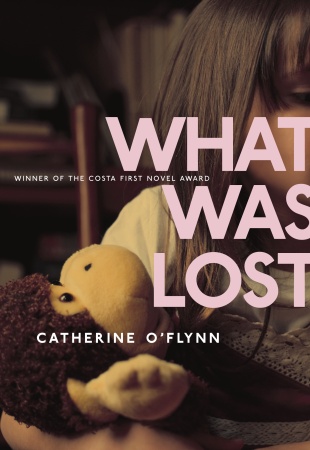
What Was Lost by Catherine O’Flynn

Catherine O’Flynn’s debut novel, What Was Lost, is as labyrinthine as the tunnels under the Green Oaks Shopping Centre. Ten year old Kate Meany is an amateur detective, raised (until his sudden death) by an older, single father. In the novel’s opening third, we travel with Kate and her stuffed monkey, Mickey, as they conduct stakeouts, deliberate over office stationary for Kate’s fledgling detective agency, and pal around with Adrian, the 22 year old son of the man who runs the store next to Kate’s house.

Flash forward almost 20 years and meet Kurt, a security guard at Green Oaks and Lisa, a manager at ‘Your Music’ a big-box music store in the same mall (and not incidentally, Adrian’s younger sister). One night, while sleepily watching the security moniter, Kurt sees Kate. It’s not possible: Kate disappeared the year she was ten and was never found. Adrian, suspected of wrong-doing, but never charged, disappeared and made no contact with his family except for a mixed tape he sent to Lisa every year on her birthday.

From these tangled threads, O’Flynn weaves an exceptionally good story about missed opportunities, luck, family and secrets. She even throws in a slightly gloomy (but fairly funny) picture of what it’s like to work in retail.

O’Flynn’s real strength is in her characters. Kate Meany is a wholly believable and totally enchanting little girl. Lisa and Kurt are flawed and likable. O’Flynn manages to tell us everything we need to know about a character with a line or two – whole back stories come to life with a few carefully chosen words. Even minor characters spring to glorious life and create a picture of small town-life which is ultimately eroded by progress aka big  impersonal malls.

The story had an extra layer of meaning for me because it took place in the West Midlands of England and I once lived there.  I am pretty sure that Green Oaks is actually Merry Hill, a huge shopping centre on the outskirts of Birmingham.

If I have one niggle about the book, it comes at the end. I didn’t like part 42- it felt extraneous to me, like an unnecessary bow on a beautifully wrapped present. Had O’Flynn quit at the end of part 41, I think this little gem of a novel would have been damn near perfect.

Late Nights on Air by Elizabeth Hay

“Psychologically astute, richly rendered and deftly paced. It’s a pleasure from start to finish.” – Toronto Star

Canadian author Elizabeth Hay won the Giller Prize for her novel, Late Nights on Air. Obviously, you begin a book like this- one with a certain pedigree already attached- with a little trepidation. I mean, what if you hate it?

I am happy to report that this is a beautiful book.

Set in Yellowknife in 1975, the novel tells the story of the intersecting lives of Harry (a CBC radio station manager), Dido (a beautiful announcer who has fled to the North to escape a complicated, but profound, relationship), Eleanor (the station’s secretary), Eddy (the station’s technician), Ralph (a local photographer and on-air book reviewer) and Gwen (a newcomer, who had come to the North inspired by the tragic story of an explorer named John Hornby.) Although Gwen is clearly the central character of the book, Hay deftly manages the interior lives of all the characters and, in doing so, makes us yearn to know more.

The last third of the book takes four of the characters on a tremendous canoe trip, inspired by the life of Hornby. That trip and the consequences of it forever change the lives of these characters.

I have always said that I hate a book that flashes us forward in time and shows us where the characters are now. Hay employs this device, but it seems almost organic. And at the book’s conclusion, I felt truly sad to be parting company with these people.

Ultimately, though, this book is about silence, longing, isolation, community and what love looks like.

I highly recommend it.

Sweet Ruin by Cathi Hanauer

Cathi Hanauer’s book takes an age-old theme, adultery, and turns it into a gripping page-turner of a novel. Sweet Ruin introduces us to 35 year old Elayna, a work-at-home editor who is just crawling out of a two-year depression after the death of her infant son, Oliver. Her husband, Paul, is a benign, but absent figure, someone who is clearly burying his own grief in his work as a lawyer. Their six-year-old daughter, Hazel, is intelligent and demanding.

“…that brilliant April, after rain had soaked us all March, it felt to me as if the earth and the plants, the insects and trees just couldn’t stay in their pants,” Elayna observes. And from the ruin of her life, Elayna begins to emerge and just as she does she meets, Kevin, a much younger boy-man who lives across the street.

It would be easy to find fault with Elayna- after all, she loves her husband and her daughter and has, what appears to be a perfect life. But Hanauer asks us to imagine Elayna as a woman who has lost more than a child; she’s lost, in a life filled with bossy caregivers and schedules dictated by a busy child and workaholic husband, some essential part of herself. It’s almost impossible not to relate to her.

And as Elayna’s relationship with Kevin skirts closer and closer to something from which there will be no turning back, it’s hard not to be swept along. Partly it has to do with Hanauer’s beautiful prose and partly it has to do with how carefully she builds Elayna’s world. Either way, it was impossible to put this book down because even though the it tells an age-old story, it felt new and heartbreaking to me.

Gorgeous.

The Thirteenth Tale by Diane Setterfield

“The Thirteenth Tale is a cleverly plotted, beautifully written homage to the classic romantic mystery novel… Gothic elements are skilfully re-imagined in a peculiar tale of madness, murder, incest and dark secrets…. It is a remarkable first book, a book about the joy of books, a riveting multi-layered mystery that twists and turns, and weaves a quite magical spell for most of its length.” –The Independent

Diane Setterfield’s first novel is a wonderful accomplishment. This is a book lover’s book- even the book’s cover and the weight of the pages appealed to the bibliophile in me. But beyond the aesthetics of the book, Setterfield tells a rip roarin’ tale, an old-fashioned tale filled with mystery and intrigue and personal ghosts.

Margaret Lea lives a quiet life, working with her father in their little antiquarian bookstore. We know very little about Margaret other than the fact that she is close to her father, but not to her mother. She is unmarried. We don’t know how old she is. We do learn, early on, that she is a surviving twin- a fact she stumbles upon, quite by accident when she is young, a piece of her family history which haunts her throughout her life.

Then Vida Winter, the most celebrated writer of the time, writes to Margaret inviting her to hear the truth of her life- a life which has been largely reclusive. This story is the subject of The Thirteenth Tale. And it is a tale that is Gothic, relying on the conventions of literature from the 18th and 19th centuries: ghosts and secrets and unrequited love abound in its pages. It’s a page-turner in the very best sense.

And as the story’s mystery unravels, you’ll find yourself wondering whether all the clues were there from the very beginning…and want to go back to trace the breadcrumb trail.

Heart-Shaped Box by Joe Hill

I didn’t know who Joe Hill was when I bought Heart-Shaped Box. I read a review, thought it sounded interesting and bought it.  The book sat on my to-read shelf for several months (yes, my to-read shelf is ridiculous!) until I had a conversation one day in the bookstore.

Customer: I’m looking for 20th Century Ghosts by Joe Hill. You probably don’t even have him.

Me: He wrote Heart-Shaped Box.

Customer: (looking surprised) Yeah. Have you read it?

Me: (sheepishly) No. But I’m going to.

Customer: He’s Stephen King’s son.

Me: (my turn to be surprised) Really? Wow.

Customer: I *loved* Heart-Shaped Box. It’s fantastic.

And now,  just this morning,  after my kids left for school and my husband left for work and before I had breakfast or started any of the things I have to do before I go to work…I finished the book. Ironically, the last time I carted a ‘horror’ novel around with me it was King’s book It. That was a long time ago. I loved that book.

I loved Heart-Shaped Box, too. As a matter of fact, before I was even half-way through the book, I hand-sold a copy to a woman who was purusing the Horror section. (I work at Indigo.)

Me: Do you like scary stories?

Customer: (looks sheepish) Yes.

Me: Have you heard of Joe Hill?

Her: No.

Me: I am currently reading Heart-Shaped Box. It’s great. (hand her a copy). He’s Stephen King’s son.

Her: (looking at picture) Only better looking. (laughs and puts book in shopping bag)

I hope Mr. Hill doesn’t think it’s a disservice to draw a comparison between him and his famous Dad. I grew up reading Stephen King. I don’t like everything he’s ever written. For example, even after several attempts I cannot get into The Stand and I know people who love that book. But the thing about King is that he writes books peopled with characters whose fate you actually care about. If you didn’t give a toss about them- the horrible things that happen to them wouldn’t matter. They’d have it coming.

Judas Coyne, the middle-aged, former rock star, slightly misogynistic anti-hero of Heart-Shaped Box, might have had it coming except for this:

“Not my hand! No, Dad, not my hand!”

Any ambivalence I felt about Jude’s fate ended right then and there. Suddenly, he was a character- fully drawn, with an aching past and a boulder the size of Mount Rushmore lodged in his heart. Hill doesn’t go over-the-top with details of Jude’s horrific childhood; I didn’t need to hear anymore anyway. Your imagination always fills in the blanks.

Besides, Heart-Shaped Box operates on a more immediate level. The book has barely begun before Jude buys a dead man’s suit and the ghost that accompanies it. Then all hell breaks loose and Jude and his goth-girlfriend-of-the-moment are running for their lives. And, thanks to Hill, they are lives we actually care about.

Of course there are some horror conventions in this book: radios that intone doom, television news reports that announce horrible endings, creepy people with scribbled out eyes.  There are no cliches here, though.

And I wonder if Jude’s flight- away from the ghost that he’s bought and towards the ghost that has haunted him for the past 34 years was intentional on Hill’s part. It must have been, I know. It adds an extra layer of depth to the book’s denouement, though, that’s for sure

Mr. King must be tremendously proud.