Desert Places by Blake Crouch

desert

Okay, I admit it. I have a kinda thing for psycho-killer novels. You know, some crazy person who chews up the landscape doing unspeakable things to innocent people. The best one I’ve ever read is Intensity by Dean Koontz. I could not put that book down.

Blake Crouch’s debut novel Desert Places isn’t nearly as good as Intensity, but it’s pretty darn good. It tells the story of successful mystery writer Andrew Thomas. One day Andy gets a letter in his mailbox: There is a body buried on your property covered in your blood. And we’re off. And so is Andy on a harrowing ride which cuts pretty close to home. I don’t want to give away a pivotal plot point, even though it comes fairly soon in the novel. Suffice to say, Andy is about to have a very bad few weeks.

Books like these fail or succeed (for me at least) because of a couple important ingredients. First of all, I want the good guy to be someone I want to root for. He doesn’t necessarily need to be the nicest guy, but he has to be decent in a way that the bad guy is not. Andy, the writer, is decent enough. He visits his mother faithfully, has a good friend. He’s smart and human. I also like the bad guy to be scarily bad. I want to feel afraid when I read a book like this, otherwise what’s the point? Trust me, this book is scary….especially the first third of it.

I am not sure that Desert Places delivered on its early promise, but that won’t stop me from checking out Crouch’s other books.

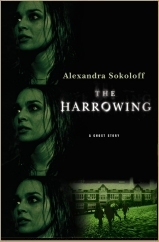
The Harrowing by Alexandra Sokoloff

harrowing

It’s been a long time since I’ve read a book this quickly. I started it last night and finally had to turn my light off after 100 pages…my eyes were burning and my heart was pounding.

Alexandra Sokoloff’s background is in theatre and as a script writer and The Harrowing, her first novel, certainly owes a debt to the screen. The prose is straightforward and while I wouldn’t go so far as to say the book is filled with trademark horror-film cliches,  the book’s creepiness (and trust me- the book is creepy) does owe a debt of gratitude to all those scary movies you watched as a teenager.

First of all, the book takes place at a remote college campus- specifically in a dorm filled with dark halls and secret staircases. You know what that means, right? The novel’s protagonist is Robin, a lonely girl who doesn’t quite fit in with the usual suspects (and trust me- all the stereotypes make an appearance: the handsome jock, the emo musician, the Southern belle, the slutty girl, the intellectual.) The book opens on a stormy Thanksgiving weekend. Everyone is heading home except for Robin; she has to spend the weekend all alone in her dorm.  Turns out she’s not alone, though.

The Harrowing benefits from its fast-moving plot and sketchy characterizations, ie it moves along at a breathtaking clip. That’s not to say that you don’t care about the characters, but this is a book with one purpose: to scare the bejebus out of you and it works on many levels.

It’d make a damn fine movie.

Heart-Shaped Box by Joe Hill

I didn’t know who Joe Hill was when I bought Heart-Shaped Box. I read a review, thought it sounded interesting and bought it.  The book sat on my to-read shelf for several months (yes, my to-read shelf is ridiculous!) until I had a conversation one day in the bookstore.

Customer: I’m looking for 20th Century Ghosts by Joe Hill. You probably don’t even have him.

Me: He wrote Heart-Shaped Box.

Customer: (looking surprised) Yeah. Have you read it?

Me: (sheepishly) No. But I’m going to.

Customer: He’s Stephen King’s son.

Me: (my turn to be surprised) Really? Wow.

Customer: I *loved* Heart-Shaped Box. It’s fantastic.

And now,  just this morning,  after my kids left for school and my husband left for work and before I had breakfast or started any of the things I have to do before I go to work…I finished the book. Ironically, the last time I carted a ‘horror’ novel around with me it was King’s book It. That was a long time ago. I loved that book.

I loved Heart-Shaped Box, too. As a matter of fact, before I was even half-way through the book, I hand-sold a copy to a woman who was purusing the Horror section. (I work at Indigo.)

Me: Do you like scary stories?

Customer: (looks sheepish) Yes.

Me: Have you heard of Joe Hill?

Her: No.

Me: I am currently reading Heart-Shaped Box. It’s great. (hand her a copy). He’s Stephen King’s son.

Her: (looking at picture) Only better looking. (laughs and puts book in shopping bag)

I hope Mr. Hill doesn’t think it’s a disservice to draw a comparison between him and his famous Dad. I grew up reading Stephen King. I don’t like everything he’s ever written. For example, even after several attempts I cannot get into The Stand and I know people who love that book. But the thing about King is that he writes books peopled with characters whose fate you actually care about. If you didn’t give a toss about them- the horrible things that happen to them wouldn’t matter. They’d have it coming.

Judas Coyne, the middle-aged, former rock star, slightly misogynistic anti-hero of Heart-Shaped Box, might have had it coming except for this:

“Not my hand! No, Dad, not my hand!”

Any ambivalence I felt about Jude’s fate ended right then and there. Suddenly, he was a character- fully drawn, with an aching past and a boulder the size of Mount Rushmore lodged in his heart. Hill doesn’t go over-the-top with details of Jude’s horrific childhood; I didn’t need to hear anymore anyway. Your imagination always fills in the blanks.

Besides, Heart-Shaped Box operates on a more immediate level. The book has barely begun before Jude buys a dead man’s suit and the ghost that accompanies it. Then all hell breaks loose and Jude and his goth-girlfriend-of-the-moment are running for their lives. And, thanks to Hill, they are lives we actually care about.

Of course there are some horror conventions in this book: radios that intone doom, television news reports that announce horrible endings, creepy people with scribbled out eyes.  There are no cliches here, though.

And I wonder if Jude’s flight- away from the ghost that he’s bought and towards the ghost that has haunted him for the past 34 years was intentional on Hill’s part. It must have been, I know. It adds an extra layer of depth to the book’s denouement, though, that’s for sure

Mr. King must be tremendously proud.

Off Season by Jack Ketchum

There’s no way to describe Jack Ketchum’s book, Off Season other than to call it torture porn. I was called out for this label, but I stand by it. It’s so gruesome, so over-the-top, it’s impossible to call it straight up horror.

This book caused quite a sensation way back in 1980 when it was first published. It was Ketchum’s debut novel and the editorial team at Ballantine wanted to make substantial changes to the book’s vivid (for lack of a better word) writing and pretty damn depressing denouement. Ketchum was reluctant, but also pretty excited about having his first novel published. Ultimately, he went along with the changes. He tells the whole story in the Afterward of the Leisure Fiction edition  of  Off Season, which is uncut and uncensored (and by this I mean, the story appears as Ketchum had intended it to appear all those years ago.) And, likely for some readers, the book is unpalatable.

I’ve got a pretty strong stomach. Thank God because this book was pretty horrific. It tells the story of a group of six friends who are about to spend a week together in a remote cabin on the coast of Maine. This is Deliverance country, folks, only ten times as nasty. Ketchum does a good job of moving the story along (the whole thing plays out over a couple days), of giving us characters we can root for (although not necessarily keeping them alive) and of grossing us out even as we’re turning the pages.

It’ll only take a couple hours to read the book, but I don’t recommend you do it at night or if you have a queasy stomach.

And, while I’m here: I read Ketchum’s novel The Girl Next Door a couple years ago. Based on true-life events, that book was a riveting story of how people are able to justify extreme cruelty against innocence. It was even scarier, for me, than Off Season because the narrator was, despite his compliance, likable.

Four and Twenty Blackbirds by Cherie Priest

Cherie Priest’s book was a huge disappointment to me. And it’s a book that makes me wonder about the ringing endorsements you find on book covers- because this book had them in spades. Even Ramsey Campbell, a writer I admire, had glowing praise for it, calling the book “breathlessly readable, palpably atmospheric and compellingly suspenseful.” I just don’t get it.

Orphaned at birth, Eden Moore lives with her aunt Louise and Uncle Dave. She’s a strange little girl, but it’s hardly her fault: she sees dead people. Okay, maybe I’m being a little glib, but she does have a trio of dead women who appear to warn her of danger. And Eden is often in danger; her wacky nut-job of a cousin Malachi is often trying to kill her; she fearlessly (stupidly) wants to know the secrets of her past (why doesn’t someone just tell her already) and none of the chills added up to very much of anything for me.

I know a book isn’t working for me when I start to notice punctuation issues…and when dialogue just seems stupid- there’s a whole section in the book when Eden’s Aunt Eliza tries to convince her to go home with her and Eden keeps on saying ‘no’ just because it’s fun. Um- not so much fun for the reader. And I also found the book had a lot of exposition- Eliza conveniently has a ‘butler’ who has the answers to all the questions Eden has and is able to fill in all the missing blanks just like that.

So, not for me, I’m afraid. But reviews are generally good so I suspect I am in the minority.

The Ruins by Scott Smith

Smith’s book has been on my to-read list for a while. I have had a life-long love affair with horror novels…both the truly creepy (Peter Straub’s Ghost Story springs to mind) and the truly schlocky (just about anything by John Farris) but I don’t read them too much anymore. Still, The Ruins came with quite a pedigree. Smith wrote A Simple Plan a kick-ass book about how the discovery of a crashed plane and millions of dollars irrevocably changes the lives of three average guys. If you haven’t read it yet, I highly recommend it.

The Ruins
follows the fortunes of four friends on vacation in Mexico. They go to the site of Mayan ruins with Mathias and Pablo to search for Mathias’s missing brother. What follows is an entertaining enough story of pure fantasy- meaning that the horror they encounter isn’t the worst thing to happen to them. (And it’s not all that believable, even for a horror fan.) Smith’s true talent is in scraping at the dark things people do to each other and themselves when they find themselves in a bad place.- For my money though, A Simple Plan does a much better job of making us both wince and shudder.

Stephen King called The Ruins “the best horror novel of the new century.” I’m a King fan, but I’m going to have to disagree. If you want to go to the dark place, read A Simple Plan or better still, read King’s classic, It.

Come Closer by Sara Gran

I dunno. Margot Livesey said Come Closer ought to carry a warning to readers. It’s impossible to begin this intense, clever, beautifully written novel without turning every page.” And Stewart O’Nan said: “Sara Gran has created a sly, satisfying novel of one young woman possessed not only by a demon but also by her own secret desires.”

I quote these two reviews because I have read both Livesey and O’Nan and admire their writing. Believing their assessment of this book is sort of like reading fic recced by an author you like. You sort of hope they’ll point you in the direction of the good stuff.

And while Gran’s novel isn’t exactly what I’d call the good stuff- it wasn’t rotten, either.

Amanda is an architect who lives with her wonderful husband, Ed, in an unnamed American city. We don’t get any real insight into Amanda’s life before weird things start to happen: funny noises in her home, strange and troubling dreams, black outs, missing time she can’t account for.  These events transpire in little snippets. Things happen, we hear about them and then we’re on to the next thing. I never really felt connected to Amanda. I didn’t fear for her or care for her and if the novel has a failing for me, that’s probably it. As Amanada says herself: “What we think is impossible happens all the time.” And sometimes those impossible occurrences are horrific.

Just not in this book.

Which is apparently being made into a flick.