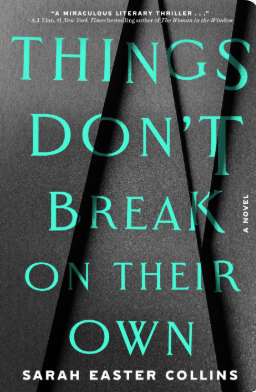
Although Things Don’t Break on Their Own is touted as a “miraculous literary thriller”, I think that’s doing Sarah Easter Collins’ debut a disservice. While the book is definitely literary and it’s definitely a page turner, I don’t think I would call it a “thriller”. But maybe that’s nitpicking and it really doesn’t matter.
Robyn and her wife, Cat, have invited some friends and family round for dinner. There’s Robyn’s older brother, Michael, and his girlfriend, Liv. There’s Nate, Cat’s brother, and his new girlfriend, Claudette, and then there’s Willa and her boyfriend, Jamie. Robyn and Willa have history; when they were 17 and in boarding school together they were roommates and then lovers, but it ended badly. That was years ago, now, though and the two women are friends. It wasn’t a particularly happy time for Willa. Her younger sister, Laika, disappeared when she was just 13 and nearly 22 years later, the family still doesn’t know what happened to her.
The story changes perspectives and doesn’t follow a straight line. As Robyn anticipates Willa’s arrival, she remembers the summer she took her back to Tea Mountain, the remote place she calls home. It is a transformative experience for Willa, whose own family is a dysfunctional mess. Robyn’s father is a potter, and as he repairs a broken bowl using the Japanese method of kintsugi, he assures Willa (without even knowing her all that well) that “You can fix anything, given the right tools.”
There is no fixing Willa’s fractured family though. Her father, Bryce, has a successful business, so money is not an issue, but he is a horrible and abusive bully, especially to Willa’s mother and Laika. In fact, Bryce never touched Willa, and perhaps some of her guilt stems from that. About Laika, Robyn says
I tried to keep her safe. I really did. I told her, keep your head down, don’t bring unnecessary attention to yourself, just do what you’re told, all the things that just came naturally to me. But I was so busy keeping her safe from herself that I forgot to warn her about the outside world. I should have told her that there were people out there, men, women even, who could harm her.
So much was my fault.
Robyn and Cat’s dinner party proves to be revelatory, but by the time you get to the “twist” (maybe that’s why they call this book a thriller), you’ll be so invested in these characters that –well, I don’t want to say it hardly matters, but it was honestly the least interesting part of the book.
I really enjoyed Things Don’t Break on Their Own. The writing was great, the characters were compelling, and the mystery surrounding Laika’s disappearance was intriguing. It’s a solid debut and I highly recommend it.
According to Merriam-Webster, crux is “a puzzling or difficult problem: an unsolved question; an essential point requiring resolution or resolving an outcome; a main or central feature”.
Gabriel Tallent’s novel, Crux, comes nine years after his debut, the much lauded My Absolute Darling. Crux landed on the top of my must read pile based on my love for his debut and now that I have read it, it cements Tallent’s place in my auto buy list. (I hope I won’t have to wait another nine years for is next book!)
For Tamma and Dan, seventeen-year-old besties, a crux is a metaphor for the difficulties and decisions they face in their everyday lives, but also the very real problems they encounter every time they head out into the Mojave to climb boulders.
These kids live next door to each other in the middle of nowhere. Their mothers, Alexandra and Kendra, used to be best friends until they had a falling out and now no longer speak. Alexandra wrote a best-selling novel when she was eighteen. She married Lawrence, a construction worker, and had Dan. Kendra is a diner waitress and, besides Tamma, is mother to Sierra (who has three kids of her own) and Colin. She lives with a dirtbag drug dealer ten years younger than her in a ratchety trailer. Neither Dan nor Tamma’s home lives are particular stellar. Dan and his father don’t really have much to say to each other; Alexandra barely comes out of her room. She had heart valve replacement surgery years ago, and the valve is now deteriorating. Although she did write a second novel, she’s been blocked ever since. Kendra is deplorable. Whether it’s the circumstances of her own life or she’s just an awful person, she is not kind to Tamma. On the rare occasions Tamma would be in Dan’s house, Dan would “catch Tamma eating orange peels. Chewing steak bones from the night before. She’d nab butter off the stick. […] “Dude,” he’d whisper, meaning, That bread is moldy, and “Dude,” she’d say back, meaning, Don’t worry, I scraped the mold off.”
Tamma and Dan spend as much time out in the desert as they can. They don’t have the right gear, but they climb anyway, spotting each other and egging each other on and challenging each other to climb more difficult rocks. “On the ground, Tamma was the clumsiest person he had ever met, but on the wall, she was breathtaking. […] Everyone he knew seemed to think Tamma was trash, but he thought she was some kind of genius.”
The teens have a dream, and that is to graduate from high school (although it is highly unlikely Tamma will graduate, Dan is a whipsmart scholar) and head to Indian Creek, “the last place on earth you can still dirtbag, the way the old-school climbers did.” The friends dream about perhaps going pro, making a living doing the thing that they love the best of all.
But life seems to have other plans for them.
Dan’s mother has a life-threatening medical issue. Tamma’s baby nephew, River, has a traumatic brain injury. Suddenly the pair find themselves having to reassess their lives and priorities. Their choices will have a profound impact on their lives.
Tamma couldn’t say that she’d never despair. All she could do was think, Not today. All her hope felt terribly insecure. And she could get to where she had this feeling of rage. I don’t want to be strong. I don’t want to have to try and find joy when it all feels so scary. And then she’d think: You can do this. You are a rad climber and people like you. You can show up every day and be an indomitable force for joy and hope and you can let everyone else fall apart without falling apart yourself.
Dan has his own struggles, but he knows that his parents “believed that it was possible for [him] to go out into the world and succeed. That belief was built into [his] worldview. No one had ever believed that about Tamma.”
Boulders aren’t the only things Tamma and Dan have to climb; life is going to shoot the motherlode of obstacles their way. How they ultimately handle these trials is what makes these characters people you want to root for. Their friendship is genuine and refreshing; their conversations often laugh-out-loud funny; their love and admiration for each other is real and beautiful.
There is a lot of climbing jargon in this book and that might not be to everyone’s taste. I don’t know a dang thing about climbing, but by the end of it I was invested in their pursuit of “sending” each climb they attempted. I loved Crux. It’s my first five star read of 2026.
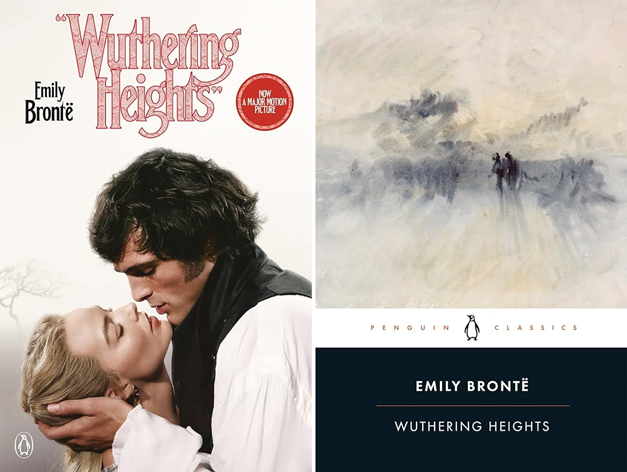
Just before my daughter and I went to see Emerald Fennell’s movie “Wuthering Heights”, I decided to re-read Emily Brontë’s one and only novel, Wuthering Heights. The novel was published in 1847, just one year before Emily, a reclusive spinster, died at the age of 30. Critic V.S. Pritchett said “There is no other novel in the English language like Wuthering Heights“. Indeed, the novel has endured for 179 years and, if nothing else, might expect an uptick in readers based on Fennell’s movie. New readers, however, are likely to be flummoxed.
I read Wuthering Heights for the first time when I was in high school, so 50 years ago. My memories of it going into this re-read were of Catherine and Heathcliff, tortured lovers on the moors of Yorkshire. I always credit this novel for setting up my romantic expectations/aspirations, which may explain why I have always been drawn to angsty love affairs: couples who love each other but can’t be together, or lovers who shouldn’t love each other but do, are totally my romantic jam. Probably also explains why I am single. My romantic expectations were skewed at an early age.
In my memory, Catherine and Heathcliff were passionately in love with each other, but he wasn’t the right guy for her socially; she needed to marry up the social ladder. Enter Edgar Linton. What I didn’t remember was that Catherine was dead by page 200 and for the rest of his miserable life, Heathcliff tries to ruin the lives of everyone around him including his son, Linton, and Catherine’s daughter, Cathy.
As a teenager, I saw Wuthering Heights as a tragic but ultimately romantic love story, but upon re-reading I discovered it’s slightly more complicated than that.
Catherine and Heathcliff’s story is told to Mr. Lockwood, a lodger at Thrushcross Grange, who falls ill and convalesces under the care of Ellen “Nelly” Dean, housekeeper at both Thrushcross and Wuthering Heights, Catherine Earnshaw’s family home. She tells Mr. Lockwood about how Mr. Earnshaw, in an act of benevolence, plucks Heathcliff from the streets and brings him back to Wuthering Heights, “a sullen, patient child; hardened, perhaps to ill-treatment”, ill-treatment which he further endures at the hands of Catherine’s older brother, Hindley, the most odious of characters.
Catherine takes an immediate shine to Heathcliff. “”She was much too fond of Heathcliff,” Nelly tells Mr. Lockwood. “”The greatest punishment we could invent for her was to keep her separate from him””. They pass their childhoods running wild on the heath.
Catherine has a willful streak and a fiery temper; she is no shrinking violet. In fact, even Mr. Earnshaw favoured Heathcliff over his own daughter “who was too mischievous and wayward for a favourite.”
Certainly, she had ways with her such as I never saw a child take up before; and she put all of us past our patience fifty times and oftener in a day: from the hour she came downstairs till the hour she went to bed, we had not a minute’s security that she wouldn’t be in mischief. Her spirits were always at high-water mark, her tongue always going–singing, laughing, and plaguing everybody who would not do the same. A wild, wicked slip she was–but she had the bonniest eye, the sweetest smile, and the lightest foot in the parish; and, after all, I believe she meant no harm.
When Edgar Linton asks Catherine to marry him, she tells Nelly “I’ve no more business to marry Edgar Linton than I have to be in heaven […] It would degrade me to marry Heathcliff now; so he shall never know how I love him: and that’s not because he’s handsome, Nelly, but because he’s more myself than I am. Whatever our souls are made of, his and mine are the same.”
So, she does marry Edgar and moves to the palatial Thrushcross Grange to live with him and his sister, Isabella. Heathcliff disappears and when he reappears, three years later, he is much changed.
He had grown a tall, athletic, well-formed man; beside whom my master seemed quite slender and youth-like. His upright carriage suggested the idea of his having been in the army. His countenance was much older in expression and decision of feature than Mr. Linton’s; it looked intelligent, and retained no marks of his former degradation. A half-civilized ferocity lurked yet in the depressed brows and eyes full of black fire, but it was subdued; and his manner was even dignified: quite divested of roughness, though too stern for grace.
His reappearance shakes up everyone. To Edgar Linton, Heathcliff was nothing more than “the gypsy–the ploughboy” but, well, we know what Catherine thought of him. Surely, this will not end well.
And, of course, it doesn’t.
The vitriol against Emerald Fennell’s adaptation of what she says is her favourite book of all time is both deserved and undeserved. “Wuthering Heights” is Wuthering Heights adjacent; it is not a faithful adaptation of the book. My daughter, who is 28, loved the movie. She sobbed for the last fifteen minutes. She has never read the book.
Fennell encountered the book when she was about 14, so a similar age to my first exposure. I think she saw something similar to what I saw when I first read it: a great love story. Her movie is fanfiction, really, because it imagines (in a kind of annoying music video montage), a lot more sex than exists in the novel. In fact, Heathcliff and Catherine are never physically intimate in the book. The on-screen sex is not graphic, despite one of my friends calling it “porny.” As an avid consumer of fanfiction back in the day, I know how graphic writers can be when describing what they ‘imagine’ happens when the source material fades to black–and truthfully, that’s what Fennell is doing here–but what we see on screen is pretty tame; nary a breast or a butt.
It also portrays Nelly as the villain of the piece; she deliberately coaxes from Catherine the confession that she can’t marry Heathcliff because he is beneath her when she knows that Heathcliff will hear, but he doesn’t hear when Catherine when says she loves him or see how tortured she is about the decision. Hindley doesn’t exist in this version. Isabella is played for laughs and as a submissive in a bizarre scene where she is chained up in Heathcliff’s house and barks like a dog.
Another criticism of the movie is the casting. Margot Robbie is 35; Catherine was 18 or 19 when she died in childbirth. Jacob Elordi is not by any stretch (and at 6’5″ there’s a lot of stretching to be done) a “dark-skinned gipsy”. But I didn’t care too much about that because both of these people can actually act and they are beautiful to look at and since the movie isn’t *really* Wuthering Heights, I was content to let the whole thing play out. Yes, I understand this is problematic whitewashing, but it was clear to me that Fennell was making a version, her 14-year-old wishful thinking version, of the book. For example, the actor who plays Edgar Linton is played by Shazad Latif, who is by no means the insipid Edgar I imagined. In the book he is described as light-skinned, blue-eyed, and slender. So, make of that what you will.
The whole movie is beautiful, really, but certainly not the Wuthering Heights of my teenage imagination. (In fact Wuthering Heights, the house, looked like it was made of plastic. It was weird.) The costumes, the landscape, the overall aesthetic was easy on the eyes. But the movie doesn’t demand anything of you beyond your belief that Heathcliff and Catherine love each other. That’s what I believed at 15.
Maybe now I think their relationship is more obsessive, complicated, and toxic, but I will not deny that I still find the tale hopelessly romantic even though Catherine and Heathcliff are not especially likeable and are certainly, on occasion, horrible to each other and others. The movie doesn’t portray anything beyond Catherine’s death, but the book still has 200 pages to go after she dies and in those pages we see Heathcliff destroy everything in his path. Does he do it because of grief? Eighteen years after her death, he admits to Nelly that he bribed a sexton to open her coffin, and when he saw her face again “it was hers yet.”
…she has disturbed me, night and day, through eighteen years–incessantly–remorselessly. […] I felt Cathy was there: not under me, but on the earth. A sudden sense of relief flowed from my heart through every limb. I relinquished my labour of agony, and turned consoled at once: it remained while I refilled the grave, and led me home.
Emily Brontë’s novel is a masterpiece of mood, passion, and tension. In her introduction to the Modern Library edition of the novel, Diane Johnson writes: “In their rage and frustration at the impediments that society and conventional morality impose on them, preventing the perfect expression of the erotic life force they embody, the two lovers symbolize the ultimate tragedy of man’s earthly condition.”
Emerald Fennell’s movie is Wuthering Heights for the TikTok generation. I enjoyed watching it, but I enjoyed my re-read far more.
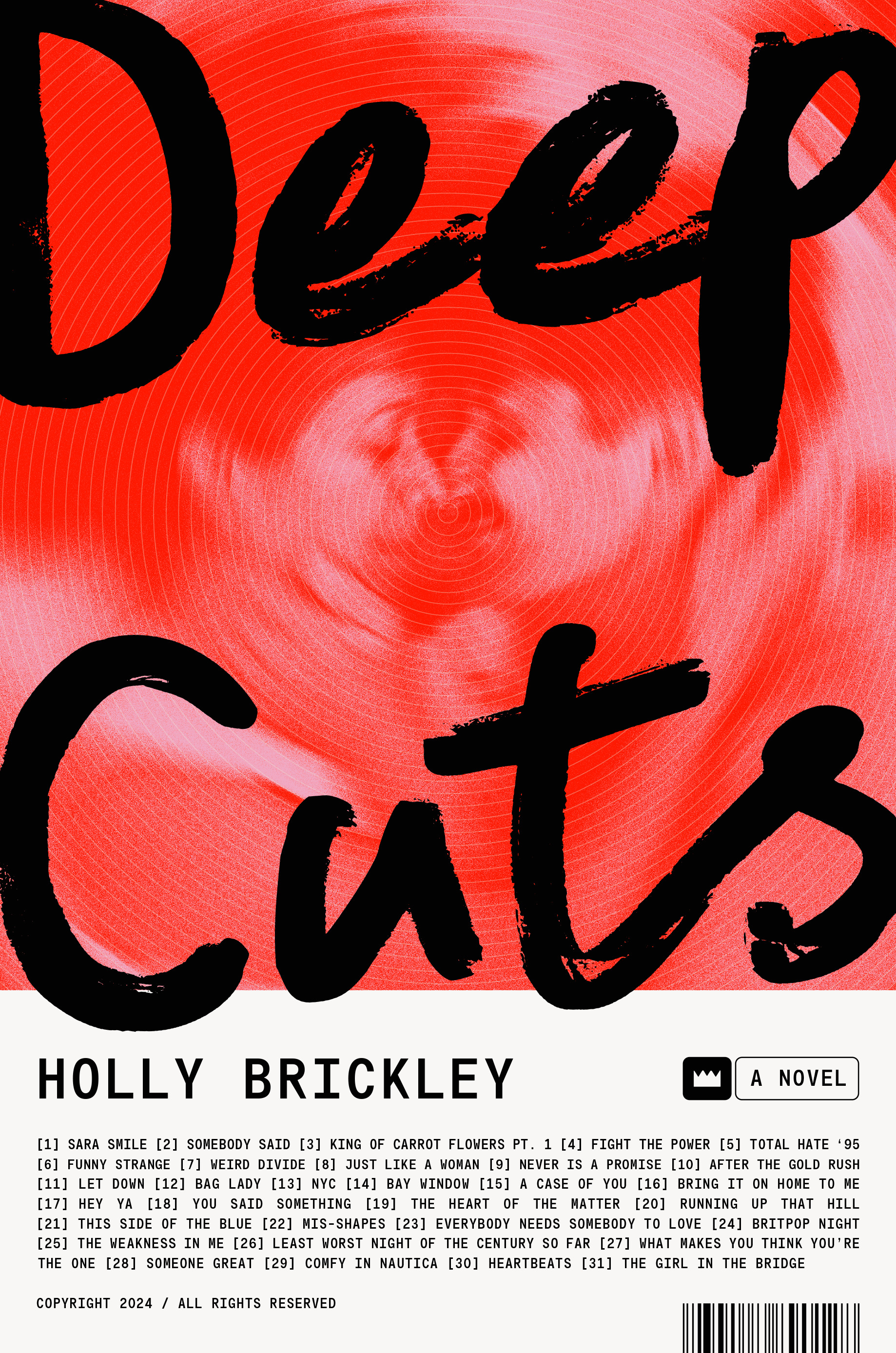
I think your enjoyment of Holly Brickley’s debut novel Deep Cuts will very much depend on how much you love music…and not just in a casual way but in an all-consuming, possessive, nerdy way.
Percy and Joe meet at a campus bar in Berkeley in 2000. They are both students and peripherally known to each other “in that vague way you can know people in college, without ever having been introduced or had a conversation.”
Then “Sara Smile” comes on while they are both waiting for drinks and it kicks off a conversation about the difference between a perfect track and a perfect song. Apparently, there is a difference. Percy explains:
“A perfect song has stronger bones. Lyrics. Chords. Melody. It can be played differently, produced differently, and it will almost always be great. Take ‘Both Sides, Now,’ if you’ll excuse me being a girl in a bar talking about Joni Mitchell–any singer who doesn’t suck can cover that song and you’ll be drowning in goosebumps, right?
[…]
“Now, ‘Sara Smile’–can you imagine anyone besides Daryl Hall singing this, exactly as he sang it on this particular day?”
Joe is an aspiring musician and Percy a writer and their meet cute morphs into a decade long will they/won’t they, should they/shouldn’t they relationship. Joe has a girlfriend, Zoe, “a tasteful punk”. Joe describes their relationship to Percy as “a perfect track [because you] need the context–family, friends, our hometown.” Soon, the three are hanging out together, although it’s clear that Percy has a thing for Joe.
Joe asks for Percy’s advice about some of his music and Percy is nothing if she isn’t honest. She tells him his song “is over-written [and] kind of forced” but that his singing is “magical.” Joe comes to depend on this honesty as he starts to chase a professional musical career.
When Zoe and Joe break up and Zoe gives Percy her blessing to make her move, things are further complicated because Joe, it seems, doesn’t want to mess up this musical partnership the two have going. Thus the will they/won’t they. Their lives pull them in different directions after college, but they are besties (without the benefits) until one night at a wedding when they suddenly aren’t.
I enjoyed Deep Cuts well enough. I did find all the song references tedious, but that didn’t stop me from making a playlist. I found Joe and Percy sort of tedious, too, but only in that way many kids in their 20s are – especially as seen from the viewpoint of someone in their 60s. I suspect that had I read this book in my 20s, I would have enjoyed it a lot more. That is not to say that I didn’t enjoy this. I loved the angst; I enjoyed some of the secondary characters. The dialogue felt authentic and so did the 20-something navel gazing.
Life itself provides some deep cuts of its own. Mistakes are made. Feelings are hurt. Friendships ebb and flow. By the end of the book I was trying to decide if Percy and Joe actually should or shouldn’t be together. They hurt each other, but they love each other, too. Like any great song, they are a sum of all their parts.
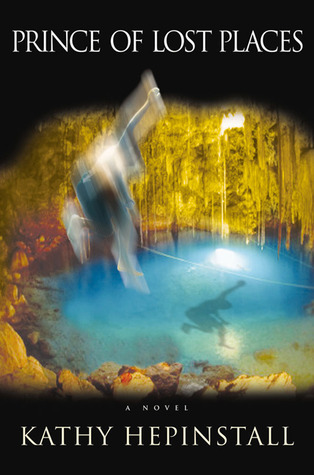
Prince of Lost Places is my second book by this author; the first book I read by her was The House of Gentle Men over 15 years ago. Yikes. This book has been languishing on my bookshelf for ages. (Trust me, it’s not an outlier, buying more books than I could ever possibly read is a thing.)
Martha Warden has kidnapped her six-year-old son, Duncan. She has her reasons. Her husband, David, tells the detective he’s hired to find her that “She’s sick. […] Her mind has left her. She is in no condition to be wandering around somewhere.”
Martha takes Duncan to a cave someone told her about. It’s on the Rio Grande, isolated, and although Duncan misses his father, the two sort of settle into a life in the wild. Martha has planned well, packing as many of the necessities as she could manage and setting her car on fire in the desert before she and Duncan set off in a rubber raft down the river.
We know something has happened, but Martha is slow to reveal exactly what that something is. Early on she tells us about Duncan’s friend, Linda, and then she tells us that “Linda has been dead for nearly three weeks.” Is Duncan responsible for her death? David? Why have they run away?
Then Andrew arrives on the scene.
The man I saw was tall and lanky, wearing tattered, faded jeans, desert boots and a T-shirt with a plaid shirt thrown over it. A knapsack was strapped to his back. He had a narrow, friendly face and tousled light hair, and as he knelt down he paused to scratch at a full beard.
Who is this man? He claims that he, too, is trying to figure some things out and while Martha doesn’t trust him at first, he turns out to be a good listener. Soon, they become a trio.
Prince of Lost Places is a quiet and thoughtful book about motherhood, love, guilt and grief. I suppose some people will be unhappy with the end, but I thought it was terrific.
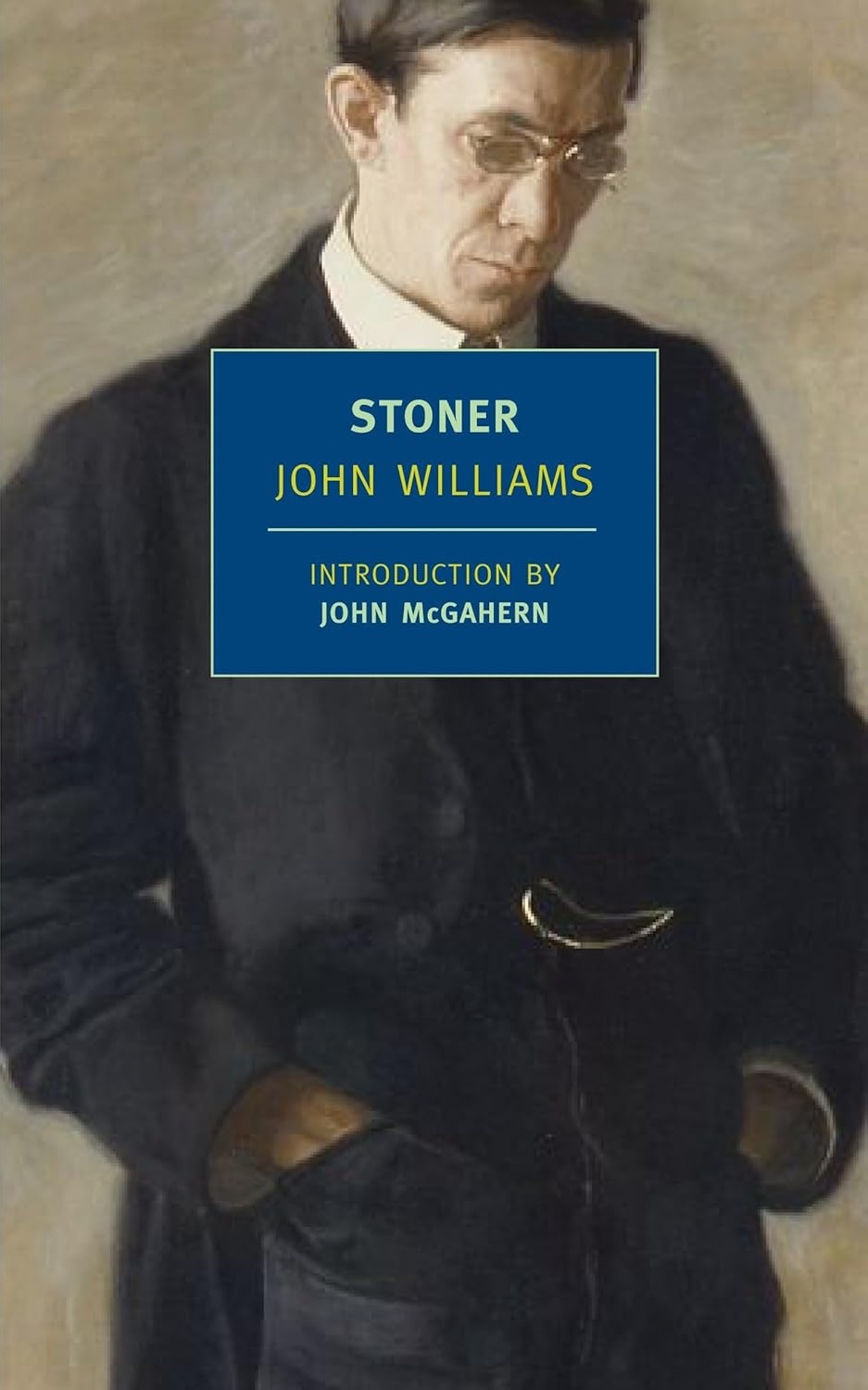
John Williams’ 1965 novel Stoner probably would not have been on my reading radar without booktube. It seemed as though many young readers (people in their 20s and 30s – and yes, those are young people to me now) were reading it and talking about it and so I added it to my physical tbr pile, figuring that I would get to it eventually.
Back in November when my friend (and former student) Luke and his wife, Lauren, were making their plans to come home for a visit over the holidays, they suggested a book club of three. Whenever we see each other, we always spend a lot of time talking about books and so this seemed like a good idea. I perused my shelves and suggested five titles, Stoner among them, and so that is where we landed.
Stoner is the story of William Stoner, son of impoverished Missouri farmers, who goes off to college ostensibly to take an agriculture degree, but who ends up taking a different path altogether. When the professor, Sloan, reads a sonnet and says “Mr. Shakespeare speaks to you across three hundred years, Mr. Stoner; do you hear him?”, Stoner falls in love. I also fell in love… with this book.
The novel follows Stoner through his undergraduate degree, his post graduate work, his early marriage to Edith, academic politics, the birth of his daughter, his affair. Williams doesn’t spend an inordinate amount of time at any of these road stops in Stoner’s life and yet somehow we come to know him very well.
Anybody who loves literature would find touchstones in this book and, indeed, in Stoner’s own life.
Sometimes, immersed in his books, there would come to him an awareness of all that he did not know, of all that he had not read; and the serenity for which he labored was shattered as he realized the little time he had in life to read so much, to learn what he had to know.
Luke, Lauren, and I could all relate to the feeling of anxiety at how little we will actually be able to read over the course of our lives, and Williams managed to capture that exact feeling. I think Luke and Lauren read far more deeply that I ever did at their age. (Luke is enrolled in a PhD of Philosophy and is currently reading Proust; Lauren is a research scientist at Harvard, about to start her own PhD. You might wonder what they are doing giving up precious family time to hang out with me; I wonder the same thing myself. :-)) Even if I have read upwards of 2000 books over the course of my life, lots of them were crap.
I also had another point of intersection with Stoner, and that was his feelings about teaching.
Always, from the time he had fumbled through his first classes of freshman English, he had been aware of the gulf that lay between what he felt for his subject and what he delivered in the classroom.
Sometimes Stoner feels like he is doing a great job and sometimes he feels like everything he does is crap and that is a feeling I have experienced over the course of my career. Of course, he is teaching at university and I am a high school teacher, so there’s that.
We had quite a lively discussion about Edith’s role in Stoner’s life, too. Lauren was a lot more sympathetic about her; Luke and I hated her. She never seemed like the right person for Stoner, and she did a lot of damage to his relationship with his daughter. It was hard to see anything positive about her at all. Did she redeem herself at all in the end? Not in my opinion.
Stoner is a book that gets you thinking about so many things, ‘what makes a life?’ chief among them. In the end, all three of us agreed that it was a fantastic book and a made for a great first book club of three discussion.
I started reading Emma Donoghue’s 2008 novel The Sealed Letter at the start of September, in anticipation of our book club discussion on Sept 25. I figured it would take me a while because of the many pages (close to 400) and tiny font, so I wanted to leave myself a lot of time. I barely finished in time – and not because of either of the aforementioned reasons. I couldn’t read more than three or four page before I nodded off.
Emily “Fido” Faithfull is a business woman in 1860s London. She runs a printing press where she gives young woman an opportunity to make their own money. True, she hasn’t had any luck in love and is, at 29, a spinster, but she is a woman of independent means.
When the novel opens, she runs into Helen Codrington, a slightly older woman with whom she was once friends. Their friendship lost its way due to miscommunication, but now Helen and her husband, a ranking officer in the navy, are back in London and the two women begin to see each other again.
It isn’t long, though, before Fido is drawn into Helen’s extra-marital intrigue and I would like to say that that speeds things up, but it doesn’t. When Helen’s husband, Harry, a stiff older man, gets wind of his wife’s shenanigans and decides to leave her, Fido suddenly finds herself pulled into a court case (because divorces were settled in court with a jury and witnesses etc) which upends the life she had created for herself.
I would have definitely abandoned this book if it hadn’t been for the fact that it was a book club pick and I hate not finishing those. Although the writing was fine (although not really my cup of tea), I didn’t like Fido or Helen. I really could not have cared less about how things were all going to work out. For someone so smart, Fido sure was blinded by her affection for Helen who was manipulative and duplicitous.
The “sealed letter” of the title comes to play only near the end and is ultimately a disappointment. And while it’s alluded to throughout the novel (and the LAMBDA winning status is on full display), that aspect of the novel feels like a plot point.
If you’re looking for a historical page-turner, I recommend Fingersmith. This one is a no from me.
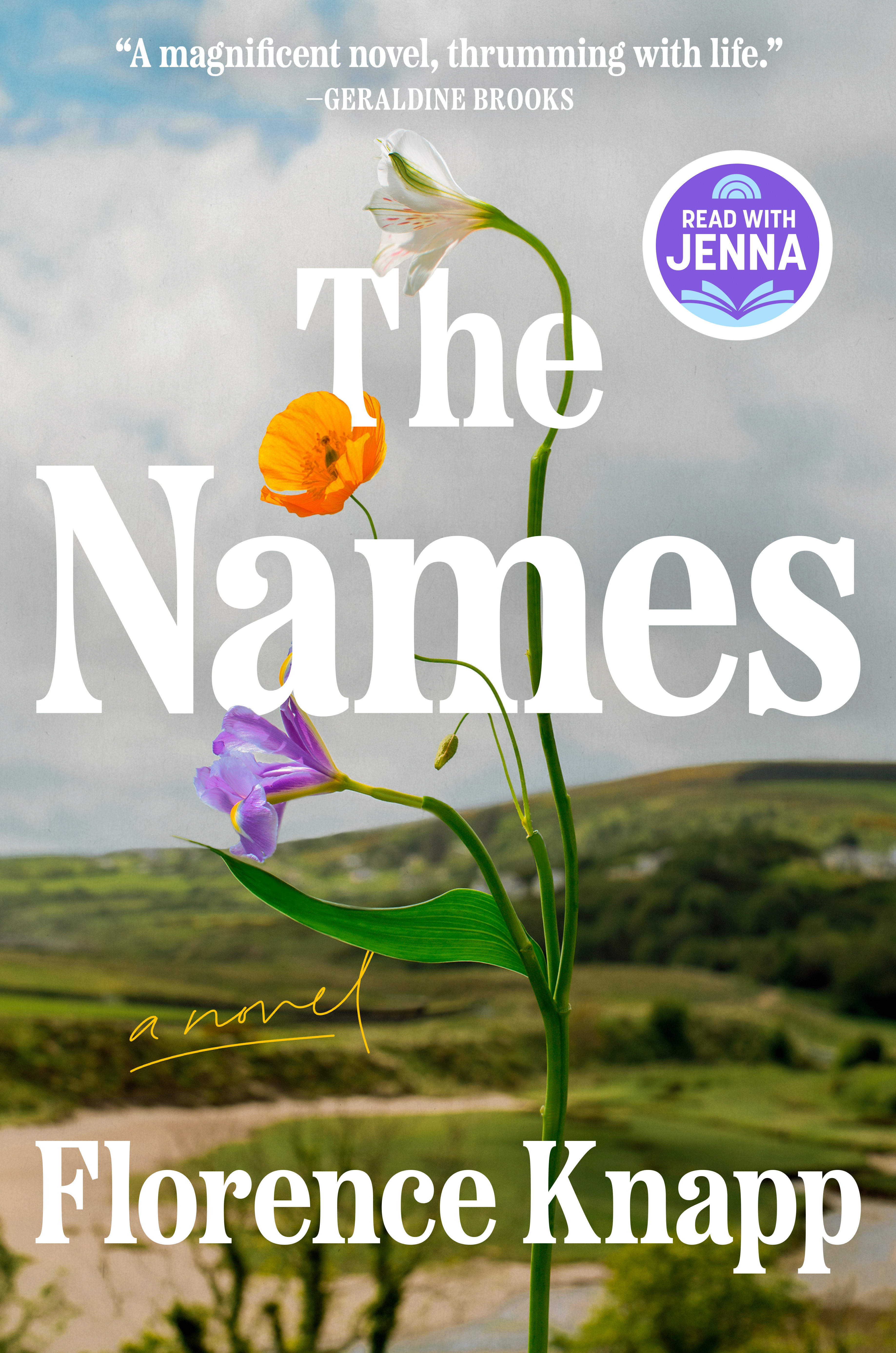
Cora has never liked the name Gordon. The way it starts with a splintering sound that makes her think of cracked boiled sweets, and then ends with a thud like someone slamming down a sportsbag. Gordon. Bu what disturbs her more is that she must now pour the goodness of her son into its mold, hoping he’ll be strong enough to find his own shape within it.
This is Cora’s dilemma after the birth of her second child. She doesn’t want to name the baby after his father, a prominent, beloved doctor who is also a physically and mentally abusive husband. So, on the day that Cora and her daughter Maia, 9, walk to the registry office to officially register the baby’s name, they imagine other names instead of Gordon. Maia is fond of Bear because “It sounds all soft and cuddling and kind.” Cora is partial to Julian, which means “sky father.”
Florence Knapp’s novel The Names imagines the lives of these characters if the baby had been named Bear, Julian or Gordon – skipping forward at seven year intervals for thirty-five years. Who dos this little boy become and how does his name affect the people in his life?
I loved everything about this book, honestly. Although the author has written books previously, The Names is her debut novel and it’s a corker. I loved the glimpses into Bear/Julian/Gordon’s life, loved seeing what things were similar in each iteration an what things were vastly different.
But the novel is not just concerned with his life. We are also privy to Cora’s story, her early courtship with Gordon, her upbringing in Ireland, and what becomes of her in each of these scenarios. Maia, too, gets her story.
What’s in a name? Turns out, quite a lot. Highly recommended.
It’s hard to ignore the similarities between Daniel Clay’s 2008 debut, Broken, and Harper Lee’s 1961 Pulitzer winner To Kill a Mockingbird. For example, in Clay’s novel, the residents of a small suburb in the south of England, Hedge End, are people like single-father solicitor, Archie, and his children, Jed and Skunk (aka Atticus Finch and his children, Jem and Scout). Across the square lives single dad Bob Oswald (Bob Ewell), an unemployed thug whose council house backs onto a dump. Rick Buckley (Boo Radley), a shy awkward 19-year-old disappears into his house one day and is never seen again. Then there’s Dillon (Dill), a gypsy, who briefly enters Skunk’s life.
In the notes at the back of Broken Clay says “I don’t think my characters and plot resemble To Kill a Mockingbird [but] I really can’t stress enough that I would never have sat down to write Broken had I not read To Kill a Mockingbird.”
I am not sure I totally agree with Clay’s assertion that his plot and characters don’t resemble Lee’s. It was pretty obvious to me even before I read the notes at the back of the book. Even the structure is similar; the book begins with something horrible having happened to one of the characters and then circles back around to that event, filling in all the details. But plot structure and character similarities aside, Broken more than holds its own.
Skunk and Jed have an okay life with their father. Skunk is a keen observer of the people around her. She watches on the day that 19-year-old gets beaten by Bob Oswald because one of Bob’s daughters told him that Rick had raped her. Rick is never quite right after that and earns the nickname “Broken.” Of course, he is not the only broken character in the book. The Oswalds are broken, too. The other children in the neigbourhood live in fear of the older Oswald girls who steal lunch money and threaten physical violence if their victims don’t comply. Skunk’s teacher, the handsome Mr. Jeffries, is Skunk’s live-in babysitter Cerys’s former boyfriend. Skunk is pretty sure he’s the smartest person on the planet and if nothing else, he makes learning interesting. Then he runs afoul of Bob Oswald, too.
Broken is really about how all these characters’ lives intersect in ways that are often humourous, but also devastating. The writing is fresh and evocative. It is hard not to fall in love with some of them and easy to loathe others. While I wasn’t a huge fan of the ending, I really enjoyed my time in Hedge End.
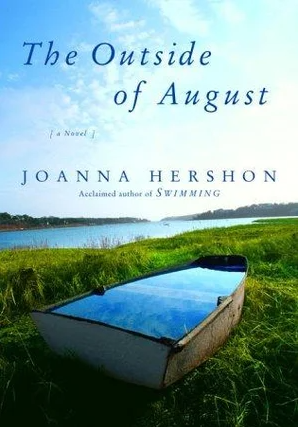
Plucked from my TBR shelf, Joanna Hershon’s 2003 novel The Outside of August concerns siblings Alice and August and their fraught relationship with their seemingly free-spirited mother, Charlotte. The story starts when Alice is a kid, Gus a couple years older. Alice spends all her time waiting for her mother to come home, or if she is home, to acknowledge her in any way.
Alice was ten years old and she still couldn’t figure out what her mother did with her days. Charlotte hadn’t gone anywhere since mid-January, when she’d left for a month while the children were at school, having said good-bye only in passing, as they were headed out the door.
The novel propels us through the siblings’ adolescence until an event separates them, only bringing them back together many years later before separating them again. Alice feels that Gus knows something that he isn’t telling her, and after a late-night call from his wife, Cady, Alice hops a plane and heads to Mexico where Gus is squatting and surfing.
Sadly, I do not have unlimited shelf space, so when I finish a book I have to make the decision of where to house it. Will it go on my finished shelf or will I give it away? It used to be that I gave nothing away – even the books I didn’t really like. Even books that don’t really float my boat have something to offer, and if I actually finish it then that’s something, right? I am way better at DNFing now than I used to be. That might have something to do with the mountain of books in my physical tbr pile.
I didn’t actively dislike The Outside of August. I thought a lot of the writing was really lovely, but I also thought that the story was slow and meandering and when Alice arrived in Mexico the narrative felt disjointed and feverish – although maybe that was the point. The “secret” Alice felt August was keeping from her was revealed via a letter from their mother and it felt a little bit like a cheat – also unexamined, really, by either sibling. I know, life sometimes happens that way, but I didn’t feel emotionally satisfied when I finally finished my time with these characters.



 The Ludic Reader