
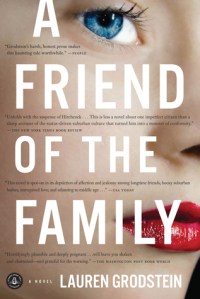
 The Washington Post named Lauren Grodstein’s novel A Friend of the Familyone of the best books of 2009. In fact, just about every major media outlet lauded this tale of Dr. Pete Dizinoff who lives in suburban New Jersey with his wife, Elaine and their son, Alec.
Dr. Pete tells his story– and I have to admit that it wasn’t at all the story I thought he was going to tell– from some point in the future. If people ask him how he’s doing these days his reply is “Listen, life goes on. And I’m not just feeding them formula, pap. Life really does go on. That’s what I’ve learned. It goes. You’d be surprised.”
Dr. Pete’s life is pretty perfect, although he is certainly not immune to life’s trials and tribulations. He loves his wife. He adores and is frustrated by his son in equal measure, especially since Alec recently dropped out of college “after three semesters and almost sixty thousand dollars of tuition, books, board, and other proofs of parental esteem.” Now Alec is living at home and creating art in the studio his parents have built above the garage. Well, that’s not exactly true, since the studio above the garage is where Dr. Pete is currently sleeping. The reasons for this are alluded to but never really revealed until much later in the book.
Pete and Elaine’s best friends Joe (also a doctor) and Iris live in the same neighbourhood, and the two families spend lots of time together. In the past, their close bond is tested when Joe and Iris’s daughter, Laura, commits a horrible crime, and when Laura reappears many years later the residual feelings of horror colour Pete’s feelings towards her.
I hadn’t seen her since the week they took her to Gateway House thirteen years ago, and Christ, the girl had changed in a million beautiful ways. Back then she had been hollow-eyed, eviscerated by the trial and the confinement and everything that had preceded it. A criminal, a teenager, depressed and hidden in oversized shirts. But now-
For Pete, Laura’s arrival back in their lives reminds him of the latent feelings he has for her mother and also draws his son further away from him. A Friend of the Family is a domestic drama at its finest: well-written, fraught with tension and, ultimately, devastating.
 and have watched straight through on more than one occasion.) Still, Natalie Bloom’s story resonated on so many levels for me. It shot me straight back to my university days; not the rose-coloured view I have now, but the awkward, muddled, feeling-my-way experiences I actually lived.
 I was invested in Jacob McNeely, the narrator of David Joy’s novel Where All Light Tends to Go, by the end of the first chapter. The eighteen-year-old high school drop out has climbed to the top of the water tower to smoke a joint and watch what should have been his graduating class leave the school. From his perch, he can see Maggie, the girl he has loved for as long as he can remember.
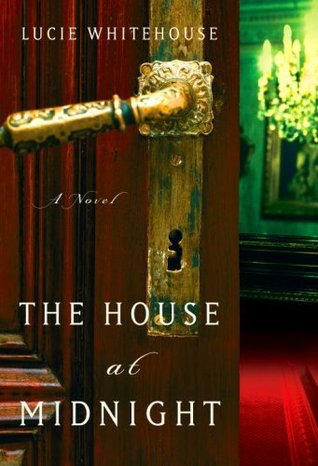 Lucie Whitehouse’s debut novel The House at Midnight tells the story of Joanna and her close-knit circle of friends who spend weekends at Stoneborough Manor in Oxfordshire. Her dearest friend, Lucas, has recently inherited Stoneborough from his Uncle Patrick, a well-known art dealer. On their first visit there, Joanna observes that the house is “Three storeys high, [and] it reared up out of the night as if it were facing the darkness down.” The house gives Joanna a “pang of anxiety.” She wonders “How could it not change things between us.”
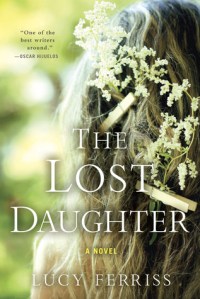 figure out whether I liked it — not the book, exactly, the whole family drama thing. Am I really interested in life’s ups and downs? Do I care about people’s children and marriages? Well, if every book was as good as this one, the answer would be yes.
 Nico is just thirteen when her seventeen-year-old sister Margaret drowns. Nico tells us “We lived on the shore of Mirror Lake, and for many years our lives were as calm and transparent as its waters.” Margaret is the poet in the family, the beautiful daughter about to graduate from high school and head off to study music. She was named for Gerard Manley Hopkins’ poem “Spring and Fall: To a Young Child.”
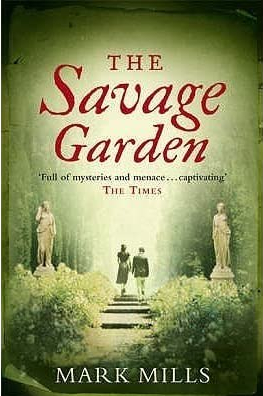 It’s 1958 and 22-year-old British student Adam Strickland has been given the opportunity to study a Renaissance garden at the Villa Docci in Tuscany. Of course, he jumps at the chance. Signora Docci will soon be leaving her home in the care of her son, Maurizio, but until she goes she knows the garden has some secrets to give up.
 And then there’s The Roanoke Girlsby Amy Engel. Can’t remember when I bought it or how long it’s been languishing on my tbr shelf, but I started reading it and finished reading it in just a few hours because it has ALL THE THINGS I love in a book. (Lots of other reviewers loved all the things, too, because this book received lots of well-
 novel
novel 
