After You – Julie Buxbaum

Do we really know the people we love?

Ellie Lerner’s already problematic life is turned upside down when her best friend, Lucy, is murdered while walking her daughter, Sophie, to school. Ellie flies to London to be with Lucy’s husband, Greg, and daughter, leaving behind her own husband, Phillip.

As Ellie settles into life with Greg and Sophie, she pushes her own problems further away. And it is clear from the beginning that she has problems. When, after the funeral, Phillip suggests that she come home, Ellie replies:

” They need me here.”

“I need you here,” he says, but we both know he is pretending.

After You is a story about friendship – a long complex friendship between women who have known each other virtually their whole lives. The novel tells the story of Lucy and Ellie in anecdotes Ellie recalls during her time in London.

When you meet someone at the age of four, tumbling and doing the “downward doggie” in Mommy & Me yoga, and their house is just two blocks away and they make you laugh for over three decades, starting their first day when she stuck out her tongue and made stupid faces behind the yoga teacher’s back, a friendship is inevitable. Maybe even fated.

But as Ellie settles into her life in London, she begins to realize that she didn’t know everything about Lucy. In many ways, Ellie is closed off to possibilities. Instead of dealing with her marital problems and the issues that precipitated them, she decides that she will stay in London where she is needed and wanted. As a way of helping Sophie cope, Ellie starts to read her Frances Hodgson Burnett’s magical book The Secret Garden. Burnett’s book, if you’ve never had the pleasure of reading it, is a book about grief and renewal. As they read, Ellie and Sophie book begin the process of letting go of their pain.

Buxbaum’s novel tackles some  big questions: what do you do when you’ve been betrayed? how do you move on? how do you forgive? is it really possible to have a second chance at love? I think she does an admirable job in After You. Ellie is a likeable character; in fact there are no bad guys here – just people, doing their best to live their lives, however imperfectly.

One Night – Margaret Wild

The parties were Bram’s idea-

calculated,

sophisticated,

daring.

For a long time

they were the best-kept secret

in the city.

They ended one night

when Al nearly killed Raphael.


Margaret Wild isn’t the first writer to pen a novel written in poems, but One Night is the first poetic novel  ever read. One Night tells the story of three friends, Gabe (the beautiful one), Al (the wild partier) and Bram (the planner).  They’re in their last year of high school somewhere in Australia. Their personalities are revealed slowly, little snapshots that illuminate them, make them more than what they seem on the surface. Bram, for example “catches two buses to school,/ and never brings friends home.”  Al wears a coat summer and winter because “without it he would be/ a snail without it’s shell-/soft/exposed/defenseless.”

Into the boys’ world comes Helen. She has a damaged face and a dazzling smile. Just one night and one of the boy’s lives is forever changed.

One Night only took a couple hours to read, but that doesn’t mean that Wild’s novel is lightweight.  These characters are fully realized. In just a few short lines, Wild had me feeling tremendous sympathy for Bram, a character who appears to be – on the surface at least – all hard edges. One Night captures the daring sense of ‘anything goes’ shared by many young people; the notion that actions have no real consequences. In Helen, we have a character willing to make sacrifices and decisions far beyond her years.

One Night is also about family. It isn’t only biology that binds us; sometimes we choose our families out of need and circumstances and sometimes these families serve us better than those we came by naturally.

One Night is a terrific novel – timely and beautifully witten.

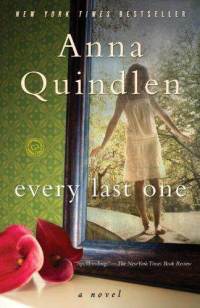
Every Last One – Anna Quindlen

Sometimes I feel as though the entire point of a woman’s life is to fall in love with people who will leave her. The only variation I can see is the ones who fight the love, and the ones who fight the leaving.  It’s too late for me to be the first, and I’m trying not to be the second.

Anna Quindlen’s 6th novel Every Last One is  filled with the quiet detritus of every day life.

“This is my life: the alarm goes off  at five-thirty…” thinks Mary Beth Latham, the novel’s narrator. Wife to Glen, mother to daughter Ruby, 17, and twins Max and Alex, 14, Mary Beth spends her days spinning the every day plates that keep families in motion and trying to carve out a little time for herself, something to remind her that she is more than just a wife and mother.

Mary Beth loves her family, but she doesn’t gloss over the difficulties of raising kids or trying to keep a marriage afloat. Ruby, an aspiring writer,  is just about ready to leave home. The twins are as different as night and day and as Mary Beth finds herself focusing more and more on Max’s moodiness, she fails to acknowledge that Ruby’s ex-boyfriend, Kiernan, is trying too desperately to win Ruby back.

Quindlen does a masterful job of leading the reader towards a climax that – even if you see it coming – shocks the hell out of you. It’s her careful layering of life’s little details – the slights, the carelessness, the mistakes we make, family dinners, blow-ups and meltdowns, reconciliations – that add power to the book. Mary Beth isn’t a saint.  And just like the rest of us, she’s forced to put one foot in front of the other and keep on walking, even when it doesn’t seem possible to take another step.

Anna Quindlen has the distinction of being the first author my book club ever read twelve years ago. We read Black and Blue for our first ever meeting and despite the subject matter (domestic abuse), we all really enjoyed it. A few years ago we read Rise and Shine, but I have to say I didn’t enjoy that one at all. Every Last One, while often difficult to read, confirms what I always thought about Quindlen’s talents though. It’s definitely worth a read.


What Love Mean to You People – NancyKay Shapiro

I started to read NancyKay Shapiro’s debut novel a couple years ago, got about 40 pages in and put it aside. I’m not really sure why I stopped, I just wasn’t groovin’ to the story. And I desperately wanted to like it. See, NancyKay Shapiro was something of a Big Fandom Name back in my days in a certain fandom (which shall not be named so I don’t out her). She wrote a different pairing than I did and I didn’t always agree with her characterization, but there was no question that she could turn a phrase.

In a way, What Love Means to You People is sort of like reading her fanfiction. The writing is smart and often quite beautiful, but I had serious problems with the characterizations of her three main characters: Jim, a widowed gay man in his early 40s; Seth, Jim’s new beautiful, troubled, much younger lover and Cassie, Seth’s sister who shows up and causes all sorts of trouble for the men.

Jim is a rich advertising guy. He’s been single ever since the love of his life, Zak, died. One day, he meets Seth McKenna:

Rippled nose with a slender ring in one nostril. Cheekbones and a clean jaw. Shorty bleached hair in trailing bangs, pointy sideburns. Silver rings climbing one earlobe, small, smaller, smallest. An appealing athletic body, too, in white chinos and a tank shirt. Quite nice, despite the trivializing modifications.

Jim is smitten. They have dinner. Seth tells a lie. Or two. Seth, it seems, has a past from which he has tried desperately to distance himself. It looks like none of it will matter, until his younger sister, Cassie, shows up with her small-minded attitudes about gay men and the key that opens the door to Seth’s past.

There are lots of plot twists, relationships fractured and pieced back together. Lots of graphic gay sex, too, if that’s your thing. I think Shapiro was aiming for a story that examines families, and how sometimes the ones we choose are better than the ones biology gives us but, ultimately, for me, What Love Means to You People wasn’t really much more than a well-written soap opera, complete with stock characters and a neatly tied bow of an ending.

AngelMonster – Veronica Bennett

Veronica Bennett reimagines the life of Mary Shelley, author of the novel Frankenstein, in her novel AngelMonster. It is 1814 and Mary is a smart but dreamy 16 year old. She and her sister, Jane, often imagine finding true love with a poet because  as Mary remarks, “a poet is the only acceptable sort of lover these days.”

Jane and I had often discussed the possibility of falling in love with a poet. If poetry was any measure of a man, we had observed, everything we longed for in a lover – romance, desire, spirit, soul – was clearly contained in it.

Into Mary’s life (well, her father’s bookshop) walks Percy Shelley. Not yet the super-star poet he was to become he is nevertheless known as someone to watch and certainly meets Mary’s criteria for a lover. And lovers they become, even though Shelley is already (at the tender age of 20) married with children.

AngelMonster is a thoroughly modern tale. It’s kind of like reading a memoir from a current celebrity. It drops names ( Lord Byron and Polidori are companions of Shelley’s) and is full of dalliances and intrigues and twisted love triangles. Young readers, especially those who dismiss poetry and classic fiction as boring, might be intrigued by the flesh and blood people who actually lived and wrote these works that have endured.

Mary herself is an interesting character.  Her mother, Mary Wollstonecraft, was one of the first feminists and author of A Vindication of the Rights of Women. (Wollstonecraft died a few days after Mary was born.)  Her father  was the writer and political journalist,  William Godwin. Mary herself is clearly intelligent, but youth makes her romantic and dreamy. Still, she wrote Frankenstein when she was just 21. As Bennett writes her, she is young but determined. Her affair with Percy is ill-advised, but she loves him and sticks with him even when he doesn’t deserve it. She is a thoroughly modern creation.

I think AngelMonster would be a great companion to a  young adult’s study  of the works of Byron,  and both Percy and Mary Shelley.

One Day – David Nicholls

One Day was the first book of our book club’s 2011-12 reading season (and our 12th year together!) After last year’s (mostly) snooze-a-palooza, it was terrific to come back to some current fiction. One Day comes with a little bit of hype, but I think it totally delivers on its promise.

Emma and Dexter  meet on the eve of their graduation from the University of Edinburgh in 1988. Although Emma has admired Dex from afar, this is their first real encounter and she is totally smitten. Although they come from different worlds (Emma is working class and Dexter comes from money) their one (unconsummated) night begins a friendship that we see in snapshots over twenty years. The beauty of Nicholl’s novel is that we revisit Dex and Emma on the same day, July 15th, and sometimes threads of their lives are left dangling.

In the beginning, both Emma and Dexter suffer from post-college malaise. What are we going to do with our lives? Dexter travels and Emma writes him long letters. He falls into a plum job in TV production. Emma works at a crappy tex-mex restaurant, then becomes a teacher. Through it all they prop each other up and tear each other down in the manner of friends who might be more if only they could get their act together.

This is one of the things Nicholls handles so beautifully in this novel. He juggles their lives – their various liaisons and miscommunications- with such finesse. Even when Dexter is acting like a complete prat we see exactly what Emma sees in him. When Emma is perhaps too serious, we just want to shake her. They are beautifully realized characters, flawed and heartbreakingly fragile.

But Nicholls has even more in store for the reader. The book’s denouement adds a layer of richness to the story, bringing us full circle and allowing the reader to consider the infinite possibilities inherent in just one meeting. Oh, the difference a day makes.

I loved this book.

The Housekeeper – Melanie Wallace

Melanie Wallace’s novel, The Housekeeper, was longlisted for The Orange Prize. For about the first 100 pages, I couldn’t figure out why. The story itself – if the synopsis is to be believed – sounded intriguing: When Jamie Hall finds a boy tied to a tree and cuts him loose, she can have no idea of the desperate chain of events her act of humanity will trigger.

Jamie is 17. When her mother dies of cancer, she leaves home with her dog and heads for Dyers Corner – the only place she has any connection to; a place her grandmother, while alive, lived. She has nothing and she seems to want nothing. She falls into a strange relationship with Damon, a married man who eventually returns to his pregnant wife. She becomes housekeeper for an elderly photographer, Margaret. Galen, a trapper, pines for her. It is winter and the stark landscape adds to Jamie’s isolation.

The boy Jamie cuts loose is wrong. “He thought of nothing in words and so gave no thought to those things he saw before him…” Jamie’s act of kindness begins a series of violent acts that culminate in a tragedy that seemed inevitable, but still left my mouth hanging open.

It took me a while to warm up to Wallace’s story and the way it was written, but once I fell into its rhythms, I loved Jamie. She is a smart and resilient character who seems to accept her lot in life without complaint. But her life is grim. And so is Wallace’s story. Spring never comes for these characters, even those who deserve it most.

Body Surfing – Anita Shreve

I have been an Anita Shreve fan for several years – well, okay, decades. I read her first novel, Eden Close back in the 70s when it first came out and remember really liking it.  Her novel The Pilot’s Wife was an Oprah pick and, thus, huge. But I’m partial to the quieter novels: Where or When, The Last Time They Met.

Body Surfing is the story of Sydney, a once-divorced, once-widowed woman who comes to live on the New Hampshire coast to tutor the beautiful but intellectually challenged Julie, youngest daughter of icy matriarch Mrs. Edwards and kind architect, Mr. Edwards. Her summer at the seashore is disrupted by the arrival of Julie’s older brothers, Ben and Jeff. Soon, Sydney is caught in the undertow of the strange and antagonistic relationship between the brothers.

I found the novel odd and oddly compelling. Shreve unfurls Sydney’s story in short elliptical passages, layering Sydney’s  day-to-day routine with memories of her divorce and dead husband. It’s hard to say what she is searching for because most of the time she isn’t even aware of it. Perhaps she is looking for family – but the Edward’s have issues of their own despite the appearance of perfection. Whatever she is looking for, it is complicated and there aren’t any easy answers.

Shreve is a good writer, but I wouldn’t say that Body Surfing is her best book. Of course, even on a bad day, she’s still a cut above the rest.

Song of Kali – Dan Simmons

Dan Simmons’ novel Song of Kali was first published in 1985. At the time, Simmons was not the  well-known writer he is today – he had a few published short stories under his belt, but that’s about it. Song of Kali was the winner of the World Fantasy Award and received universal priase as a novel as “harrowing and goulish as anyone could wish” (Locus) and “an absolutely harrowing experience” (F. Paul Wilson).

“Some places are too evil to be allowed to exist,” narrator Bobby Luczak says. He’s talking about Calcutta. Bobby, a  poet and editor (with his partner, Abe) of a literary magazine called Other Voices is being sent to India to retrieve a manuscript by an important Indian writer, M. Das. Das is presumed dead: he’s been missing for years. Bobby takes his wife, Amrita (who was born in New Dehli, but left for England when she was seven) and their infant daughter, Victoria.

Although Bobby lives in New York City, Calcutta is unlike any place he’s ever been. The heat, the poverty, the stench:

Rotting residential slums gave way to larger, even more decayed-looking buildings. There were few street lights. Vague flickers of heat lightning were reflected in the deep pools of black water that filled the intersections…the buildings seemed ancient beyond age, decayed remnants of some forgotten millennium – some pre-human age – for the shadows, angles, apertures, and emptiness did not fit the architecture of man. Yet, on every second or third floor there were open-windowed glimpses of humanity inhabiting these druidic shambles: bare bulbs swinging, bobbing heads, peeled walls with plaster rotting off the rib-bones of the building…the sight of sheeted figures lying like corpses in the sidewalk shadows.

From the moment Bobby and Amrita arrive in Calcutta life as they’ve known it as intellectuals is tested. Perhaps it is the heat; perhaps it is the lack of those conveniences they’ve always taken for granted, but Bobby’s quest for Das’ lost manuscript takes him to the edge of sanity. Secret meetings, whispered stories and Kali – the Goddess of death- all contribute to the claustrophobic atmosphere Simmons does such a terrific job with. There are some truly heart-pounding moments in this book.

But – this is not a horror novel in the traditional sense. Yes, it’s horrific, but ultimately the truly horrible thing that happens to Luczak’s family is not supernatural. And as we all know, men are  the most evil beings we’ll ever encounter in our lifetime.

So, Song of Kali is atmospheric, creepy and strangely affecting but not in the ways you might expect.

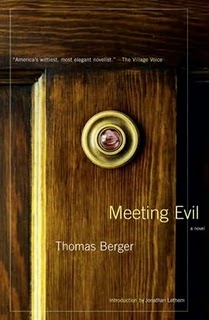
Meeting Evil – Thomas Berger

According to Jonathan Lethem, Thomas Berger is  “one of America’s three or four greatest living novelists.”  I’d never heard of him when I added Meeting Evil to my tbr list, then shelf – where it languished for several years before I fnally got around to reading it. 

Meeting Evil is the story of John Felton, a young real estate agent suffering through the downturn in the American economy. He’s married to Joanie, father to Melanie and Philip and his life is about to get very complicated.  It’s Monday morning when his doorbell rings. Standing there is Richie, a young man of John’s general age. His car has stalled in front of John’s house and Richie asks for assistance. What begins as a an act of good samaritanisim, quickly devolves into a harrowing crime spree – with John along for the ride.

I’ve never  read a book quite like Meeting Evil before. While sometimes John seemed ridiculously naive and stupid to me, the character of Richie is a creation of pure malevolence.  He’s dangerous and unpredictable. Before John even knows what has happened, he’s part prisoner and part co-conspirator in Richie’s road trip from hell.  Although John soon realizes the danger he is in, Richie turns out to be a master manipulator. At one point John even announces “We’re all in this together.”  Try as he might to escape (and he does try) John’s day just keeps getting worse.

Berger is a masterful writer. The book has a propulsive energy and is often wickedly funny. It’s quite unlike anything I’ve read before and I look forward to reading the second Berger title on my tbr shelf, Best Friends.