Those Across the River -Christopher Buehlman

Those Across the River is my second novel by Christopher Buehlman (The Lesser Dead) and he now joins the ranks of my auto buy authors.

Frank Nichols and his soon-to-be-wife Eudora have just landed in Whitbrow, a backwater town in Georgia. Their life is a little bit in flux. Frank was essentially chased out of Chicago, where he’d worked at a college, because Eudora had been married to a colleague. The two meet at a faculty luncheon.

She was twenty, wearing a sweater the color of an Anjou pear. I was still built like the St. Ignatius basketball center I had been fifteen years before.

We were in love before the salads came.

It is 1935 and Frank is a WW1 veteran, prone to night terrors; Dora is a school teacher. They land in Whitbrow because Frank has inherited a property. The letter that tells him about this inheritance also cautions him to sell the property, that there is “bad blood” there, but with limited options, they decide to move. Frank is going to write the history of Savoyard Plantation, a derelict property owned by his ancestors.

As Frank and Dora settle into their new lives, they find it to be both secretive and charming. For one thing, the townspeople gather once a year to release pigs into the woods as a sort of sacrifice. But to what? Then there’s the plantation, which is located somewhere across the river, but Frank finds that no one is interested in taking him there. One of the locals tells him “Them woods is deep and mean.”

Just how mean? Well, it takes a while for Frank (and the reader) to figure out just what the heck is going on. Some readers might get frustrated with the slow pace at which the story unfolds, but I liked it. I really enjoy the way the Buehlman writes; he’s also a poet and it shows in his prose. One reviewer suggested that the main characters are wooden and the plot not that compelling, but I disagree. I was wholly invested in this story.

I won’t spoil the reveal. I did figure it out before the end, and while it isn’t a scary horror novel, it is atmospheric and a compelling read.

My Brilliant Friend -Elena Ferrante

A former student, someone for whom I have a lot of respect and admiration, encouraged (aka begged) me to read Elena Ferrante’s novel My Brilliant Friend, a book that was recently named #1 Book of the Century by the New York Times. I didn’t own the book and I don’t know whether I would have ever gotten around to reading the book given the state of my physical TBR pile, but I was next up for book club and so I chose this one, mostly in deference to Luke. Despite the fact that it was published in 2012 and is relatively popular (and has its own series on Prime), none of the members of my book club had ever read it.

This novel is the first of a quartet by the famously private Ferrante. Apparently, no one actually knows who she is, so the author’s name is actually a pseudonym, and since we don’t know very much about her, claims that My Brilliant Friend is autofiction is also an unfair characterization. How can we say the events of the novel are drawn from the author’s own life if we don’t know anything about her? Or him? Whether or not who the author is makes any real difference is beside the point at any rate.

Luke loved it. Two of the women in my book club of eight didn’t finish it. Three women loved it. (My best friend, Michelle, is on book three and has already watched the entire series.) Two women hated it (one of these is one of the DNFers). And two of us (myself included) felt just meh about it.

In a nutshell, the novel opens when 60-something Elena (also known as Lenu) receives a phone call from Rino, the adult son of her oldest friend, Lila (also known as Raffaella or Lina). Lila is missing. Poof. Vanished. This news seems unsurprising to Elena even though “it’s been three decades since [Lila] told [her] that she wanted to disappear without leaving a trace.”

Elena seems annoyed by the news and she doesn’t offer Rino much in the way of comfort. Instead she thinks

I was really angry.

We’ll see who wins this time, I said to myself. I turned the computer on and began to write– all the details of our story, everything that still remained in my memory.

And that’s essentially what My Brilliant Friend is, the written account of the friendship/rivalry love/hate relationship between these two girls beginning in the 1950s, in a neighbourhood outside of Naples, Italy. It’s the story of poverty, crime, the power of education, loyalty, family and friendship.

This is what Luke said:

“I loved the portrayal of friendship and how central it was to forming them into who they are. I loved the background setting of Naples and how poverty is corrupting everyone’s life. All of the characters come alive for me and I find her such an incredibly powerful writer. I was so invested in Lila and Elena’s relationship. […] I think she’s a beautiful writer telling a wonderful story…”

Luke and I talk about books whenever we have the chance. When he was in my Young Adult Lit class he read more than anyone and he read widely. If I talked about a book I really loved, chances were pretty high that he would read it. So it hurt me a little bit not to love this book as much as he loved this book. For me, I found it sort of slow and dry and although the friendship between the two characters was well-drawn, I didn’t especially care about either of them. I certainly feel no compulsion to carry on with the books, although I may watch the series this winter.

The New York Times compiled their Top 100 books by asking 503 literary luminaries to provide their list of all-time best books based on the following criteria: impact, originality and lasting influence. It’s an interesting list which demonstrates just how subjective a ‘best books’ list can be. Number 2 was The Warmth of Other Suns, a book I have never heard of by an author I have never heard of. Kazou Ishiguro’s Never Let Me Go barely made the top ten. Atonement by Ian McEwan was #26. 26!!! Both my children would say Atonement is one of the best books ever written…and I would agree. Donna Tartt’s The Goldfinch, which won the Pulitzer (although not without controversy), came in at #46. Station Eleven was #93.

I tasked the ladies in my book club to pick their top three books of all time based on the criteria provided by the Times. We’ll share those Top 3 lists at our next meeting and with their permission, I will share them with you here after we meet.

The fact that no one reads the same book is one of the best things about reading, but I am sad that I didn’t love My Brilliant Friend more than I did. Sorry, Luke.

Talking at Night – Claire Daverley

If I had read Claire Daverley’s debut Talking at Night a little bit earlier, it would have most certainly made my list of the top twenty books I read this year because I LOVED it! I am always talking about how straight-up romances just don’t float my boat, how I need a little pain with my pleasure. This book delivered and then some.

Rosie and Will meet at a bonfire when she is seventeen and he a little older. Although they go to the same school and share some friends, and Will tutors Rosie’s twin, Josh, in further maths (advanced A level math), these two don’t really know each other until Will suddenly finds himself telling Rosie things he’s never said to anyone.

Will and Rosie could not be more different. Will is “detached and standoffish, despite his popularity and a long list of girlfriends.” Rosie is “a virgin, and she is vanilla.” She also suffers from OCD and is far less outgoing than Josh. It is clear, though, that these two are drawn to each other in ways that neither of them quite understand.

When Rosie tries to pre-emptively end things (because things haven’t really even begun, although they both understand that there is something between them), Will tells her that he thinks about her “On my bike. And in the garage. And when I’m cooking, and running, and trying to sleep.” This is new territory for Will.

Watching these two navigate these feelings over the years – because the novel does span decades – is truly a thing of beauty. There are lots of obstacles preventing them from having the HEA that I wanted for them, but that’s the bit I like best. Where’s the story if they meet, fall in love and suddenly have everything they didn’t even know they wanted?

Will has demons and a past. Rosie has a complicated relationship with her mother and subverts her own desires to make others happy. Tragedy looms around the corner which further complicates things. Rosie goes off to university, but Will stays home in Norfolk. And through it all – Will and Rosie pine and hell yes! so did I.

I loved these two characters. I loved the secondary characters. I loved the unexpected bonds that are forged. I loved the way this book is written. I read it in two sittings, turning the last page way past my bedtime.

If I had my Top Twenty list to do over again, this one would definitely be in the Top 3! Although perhaps not objectively the best book ever…it hit all my sweet spots and so it’s 100% a winner in my book, and that’s the beautiful thing about reading – my opinion is the only one that counts.

Adelaide – Genevieve Wheeler

Adelaide Williams is drunk when she first meets Rory Hughes.

Late that afternoon, tipsy and tanned, she saw him.

He was wearing a scarf and a blue button-down and Adelaide loved him instantly – all brown curls and razor-sharp jawline. Like a young Colin Firth.

She is compelled to waltz right up to him and tell him that he looks “like a Disney prince.

Nothing comes of that meet cute, but several months later Rory and Adelaide match on a dating app, something she has been using for casual hook ups. She figures that this night will be no different from the string of other nights she’s recently had. It turns out though that meeting Rory again upends her world.

Genevieve Wheeler’s debut Adelaide tracks the titular character’s time in London where she is first finishing her Master’s and then working. Their first date and first kiss lights a fire inside Adelaide and “in her memory, standing on that street corner, the sky was bright. Birds chirping, clouds parted, sun shining. It’s painfully clichéd, but darkness didn’t exist here, not in this little universe Adelaide entered when she first kissed Rory Hughes.”

At twenty-six, Adelaide is navigating young adulthood. She has her roomies, Celeste and Madison, and her stateside best friend, Eloise. Rory, perfect Rory, is – she is sure – her soul mate. Except, you know, he’s not. He’s got a lot of baggage and it turns out he’s not the best boyfriend. It’s one of those “all that glitters is not gold” situations; when he’s with her, it’s impossible not to feel the heady thrall, but he often disappears or breaks plans; he’s emotionally unavailable.

I am not 26, but I sure understood Adelaide. Her relationship with Rory mimicked many of my own twenty-something relationships which required a lot of work on my behalf, a lot of subjugating my own feelings in service to others, mostly because I was always choosing the wrong others. Adelaide’s fumbling wasn’t frustrating to me; it was relatable.

This is a book about loving someone else fiercely, but ultimately learning that the person most deserving of that sort of care and attention is actually yourself.

Loved it.

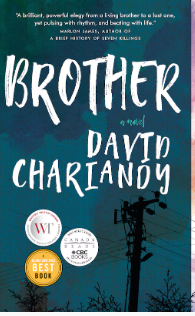
Brother – David Chariandy

New-to-me Canadian writer David Chariandy’s novel Brother is an elegy to family. Published in 2017, this novel topped all the Best Of lists and won a Writers’ Trust of Canada award, as well as being nominated for the Giller. I have had it on my TBR shelf for several years, and in an attempt to tackle some of my backlist, I finally read it.

Michael and his older brother Francis live with their Trinidadian mother in The Park, a “cluster of low-rises and townhomes and leaning concrete apartment towers” – a not-so-nice suburb of Toronto. Their father is long gone.

When the novel opens, Michael is meeting with his friend, Aisha. They haven’t seen or spoken to each other in a decade and her arrival opens Michael up to the trauma of an event that transpired many years ago – one that he and his mother have never gotten over. This tragedy is alluded to early on in the book, but I’ll be vague about it here.

Brother toggles back and forth between Aisha’s return – which dredges up the past – and the past itself.

Francis was my older brother. His was a name a toughened kid might boast of knowing, or a name a parent might pronounce in warning. But before all of this, he was the shoulder pressed against me bare and warm, that body always just a skin away.

Francis and Michael are close, especially as young boys when they are often left to fend for themselves as they are left alone while their mother works. Their mother worked as a cleaner, and often took on extra work to try to make ends meet.

She was never happy about abandoning us, and if she learned the evening before of an impending night shift, she would spend precious sleep time cooking and worrying over the details of meals and activities for the following day.

Chariandy captures the poverty, violence, and hopelessness of the lives of the people who live in The Park, but he also captures the sibling bond, the friendships and the hope for a better future. I particularly admired the subtlety of Francis’s relationship with Jelly, a wannabe DJ.

When Aisha arrives back at The Park, she tries to unclog the grief Michael and his mother have been stifled by for many years. And by allowing Michael to finally tell his story, perhaps she has succeeded.

Beautiful writing and a timely story about police violence and the immigrant experience make Brother worth checking out.

Real Americans – Rachel Khong

Rachel Khong’s novel Real Americans spans many years (1966-2030) and is told from the point of view of three characters: Lily, Nick, and May.

After a short intro about an event in 1966, the novel fast forwards to 1999, where we are introduced to Lily, who works as an unpaid intern for an online travel magazine. At the company’s holiday party, she meets Matthew, who, despite being “distractingly hot – athletic but not vacant, a muscular nerd” is not her type.

Matthew, it turns out, is actually a great guy and the first part of the novel follows their relationship, break up and make up. Despite the fact that his family is insanely rich and her parents came to America from China with little more than the clothes on their backs (and jobs as research scientists), Matthew and Lily marry and have a son, Nico/Nick.

In Nick’s section, he and his mother are living on a small island off the coast of Washington. Nick is now fifteen and has no idea who his father is. Nick also doesn’t look even remotely Chinese, having inherited none of his mother’s traits. Instead, he is blonde-haired and blue-eyed and tall. Nick can’t figure his physical appearance out, other than to assume it as “some bizarre accident of genetics.”

The story Lily has always told him is that his father wanted nothing to do with them, but when Nick’s best friend Timothy suggests they do DNA tests, he is reunited with Matthew. Matthew has a different version of what happened than he had been told by his mother and Nick “found himself trusting him over [his] mom. Hs face was so like [his] own the [he] believed, correctly or not, [he] knew it.” Thus begins a complicated relationship between father and son.

Finally, we have May’s story. She is Lily’s mother. Her story takes us back to Mao Zedong’s China. The May readers are introduced to in Lily’s part of the book seems cold and distant, unloving even. This section of the book allows us to see how she grew up and ultimately escaped Communist China. It certainly paints her in a much more sympathetic light.

Real Americans is quite a long book, almost 400 pages, but I enjoyed my read. Although the story didn’t quite land for me and I often felt that I didn’t understand the characters or their motivations enough to be fully invested in them, I still enjoyed my reading experience overall.

True Story – Kate Reed Petty

Kate Reed Petty’s debut True Story is the story of a high school junior’s sexual assault in the back of a car. Drunk at a party, Alice Lovett is driven home by two lacrosse players, Max and Richard, and the details of the assault spread throughout their town, destroying several lives in the process.

When the novel opens Alice is living in Barcelona and working as a ghost writer. Someone has asked her to tell the story of what happened all those years ago, but Alice is reluctant to even talk to this person.

The truth is I was embarrassed. You’ve always been the one who was brave – no, the one who was sure. You’ve always been so sure of the story you want me to tell. the story you’ve been asking me for since we were seventeen: the story about the things that happened while I was asleep.

Now, Alice hopes this person will accept the version of the story she is prepared to give.

Petty employs a variety of different formats to tell this story. There are movie scripts, college application drafts (complete with teacher feedback); there’s an account from Nick Brothers, a member of the same lacrosse team who was there when Max and Richard came back to the Denny’s and bragged about what they had done to Alice in the backseat of the car; there’s a whole series of email messages from Alice to Haley (the friend who has been encouraging Alice to tell her story); there’s the transcript of an interview Alice is trying to spin into a book for a client. There is nothing necessarily linear about the narrative and it doesn’t matter one bit.

I couldn’t put this book down.

But besides being a page turner, True Story definitely has something to say about rape culture and the way women’s stories are told. I found Alice’s college application essays a perfect example of this. She is trying to write about something that has had an impact on her life (the assault) and she attempts to get there through several drafts, before eventually landing on a benign story about shoes. Society has made it almost impossible for women to tell their own stories and you barely even know that it is happening.

True Story is a horror story, a mystery, a revenge story: it’s well-written and fast-paced and thoughtful and I highly recommend it.

Sweet Dream Baby – Sterling Watson

In an effort to do something about my toppling Mount Doom of backlist books, I am going to read one for every newer release I read. Not sure it will help, but maybe I will luck out and the majority of books languishing on my shelves will be as good as Sweet Dream Baby by Sterling Watson.

In this book, 12-year-old Travis Hollister is sent to Widow Rock, Florida to live with his paternal grandparents and 16-year-old aunt, Delia. It is 1958 and Travis’s father can’t cope. Travis’s mother is convalescing because, as Travis explains, “One day, I came home from school and found Mom curled up under the kitchen sink.” This will be the break everyone needs.

Travis’s grandparents are two sides of a coin: his grandmother is an effusive women, given to retreating to her room with headaches; his grandfather, the town sheriff, is a hard man who demands respect. The real surprise for Travis is his father’s much younger sister, Delia, whose smile “is like a sunrise over the wheat fields back in Omaha.”

Delia takes Travis everywhere and Travis is soon privy to things he doesn’t really understand. Ultimately, it makes this novel more than just the story of one boy’s coming of age. I blame Delia. Delia’s super power is her ability to wrap people, particularly men, around her little finger.

When Travis first meets Delia, he can see the effect she has on her father after she speeds into the garage, music blaring.

Grandpa Hollister’s eyes change. They look like I never expected them to. They say he doesn’t care about the loud radio or the reckless driving. Nobody’s gonna get arrested. They say he can’t do nothing about how he feels right now. Nothing at all.

It seems that every male who comes into Delia’s orbit, from Princeton-bound Bick Sifford, to the the local James Dean wannabe Kenny Griner, wants something from Delia. And soon, Travis wants something from her, too.

Sweet Dream Baby captures the innocence of youth, and the sharp tang of sexual longing and sets it all to the soundtrack of the music of the period. The book doesn’t go where you expect it to and ends up being quite a bit darker, too.

I loved every second of it.

Small Things Like These – Claire Keegan

Irish writer Claire Keegan seems to be having a moment these days, at least in the bookish circles in which I travel. Her novella Small Things Like These was shortlisted for the 2022 Rathbones Folio Prize, awarded for the finest work of literature published in English, and it won several other awards including the Kerry Group Irish Novel of the Year.

At just over 100 pages, the story follows Bill Furlong, “the coal and timber merchant” as he goes about his daily rounds in New Ross. It is 1985, in the weeks leading up to Christmas, and Bill, married father of five daughters, is in an introspective mood. He is aware of his humble beginnings: “Furlong had come from nothing” and he is also aware of his relative success – he owns his business and is able to provide for his family and he feels “a deep, private joy that these children were his own.” He is aware that in some ways he is an outsider: his mother was an unwed teen and he grew up in a large house under the care of his mother’s employer, Mrs. Wilson, a widowed Protestant. He doesn’t know who his father is. He thinks about this sometimes as he also considers the daily grind of life, but ultimately Furlong seems to be a glass half full sort of bloke.

Before long, he caught a hold of himself and concluded that nothing ever did happen again; to each was given days and chances which wouldn’t come back around. And wasn’t it sweet to be where you were and let it remind you of the past for once, despite the upset, instead of always looking on into the mechanics of the days and the trouble ahead, which might never come.

A delivery to the local convent shakes something loose in Furlong, though. He grapples with what makes someone good and how can one be truly good if they turn a blind eye.

Small Things Like These is a essentially about one good man’s defiant act. It is a quiet, beautiful novella.

Girl A – Abigail Dean

You don’t know me, but you’ll have seen my face.

At just fifteen, Lex Gracie escapes her family home on Moor Woods Road, flags down a car and thus rescues her siblings from what is soon dubbed by the press as the “House of Horrors”. She is named Girl A to keep her identity secret from the world. Her siblings, Ethan, Evie, Gabriel, Delilah and Noah, are similarly named.

Now, years later, Lex, a lawyer based in NYC, is off to the prison where her mother has just died. Lex has been named executor of the estate, which is comprised of the house and a little bit of money. Lex feels the right thing to do is to build a community centre where the house stands, but in order to do that she needs her siblings to sign off. Abigail Dean’s accomplished debut Girl A traces Lex’s journey through the trauma of her past as she locates and visits with her siblings in an effort to secure their signatures.

Wisely, Dean chooses to leave much of what happens in the house to the reader’s imagination. It’s more than enough, trust me.

Sometimes, in my head, I visit our little room. There were two single beds, pressed into opposite corners, as far away from each other as they could be. My bed and Evie’s bed. A bare bulb hung between them and twitched at footsteps in the hallway outside. It was usually dull. but sometimes, if Father decided, it was left on for days. He had sealed a flattened cardboard box against the window, intending to control time, but a dim, brown light seeped through and granted us our days and nights.

The disintegration of the Gracie family doesn’t happen all at once, although the father, Charlie, is definitely volatile. As he becomes more and more evangelical – even going so far as to start his own church – he becomes more rigid and violent. Lex and Evie finds solace in a hidden book of Greek myths and school is a safe place until Charlie forbids them to go. Lex’s mother shrinks into the background, often disappearing for days into her bedroom to care for the newest baby.

Lex unspools the story of her childhood as she visits with each of her siblings, all adopted into different families after the rescue. Thus, this is a story about the aftermath of trauma as much as it is about the trauma itself. What becomes of these children makes for compelling reading.

Highly recommended.