Scribbling the Cat by Alexandra Fuller

Alexandra Fuller’s memoir Don’t Let’s Go to the Dogs Tonight has been on my tbr list forever.  It was universally praised and having recently finished Scribbling the Cat I am even more anxious to read it.

Fuller was born in England and moved, with her family, to Rhodesia when she was 3.  Here’s an even more interesting fact: Fuller received her B.A. from Acadia University.  Since I live next door to Nova Scotia –  I feel a certain kinship to her now; she’s an honorary Maritimer!

Scribbling the Cat is Fuller’s story of  ‘K’,  a man she meets on a trip back to Zambia to visit her parents who still live and work there. Fuller has left her husband and two children behind in the States. She does a wonderful job, throughout this book, of juxtaposing those two very different worlds: one of excess and waste and one where nothing is wasted, where potential danger always seems to be lurking.

K  is something of an enigma.  She hears about him before she actually meets him and when she meets him, he takes her breath away.

Even at first glance, K was more than ordinarily beautiful, but in a careless, superior way, like a dominant lion or an ancient fortress.

Of course, I immediately thought that Scribbling the Cat was going to be about a sexual relationship between Fuller and K –  but their relationship turns out to be far more complicated than that. K was a soldier in the Rhodesian war and having grown up there, Fuller is intensely interested in his story. As their friendship develops, she gets the idea that they should journey to the places he had fought. She is, after all, a writer and he is a remarkable subject.

K is an endlessly fascinating subject – he rants, he weeps, he recalls with equal vigor.

Scribbling the Cat is an unflinching look at war – the horrible things people do and how they must find some sort of peace with their actions when the war is over. This is K’s story, to be sure, and it’s a horrific one.  But this is Fuller’s story, too, and it’s a remarkable.

Read for the Memorable Memoir Challenge.

Memory by Philippe Grimbert

Although Philippe Grimbert’s book,  Memory, claims to be a novel, the story has the ring of truth.

Although an only child, for many years I had a brother. Holiday friends and casual acquaintances had no option but to take my word for it. I had a brother. Stronger and better looking. An older brother, invisible and glorious.

Grimbert’s novel is the story of a family. The narrator, a sickly child of  athletic and beautiful parents whose “every muscle had been buffed and toned”, recounts the family’s history as it is told to him by, Louise,  a woman who runs a sort of homeopathic consulting business in two rooms in the same building as the narrator’s parents have their whole sportswear business.

It is clear from the beginning that the family is Jewish and that their story has been deeply affected by the Nazi’s.  It is Louise who unspools the narrative for the boy after he discovers  a toy dog in an attic filled with suitcases and furniture.

Memory is a scant 145 pages long, but it packs a punch as, I think, all personal stories about Hitler’s regime do.  It won numerous prizes and was a bestseller in France. Despite its claim of being fiction, it is impossible to deny its ring of authenticity and the knowledge that some (if not all) might have happened gives the book even more emotional heft.

Before the Knife by Carolyn Slaughter

The Betty and Boo Chronicles is hosting a Memorable Memoir Reading Challenge and as I actually have a few memoirs on my tbr pile, I thought I could manage to fulfill the challenge’s requirements: read four memoirs in one year. That’s doable.

I just finished my first memoir, Before the Knife by Carolyn Slaughter.

Before I talk about the book, let me say a few words about the author. I discovered Carolyn Slaughter 20 odd years ago, purely by accident. I came across her novel, The Banquet in a book store and its tag line “a taut and powerful story of obsessive love” caught my attention.  Well of course it did. At the time I was madly (and a little obsessively) in love myself. I devoured the book and then went looking for more. In a second hand store I came across her novel Relations (which is also known as The Story of the Weasel in that weird way books have their name changed between the UK and North America). That book was stunning. That book caused me to write a letter to Ms. Slaughter, the first and only fan letter I have ever written to an author. A letter to which she replied. In total I have read six novels by Ms. Slaughter (I highly recommend Magdalene as well as the two I have already mentioned) and I count myself a huge fan. She is an immensely talented writer.

Her memoir wasn’t what I expected, however, and I can’t say I loved it. Born in India, her parents moved to Africa when Slaughter was very young. Her father had some sort of government job; her mother was mostly emotionally unavailable and Carolyn, her older sister, Angela and her younger sister, Susan had a weird and unhappy childhood.

Carolyn prefaces her story by telling the reader of a horrific incident that happened to her when she was six. Then she goes on to say that Before the Knife isn’t a memoir about that. Except it is –  because Carolyn was clearly shaped by what happened to her. She does her best to survive her cruel mother and horrible father and much of her survival depends on her affinity with the land. She clearly loves Africa, its wild and exotic landscape a place of  refuge for her.

The story covers Slaughter’s life from her arrival in Africa to her return to England when she’s 16 or so. The pages in between are filled with striking images of the land, the people (both blacks and whites) who occupied it and Slaughter’s complicated and strained relationship with her siblings and parents. She’s not entirely likable – prone to violence against others and herself.

It’s not until years later, when she herself remembers what had transpired when she was just a little girl, that her story comes into focus. By then, though, I felt disconnected from her – the strange little bits of revealed life never really coming together. And I really wish she’d talked about writing.

Nevertheless, I have no regrets about reading her story. There was certainly nothing ordinary about it!

My first ever reading challenge…

Sandy at You’ve GOTTA Read This mentioned  a challenge I think I can manage.  The Betty and Boo Chronicles is hosting a ‘Memorable Memoir’ challenge.  I like this one because it’s totally doable: you have to read four memoirs by the end of the year.  I have four memoirs on my tbr shelf…so this will be the perfect excuse to finally read them!

The four memoirs I plan to read are:

  1. Scribbling the Cat by Alexandra Fuller
  2. The Year of Magical Thinking by Joan Didion
  3. Before the Knife by Carolyn Slaughter
  4. Cherry by Mary Karr

Traveling with Pomegranates by Sue Monk Kidd and Ann Kidd Taylor

Having read The Mermaid Chair and  The Secret Life of Bees, both by Sue Monk Kidd,  I was excited when this was chosen as one of our book club selections. That was in November. I just finished reading the book now. What does that tell you?

Traveling with Pomegranates should have been a better book than it actually is. This is a mother(Sue)/daughter(Ann) memoir about travel, faith, love, creativity and writing. At the beginning, as I settled in, I thought that it was going to be quite compelling. I felt a kinship with Sue:

“I didn’t understand why I was responding to the prospect of aging with such shallowness and dread, only that there had to be more to it than the etchings on my skin” (4).

In Sue’s capable hands, this journey is – if not always engaging – at least well written and thoughtful. Sadly, I can’t say the same for Ann’s part. I found her whiny and entitled. I never warmed up to her.

Mother and daughter visit Greece together in 1998. Ann is 22 and Sue mourns the loss of the little girl she was. She is also acutely aware that something troubling is going on with her daughter. At first glance it might seem that Ann’s disappointment has to do with the fact that she didn’t get into graduate school, but as the mother/daughter writers unspool the story it turns out that they are both looking for something more complicated. And they spend the rest of the book kneeling at the feet of Madonnas (and other powerful female icons) in Greece and Crete and France…trying to find it.

Ultimately, it turns out that graduate school was never what Ann truly wanted; she wants to be a writer. And how wonderful for her that her mother is and that they could do this book together.

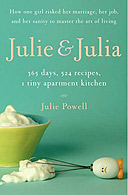
Julie and Julia by Julie Powell

Julie Powell had me at : “we both recognize the genius of Buffy the Vampire Slayer.” That revelation comes early on in her book Julie & Julia, a  memoir that builds upon the “Project” she embarked on just before she was about to turn 30. Disheartened with her life as a government drone in New York City, Powell was, as many of us were, looking for meaning in a post 9/11 world. But further to that- she was looking for meaning in her own life. Or at the very least, she was looking for something meaningful to do.

While visiting her parents in her native Texas, Powell confiscates her mother’s copy of Mastering the Art of French Cooking (MtAoFC) by Julia Child.

“Do you know Mastering the Art of French Cooking? You must, at least, know of it,” Powell says. “It’s a cultural landmark, for Pete’s sake!”

And from this cookbook…and a conversation with Powell’s long-suffering (and incredibly supportive) husband, Eric, springs the Julie/Julia Project. Powell decides to cook every single recipe from the book and blog about it.

Blogging. Ahh, yes. Curious thing, that. You write and people read and the next thing you know you have a book deal. Or something like that.

Julie & Julia follows Powell’s project from beginning to end- and includes everything from her failures in the kitchen to her friend’s extramarital affairs. It is laugh-out-loud funny and occasionally self-indulgent (but what blog isn’t?). It’s peppered with expletives and bits of strange insight.

So this search for meaning (personal meaning, at least) has been done before. Elizabeth Gilbert (whom Powell thanks in her acknowledgments) did it in a little best-seller called Eat, Pray, Love. I liked Powell’s book better and here’s why…

I could relate to Powell. And, no, it’s not just because of her Buffy-love (although that certainly earned her free points.) Where Gilbert took a year off to spend four months each in three different countries, Powell could only afford the occasional day of playing hooky from her crap job while she cooked her way to enlightenment. Her house was unkept, she drank too-much and swore even more. She didn’t set off on the Project for fame and glory- she wanted to find an essential piece of herself that she thought was missing.

And she does…one recipe at a time.

Will the Vampire People Please Leave the Lobby by Allyson Beatrice

If you are already a member of fandom, Allyson Beatrice’s book Will the Vampire People Please Leave the Lobby? (WTVPPLTL) won’t actually tell you anything you don’t already know. For example, anyone who is a part of fandom (any fandom- not just the Jossverse) knows that there are hugely generous fans and, at the other end of the spectrum, asshats. Fandom folk know that the Internet can be scary and also scary fun.

Based on Beatrice’s own experiences in the Buffy/Angel/Firefly fandom, the book, with its coda ‘True Adventures in Cult Fandom’ isn’t a titillating who’s who tell-all. In fact, unless you were an original member of The Bronze Posting Board, you probably won’t know any of the people Beatrice mentions. (I wasn’t a member of The Bronze, having arrived late to the party…and I only recognized a couple names.)

WTVPPLTL
is essentially a series of essays that describe Beatrice’s various  adventures in fandom- like how she was once called upon to find a new home for Joss Whedon’s cat and how she and Tim Minear are great friends and how fandom raised enough money to bring someone to the States from Israel. Stories like these have limited appeal- unless you are part of the inner circle being discussed.

The book is Jossverse specific only in the sense that those are the shows Beatrice was a fan of- I’m pretty certain that the same stories could be told in the Lost fandom…or Harry Potter. And Beatrice might alienate some of her readers with a statement made early on that she thinks that “academics obsessing over Buffy the Vampire Slayer, tying obscure cultural/socio/historical events to a tiny cult show is weird.” Still, she admits to having spent thousands of hours discussing the show with other fans. So- she is like the rest of us mortals after all.

The book is very conversational, sprinkled with expletives, and, no question, Beatrice is a clever woman who can turn a phrase. She makes a great case for explaining how fandom is family- for many people the only family they’ve got. I suppose some people will accuse Beatrice of thinking a lot of herself; I found her quite amusing- someone I might have been excited to cross paths with in her BNF days.

If I have one complaint it’s that the title is misleading in that there’s very little real chatter about the Jossverse. And as a Joss-starved fan, I would have loved hearing more about a fandom that is still, I think, pretty active. Even if the stuff I was hearing about took place back in the shows’ glory days.

Eat, Pray, Love by Elizabeth Gilbert

Elizabeth Gilbert’s well-received book, Eat, Pray, Love tells the story of the author’s own search for meaning in the world. Personal meaning, that is. In order to find it, she takes a year off from her very successful writing career (she’d have to be successful, wouldn’t she) to spend four months in each: Italy (for pleasure), India (for prayer) and Indonesia (for balance).

This book is huge- practically every woman alive will have read it- or plans to- and don’t let my cynicism dissuade you. Gilbert is a wonderful writer. It’s hard to sustain the perfectly pitched conversational tone her book does and not be a skilled craftsman, but…

But, here’s the thing. Lots of people wish they could stop their hectic, horrible, messy, complicated, screwed up lives in order to find their deeper purpose; in order to mend their broken hearts and psyches, in order examine their place in the world, their connection to the people with whom they share the planet…and their relationship with a higher power (God, in Gilbert’s case, although she says “I could just as easily  use the words Jehovah, Allah, Shiva, Brahma, Vishnu or Zeus.”) Not everyone has the means. Plus, although Gilbert’s journey was preceded by a divorce, she has no children. Trust me, I’d love four child-free months in Italy, too.

That said, the book is so engaging that even though I didn’t internalize Gilbert’s search, I certainly enjoyed listening to her talk about hers.

In This Dark House by Louise Kehoe

What makes another life fascinating enough to commit it to paper? I know that memoirs are all the rage these days and I have read a few and this once did not disappoint. In This Dark House was the winner of a National Jewish Book Award and uniformly praised by critics who called it “well constructed and beautifully written, has an emotional honesty which generates its own kind of lasting truth” (Susie Harris, The Times Literary Supplement) and a “heartbreaking story…astonishing enough on its own, but her riveting luminous prose style transforms it into a triumphantly beautiful and moving work of art.” (Booklist)

Louise Kehoe was born in England in 1949, the youngest of four children. Her father, Berthold Lubetkin, was a well known architect who had been born in Czarist Russia  and her mother, Margaret Church, was born in England and met Berthold as an architecture student.

Kehoe recounts her childhood living at World’s End, a remote house in Upper Killington, England. A practicing Communist, Louise’s father is intellectual and emotionally remote. One might say he’s actually abusive- he withholds and doles out praise like a dictator.  Kehoe’s mother does her best to moderate, but her loyalty is to her husband and her children, although she clearly loves them, come a distant second.

What Kehoe doesn’t know until her father’s death (at nearly 90) is that he is harbouring a horrible secret and the beauty of this book is that Kehoe, despite the barren emotional landscape of her youth, cares enough to search it out. Uncovered, the secret opens a door wide into her father’s life and makes him much more sympathetic. And, of course, Kehoe is able to forgive him which she does eloquently and with love.

A beautiful book.