The Woods by Harlan Coben

Woods

So, I know there are loads of Harlan Coben fans out there. I get why people like him. He’s a straight-up writer, lots of dialogue and characters and plot threads to keep you busy. Coben’s the sort of writer you read when you’re looking for something fast-paced and, dare I say it, fluffy.

The Woods has a convoluted plot that concerns Paul Copeland, County Prosecutor. Twenty years ago his sister, Camille, went missing (presumed dead) along with three of her friends while they were all at a camp for teens. When one of the presumed dead turns up dead (again) twenty years later, it cracks open a door to a past that Paul knows nothing about.

I liked Paul’s character. He’s a smart-mouthed lawyer who isn’t afraid to look the bad guy in the eye. His chief investigator, Muse, is the female equivalent of Paul and they make a fine team.

For me, though, The Woods was just too busy and, at the end of the day, the secrets buried in the woods just weren’t enough to hang 400 pages on.

Envy by Kathryn Harrison

envy

I have mad love for Kathryn Harrison. I think she’s a beautiful writer and she often tackles difficult subjects, train wrecks from which you can not turn away.

Envy is the story of psychoanalyst Will Moreland. The landscape of his life is pitted with estranged relationships (his identical – save for the brother’s wine-stain birthmark – twin, Mitch); death (his young son, Luke, killed in a boating accident) and a strained sexual relationship with his wife, Carole (they still do it, but not face to face and Will isn’t allowed to touch her).  From these more-connected-than-you-think threads, Harrison weaves a story which is often funny, sometimes creepy, and slightly over-wrought (particularly near the end).

The novel opens as Will is about to return to his alma mater  for his 25th reunion. He’s clearly not interested in the majority of his classmates. He’s on the lookout for two people in particular: his brother, whom he hasn’t seen since he married Carole 15 years ago and Elizabeth, his college girlfriend.  His brother is a no-show. Elizabeth is there, but their reunion brings to the surface a disturbing revelation.

There are elements of Envy which revisit  some of the themes Harrison has used before in her work: sex used as power, grief, incest. It’s one of the reasons why I like her work so much- she’s practically fearless. Still, I didn’t love this book. I understand Will is traumatized by the death of his young son. I understand that as a professional in the mental health field he’s likely to be less astute about his own feelings and motives, but Envy (for me at least) suffers under the strain of too much plot. For instance, I liked Will’s dad, but do I care about his extra-marital relationship or his second career as a photographer. Not particularly.

And I didn’t like the ending all that much.  Some pretty devastating things happen in this novel, yet Carole and Will seem to move past it all almost effortlessly.  Since the book is told entirely from Will’s point of view, Carole’s feelings about the loss of her son, her struggles to carry on, her own traumatic experiences are exposed only in dialogue and only at the very end. On the other hand, Will examines and re-examines his feelings, sort of distantly and myopically, though. Sometimes I just wanted to see him as  a middle-aged man trying to do his best. And who, might I ask, is paying the least bit of attention to Samantha, the couple’s surving child?

Still, it’s Kathryn Harrison and I’ll take one of her books over just about anything else out there any day of the week.

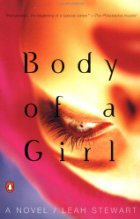
Body of a Girl by Leah Stewart

bodyofgirl

I read Leah Stewart’s novel The Myth of You and Me a couple years back and I had a lot of problems with it. I had a lot of problems with Body of a Girl, too.

Olivia Dale is a crime reporter for a Memphis newspaper. She’s not a rookie, but she’s young and it shows despite her best attempts to hide her reactions to the horrible things she’s called upon to write about. When the novel opens, she’s at a crime scene. Timing allows her to be closer to the body of a girl than she would normally be allowed.

“I’ve learned to stomach the photographs they show me,” Dale says, “but now I know it’s nothing like being so close you could lean down and touch that dead, dead skin” (2).

Perhaps because the dead girl is similar in age and appearance or perhaps she’s just the final straw in Dale’s precariously constructed life-  either way,  she  becomes obsessed with finding out everything there is to know about the dead girl. Not only does she throw  her personal safety out the window, she chucks out her common sense as well. As the book chugs along I felt less and less sympathetic and more and more annoyed with her.

I think Body of a Girl attempts to answer some of the questions we all ask: what makes us the same, what makes us different? How close to the edge can we walk without toppling over? Can we ever really know someone? The problem with Dale is that, despite her profession, she’s a piss-poor judge of character and doesn’t seem to have a compass of any sort. Her journey, ultimately, seems self-destructive, rather than a real attempt to understand the human condition. Dale just seems reckless and stupid by the novel’s rather sappy ending.

Standing Still by Kelly Simmons

standing

I loved pretty much everything about Kelly Simmons’  novel Standing Still. It’s always a relief to read something you can be excited about after a couple of mediocre books. Standing Still is just a terrific book: part page-turner (there’s an intriguing mystery at this book’s core) and part meditation on marriage and family and the lives women leave behind in order to have those things.

Claire Cooper, mother of three young daughters, spends a lot of time alone because her husband, Sam, travels for business. One night someone breaks into her house and Claire finds him about to make off with one of her daughters. “Take me,” she tells the man. “Take me instead.”

The man does take Claire and over the week of her captivity the reader has access to   Claire’s thoughts about her children and husband, as well as to her growing relationship with her captor, a relationship that proves to be far more profound and moving than you might expect. Their relationship becomes one of intimacy and, dare I say it, friendship and I know there is probably some psychological explanation for what happens between kidnap victims and their abductors, but I don’t think that explanation would actually suffice in this case. Claire is carrying a lot of emotional baggage and for the first time in her life she is forced to confront some of it. It is her time with this unlikely ‘therapist’ that makes healing possible.

On top of all this human drama, Simmons is a beautiful writer. Claire is a fully realized character, fragile and brave. Her unnamed captor is equally interesting –  a scene towards the novel’s conclusion where Claire makes the observation that, sleeping next to him will be the last time she’ll ever feel this safe (232) is both ironic and heartbreaking.

I also really loved that Claire is a woman who is trying to reconcile motherhood and marriage with the fact that she was, once, a very successful career woman. I loved her wild past, her ability to fall in love with a man based on a single characteristic, her yearning for that simple pleasure once again.

This was a book I couldn’t wait to get to at the end of the day…and one I was sorry to finish even as I was racing to the end.

Heartsick by Chelsea Cain

heartsick

What prevents Chelsea Cain’s debut novel, Heartsick, from being a run-of-the-mill psycho killer story?  I mean, truthfully, it has all the ingredients: troubled, lead detective; smart-cookie reporter with a past, crazy killer who targets high school girls, red herrings.

Heartsick opens with a flashback. Detective Archie Sheridan has been tracking the ‘Beauty Killer’ for ten years and he has finally caught her; or rather, she’s caught him. Held captive in her basement, Gretchen Lowell spends ten days torturing Archie in a variety of inventive and gruesome  ways. Strangely enough, Archie and Gretchen form a bond and it is that relationship which separates Heartsick from other novels in the genre.

Instead of killing Archie at the end of ten torturous days, Gretchen saves him by bringing him back to life and then calling 911. Then she does something even more remarkable- she turns herself in. She agrees to spill the beans about all the murders she’s committed over the years, but she’ll only talk to Archie. Their twisted relationship permeates all other aspects of his life, including his relationship with his wife, Debbie, and their two children. It’s also the most interesting thing about the book.

Archie is called back into service to lead a task force tracking a new serial killer. That part of the story treads familiar ground and is really only a framework for Cain to explore Gretchen and Archie’s co-dependancy. Archie is a complicated character; he loves his wife and children despite the fact that he no longer lives with them, he’s addicted to a variety of pain killers and sedatives, he’s as smart as hell. Gretchen is beautiful and cunning and one of the most evil characters you’re ever likely to meet. If you pick up Heartsick, do it because watching Gretchen and Archie navigate their twisted boundaries makes for riveting reading.

A Reliable Wife by Robert Goolrick

reliablewife

Everyone,  it seems, is raving about Robert Goolrick’s novel A Reliable Wife. Sadly, I am not going to be one of those people. I don’t mean to imply that I didn’t enjoy the book; I actually liked the book quite a lot (once I got past the first dry chapter). Still, there were elements of the book that just didn’t work for me.

A Reliable Wife tells the story of Ralph Pruitt, a wealthy man who lives in Wisconsin. He’s been a widower for the past twenty years and when the story opens he is standing on the platform at the train station waiting for Catherine Land, his soon-to-be-bride. Catherine has answered Truitt’s advertisement in a St. Louis paper for ‘a reliable wife.’ It is 1907.

Not all is as it seems with these two characters, though. Each has hidden agendas and secrets galore and as I read I imagined the fantastic movie this would make. Did it make a fantastic book, though, that’s the question. Well, yes and no.

What did A Reliable Wife do well?

It gave the reader a real glimpse into the hardships and isolation of a mid-western winter. It dealt sympathetically with the novel’s central characters: Catherine and Truitt. Truitt is especially well-drawn. He is a man who selfishly chases  erotic pleasures for much of his young life, returning to the family business only after his father dies. His story unfolds a little at a time, saving one last ’secret’ for the novel’s final pages.

Catherine comes to him the supposed daughter of missionaries, but her story is actually far more sordid.  It gives nothing away to say that she has come to Wisconsin to marry and then murder Truitt by way of arsenic poisoning.

What did A Reliable Wife do less well?

At a certain point in the novel I felt like everything became melodramatic. Sub-plots did nothing to advance the story. Catherine’s sister, Alice, is introduced near the middle of the book and I know it’s meant to juxtapose her life with Catherine’s, but for me it seemed tacked on. We hear tidbits of violent crimes or horrible accidents which have happened in Truitt’s community followed by the author’s statement ”such things happen”, as if this explains all the wrong-doing in the world. Or, perhaps, to say that some things can’t be explained.

Ultimately, A Reliable Wife asks the question: Is it possible to be redeemed? Truitt wants to make up for what he believes is a horrible mark against him as a father. Catherine makes a decision which changes the course of her future. Other characters hold on to their anger and bitterness and suffer a more drastic fate.

There is also the question of suspense. I wouldn’t say that the book was suspenseful in the way modern readers might expect. We know from the book’s jacket that Truitt and Catherine are hiding something and so we start reading with the knowledge that not everything is as it seems. I don’t think the story is propulsive because of any so-called suspense.  A lot of stuff happens and it happens at a relatively quick clip. On a few occasions  (especially towards the end) I actually felt I was being told what was happening rather than watching the story unfold.

One thing that totally surprised me about this book was the amount of sex in it. These are people with very real human appetites and the book does a terrific job with sensual details of all sorts: the sex is not the fade-to-black kind. Truitt’s sexual reawakening, in particular, is impressively realistic.

All this to say that I enjoyed reading the book, but I didn’t feel totally satisfied when I’d finished.


Beautiful Lies by Lisa Unger

beautifullies

Beautiful Lies is a silly book. Silly in the sense that the plot is mostly ridiculously contrived and way more convoluted than it needed to be. But who cares? When you read suspense thrillers only a couple things really matter. First of all- can we get behind the main character? Do we like her/him? Do we care what happens to them? Secondly,  is there enough  mystery/action/suspense/sex to keep the pages turning?

Beautiful Lies concerns the life of Ridley Jones, a successful, single freelance writer living in New York City. One day, on her way to meet her ex-boyfriend for breakfast, she saves a life and is thrust into the spotlight.  Soon after,  she gets a letter in the mail and everything she ever thought she knew about herself and her life is suddenly suspect.

There’s a lot of stuff going on in Unger’s book: doting parents who have pat answers for all Ridley’s questions, a junkie brother, a cloying ex-boyfriend, and a new love interest cut from romance 101 fabric.

Yet even as I questioned some of Ridley’s choices, even as I tried to piece together things that didn’t make a lick of sense, I kept turning those pages.

Perhaps it was Unger’s conversational style. Ridley tells the story herself and in some ways as a reader I felt as though she was telling me her story over a pot of tea on a  long afternoon. That intense focus, though, also means as a reader you get to be more critical of the character and I have to admit that sometimes I did want to shake her.

Ultimately, though, you don’t read a book like Beautiful Lies for insight into the human condition. You read it for sheer fun and I had a lot of that.

Obedience by Will Lavender

obedience

There’s no lack of praise for Will Lavender’s debut novel, Obedience. It’s a twisty, knot of a book that concerns students in a Logic and Reasoning Class at a small college campus in Indiana. Their only assignment:  find a missing girl, Polly, before the six-week course is up or she will be murdered by her abductors.

Lavender does not  concern himself with all the students in Professor Williams’ class. He focuses his attention on Mary, a slightly fragile and obsessive girl; Brian, a student overcoming the loss of his brother and Dennis, Mary’s ex-boyfriend. As they work alone and then together to solve the mystery of Polly’s disappearance, Lavender strings them (and us) along with enough plot twists and convoluted clues  for three novels. At one point I considered making a chart.

I can’t claim any real expertise when it comes to mystery novels. I read them, I enjoy them. Lavender is working on -at least- a couple levels in Obedience and while the ending is certainly clever and tidy…the final chapter made me question what I thought I knew all over again.

No matter- this is a fast-paced page-turner of a novel, smart and complicated and, yeah, a chart’s not a bad idea.

The Enchantment of Lily Dahl by Siri Hustvedt

lilydahl1

Despite early reservations,  I kept reading The Enchantment of Lily Dahl, but I wouldn’t necessarily say that I loved the novel in the end. It’s a strange book populated by a cast of characters so odd it seems impossible that they should all end up in the same story.

There’s Lily, the 19 year old waitress who worships Marilyn Monroe and dreams of becoming an actress. There’s Mabel, her elderly next-door-neighbour, who  can’t sleep and spends her time writing  the story of her life. There’s Dick and Frank, two elderly men who are so filthy they leave a black cloud wherever they go. There’s Hank, Lily’s beau-hunk of an ex-boyfriend. There’s Edward, the artist who lives in the building across the street. And then there’s Martin, an oddly menacing boy Lily has known her whole life. This wild assortment of characters live in a small town, Webster Minnesota, where Lily works as a waitress at the Ideal Cafe.

The story Hustvedt is trying to tell seems to be one about secrets and memory, youth and old age, dreams lost and realized. The whole middle section of the book, though, reads as though Lily is crazy and it’s hard to say whether this is a triumph (and I am just too dense to see it) or a failing.

In between waiting tables and sleeping with the painter from the building across the road, Lily is rehearsing her part in A Midsummer Night’s Dream. She also seems to be, to some degree, coming apart at the seams- although I think this is supposed to be the character navigating the tricky road from innocence to experience.

For me, though, while her coming-of-age-journey was nicely written, I never felt connected to Lily or what was happening to her. Both the real and the imagined obstacles were off-kilter…as odd as Lily and the people she spent time with.

The Awakening by Donna Boyd

awakening1

Donna Boyd’s novel The Awakening starts off promisingly enough. A woman wakes up, confused and disoriented. It’s clear that something  traumatic has happened to her, but she has no recollection of what it is. Then we meet Paul Mason, his wife Penny and their daughter, Elsie. Paul’s a famous writer who hasn’t published anything new in over six years; Penny is a busy surgeon; Elsie is their troubled thirteen-year-old daughter. Paul and Penny’s marriage is hobbling along after Paul’s infidelity; Elsie is apparently in therapy to recover from some traumatic event.

The Awakening is a ghost story. Apparently, though, writing a ghost story wasn’t sufficient for Boyd, so she’s thrown in teen angst, suicide pacts, buried family secrets, cancer, and the whole notion of life after death. All the bits and pieces are meant to add up and when the ghost finally comes to terms with her death (and is ultimately reuinited with her true family, although we don’t actually see this happen ), the miracle of her existence propels the Masons down a road towards reconciliation and emotional healing.

Should you expect more than entertainment when you read a book like this? Not necessarily, I guess. There was something that just didn’t add up though…or maybe it’s that things did add up, just the teensiest bit too easily. So many big topics, Paul’s infidelity, for example or the ways that he and Penny had drifted apart or what happened to Elsie which had caused so much stress in the family, all of it is explained or resolved in the book’s final pages.

The Awakening turned out to be one of the tamest ghost stories I’ve ever read and an even less compelling family drama.