All The Bright Places – Jennifer Niven

Not all YA books are created equal. When I was a teen in the 70s YA was barely a thing. Basically I went from reading The Bobbsey Twins and Trixie Beldon to reading Jane Eyre and A Tree Grows in Brooklyn. The Scholastic flyer at school offered some options and I can all-the-bright-places-jktspecifically remember reading and falling in love with S.E. Hinton’s That Was Then, This is Now (a book I loved way more than I loved The Outsiders), and Judy Blume’s Forever, but the reading choices certainly weren’t as varied as they are for teens today.  I read a lot of YA now because I teach teens. Lots of it is mediocre. Lots of it is good. Then, every so often, you read a book you just want to tell all your students about. You want every single teen you know on the planet to read it. Jennifer Niven’s All the Bright Places is one of those books.
Theodore Finch is seventeen. He begins his story by asking “Is today a good day to die?” He’s considering this question from “a narrow ledge six floors above the ground.” That’s when he sees the girl, Violet Markey. “She stands a few feet away on the other side of the tower, also out on the ledge…”

This is how Niven begins to tell the story of Finch and Violet. Finch ‘rescues’ Violet, but because he has a reputation as being a freak, a loser, and unstable, the rumour around school is that Violet saved him. From this unlikely scenario, a beautiful friendship springs.

After Finch talks Violet off the ledge he asks her: “Do you think there’s such a thing as a perfect day?…A perfect day. Start to finish. Where nothing terrible or sad or ordinary happens. Do you think it’s possible?”  Just typing that now makes me feel as though I want to cry.

Violet doesn’t seem like a likely match for Finch. She’s “cheerleader popular” and dates Ryan Cross, a movie star handsome baseball star. Still, when the two are paired to participate in a “Wander Indiana” project (part of a course in U.S. Geography), they discover a kinship neither expected. As they travel to various points of interest, they start to trust each other. Violet begins the painful process of shedding the grief of a tragic accident and Finch finds more and more reason to stay “awake.”

One of the things that makes a YA novel great for me is characterization. I want the teens to feel authentic, not like stereotypes. Finch and Violet are beautifully crafted creations, and the people who circle their lives (parents and siblings and friends) are also well-drawn and nuanced. Finch’s mom is broken from her failed marriage; Violet’s parents are over-protective. As a mom of teens myself, I like to see parents in YA portrayed as real people – flawed and messy and trying to do the best they can even when they can’t fix anything at all.

The other element of the novel that Niven handles so well is the issue of mental illness. All the Bright Places is not a “sick lit” book. Finch’s struggles are authentic and nuanced and painfully rendered in prose that is a joy to read. I can’t remember the last time a character has broken my heart, but Finch most certainly did.

I can’t recommend All the Bright Places highly enough. Buy it for every teen you know. Buy it for yourself.


Ten – Gretchen McNeil

There are enough diversions and red herrings in Gretchen McNeil’s YA mystery Ten to tenkeep attentive readers on their toes. The straight-forward narrative and familiar characters (the mean girl, the jock, the good girl) will certainly be appealing to readers of a certain age, but there isn’t much on offer here for anyone else.
Meg and her best friend, Minnie, have been invited to a weekend party on Henry Island, one of the islands off the coast of Washington State. Meg’s not really the party type and she’s already anxious about the fact that they’ve “lied to [their] parents and gone to a house party in the middle of nowhere.”

The party comes on the heels of a gruesome discovery at a rival high school – “the charred remains of a body found in the locker room.”

When the girls arrive (by ferry), they find the rest of the party guests: T.J. Fletcher, hunky football player and Meg’s not-so-secret-crush; Ben, the new boyfriend of their hostess, Jessica (who never shows us); Gunner, surfer dude; Kumiko, Gunner’s new girlfriend (Minnie was his former girlfriend); Vivian, seemingly sensible; Lori, random girl; Nathan and Kenny; token Neanderthals.

The festivities start with a few beers and then things start to go whacky. First of all, Ben almost dies from anaphylactic shock. Then, the group watches a strange and disturbing video that claims : “Vengeance is Mine.”  Someone tosses the room Meg and Minnie are sharing. Meg finds a strange diary. And then, one by one, people start to die.

Alliances and nerves start to fray as the teens realize they are cut off from civilization (no cell service or Internet) and that no one knows where they are. The most they can hope for is that Jessica arrives, as planned, on the next ferry.

McNeil keeps the action ticking along. The third person narrative is focused pretty tightly on Meg – but who hasn’t heard of an unreliable narrator before? There’s not a lot of opportunity for character development, not that it really matters. I think most teens will enjoy the straight ahead action, the creepy deaths and Meg’s valiant attempt to figure out who the killer is before it’s too late.

For the record: I didn’t get it right.


The Dead House – Dawn Kurtagich

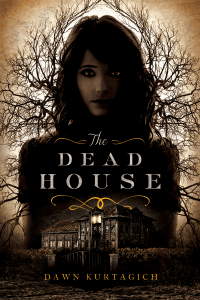
I cannot resist a book with a creepy cover – especially if there’s a  creepy house or building on it and so even though I’d heard nothing about this book and had never heard of its author, I took  a chance on Dawn Kurtagich’s debut novel, The Dead House.

deadhouseThe premise is that investigators are looking into the death of three students at Elmbridge High, a boarding school in Somerset,  England. The school was destroyed by fire.  In order to unravel the story they have gathered police interviews, personal diaries, notes and video tape footage which has been transcribed (although it might have been cool to include links to a site to watch the tape). The incident happened over twenty years ago and as the report statement reveals “little was revealed about the tragedy.”
The incident has been something of an urban legend  connecting Kaitlyn Johnson, “the girl of nowhere” to the blaze. When her diary is found in the rubble, it spurs a new investigation into what actually happened in the days leading up to the fire.

Readers will know they’re not in Kansas anymore from the book’s opening pages. First of all,  we’re at the Claydon Mental Hospital. Kaitlyn has written in her diary:

I am myself again.

Carly has disappeared into the umbra, and I am alone. Ink on my fingers – she’s been writing  in the Message Book.

Good night, sis! she writes. We’ll be back at school soon. I can’t wait.

Turns out Kaitlyn and Carly  are one and the same. Carly, sweet and shy, inhabits the day and Kaitlyn, a little tougher around the edges, inhabits the night. Dr. Lansing, their psychotherapist, says that Kaitlyn is a product of trauma, a personality born of a personal tragedy. The two personalities communicate via a message book. They remind each other of people they’ve met, food they’ve eaten and the minutiae of daily life. Their separate lives happily co-exist.

But then Carly seems to go ‘missing’ and that’s when things take a decided turn into the weirder.  Dr. Lansing considers the disappearance of one personality a breakthrough. She tells Kaitlyn, “Carly is letting you go. It has to happen. It will feel like abandonment, it will be so hard. But, eventually, you’ll find peace. You’ll integrate. Absorb.”

Kaitlyn is convinced that that is not what is happening. She thinks Carly is trapped in the “dead house” and she has to rescue her. Kaitlyn isn’t alone. Naida, Carly’s best friend, is also sure that something sinister is going on – something to do with powerful dark magic.

Whichever way you read The Dark House, as a novel about mental illness or a supernatural horror story, Kurtagich’s novel is unusual and compelling, if not always comprehensible.

The Dogs – Allan Stratton

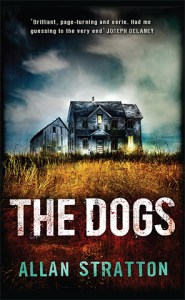
Cameron and his mom have been on the run for as long as Cameron can remember. the_dogs_uk_cover_med_frontCameron’s dad is dangerous and they’ve never been able to stay in one place for very long. This last move takes them to a farmhouse in the middle of nowhere, outside of a small town called Wolf Hollow.
“Whoa! Somebody! Put this place out of its misery.” That’s how Cameron describes the two-storey, ramshackle building he and his mom are going to call home. Mom notes the two staircases and says “It’s good to have more than one escape route…in case of fire.” Mr. Sinclair, the old farmer who owns the house, is secretive and slightly menacing.

But Cameron’s creepy father isn’t the only creepy thing going on in Allan Stratton’s YA novel The Dogs. Cameron discovers some drawings and a photograph in the coal room and the discovery connects him to a strange mystery that has haunted the farmhouse for decades. One of the drawings depicts “a pack of wild dogs ripping things apart.” Further investigation reveals that the previous owner, Mr. McTavish, was ripped apart by his dogs after his wife and son, Jacky, ran off with another man.

The clever things about The Dogs is that it operates on many different levels. As Cameron spends more and more time trying to figure out what really happened in the farmhouse all those years ago, he also begins to question his own memories of his father. Is his mother telling him the whole truth or is she leaving out essential details? Is his dad really as bad as his mother says?

Cameron’s traumatic childhood makes him especially suggestible and readers will share every spooky bump-in-the-night incident with him as he tries to reconcile his memories with what is happening in the house. Is he crazy, as his mother worries he might be, or are the things he sees and hears really happening?

“It’s not my fault I picture things, or talk to myself. If I try to keep all the stuff in my head inside, I’ll explode,” Cameron explains to his mother.

The Dogs is written in straight-forward prose, which will appeal to many young readers particularly reluctant readers. I think any reader will enjoy the book’s eeriness and honest portrayal of a teenage boy who despite his own difficulties shows tremendous resilience. I know I did.


Two Or Three Things I Forgot To Tell You – Joyce Carol Oates

I have a love/hate relationship with Joyce Carol Oates. Sometimes I read her and after I’ve settled into the odd rhythm of her writing I think, yeah, that was pretty good (We Were the Mulvaneys; Beasts) and then sometimes I read her work and think, that was a lot of effort for nothing (Rape: A Love Story) and then there’s this time, when I read Two Or Three Things I Forgot To Tell You and about two thirds of the way in I thought, what the hell just happened? 13501407

Merissa Carmichael has just been accepted into Brown, her first Ivy League choice. Merissa, M’rissa to her friends, has it all going on: good students, good athlete, good friend, pretty and popular, but she is also deeply troubled.

…in the little bathroom adjoining her room, with trembling hands – trembling with excitement, anticipation! – opening a drawer beside the sink, and, at the very back of the drawer, seizing the handle of a small but very sharp paring knife – bringing out the knife, and pressing its tip against the inside of her wrist, where the skin was pale and thin…

Nadia Stillinger, Merissa’s friend, “hadn’t a chance of getting into Brown, or any Ivy League university” has her own problems including a father who works too much and a too young step-mother. She’s fat, too, weighing in at a whopping 119 pounds. And everyone knew that  it was “utterly, utterly disgusting to be fat.”

The one thing Nadia and Merissa share is Tink, the child-star who moved to their town of Quaker Heights, New Jersey during their junior year. Tink is a “short, fiery-haired girl” whose  “face was pale and plain, as if it had been scrubbed, and even her freckles looked bleached.” She’s unlike any other girl at Quaker Heights High.  She talks back to teachers, doesn’t give a rat’s ass for fashion and doesn’t even seem all that interested in making friends, which is why the girls in Merissa’s circle so desperately want to fly in Tink’s orbit. She seems fearless. Until she kills herself – which actually happens before the story begins – so much of the story is told in flashback.

Two Or Three Things I Forgot To Tell You  isn’t your average YA novel. First of all, the narrative is  Joyce Carol Oates wacky. The narrator is one of the girls – but not Merissa and not Nadia and not Tink. Lots of personal pronouns, though, like “We were stunned” and  “We laughed because Tink laughed”. Still, the first part of the novel is tightly focused on Merissa and her penchant for cutting and the trauma of her parents’ crumbling marriage. Then, Merissa is abandoned (presumably in a much better emotional place than when we meet her) and the focus switches to Nadia and her problems – mostly to do with an incident at a party and her inappropriate feelings for her kind (and handsome) Science teacher.

You either get used to the way Oates writes or you don’t. This book is rife with parentheses and asides couched in dashes. Perhaps the writing is meant to mimic the frenetic minds of its characters, but whatever the case I read the novel quickly. I can’t say I didn’t like it, but I can’t say I loved it, either. There is potential for discussion because the book is topical and in many ways captures the complicated and fraught time in a young woman’s life just before she is about to step over that imaginary line into adulthood. Sadly, some don’t make it.

Between the Devil and the Deep Blue Sea – April Genevieve Tucholke

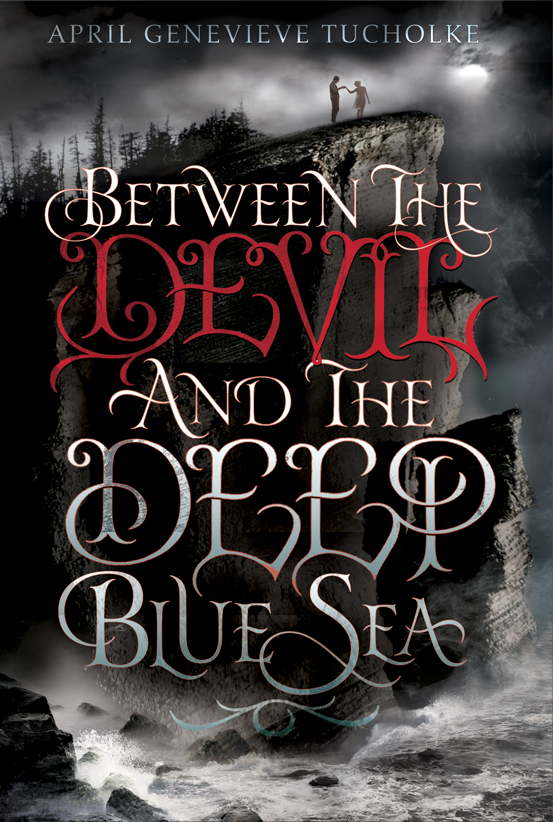
Seventeen-year-old Violet and her twin brother, Luke, live in a crumbling mansion in the town of Echo, somewhere on the coast of the Eastern United States. Their parents are absent, artists traipsing through Europe, so Vi and Luke are left to fend for themselves in the house built by their rich great grandparents. The money is long gone and now the house is no longer “dignified and elegant and great and beautiful.” Vi calls it Citizen Kane, but mostly because her grandmother, Freddie, had given it the nickname. Now Freddie is gone and so is the rest of the money Vi’s parents had left for her and Luke to live off until they returned from Europe. That’s the reason Vi decides to rent the guest house and that’s how River comes into her life. between-the-devil-and-the-deep-blue-sea

He was not tall – less than six feet, maybe – and he was strong, and lean. He had thick, dark brown hair, which was wavy and parted at the side…until the sea wind lifted it and blew it across his forehead and tangled it all up. I liked his face on sight.

River’s arrival shakes things up for Vi. She’s an introspective girl, prone to solitude and tucking herself away with a volume of Nathaniel Hawthorn short stories. Her one friend, Sunshine (the daughter of hippies who live down the road) is more a friend of proximity than anything else.

April Genevieve Tucholke’s YA novel Between the Devil and the Deep Blue Sea is a strange hybrid of gothic romance and suspense thriller. Although Vi is naive, she’s no – wait for it – shrinking violet. River’s just about the most exciting thing to happen in Echo in her whole life. The problem is that shortly after his arrival strange things start to happen. For one thing, a little girl goes missing and children in town claim to have seen the devil. Then the town drunk slits his own throat, in broad day-light, in the town square. Then River’s brother, Neely, shows up and Vi discovers that River has a tendency to lie about just about everything.

There are some truly creepy moments in Between the Devil and the Deep Blue Sea and, like Vi, you’ll be conflicted about River’s motives and actions. I don’t want to say too much about what’s going on because it’ll be more fun if you find out for yourself. Let’s just say, there’s some nasty energy in Echo and this book has a kick-ass denouement. There is a second book, Between the Spark and the Burn and according to Tucholke there are no plans for a third (praise the book gods!) so I will probably purchase the second book just to see what happens.

Lovely writing and page-turning fun makes Between the Devil and the Deep Blue Sea a winner.

Night School – C.J. Daugherty

Over 400 pages and I read them all lickety-split. C.J. Daugherty’s YA novel Night School is so much fun! Even when I discovered – about half way in – that the book is the first in a series (and you know how I feel about series), even then…I had to keep reading. (I don’t really have anything personal against series. It’s just that it’s such a commitment of reading time and that’s in short supply in my reading world. Still, as soon as I finished the book, I had to go online to see whether the sequel(s) was out. Um. There are four more books, people!)

Sixteen-year-old Allie Sheridan is always in trouble these days. She used to be a good kid, but then her older brother, Christopher, disappeared under extremely mysterious circumstances, and Allie’s been hanging with losers, defacing school property and just generally getting into trouble ever since. Finally her parents can’t take it anymore and decide to send her to Cimmeria Academy, an elite private school in the middle of the English countryside.

Night_SchoolThere – cut off from the outside world (no technology allowed) – she meets Isabelle, the school’s headmistress, and a cast of intriguing teenagers, among them Sylvain, gorgeous and French; Katie, the snotty rich girl; down-to-earth, Jo and Carter West, he of the endless brown eyes and bad reputation. They are all staying on at Cimmeria for the summer term. (School breaks up about mid-July in England and then goes back after Labour Day, early September…so about a six week break.)

Allie soon falls into the school’s rhythms and discovers that she kind of likes it at Cimmeria. Jo is nice and Sylvain is paying special attention to her. The food is great and the school is beautiful.  What’s not to like?

Well, first of all there’s ‘Night School’, but like ‘fight club’ – you’re not supposed to talk about it.

Students in certain advanced areas of study take part in Night School to prepare them for life after Cimmeria so you will sometimes hear them working late in the evening. Only very few select students are offered this opportunity; if you are not among them, you must not attempt to interfere with or observe Night School, and the fourth floor of the class-room wing is off limits.

Then there’s the woods though, according to Jo,  “we don’t actually do much in the woods, and they kind of discourage it because of, I dunno, health and safety or something.”  Then there’s Carter’s cryptic warning: “You haven’t been at Cimmeria long enough to understand how things are here. So be careful, okay? Things are not what they seem. People aren’t always who they seem to be.”

And I still had 200 pages to go!

There are creepy moments aplenty in Night School. Intrigue galore. And even if the payoff isn’t quite there, there’s more than enough to keep readers turning the pages. I would definitely be interested in reading the next book in the series, Legacy, to see how Allie makes out.

My only other niggle is that the characters don’t sound British. The occasional ‘blimey’ thrown into their dialogue does not a British accent make. They sounded decidedly American to me, which stands to reason: Daugherty is from New Orleans, though she now lives in England. That’s a small thing, though, and in no way undermined my overall reading experience.

Fun, fun, fun!

Fitz – Mick Cochrane

fitzMick Cochrane’s YA novel, Fitz, is the story of what happens when a boy decides to confront the father he’s never met.

Fitz is a “typical fifteen-year-old boy. A sophomore on the B honor roll. A kid with a messy room, an electric guitar, a notebook full of song lyrics, vague dreams about doing something great some day, a crush on a red-haired girl.”

And like many other teens, Fitz (short for Fitzgerald) lives with his single mom. His father is an unknown entity; his mother doesn’t talk about him and although he supports Fitz financially, Fitz knows nothing about him. That doesn’t mean Fitz doesn’t think about him, though.

When Fitz was a little boy, he liked to imagine that his father was quietly, secretly watching over him, loving him, for his own good and unselfish reasons, from a distance.

Circumstances have changed, though. Fitz has inadvertently discovered his father’s home address and he’s decided to confront his dad, which, sure, that seems plausible enough. What doesn’t seem quite as likely is the fact that Fitz takes a gun with him and pretty much kidnaps his father. It’s a scenario that could go horribly wrong.

Turns out, though, that Fitz’s father, Curtis, is a decent guy – clearly, he’s been paying support all these years. Over the course of the day the two listen to music, hang out at the zoo, have lunch and visit Curtis’s office (he’s an attorney). As the day unfolds, Fitz tries to figure out what it is he really wants to know about his dad and Curtis, it seems, is only too willing to talk, has – in fact – been waiting for fifteen years to have this conversation with his son. It’s kind of sweet, really.

“You were a good baby, a beautiful baby,” that’s how he starts. That’s his once-upon-a-time. He says that Fitz was healthy, bright-eyed, curious. He had amazing blue eyes. It’s just that he didn’t sleep, at least not for long stretches.

Fitz is sensible enough to listen as his father tries to explain the story of his relationship with Fitz’s mother and smart enough to realize that even parents make mistakes because, in their own once-upon-a-time, they were young enough to make them. If the story seems just a tad sentimental, Cochrane can be forgiven because Fitz is a likeable character and, thankfully, the gun is little more than false bravado.


What Happens Next – Colleen Clayton

whathappensnextColleen Clayton’s debut YA novel, What Happens Next, follows sixteen year old Cassidy ‘Sid’ Murphy after she’s drugged and raped while on a school ski trip. That seems like a pretty big spoiler, I know, but it’s not. The book pretty much spoils it with the tag line “How can you talk about something you can’t remember?” Besides, it’s not the most dramatic thing that happens in this book, even though it is the impetus for Sid’s journey.

Sid and her best friends Kirsten and Paige are pretty excited about this ski trip, but of the three Sid is the amateur and so after a few hours at the bunny hill she sends her friends off to do some real skiing. While on her own, she meets Dax Windsor, “a hot specimen.” Sid can’t quite believe he’s looking at her. He’s

… the best-looking guy I have ever seen up close and he is interested in me – goofy, loud-mouthed Sid Murphy, with my crazy red hair, bubble butt and obnoxious laugh.

Dax is all slippery charm, though, and when he invites Sid to a party the next night Sid seems powerless to refuse, even though it will mean sneaking out of her chalet. But sneak she does and when she wakes up the next morning in a strange bed with no memory of what happened the night before, Sid’s world is shattered.

Instead of telling anyone – her friends, mother, police – what happened, Sid isolates herself. Her relationship with her besties fractures; she’s kicked off the cheerleading squad, her reputation is sullied, despite the fact that no one actually knows what happened.

This is where things get tricky for the reader (and mother) in me. Although Sid has no control over what has happened to her and is powerless to undo what has been done, she finds a way to quell the panic and shock she feels. First she starts running. A lot, like hours. Then she starts eating and purging. And no one notices. Is it a case of, we see what we want to see?  I don’t know. I would like to think if something this horrific happened to my daughter, I would sense that something was wrong, but all Mrs. Murphy seems to want to do is serve starch-heavy meals.

Then, into the mix, comes Corey Livingston: slacker, stoner, degenerate. Sid judges him  in exactly the same way as everyone is judging her – without knowing all the facts. As the two start spending time together, though, Sid feels herself starting to trust Corey, not enough to tell him her darkest secret, mind, but enough to at least feel like she has one friend. Their relationship is one of the nicest things about What Happens Next.

Despite a few things that didn’t quite work for me – that last 20 pages or so just seemed rushed – Clayton’s book will appeal to any teenager who has ever felt that they have a burden too insurmountable to overcome. Sid is a likeable character, but I think the real prize here is Corey.

Made of Stars – Kelley York

madeofstarsHalf-siblings Hunter and Ashlin have been friends with Chance since they were kids and first started to spend summers in Maine with their father. Chance is the glue that bonds the three together, despite the fact that Hunter and his sister don’t really know all that much about him.

I knew all the things about Chance that mattered most. Chance was strangeness and whimsy in human form.

Chance was our summer.

We didn’t see him or talk to him through the winter, but when we arrived for summer vacation, the three of us came together like we’d never been apart.

This year things are different, though. Hunter and Ashlin have decided to take a gap year and spend it with their father, who is still recovering from a workplace accident (he’s a cop and was shot; Hunter and his sister were kept with their mothers and away from their dad for a couple years).

So, now they’re back in Maine with their dad and each other…and with no way to contact Chance. When they finally do track him down,  they discover that Chance hasn’t been 100% honest with them.  For one thing, his house “is nothing like what Chance described.”  His parents are clearly not glamorous jetsetters, either. Instead, his mother looks “like she cuts [her own hair], and her face is gaunt and tired. She’s wearing a gray men’s bathrobe over a nightgown and pink slippers that have seen better days.” Chance’s father is “broad-shouldered and stone-faced, with a jaw that hasn’t seen a razor in a few days.”

But Chance is the same. And not the same.

Kelley York’s YA novel Made of Stars captures that time between innocence and experience. These three teens have a shared history made more complicated by an unexpected love triangle. But Made of Stars isn’t a straight-up love story.  When someone turns up dead, Chance is implicated and Hunter and Ashlin set out to prove his innocence. Turns out, even that is more complicated and dangerous than the siblings could have imagined.

Enjoyable read.