How To Be Lost by Amanda Eyre Ward

howtobelost

My copy of Amanda Eyre Ward’s novel How To Be Lost came with an unusual guarantee: the publisher promised to  refund your money if you didn’t like How To Be Lost as much as The Lovely Bones . I suppose at the time of its publication, comparison to the juggernaut that was The Lovely Bones would seem like high praise indeed. But I won’t be writing to collect my refund, thanks very much. I loved How To Be Lost and, in fact, I think I liked it even more than The Lovely Bones which, in my opinion, started off with a bang and ended with a whimper.

Ward’s novel concerns the Winters family, specifically the Winters daughters: Caroline, Madeline and Ellie. We meet the eldest, Caroline, first. She’s a hard-drinking cocktail waitress in New Orleans trying to figure out how she’s going to tell her mother, Isabelle, that she’s not coming home for Christmas.

Home isn’t a happy place for Caroline. Home brings back horrible memories of her alcoholic father, her miserable mother and the disappearance of her youngest sister, Ellie. Still, duty calls.

It’s on this visit home that Caroline’s mother shows her a picture in a People magazine. As soon as Caroline sees it, she knows. It’s her baby sister.

How To Be Lost really is a story about people trying to find their way in both extraordinary circumstances (a potential love interest for Caroline has lost his wife in the 9/11 attacks and he is trying to move on with his life) and mundane circumstances (the novel is peopled with characters who spend their lives hunched over beer or whiskey in a variety of scummy bars).

Some people don’t like first person narrative, but I do, especially if the narrator is honest. Caroline is self-destructive and selfish and afraid. Her journey to find the woman in the picture is ill-advised and necessary because by making the journey she is making her first real attempt to leave the past behind.

One of the things I hated most about The Lovely Bones was Sebold’s decision to flash forward into the future. That rarely works for me. Ward doesn’t do this. Her ending, if anything, is a dangling thread. Her ending, for me, was perfect.

This is a gem of a book.

Now You See Him by Eli Gottlieb

nowyouseehim

I’m not quite sure how Now You See Him ended up on my radar; I’d never heard of its author, Eli Gottlieb, before. Ann Patchett declared that the book is a “true literary page-turner in which a string of startling revelations unfolds within the constructs of lush and beautiful prose.  It is at turns both heartbreaking and breathtaking.”

Now You See Him depicts the mid-life crisis (although I think the character is only in his mid 30s) of of its narrator, Nick Framingham. Things might not have been so complicated and devastating for Nick if his childhood best friend, Rob Castor, hadn’t murdered his girlfriend and then killed himself. Rob’s death, however, is the catalyst from which Nick begins that horrible self-examination which seems to usher in middle age. Rob was, in Nick’s eyes, the golden child: beautiful, charming, funny, irreverent, talented (he attained celebrity for writing a book of well received stories and then seemed to drop off the literary map).

Rob’s mystifying death – how could someone who seemed to have it all, kill someone and then themselves? – sets in motion Nick’s own journey. It’s a significant one because he has a wife and children and his grief pushes him away from them. He loves his wife, but no longer feels connected to her. Instead, he laments what might have been with Belinda, Rob’s vibrant, kooky, beautiful sister.

This is a book, it seems to me, about loss and losing oneself. Nick is so full of anger and regret and sadness, it tears at the very thing that should sustain him in this time of crisis: his family.  There are dark secrets in Now You See Him and as those secrets are revealed one at a time, instead of freeing Nick they seem to anchor him more firmly to the past.

Gottlieb is a beautiful writer, Patchett got that right. This story is layered and moving and, at times, difficult to read. An early sex scene between Nick and his wife, Lucy, is devastating – especially difficult to read, I suspect, for those readers who are married.

Now You See Him is a well-written, intelligent book on the nature of friendship, family and love.

On Chesil Beach by Ian McEwan

chesil1

Unlike the female protagonist of McEwan’s novel, On Chesil Beach I am not a virgin when it comes to McEwan’s work. This is the sixth book I’ve read by this author (Saturday, First Love, Last Rites, The Comfort of Strangers, The Cement Garden, Atonement), but I’d have to say it’s my least favourite.

Like his novel Saturday, McEwan compresses time and shows us Edward and Florence, a young couple dining together in a hotel on Chesil Beach on the evening of their wedding. They haven’t yet consummated their union and they are both approaching the idea of the event-to-come from vastly different vantage points. Florence is horrified at the thought of sex and Edward is both patient and anxious.

McEwan fills in the blanks in their personal stories as well as their history as a couple and does it well enough that you come to understand Edward and Florence very well. Whether or not you have any sympathy for them will depend on your patience.

As inexperienced as Florence is, I was left with the distinctly uneasy impression that her aversion to sex (and she really is repulsed by it: her description of a kiss made me reconsider kissing my husband ever again!) was the result of some traumatic event- although nothing is ever explicitly stated.   Edward’s own inexperience has its own unfortunate consequences and the repercussions are devastating.

But then McEwan does something I sort of hate in a novel- he flash forwards a few years and then many years and tells us what these people have been up to. That sort of ending never works for me.

No question, McEwan is a fabulous writer. This same story, in lesser hands, would be unbearable. As it was, I felt like I was laughing where I shouldn’t be and the climax, no pun intended, was a rather soggy affair.

Obedience by Will Lavender

obedience

There’s no lack of praise for Will Lavender’s debut novel, Obedience. It’s a twisty, knot of a book that concerns students in a Logic and Reasoning Class at a small college campus in Indiana. Their only assignment:  find a missing girl, Polly, before the six-week course is up or she will be murdered by her abductors.

Lavender does not  concern himself with all the students in Professor Williams’ class. He focuses his attention on Mary, a slightly fragile and obsessive girl; Brian, a student overcoming the loss of his brother and Dennis, Mary’s ex-boyfriend. As they work alone and then together to solve the mystery of Polly’s disappearance, Lavender strings them (and us) along with enough plot twists and convoluted clues  for three novels. At one point I considered making a chart.

I can’t claim any real expertise when it comes to mystery novels. I read them, I enjoy them. Lavender is working on -at least- a couple levels in Obedience and while the ending is certainly clever and tidy…the final chapter made me question what I thought I knew all over again.

No matter- this is a fast-paced page-turner of a novel, smart and complicated and, yeah, a chart’s not a bad idea.

Desert Places by Blake Crouch

desert

Okay, I admit it. I have a kinda thing for psycho-killer novels. You know, some crazy person who chews up the landscape doing unspeakable things to innocent people. The best one I’ve ever read is Intensity by Dean Koontz. I could not put that book down.

Blake Crouch’s debut novel Desert Places isn’t nearly as good as Intensity, but it’s pretty darn good. It tells the story of successful mystery writer Andrew Thomas. One day Andy gets a letter in his mailbox: There is a body buried on your property covered in your blood. And we’re off. And so is Andy on a harrowing ride which cuts pretty close to home. I don’t want to give away a pivotal plot point, even though it comes fairly soon in the novel. Suffice to say, Andy is about to have a very bad few weeks.

Books like these fail or succeed (for me at least) because of a couple important ingredients. First of all, I want the good guy to be someone I want to root for. He doesn’t necessarily need to be the nicest guy, but he has to be decent in a way that the bad guy is not. Andy, the writer, is decent enough. He visits his mother faithfully, has a good friend. He’s smart and human. I also like the bad guy to be scarily bad. I want to feel afraid when I read a book like this, otherwise what’s the point? Trust me, this book is scary….especially the first third of it.

I am not sure that Desert Places delivered on its early promise, but that won’t stop me from checking out Crouch’s other books.

Places in the Dark by Thomas H. Cook

placesinthedark

This is third book I’ve read by mystery writer Thomas H. Cook and I have to say that I continue to be impressed. The critics seem to adore Cook and have described Places in the Dark as “a serpentine tale of long-buried secrets leading to murder and betrayal” (The Orlando Sentinel) and “complex, multi-layered and haunting” (Romantic Times).

The story concerns brothers William and Cal who grow up in an idyllic seaside town in Maine in the 1930s. They are as different as night and day: William an energetic dreamer who rushes through life filled with hope and enthusiasm and Cal, the older more pragmatic brother. Still, despite their differences, they are close. Then Dora March comes to town.

It gives nothing away to say one brother ends up dead, but the book’s mystery isn’t so much a whodunit as a what are the circumstances surrounding the death.

Cook’s skill comes from his ability to create character. His mysteries unfold slowly, but I don’t mean to say that his books aren’t page turners. You’ll turn the pages, but I think you’ll also linger over Cook’s beautiful writing. Cook is a master of layering his character’s motives, of giving them real interior lives. He’s also pretty good at leading us on and this is particularly true in Places in the Dark where things are not always what they seem.

If you like a well-written mystery, I highly recommend Thomas H. Cook. I haven’t been disappointed yet.

Fierce by Hannah Holborn

fierce

Truthfully, I wasn’t optimistic about Fierce when I started it. This Canadian collection of shorts stories and a novella features more emotionally and physically damaged people than it should be humanly possible for one writer to conjure. Doesn’t the author, Hannah Holborn, know anyone even remotely normal?

But then a strange thing happened during ‘The Indian Act’.  I sort of fell in love.  Suddenly these crazy, damaged, sad people started making sense to me. ‘The Indian Act’ follows the fortunes (and misfortunes) of Liam, a kid who is shuffled from one foster home to the next until he finally finds a family who is decent and loves him and his best friend, Callie, whose mother just up and leaves her.

‘We Danced Without Strings’ tells the heartbreaking story of a mother coming to terms with her daughter’s diagnosis of Angelman’s Syndrome; a condition which includes an absence of speech, facial abnormalities, a protruding tongue, hand-flapping, jerky gait and, strangely, a permanent smile and easy laughter.  “If we let her,” the mother muses, “she would be happy.”

‘Ugly Cruising’ gives us a glimpse at another kid, Elvin, with another horrible condition: Treacher Collins syndrome.  “He has a torso and all the usual appendages,” Elvin’s younger sister, Cricket, notes “but what he does lack is a nose and a chin and a voice to confront others with.”  Cricket’s family deals with with Elvin’s condition in various ways: his mother, Wanda, drinks; his father, Bing, makes lame jokes and Cricket and her teenage friends apply horrible theatrical makeup and go Ugly Cruising.

The book’s novella, ‘River Rising’ is a beautiful conclusion to this book.  The story follows the lives and fates of the people of a small northern town called Everlasting. Central to this story is River, a teenager who has spent her life mourning the mother she barely knew.  The choices she makes are both inevitable and heartbreaking and, ultimately, hopeful.

Although there were a couple stories I just didn’t warm up to, by the time I closed the book on Holborn’s strange cast of misfits I felt sort of sad to be leaving their company.

The God of Animals by Aryn Kyle

godofanimals

Is there a litmus test for whether or not we like a book?  At book club last night, where we discussed our first book of 2009,  The God Of Animals by Aryn Kyle, we asked the question: would you recommend this book to a friend? The answers were varied and that’s even after we had a very lively discussion of the book’s merits (and there were a few.)

The God of Animals begins with the death of 12 year old Polly Cain. It’s a riveting scene in which we learn not only of Polly’s death but also several other important things about the novel’s narrator, Alice Winston. Alice returns to Polly’s death again and again throughout the novel, but we never learn exactly how the young girl died. Whether or not the information is relative will be entirely up to the reader, but some might find that never knowing Polly’s fate is just one of the ways Kyle leaves the reader dangling.

Alice Winston lives on the family horse farm with her father, Joe, and her mother, Marian. Alice’s older sister, Nona,  left the farm six months earlier, with her rodeo husband, Jerry. The Winston’s struggle to make ends meet on the farm and Alice’s family life is further complicated by the fact that her mother  retired to her room after giving birth to her and she’s never really gotten out of bed. Of course, that doesn’t mean she isn’t aware of what’s going on;  she watches the comings and goings (of rich women who board their horses at the farm) from her window.

The story unfolds during the crippling heat of one summer and climaxes during a snow storm- the first snow in Alice’s life. As Alice tests her boundaries and learns certain truths about the way the world works, she also navigates the tricky road of adult relationships. Then, of course, there are the horses: we see them give birth, we see the foals separated from their mothers, we see them being bred and broken, we see them maimed and killed.

Despite all this, The God of Animals is a quiet book. The prose is quiet- it never quite swept me along. The characters were interesting, but I was never wholly invested in them. I wonder what might have happened if the narrator had not been Alice?

So, back to my original question: would I recommend this book? My answer – maybe. *g

The Enchantment of Lily Dahl by Siri Hustvedt

lilydahl1

Despite early reservations,  I kept reading The Enchantment of Lily Dahl, but I wouldn’t necessarily say that I loved the novel in the end. It’s a strange book populated by a cast of characters so odd it seems impossible that they should all end up in the same story.

There’s Lily, the 19 year old waitress who worships Marilyn Monroe and dreams of becoming an actress. There’s Mabel, her elderly next-door-neighbour, who  can’t sleep and spends her time writing  the story of her life. There’s Dick and Frank, two elderly men who are so filthy they leave a black cloud wherever they go. There’s Hank, Lily’s beau-hunk of an ex-boyfriend. There’s Edward, the artist who lives in the building across the street. And then there’s Martin, an oddly menacing boy Lily has known her whole life. This wild assortment of characters live in a small town, Webster Minnesota, where Lily works as a waitress at the Ideal Cafe.

The story Hustvedt is trying to tell seems to be one about secrets and memory, youth and old age, dreams lost and realized. The whole middle section of the book, though, reads as though Lily is crazy and it’s hard to say whether this is a triumph (and I am just too dense to see it) or a failing.

In between waiting tables and sleeping with the painter from the building across the road, Lily is rehearsing her part in A Midsummer Night’s Dream. She also seems to be, to some degree, coming apart at the seams- although I think this is supposed to be the character navigating the tricky road from innocence to experience.

For me, though, while her coming-of-age-journey was nicely written, I never felt connected to Lily or what was happening to her. Both the real and the imagined obstacles were off-kilter…as odd as Lily and the people she spent time with.

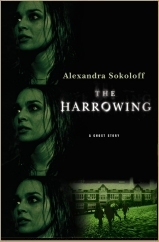
The Harrowing by Alexandra Sokoloff

harrowing

It’s been a long time since I’ve read a book this quickly. I started it last night and finally had to turn my light off after 100 pages…my eyes were burning and my heart was pounding.

Alexandra Sokoloff’s background is in theatre and as a script writer and The Harrowing, her first novel, certainly owes a debt to the screen. The prose is straightforward and while I wouldn’t go so far as to say the book is filled with trademark horror-film cliches,  the book’s creepiness (and trust me- the book is creepy) does owe a debt of gratitude to all those scary movies you watched as a teenager.

First of all, the book takes place at a remote college campus- specifically in a dorm filled with dark halls and secret staircases. You know what that means, right? The novel’s protagonist is Robin, a lonely girl who doesn’t quite fit in with the usual suspects (and trust me- all the stereotypes make an appearance: the handsome jock, the emo musician, the Southern belle, the slutty girl, the intellectual.) The book opens on a stormy Thanksgiving weekend. Everyone is heading home except for Robin; she has to spend the weekend all alone in her dorm.  Turns out she’s not alone, though.

The Harrowing benefits from its fast-moving plot and sketchy characterizations, ie it moves along at a breathtaking clip. That’s not to say that you don’t care about the characters, but this is a book with one purpose: to scare the bejebus out of you and it works on many levels.

It’d make a damn fine movie.