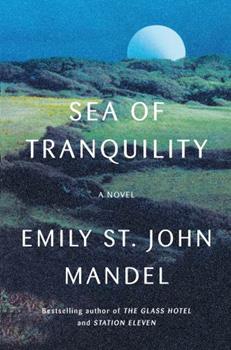
Sea of Tranquility – Emily St. John Mandel

It’s funny how some time travel books work for me and some don’t. Earlier this year I read This Time Tomorrow and I think that is probably my favourite book of the year. Years ago – before I started this blog – I read The Time Traveler’s Wife and cried so hard at the end, I couldn’t see the pages. So, I definitely went into Emily St. John Mandel’s Sea of Tranquility with an open mind, plus I loved Station Eleven.

The novel opens when Edward St. John St. Andrew is exiled from his home in England to the wilds of Canada, landing first Halifax before heading to the West Coast. It is 1912. While walking in the woods near the remote coastal community where he is staying, Edward has a strange experience

like a sudden blindness or an eclipse. He has an impression of being in some vast interior, something like a train station or a cathedral, and there are notes of violin music, there are other people around him, and then an incomprehensible sound–

Flashforward to 2020, where we are introduced to Mirella and Vincent – well to Mirella because Vincent is dead. The two women (yes, Vincent is a woman) had lost touch after Mirella’s husband had lost all his money in a Ponzi scheme orchestrated by Vincent’s husband and “how could Vincent not have known.” Now Mirella is at a concert waiting to talk to the composer, who is Vincent’s brother. It is here that we also are also introduced to Gaspery Roberts and the imminence of Covid-19.

Finally, in 2203, we meet Olive Lewellyn, who has come to Earth from the moon colonies to promote her latest novel, Marienbad, which is about “a scientifically implausible flu.” She has left her husband and daughter in Colony Two, “a city of white stone, spired towers, tree-lined streets and small parks.”

These three timelines are connected by Gaspery, but readers won’t really know it straight away. I am not a person who really digs into – or digs – the science of time travel: I enjoyed This Time Tomorrow and The Time Traveler’s Wife without spending too much time trying to figure out how all the pieces fit together. I found all the metaphysical stuff in St. John Mandel’s book a bit above my pay grade, honestly. And while Sea of Tranquility was easy enough to read, I didn’t really care too much about any of the characters so when it got to the end, and the discussion of life’s meaning – well, honestly…I just wasn’t invested.

I think my ambivalence is more about me than the book’s quality, though.
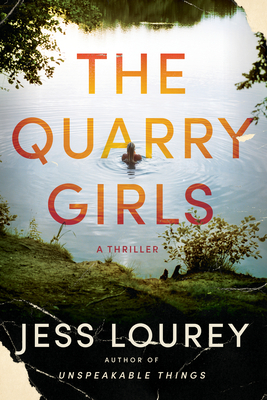
The Quarry Girls – Jess Lourey

Jess Lourey (Unspeakable Things, Bloodline) has written another fast=paced thriller ripped straight from the headlines. Literally. In her Author’s Note, Lourey says of her childhood home in Minnesota: “Three killers were on the loose in Saint Cloud when I was growing up. Only two have been caught.”

In The Quarry Girls, best friends Maureen, Brenda and our narrator, Heather, are coming of age in Pantown, a suburb of Saint Cloud, in 1977. Pantown was

built by Samuel Pandolfo, an insurance salesman who in 1917 decided he was going to construct the next great car manufacturing plant in good old Saint Cloud, Minnesota. His twenty-two-acre factory included fifty-eight houses, a hotel, and even a fire department for his workers. And to be sure they made it to work come sleet or snow, he ordered tunnels dug linking the factories and the houses.

One day, while playing hide and go seek in the tunnels, Heather and Brenda see something they aren’t supposed to see. When a local girl who is just a little bit older than they are goes missing, the teens begin some sleuthing of their own. It turns out that not everyone in Pantown is to be trusted.

There are all sorts of nefarious characters in this book including local boys Ricky and Ant and a new guy, Ed who

was way too old to be hanging out with high school kids, even a brain-fry like Ricky. […] Ed was exciting and terrifying and so out of place. His greased black hair and leather jacket against the soft, pastel Pantowners shopping behind him reminded me of a sleek jungle cat let loose in a petting zoo.

Even Heather’s parents, a mother who spends most of her time in bed and whose moods are unpredictable and a father, the local D.A. who is hardly never home, don’t seem all that reliable. Heather’s story is as much about the journey to adulthood as it is about what dark deeds are happening in Pantown.

And – an added bonus – so many references to the 1970s, the period of time in which I was coming of age. Heather’s friend Claude looks like Robby Benson. Getting dolled up meant an extra slick of Kissing Potion. Phones operated on a party line. Smokie and the Bandit was on the big screen. All these little nods to the period were just so much fun.

The story itself is fast-paced, well-written and I couldn’t put it down.

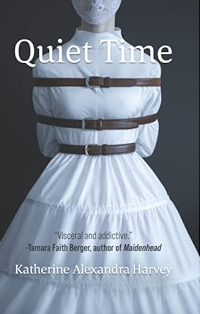
Quiet Time – Katherine Alexandra Harvey

Katherine Alexandra Harvey’s debut novel Quiet Time tells the (non-linear) story of Grace, the wild middle child of artist parents who (mostly) neglect and (sometimes) coddle their children.

My parents bought our house when my mother was pregnant. She was beautiful in a way that caused men to fall in love at first sight. Suiters would write poems about her, moaning Jayde, Jayde, Jayde, swearing they would die if she didn’t return their affection. She was often silent, lost in a daydream, didn’t return their affections.

Grace meets Jack when she is seventeen at a party hosted by her mother “for one of her new, young friends.”

He was tall, just over six feet, with dark curls piled on top of his head. He had sharp, high cheekbones that protruded just below his eye sockets. His lips were uneven, the bottom much fuller than the top.

Soon enough, Grace is hanging out with Jack, ostensibly to buy the weed that he sells. Jack is a few years older and a painter; Grace wants to be a writer. Their dynamic is not so dissimilar from her parents and it doesn’t take too long before it’s equally as dysfunctional.

I think if I had read this novel in my twenties I would have enjoyed it a lot more. There wasn’t anything wrong with it, but I just found the characters frustrating. Well, to be honest, young and stupid. Even the supposed adults, like Grace’s parents, behave like kids. The elliptical nature of the narrative made it virtually impossible to really settle into Grace’s story, which is told in vignettes. Perhaps that’s the point. Being a young adult isn’t pretty, I know, but it was hard, as a person in my 60s to really relate to any of these characters or their decisions.

The Handyman Method – Nick Cutter & Andrew F. Sullivan

I hadn’t heard anything about The Handman Method when I picked it up at the bookstore a couple weeks ago. I have an endless tbr list and so usually when I am buying books, I am choosing from that list. It’s very rare these days for me to buy books based on a cover or a blurb – unless I am familiar with the author. Nick Cutter (The Troop) aka Craig Davidson (Cascade, Cataract City, The Saturday Night Ghost Club) is a writer I really like, so when I saw this book, I bought it.

In this haunted house story, Trent and his wife, Rita, and their nine-year-old son, Milo, buy a new house in an unfinished subdivision. The house is spectacular but it “sat in moody isolation, a single unit in an otherwise uninhabited vista.” Still, it’s a dream house, the rooms “pristine, as if they had been finished with a jeweler’s attention to detail.”

It’s not perfect, though. Nick finds a crack in the master bedroom closet and it doesn’t take very long for things to start to get very weird.

Nick, a former lawyer (former because he’s on leave from his law firm after a strange incident), decides to tackle the crack on his own and that leads him to The Handyman Method, a YouTube channel where a man called Hank Trent offers his two subscribers advice on how to fix a crack in a wall and “Trent was immediately comfortable with Hank; the video was the equivalent of slipping into a comfy wool sweater.”

But Hank soon becomes an insidious force in Trent’s life and he’s not the only Internet personality who infiltrates the Saban household. Milo has his own YouTube obsession, Little Boy Blue, “a felt-limbed, Muppet-y creature [with a] toolbelt strung around its furry blue waist.”

The house starts to reveal its sinister underbelly, and I won’t spoil that for you. In many ways, it works as a haunted house story – and the backstory is …interesting. It’s hard to read a book with two authors and although Cutter explains in the notes the trajectory of the story, I’m still not quite sure how the whole thing went down.

I will say this, though: The Handyman Method didn’t really have the same emotional heft as Cutter’s other books (I am lumping all the books by Cutter/Davidson into this category.) I didn’t really care about this family as I probably should have and I am not sure if that is a flaw in the story or a flaw in me. There’s definitely some ick and some creepy moments, but I wasn’t blown away.