
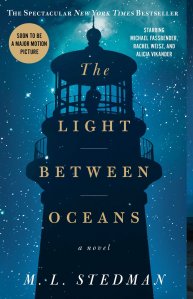
 I feel heartless for saying it – but I didn’t particularly like M.L. Stedman’s first novel The Light Between Oceans. I’ve had the book for a while, but it was last month’s book club pick, so I finally had occasion to read it. [insert long-suffering sigh]
Tom Sherbourne is a quiet man, intent on living a quiet life after having survived WW1. He’s returned to Australia and is about to take up his new post as lighthouse keeper on Janus Rock, an island off the coast of Partaguese on Australia’s western coast.
Teetering on the edge of the continental shelf, Janus was not a popular posting. Though its Grade One hardship rating meant a slightly higher salary, the old hands said it wasn’t worth the money, which was meager all the same.
Tom likes the idea of isolation thinking “If only he can get far enough away – from people, from memory – time will do its job.” It’s the horrors of war, he’s escaping, of course. But also his own childhood: a dead mother, an estranged father, a cold brother.
Just before Tom is about to leave for Janus he meets pretty, young Isabel Graysmark. Eventually the two marry and Isabel moves out to Janus. With a boat coming with supplies only about every six months, the newlyweds are certainly isolated, but they are happy.
Things start to get grim though, as Isabel suffers a series of miscarriages and then, shortly after her third, a small craft drifts into shore and in the boat a dead man and an infant. Isabel takes this as a sign from God, but Tom feels that they need to do the right thing, signal the mainland and report the incident. The decision the couple makes carries them through the rest of the novel.
So what’s not to like, you ask?
Ahhh….the melodrama. There’s boatloads of that. As Tom and Isabel wrestle with the moral, ethical and emotional questions posed by the foundling, their marriage suffers and they suffer personally, too. The constant negotiating got a little on my nerves, I have to say.
But there is another side to the story and that side belongs to the child’s birth parents. The introduction of these new characters is meant to up the emotional ante, and while it did for some of the ladies in my book club, I just felt like we were meant to wallow along with these suffering people and I just couldn’t muster any real feelings. Yes, I felt sympathy. I am a parent and I can only imagine how difficult the whole thing must have been. But to a certain degree I could see the clunky machinations of trying to fit all the pieces together and the swelling, heartfelt conclusion just left me feeling manipulated.
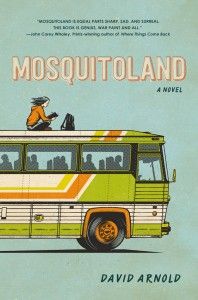 late: her parents’ divorce; her father’s quicky marriage to Kathy; their subsequent move from Ashland, Ohio to Jackson, Mississippi. When Mim overhears her father and stepmother talking to the principal, she’s convinced that her biological mother is sick and makes the decision to hop a Greyhound and travel the 947 miles back to Ohio to see her.
 Gah! This book, you guys.
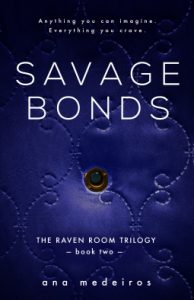 Canadian author Ana Medeiros’ The Raven Room Trilogy follows the sexcapades of Dr. Julian Reeve, a child psychologist, and journalism student Meredith Dalton. Sometimes you can jump into a series without having read the first book, but I really felt like I was at a severe disadvantage reading book two in Medeiros’ trilogy. Savage Bonds picks up where The Raven Room leaves off, but for a newbie reader, I literally had no sweet clue what was going on and I never felt as though I was sufficiently caught up.
 Creativity is a funny thing. I look around and see all these people who are tremendously creative. Both of my children are talented artists. My daughter spent many years studying ballet and is a beautiful dancer. Both my children are musical; my son taught himself to play guitar. I have other friends who are artists, painting with words or yarn or fabric or glass or clay. Some put their art on a plate. But I am probably not the only person on the planet who feels like they don’t have a creative bone in their body. I don’t draw or paint. I don’t dance. I can’t sing. The one thing I do like to do is write. I love to do it and have been doing it for as long as I can remember.
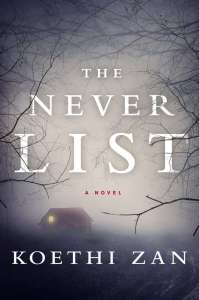 The Never List never really got off the ground for me, although the premise had a lot of potential. Koethi Zan’s debut novel is the story of Sarah, a reclusive young woman who is still suffering from the psychological scars of having been held captive by a sadist, Dr. Jack Derber.
 Amy Zhang’s novel Falling Into Place tells the story of sixteen-year-old Liz Emerson’s journey from happy child to miserable teen and the drastic choice she makes in an effort to end her emotional pain.
 Kat Rosenfield’s YA novel Amelia Ann is Dead and Gone is lush and languid, a coming-of-age story and a mystery that sends ripples through the small, insular community of Bridgeton.
 I actually put Fredrik Backman’s novel Beartown in my ‘to donate’ bag before I had reviewed it…and I guess that’s pretty telling. This was a book club selection, and not a book I would have ever chosen to read otherwise, so I guess I was skeptical from the beginning. Beartown made me cranky.
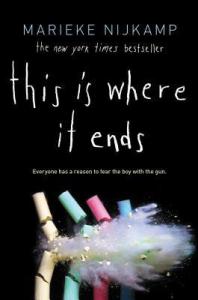 Marieke Nijkamp tackles gun violence in her compelling (and heartbreaking) YA novel this is where it ends.
