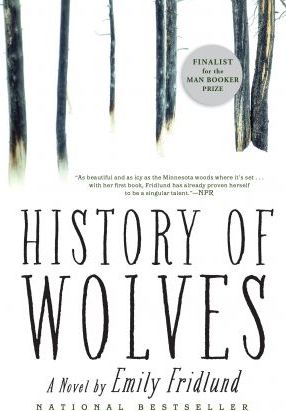
History of Wolves – Emily Fridlund

Emily Fridlund’s debut, History of Wolves, was shortlisted for the Man Booker Prize in 2017 and was the winner of the McGinnis-Ritchie Award for its first chapter. Awards generally mean very little to me because an award is no guarantee of my enjoyment. Just because someone is a NY Times best selling author doesn’t mean they can actually write. cough::Colleen Hoover::/cough

Linda lives with her parents on a lake in northern Minnesota. Once a part of a commune, Linda and her parents are all that remain.

I knew from stories how my parents had ridden in a stolen van to Loose River in the early eighties, how my father had stockpiled rifles and pot, and how, when the commune fell apart, my mother traded whatever hippie fanaticism she had left for Christianity.

The first thing to upend Linda’s life is a new teacher, Mr. Grierson, who “arrived a month before Christmas with a deep, otherworldly tan [and] wore one gold hoop earring and a brilliant white shirt with pearly buttons.”

Friendless and an outsider, Linda watches and “I wanted him to know that I saw how he looked at Lily Holburn.” The scandal about Mr. Grierson breaks in the fall of Linda’s grade nine year when he is accused of “pedophilia and sex crimes at his previous school and was promptly fired at ours.”

Then she meets four-year-old Paul and his mother, Patra, who have moved in across the lake. Thus begins a long, strange relationship which Linda recounts both as she lives it, but also from an adult perspective several years after the events take place.

At the trial they kept asking, when did you know for sure there was something wrong? And the answer was probably: right away.

History of Wolves is beautifully written, slow-moving novel about family, memory, faith and what it is to leave your childhood behind. Highly recommended.

Much Ado About You – Samantha Young

Straight-up romance is not normally my go-to genre, mostly because I find it difficult to relate to the 25-35 year-old hotties who normally populate said stories. I am a romantic at heart, but I am also a divorced 61-year-old and I come to these stories with a lot of baggage. I guess I want the characters to have some baggage, too. A much younger colleague at school told me about Much Ado About You by Samantha Young and I liked the sound of it because the protagonist is bookish and the story takes place in Northern England.

Thirty-three-year-old Evie Starling has just had her heart broken: twice. First, the guy she’d been SnapChatting with for months ghosts her, and then she’s passed over – again – for a promotion at the magazine where she works. She’s had it with Chicago and decides to shake up her life by taking an extended holiday in Alnster, Northumberland. She chooses Alnster because she sees an ad for Much Ado About Books, a cozy bookshop with a flat above where you stay while you run the bookstore. (There is a bookstore in Scotland that actually does this and it sounds like a dream vacation to me, too!)

On day one she meets Roane Robson, “the most beautiful man [she’d] ever seen”. The attraction is immediate and the two quickly become, well, friends. Evie has sworn off men, and this whole trip is so that she can figure out what she wants to do with her life. She doesn’t have time for Roane’s thick, dark hair, broad shoulders, warm brown eyes, white smile: you get it, the guy’s sex on a stick.

Evie is less than perfect – at least in her estimation.

At five foot ten, I was tall. In my four-inch heels, that put me at six foot two. But I didn’t think that was what bothered some guys. I had plentiful boobs, an ass, hips, and although I had a waist, it wasn’t super trim. Neither was my belly. Either guys loved my tall voluptuousness, or they labeled me fat.

As Evie settles into small town life, she and Roane settle into an easy friendship. That’s all they can be because Evie claims that that’s all she wants, although she certainly enjoys the eye candy that Roane provides her. The rest of the townsfolk welcome her with open arms – mostly. Evie loves running the bookshop and she loves getting into everyone’s business, so it would appear that this is a good move for her.

But, of course, the path of true love never did run smooth. Once her core starts throbbing for Roane, there’s no turning back. And once that line is crossed – although Young takes her time getting these two naked – it can’t just be smooth sailing. I found the reasons for their separation a little contrived, but you know as soon as this book starts how it’s all going to work out so whatever.

As far as romance goes, this is sweet, readable, with just a tad of tropey spice. I liked Evie and Roane; they were a great couple. I loved the setting and her bookstore gig is my dream. Did all the pieces fit together just a little too perfectly? Probably. But I don’t think you read this sort of book looking for angst.

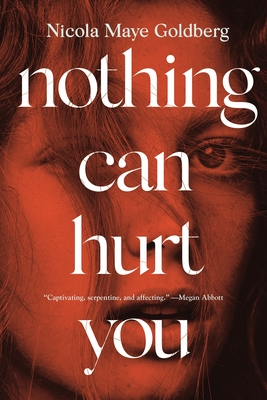
Nothing Can Hurt You – Nicola Maye Goldberg

Sara Morgan, a student at a liberal arts college in upstate New York is violently killed by her boyfriend Blake Campbell. He admits to the crime straight away and pleads temporary insanity. Nicola Maye Goldberg’s beautifully written novel, Nothing Can Hurt You, follows how this violent crime affects the people in the community where Sara lived, as well as her family and friends.

Goldberg’s novel is not linear; instead, it reads like a series of short stories that don’t even necessarily connect to each other other than the fact that the character in each one is somehow connected to Sara.

Marianne, for example, has recently moved to Rhinebeck with her husband. Marianne is fragile. She suffers from episodes.

At first it was just nausea. Then came images, as clear as if I were watching them on television. They were so violent. I saw myself stretched out on a piece of wood. Then the wood snapped in half, and so did I.

It is these episodes that have driven Marianne and her husband out of NYC, where they both hope that the fresh air and slower pace of life will help Marianne heal from her trauma. It is Marianne who discovers Sara Morgan’s body.

Katherine meets Blake Campbell at Paradise Lake, a tranquil Recovery Centre.

If she’d met Blake at a party, or a bar, Katherine would have liked him a lot. It helped that he was movie-star handsome, the kind of handsome that shifted the air in the room when he walked in.

Then there’s Luna, Sara’s half sister. Luna was just two when Sara was killed so she has no real memories of her. Twenty years later she takes a job as a nanny to Blake’s daughter, Ruby.

Nothing Can Hurt You asks you to consider our fascination with violent crime, with the perpetrators and the victims. It is not a thriller per se, but it is a thrilling read. And while you don’t come to know any of the characters very well, especially not the victim, and although there isn’t a traditional resolution or structure, this is a book that is thoughtful, intelligent and well-written.

The Swap – Robyn Harding

This is another one of those books with an intriguing premise, a strong start and then, I dunno, about half way through it all starts to fall apart, but because you’ve already invested a chunk of time, you sort of feel obligated to see it through.

Canadian author Robyn Harding’s domestic thriller The Swap is the story of three women whose lives intersect in Hawking, a small town on an island off the West Coast (I pictured Salt Spring Island). Lo is a seventeen-year-old high school student; Freya is a beautiful Instagram influencer married to a disgraced but drop-dead-gorgeous NHL hockey player, and Jamie and her husband have recently moved to Hawking to escape a personal tragedy.

For Lo, life couldn’t be more boring. She hates school; she hates her classmates; she hates her life.

My life was exceptionally boring. I had no friends, no hobbies, no extracurricular activities. I did, however, have a lot of chores.

Lo lives with her unconventional family on a hobby farm. When she’s not looking after the animals or helping her mother pickle and can food from the garden, she’s walking through the woods or along the beach taking photographs, the one thing she feels she’s pretty good at. When Freya shows up at Lo’s high school with a flyer advertising pottery classes, Lo feels something akin to excitement.

Even through the crowd in the hallway, I could tell she was somebody. There was no way I could have known then that she would come into my life and change it, change me, but I felt a magnetic pull toward her, like I had to meet her. It was destiny.

Lo signs up for Freya’s pottery class and thus begins a dysfunctional friendship between the two. Freya starts confiding in Lo, and Lo feels that the two have an impenetrable bond, that is, until Jamie enters the picture. Jamie lacks confidence and, like Lo, she basks in Freya’s attention. What neither of these two seem to realize is how toxic and manipulative Freya is. It’s only after Freya orchestrates the swap of the title (I won’t bother spoiling you here, although the book cover and blurb gives it away), that these relationships really start to crumble.

My problem with The Swap is that none of the characters are likeable or sympathetic except, strangely, Max, Freya’s husband. And sure, there are lots of twists and turns, but I didn’t believe in a single one of them. Yes, it was easy to see how Lo might be manipulated; she’s had a relatively sheltered life. The story just didn’t work for me, although it was certainly easy enough to turn the pages.

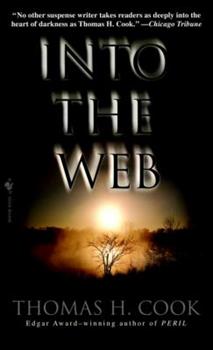
Into the Web- Thomas H. Cook

Reading a book by Thomas H. Cook is like settling into the coziest chair with a cup of tea and a long, pleasant afternoon stretched in front of you. Cook has won multiple awards, including the Edgar for The Chatham School Affair.

In his 2004 novel Into the Web, Roy Slater has returned home to Kingdom County, West Virginia after an absence of 25 years. His father, Jesse, is dying, and “…although I had nothing in common with my father, nor even so much as a tender childhood memory of him, I couldn’t let him die alone.” Roy takes a leave from his teaching job in California and makes the journey home.

His acrimonious relationship with his father isn’t the only difficult thing about returning to his childhood home. Just a few weeks before he was about to leave for college, Roy’s brother Archie was arrested for the murders of Lavenia and Horace Kellogg. Then there’s Lila, his high school girlfriend. Roy had always intended to come back for her once he graduated, but she told him she couldn’t marry him. Now he’s back in a town filled with ghosts – and then another dead body turns up.

Cook doesn’t write fast-paced novels. He takes his time. He examines complicated familial relationships, particularly between fathers and sons. He strings you along, making you feel as though you’ve got it all figured out before he takes a hard right. Cook’s novels are literary mysteries; they require patience and attention and a willingness to take your time, but I haven’t ever met a book by this author that hasn’t been worth the effort

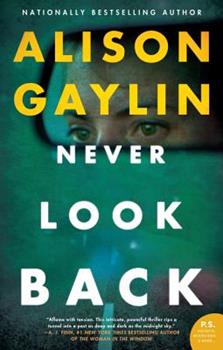
Never Look Back – Alison Gaylin

I love a good thriller – a book that keeps me turning the pages long after my bed time. There are certain things I look for in a thriller: believable characters that I can root for, plausible plot, good writing, a few twists and turns to keep me guessing, suspense. It’s not too much to ask is it?

Alison Gaylin is a new-to-me writer and for my first outing I chose Never Look Back. This is the dual-timeline story of April Cooper, a teenager who is on the run with her boyfriend Gabriel LeRoy. Together they are known as the Inland Empire killers. In the present day, Quentin Garrison is a podcast producer pursuing a story about these killers because his mother’s sister was one of their victims. His podcast series is called Closure, and that is what he is looking for.

April and Gabriel were thought to have died in a fire at the Gideon compound (a doomsday cult), but a phone call from a source leads Quentin to Renee and Robin Diamond, a mother and daughter on the East Coast.

What do all these people have in common? Secrets. There are loads of them in Never Look Back.

Gabriel is keeping secrets from everyone, including his husband Dean. Renee is keeping secrets from her daughter. In letters to her unborn baby, April reveals secrets she is keeping from Gabriel.

Gaylin’s book is inspired, in part, by Charles Starkweather, 18, and Carol Ann Fugate, 13. In 1958, Charles and Carol Ann killed eleven people, including Carol Ann’s stepfather and mother and then went on the run. This crime was made into a popular movie called Badlands, starring Martin Sheen and Sissy Spacek. I remember watching it as a teenager and really loving it.

Although Never Look Back doesn’t quite add up to the sum of its parts, I was wholly invested in the story and if you are looking for a page-turner with lots going on, you could certainly do a lot worse.

Sorrow and Bliss – Meg Mason

Martha Friel, the protagonist of Meg Mason’s widely praised novel Sorrow and Bliss, is in the middle of a crisis: her marriage is imploding. Things have gotten so bad that, on their way home from the last party they attend as husband and wife, she says to him “When you do that pointing thing it makes me want to shoot you with an actual gun.” Patrick’s response? “How about we don’t talk until we get home.”

Things weren’t always so vitriolic between the pair. Once upon a time, they were each other’s most favourite person and Martha felt as though “we had been melted down and made into another thing. […] It was the happiest I have ever felt.”

Happiness, as it turns out, is a rare commodity for Martha. She and her younger sister, Ingrid, comes from a relatively dysfunctional family. Her father, Fergus Russell, is a failed poet; her mother, Celia Barry, a sculptor. Fergus and Celia still live in the family home in Shepherd’s Bush (a district in West London), but they can only afford their lives because of Celia’s sister, Winsome, who at first seems like a rich snob, but in the end turns out to be the rock in the lives of these fragile, broken people. Patrick was childhood friends with Winsome’s son, Oliver, and Martha has known him since she was sixteen.

It is around the same time that Martha meets Patrick that she wakes up with “no feeling in [her] hands and arms.” It is the beginning of a long period of ill (mental) health for Martha. No one seems able to diagnose the problem, and her family reacts with varying degrees of sympathy. Her mother “no longer came into [her] room, except once with the vacuum cleaner. She pretended not to notice [her], but made a point of vacuuming around [her] feet.” Her father “stayed up with [her] in the night, sitting on the floor, leaning against [her] bed.” Ingrid tells her “You’ve basically turned into Mum.”

Sorrow and Bliss traces Martha’s journey through this unnamed mental illness (Mason uses dashes — instead of naming it, and a nurse in my book club said it sounded like schizophrenia), but Mason herself says that the book is not really about mental illness. In an article in The Guardian, Mason said “It’s not the schizophrenia book, the bipolar book, the borderline personality book, it’s a book about what it feels like to have X or to look after someone with X and what it does to the extended family and the marriage.”

By the time the book begins, Martha has been — with varying degrees of success –managing her mental health issues, the myriad dysfunctions of her family, her own stalled career aspirations and for the last eight years, her marriage to Patrick; one woman tells her that she should feel so lucky to be “married to a man like that.” The truth of the matter is that life and relationships are complicated and Martha’s life sometimes spins itself into a deep, dark hole from which there is often no escape. Strangely, it is a tattoo artist who puts things into perspective for Martha

Everything is broken and messed up and completely fine. That is what life is. It’s only the ratios that change. Usually on their own. As soon as you think that’s it, it’s going to be like this forever, they change again.

I loved this book. I loved Martha’s family, particularly Winsome. I loved Martha’s relationship with Ingrid – which was often laugh-out-loud funny. I loved Patrick, who somehow didn’t come across as a martyr even though he was self-sacrificing. And I loved Martha, in all her messy glory.

This book is a winner and I highly recommend it.

Five Little Indians – Michelle Good

It’s tough to review a book written by an Indigenous author about an important subject (residential schools and their traumatic legacy) and not sound like an asshole when you don’t love it. I had the same problem with The Nickel Boys. Five Little Indians, by Canadian lawyer and first time novelist Michelle Good, won the Governor General’s Literary Award and the Amazon First Novel prize and the book was well-reviewed.

And I am not going to crap all over it because there were some things I did like about the book, which follows five people who were sent to residential school as children and then were either released or escaped into 1960s Vancouver. The novel doesn’t spend much time at the school itself, but we learn enough to see how Kenny, Lucy, Clara, Howie and Maisie suffer at the hands of the priest and the nuns, particularly Sister Mary. And suffer, they did.

The majority of the book follows these five characters after they’ve left the school, their lives intersecting as they try to make sense of a world they know next to nothing about. They are without skills, without family and really, without an education. The only thing they really have is trauma and that follows them throughout their lives.

Each of these five characters has a different experience once they are away from the school. Maisie, for example, seems to have it all together when another survivor, Lucy, arrives at her door. Maisie had gone home after she was released. “I lasted a month. No matter how hard I tried, this place, their house, was no longer home, and these people, though kind and loving, were like strangers pretending to be family.” She deals with her trauma by having sex in an alley with “The Old Man”, someone who berates her as he’s having sex with her, calling her the names the priest had called her as he raped her. “These were Father’s words. They took the rhythm of his thrusts. And I couldn’t breathe without this. I didn’t exist without this.”

Lucy fares a little bit better, going to school to become a nurse until she discovers that she is pregnant with the child of another survivor, Kenny, a boy she loved at the Mission school. They love each other, but Kenny has his own demons and try as he might, he just can’t stay with Lucy.

I did love each of these characters; that wasn’t my issue with the book. I just felt as though I was being told their story rather than shown it. This might have been remedied by sticking more closely with one character and having the others drift into their orbit. I felt like there was so much more that I wanted to know about each of them, but their tales felt somehow superficial – even though their individual trauma certainly wasn’t.

I finished reading Five Little Indians on the National Day for Truth and Reconciliation which “honours the children who never returned home and Survivors of residential schools, as well as their families and communities. Public commemoration of the tragic and painful history and ongoing impacts of residential schools is a vital component of the reconciliation process.”

Personally, I think we have a long way to go to make things right.

Messiah – Boris Starling

Boris Starling’s debut, Messiah, is a straight-ahead police procedural about a team of Scotland Yard detectives tasked with finding the person responsible for a series of gruesome murders.

Detective Superintendent Red Metcalfe has a reputation for being able to get into the minds of killers and so he’s in charge of putting together a team of officers to figure out whodunnit. Red “wants people who spark off each other because they think in different ways,” and that’s how he comes up with Clifton (who’s “good enough to be Red’s successor one day”), Beauchamp (“because going into one of these cases without a female point of view is like having one hand tied behind your back”), and Warren whom he picks with the flip of a coin.

It soon becomes apparent that Red and his team are not hunting your garden-variety serial killer. Although there is one similar detail between the crimes (the killer cuts out the victim’s tongues), the cops can’t find any other link between the victims and as the bodies pile up, Red gets frustrated. Worse, there is a total lack of physical evidence at the crime scenes.

The investigation in present days is supplemented with details about Red’s past, which includes a terrible decision Red had to make as a university student. The flashbacks provide some context and help us to understand Red’s single-mindedness.

I haven’t read enough police procedurals to know how Messiah compares. (Heck, I am not even sure if this is a police procedural except that it really is all about these cops trying to catch the killer.) Still, I really enjoyed this book. It was unfussy, gory, and straight ahead entertaining (if messy crime scenes and psychopathic killers are your jam.) Apparently there’s a television series and I bet it would be awesome…even knowing whodunit.

Behind the Red Door – Megan Collins

I discovered Megan Collins when I read her novel The Winter Sister a few months ago. I was very much looking forward to reading Behind the Red Door, but unfortunately it just didn’t land as well.

This is the story of Fern Douglas, a social worker who lives with her husband Eric, a physician, in Boston. When her father enlists her to come help pack up her childhood home because he’s moving to Florida, she does so reluctantly. Her childhood was complicated and her relationship with her parents is fraught.

Fern’s arrival back in New Hampshire coincides with the disappearance of Astrid Sullivan, a girl who had been kidnapped twenty years ago and then left, drugged and disoriented but otherwise unharmed, on a curb a month later. When Fern sees Astrid’s photograph, she feels like she knows her, but she can’t figure out how. Fern is prone to obsessing, or “spiraling” as Eric calls it. Her therapist likens it to needle stuck on a record; her anxiety ratchets up and her mind keeps “telling you that you have to stay on this thought. But it’s a lie.”

When Fern gets back to her childhood home, she starts to read the memoir Astrid wrote about her time in captivity. There are details in Astrid’s book that unlock memories in Fern’s mind and she soon becomes obsessed with finding Astrid, something that not even the police have been able to do because there are no clues.

Her time at home is strange. Her father, a man who has spent his entire career researching the qualities of fear, seems more interested in tapping into Fern’s growing anxiety about Astrid than he does in helping his daughter alleviate this stress. Her parent’s marriage has crumbled and her mother has already moved out.

Then there is the cast of creepy characters: the strange man dressed all in black who walks up and down the country roads; Brennan, her father’s former colleague, Father Murphy, a priest who seems to know more than he’s telling and Cooper, her childhood bestie’s older brother, who used to terrorize her when she was a kid.

Behind the Red Door moves along at a brisk pace, but unfortunately I had a difficult time believing any of it. Fern was a sort of insipid character, even as she started (bravely or foolishly) digging into Astrid’s life. Her parents are reprehensible. Cooper, even at 40, sounds like a frat boy. I had no trouble turning the pages, but it wasn’t nearly as good as The Winter Sister.