The Fountains of Silence – Ruta Sepetys

Ruta Sepetys has a gift. Well, she has many gifts, to be fair, but I particularly admire her ability to write characters that absolutely lift off the page and linger in your imagination long after the last page has been turned.

At my high school, we introduce readers to Sepetys in grade nine, when we read Between Shades of Gray. I have yet to encounter a student, even  those who identify as non-readers, who doesn’t rip through that book, many reading way ahead of the class. In grade ten, when we introduce Salt to the Sea there are very few groans. Again, students quickly become wholly invested in the stories of the characters. When I read the final few pages out loud to my grade ten classes in the fall, I had to stop several times because I was so close to tears I couldn’t get the words out. That’s how you know these characters have become real to you, I guess: you care about their fate.
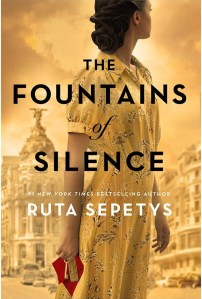
fountainsI was very excited to read Sepetys’s latest book, The Fountains of Silence, because I just knew that I was going to meet a new cast of characters to fall in love with, and I wasn’t wrong.

Daniel Matheson is almost nineteen when he travels to Madrid with his parents during the summer of 1957. His father is an oil tycoon from Texas, and his mother is originally from Spain. Daniel’s dream is to become a photo journalist, but his father disapproves. While Mr. Matheson does business, Daniel takes pictures, and in doing so he starts to see that sunny Madrid is one city to tourists and another to people who struggle beneath Francisco Franco’s yoke.

Ana works in the hotel and is assigned to help the Mathesons. Her story is one of poverty and struggle. Her father was executed and her mother imprisoned and “Her parents’ offense has left Ana rowing dark waters of dead secrets. Born into a long shadow of shame, she must never speak publicly of her parents. She must live in silence.”

Ana and Daniel feel an instant attraction to each other, but it’s the classic case of being from opposite sides of the social spectrum. There is so much Ana wants to say and can’t, and so much that Daniel doesn’t understand, but certainly will.

Although Ana and Daniel’s story is central to the plot, there are other compelling characters in this book, including Ana’s older brother Rafa and his childhood friend, Fuga; Ben, a seasoned journalist who takes Daniel under his wing, and Puri, Ana’s cousin who works at a local orphanage. Although Ana and Daniel will take up most of the space in your heart, all the characters you’ll encounter are compelling and interesting.

Once again, Sepetys has mined history to find her story. This one concerns the thousands of children who were stolen from their parents and adopted by more ‘suitable’ families. It also provides a window into the period of the Spanish Civil War and the years immediately following, when “Helpless children and teenagers became innocent victims of wretched violence and ideological pressure.”

Their stories deserve to be told and Sepetys does them, and us, a great service by telling them.

Highly recommended.
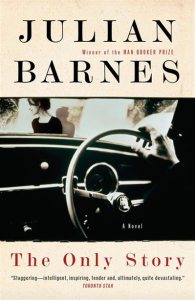
 

The Only Story – Julian Barnes

I very much enjoyed Julian Barnes’ novella The Sense of an Ending when my book clubonly read it eight years ago. (Yikes!)  I can’t say that my experience with The Only Story  was quite as enjoyable; however, we had a fantastic chat about it at book club.

Would you rather love the more, and suffer the more; or love the less, and suffer the less? That is, I think, finally, the only real question.

It’s the 1960s. Paul is an only child and has a relatively distant relationship with his parents who are solidly middle-class.  Home from university, Paul is “visibly and unrepentantly bored.” His mother looks for a diversion for him and hopes Paul might find a “nice blonde Christine, or a sparky, black-ringleted Virginia” at the tennis club. Instead he meets Susan Macleod, a middle-aged, unhappily married mother of two daughters who are older than our protagonist. Paul recalls “Who would have thought it might begin there?” The whole novel is a rambling recollection of their affair and the way such relationships are framed by memory, which is a theme Barnes visited in The Sense of an Ending.

Barnes wants the reader to believe, perhaps because Paul does, that this relationship is one for the ages. “Most of us only have one story to tell,” Paul tells us. “This is mine.”

I didn’t really like anything about this book and it pains me to say it because on the surface it seems like this book would be 100% up my angsty alley. Instead, I had a hard time connecting with either of these rather dull characters, who fumble their way through sex, and living together, and life in general. In the beginning, Paul spends a lot of time at Susan’s house; sometimes his university friends stay over, too. Paul is so self-involved that he doesn’t understand why Susan’s husband, Gordon, doesn’t seem to like him. Um, you’re sleeping with his wife! Under his own roof! Not that Gordon is at all sympathetic and he and Susan haven’t done the deed pretty much since the birth of their daughters.

Once they move in together – into a little house Susan buys in London – she (I thought) out-of-the-blue becomes a raging alcoholic, and things between the lovers start to deteriorate.

At first, Paul tells their story in the first person, but as things between him and Susan start to fall apart, he switches to the second person and then, finally, the third person. I liked this because I know how I view things from my past: sometimes it feels as though they’ve happened to someone else.

But for a story about love, the ‘only’ story – this one just didn’t work for me. No question Barnes is a master craftsman, and others in book club really liked it, but I found it a bit of a slog.

The Winters – Lisa Gabriele

Last night I dreamt I went to Manderley again.

The opening line of Daphne du Maurier’s brilliant novel Rebecca will be instantly recognizable, likely even to readers who have never read it. In that book, the unnamed protagonist meets Maxim de Winter and embarks on a whirlwind courtship. They marry and he brings her home to Manderly, his estate on the Cornish coast. It is there that the narrator’s troubles begin because Manderley is haunted by Rebecca, Maxim’s first wife, who was (apparently) beloved by all. Rebecca is a riveting read.


Lisa Gabriele treads…tromps…through du Maurier’s landscape in her novel The Winters and although I am in the minority, I am sure, I feel as though this book suffers by any comparison to its source material. But you have to compare them because Gabriele’s story is “inspired” by du Maurier’s.

In The Winters the unnamed narrator is a dog’s body for a boating company in Grand Cayman, where’s she’s grown up with her parents who were “disillusioned Americans who chose to live and work on a small fishing trawler.” Now both her parents are gone, and she is still working for Laureen, the brash Australian who owns the charter boat company.

Our plucky narrator tells us that

My features are even, my body trim, hair, eyes and skin compatible with each other in ways that make sense. Even my character, self-sufficient and serious-minded, watchful and earnest, doesn’t draw attention to itself. Men do not clamour after me.

Enter Max Winter. He’s older. Handsome. Rich. And immediately smitten with the narrator. Cue whirlwind courtship and suddenly she’s being whisked off to Asherley, Max’s Long Island version of Manderley. Instead of Manderley’s menacing housekeeper Mrs. Danvers, there’s Dani, Max’s troubled fifteen-year-old daughter.

Even though the former Mrs. Winter has been dead for almost two years, the house is still full of reminders and our narrator has trouble finding her footing. Dani, when she finally returns from Paris, takes an immediate dislike to her, and the narrator doesn’t have any experience with teenagers anyway. Dani mostly holes up in her old mother’s turret bedroom, smoking weed and (seemingly) plotting ways to make the narrator’s life miserable.

My issues with The Winters don’t really have anything to do with the story. I mean, if you’ve never read Rebecca I think you’ll probably find the plot of this one engaging enough. I was frustrated reading this book, though. I think my main problem was with the characters themselves; I just didn’t believe them. I certainly didn’t believe the way they spoke to each other. There wasn’t any real chemistry between the narrator and Max and the denouement, when it arrived, had wayyyy too many contrivances.

It’s a beach book. It doesn’t ask anything of you, and I suspect many readers will find it diverting and entertaining. For my money, though, Rebecca is a much more satisfying read.


The Damned – Andrew Pyper

223C2A3B-A2C4-455F-AEFE-1A58DF3297B0Canadian writer Andrew Pyper is often compared to Stephen King and I can see why.  Both writers skillfully find the scary in the every day, and in relationships which should be sacrosanct. Pyper mined that territory in his novel The Guardians  and he does it again in The Damned which hooks you in pretty much from page one.

Danny Orchard has come back from the dead on more than one occasion. He wrote about the experience in a memoir called The After a book that, many years later, keeps him busy at “dentists’ conventions and service club fundraisers” where he talks about what’s at the end of the long tunnel. Danny’s experience has inspired a group known as The Afterlifers, “a community for those who’ve traveled to the other side and returned.”

When Danny was sixteen he and his fraternal twin, Ashleigh (Ash), were killed in a house fire. Well, Ash was killed; Danny was saved. If saved is what you want to call it. I guess Danny would have a different opinion about it since he’s been haunted by his sister ever since. Although on the surface, it looked like Danny and his family had it all

My father, mother, and I were aware that a monster lived with us, however photogenic, however scholarship-guaranteed. And because she was only a girl, because she was one of us by name, because we feared her, there was nothing we could do about it.

Ash is clearly a psychopath and death doesn’t change that, so Danny’s life is pretty solitary until he meets Willa and her ten-year-old son Eddie.  He believes that he can keep them safe, but Ash isn’t about to let go that easily and Danny soon realizes that he is going to have to face her on her terms. If heaven is reliving the best day of your life over and over, hell is quite the opposite.

Pyper has created a compelling and nightmarish hellscape and, in Danny, a character readers will actually want to root for. At first he thinks that Ash just wants him to solve the lingering questions about her death. (Why was she in that abandoned house and what happened to the three friends she was supposedly with that day?) But Ash’s motives are far more sinister and when Danny returns to Detroit looking for answers he finds far more than he bargained for.

The Damned would make a terrific movie, but I’ve got a great imagination and Pyper is a great writer. I could see everything just fine, thanks very much. If you don’t mind white-knuckling it through a book, this is the story for you.

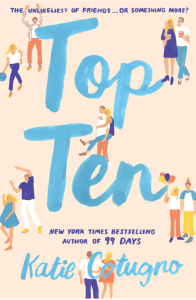
Top Ten – Katie Cotugno

Gabby Hart and Ryan McCullough meet at a house party thrown by Gabby’s older sister, Celia. It’s C2351B18-F759-4A0A-94F5-CA35ADDD53F2kinda awkward because Gabby isn’t really a party-goer; she’d much rather be holed up in her bedroom with her snacks and a good book. When she discovers Ryan barfing in her bathroom, though, it’s the beginning of a beautiful friendship. That’s the premise of Katie Cotugno’s YA novel Top Ten.

Ryan and Gabby could not be more different. Gabby is awkward and suffers from extreme anxiety, which she mostly keeps in check unless, y’know, parties or other situations that make her uncomfortable. She has great parents and siblings, a nuclear family that plays a weekly game of Monopoly. Ryan is a star hockey player, probably considered too cool to be hanging out with Gabby, but the thing is, he discovers he wants to hang out with Gabby, and so he invites himself to her house to play Monopoly. His parent’s marriage has just dissolved and he finds comfort in Gabby’s house, and in Gabby herself.

The novel actually begins just after high school graduation, when Ryan asks Gabby to recount the “Top ten moments of high school.” They both know that their lives are going to change when Ryan goes off to play hockey in Minnesota and Gabby heads to NYC to study photography. Gabby can’t imagine life without Ryan because

He was Gabby’s social security blanket, her failsafe against miserable, crippling anxiety; she had no idea what she was going to do without him come fall. Thinking about it was terrifying on a physical, visceral level, and so mostly she did her best not to think about it at all.

And then, in a decision that is decidedly not split-second, they decide to cross over into something that is more than friends. The novel then travels back over all the pivotal moments in their lives.

Top Ten is charming to the 100th power, probably because Ryan and Gabby felt like real people. Their friendship will ring true to anyone who’s ever had a bestie you’ve wondered “what if?” about. Romance aside, this is also a book about overcoming your own fears, what it means to be a friend to someone, even when they make it extremely difficult, and how to navigate those tricky teen years.

I really, really liked it.

A Brief Lunacy – Cynthia Thayer

Jessie and Carl have been married for many years, happy years from the sounds of things. They are spending some time at their isolated cottage in the woods in Maine. Their lives together have fallen into a rhythm that will be recognizable to most people; they have a shorthand. But things for the pair are about to become complicated.

Cynthia Thayer’s novel A Brief Lunacy examines the fault lines in a marriage. 15CE5884-6960-432B-8415-E41334905966Sometimes those cracks don’t appear until something remarkable happens and the catalyst in this novel is the arrival of  Jonah, a mysterious young man who turns up at their cottage, claiming to have had all his camping gear stolen. Carl insists Jonah head up the road to the highway, but Jonah finagles his way into a dinner invitation and crashing on the couch for the night. In the morning, all hell breaks loose.
It turns out that Jonah isn’t exactly who he says he is. In fact, he’s Jessie and Carl’s daughter Sylvie’s boyfriend. Earlier that day, they’d received a call from the care facility where Sylvia has been living as a psychiatric patient to inform them that she’d gone missing. Jonah’s arrival is no coincidence. He’s come to get to know Carl and Jessie and his arrival forces them to reveal things about themselves to each other that they never expected to divulge. Carl, in particular, has been harbouring a dark secret for decades.

Despite the fact that I found the way that Carl and Jessie spoke to each other rather stilted, I still found A Brief Lunacy a compelling book. The whole encounter between the couple and Jonah lasts under 24 hours, but it’s pretty intense. Bad things happen. Jonah, it won’t take readers long to figure out, is completely unhinged.

A Brief Lunacy has lots to say about survival and what we are willing to do to save ourselves and those we love.


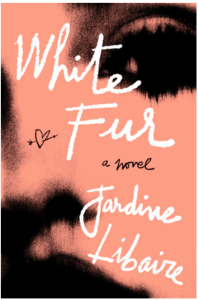
White Fur – Jardine Libaire

2A9B3047-F747-494D-9D63-8CA23DE73869Funny, or maybe not, that the book I read right after Normal People was also about a love affair between two young people. Jardine Libaire’s novel White Fur shares a couple similarities with Sally Rooney’s novel; both books concern couples who are from very different social classes and both pairs of lovers have fraught relationships.
Jamey Hyde is a student at Yale when he meets Elise Perez. She lives next door to Jamey with Robbie, the guy who rescued her from sleeping in a parked car. Jamey and Elise couldn’t be more different, and you know what they say about opposites attracting.

“Is she frightening? Is she pretty?”

That’s what Jamey and his roommate, Matt, think when they first meet Elise and the truth is she is both. She’s run away from a messy home life, and she doesn’t suffer fools lightly.

She didn’t leave home last summer with a plan. Twenty years old, she never finished high school, she was half-white and half-Puerto Rican, childless, employed at the time, not lost and not found, not incarcerated, not beautiful and not ugly and not ordinary. She doesn’t check any box…

In some ways she is almost too tough, but something about her exerts a magnetic pull for Jamey. He’s heir to a vast family fortune and has never really had to work for anything in his life. Instead of making him a spoiled brat, though, he’s actually a decent guy. Before he even meets Elise, his life is sliding sideways. He and Elise shouldn’t work, but they actually make a strange kind of sense.

When the novel opens, Elise is holding a shotgun to Jamey’s chest and from there the novel flashes back to unravel the tale of their meeting, their tremendous sexual attraction, and their crazy summer in New York City.  Because you want to know how they ended up in a motel in Wyoming with a gun, it’s easy to turn the pages and Kirkus called this book one of “11 Thrillers for Summer.” But this isn’t really a thriller.

This is a book about love, about making your own way in the world in spite of the odds against you and in spite  of the privileges you’ve been given. The writing is beautiful and these are characters you won’t soon forget.

White Fur probably would have meant something different to me if I had read it 40 years ago, back when all my relationships felt a little bit like this one. I could relate, on many levels, to the crazy intensity these two felt for each other. But that’s not to say that I didn’t enjoy this book as a woman of a certain age because I enjoyed it a great deal.


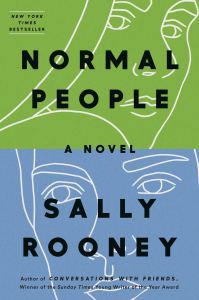
Normal People – Sally Rooney

normalpeopleYou know you’re getting old when…

That’s my main take away from Irish writer Sally Rooney’s second novel Normal People. The story follows the on again – off again – on again relationship between Marianne and Connell, a couple 18-year-olds (when the novel begins) who strike up a friendship of sorts when Connell arrives at Marianne’s house to pick up his mother, who is the housekeeper there.

The two would never have said a word to each other at school where Connell is “so beautiful” that Marianne liked to imagine “him  having sex with someone; it didn’t have to be her, it could be anyone. It would be beautiful just to watch him.”  Marianne herself is awkward and “has no friends and spends her lunchtimes alone reading novels.” The two of them just happen to be the smartest kids at school and so somehow, despite their awkwardness,  (because Connell,  despite his beauty, is awkward), the two form a relationship that shapes the next few years of their lives.

The thing with these two, though, is that they never seem to be playing the same game at the same time. Their attraction turns out to be mutual, but Connell suggests they keep their relationship a secret and when he finally betrays her, the two go their separate ways. It doesn’t matter, though, they are drawn to each other – moths to flame – and in that respect, I could so relate to their story. The two meet up again at Trinity College in Dublin, where suddenly Connell is the fish out of water and Marianne seems to have found her people. Rooney deftly handles the strange dance that happens when two young people desperately want to be together, but keep fucking it up.

So, is Normal People a book for an old doll like me? Am I the novel’s intended reader? Probably not, and I have a feeling that the ladies in my book club (for which this was our January 2020 pick) are likely going to pan the book. They’ll take exception to the lack of quotation marks for dialogue (and I knew that was going to bug me  – but ended up not being as annoying as I thought it might be) and they’ll probably dislike the melodrama inherent in a story about young love,  but I liked this book.

I was always falling in love at that age and I could see myself in both of these characters. Their need for connection, their disillusionment, their constant search for themselves was reminiscent of my own journey, and will likely ring true to anyone who has ever felt like an outsider. I found the book eminently readable, elliptical and troubling. When I finished the book – and I whipped through it in just a couple sittings – I found myself really trying to wrap my head around what I’d just read, and I think that’s the sign of something special.


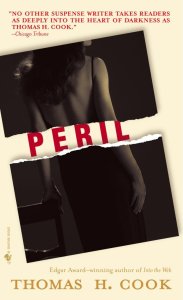
Peril – Thomas H. Cook

My first finished book of 2020 is Thomas H. Cook’s 2004 novel Peril. Unlike most of the perilother books I’ve read by  Cook, which have generally focused on one narrator, Peril lets the reader see the same set of circumstances through a variety of lenses.

Sara Labriola is hoping to disappear. After nine years of marriage to Tony, she can’t go on and so one day she packs her clothes, leaves her wedding ring and takes the bus into Manhattan.

Tony is devastated when he discovers Sara missing, but his father, Leo, is furious. Leo is a thug who berates everyone around him, including Tony who has never had the nerve to stand up to him. Leo tells his guy Caruso to find Sara and Caruso leverages the help of Mortimer Dodge because he owes Leo money. Dodge works for a guy named Stark, a guy whose job it is to find people.

Need a chart yet? Let’s recap.

Sara runs away from Tony.

Tony wants to find his wife before his father does because he knows that if Leo finds her first the consequences will be grim. He tasks his employee and friend Eddie with helping him.

Leo gets Caruso on the job. Caruso gets Mortimer on the job. Mortimer gets Stark on the job.

Sara is in NY and thinks she has found a job singing in a night club owned by Abe, who happens to know Mortimer.

It all sounds way more complicated than it is and it’s actually way more compelling than this, too, and that’s because, well, Thomas H. Cook wrote it.

You know how you can read some thrillers or mysteries and they’re just straight ahead books that are driven by plot but not much else? Yeah, that’s not Cook. There is not a character in this novel who doesn’t have a totally believable backstory that makes them, even when they are not particularly likeable, sympathetic. (The exception here is Leo Labriola, who is a misogynistic asshat.) And I mean every character, even characters we only meet a couple times, like the mother of Sara’s neighbour, Della.

And if you think all this backstory is going to bog down the plot – which would be bad, too – forget about it. You’ll turn the pages lickety-split because, well, Thomas H. Cook. He balances character and story and even if some of what happens here seems a tad too coincidental, you won’t care. At all.

There’s something old school about Peril. It’s like a noir film, peopled with shadowy gangsters in crumpled hats, a beautiful, fragile heroine who earns the good will of the men she meets, and a bunch of guys who ultimately, turn out to be loyal and decent.

You will NEVER be wasting your time reading a Cook book. (Couldn’t resist.)

A reflection on my 2019 reading year…

Happy New Year!

For the past several years I’ve completed a little reading survey, a sort of look back at the reading year that was. I normally spend a few hours reflecting on my year, choosing most favourite and least favourite books and talking about other bookish things that happened to me, but I usually do that in advance of January 1st. This year I had to return my daughter to university and then I spent a couple days with my best friend and her family out of the city…so no time to get that post ready in advance. I do like to think about my reading year, though, so here are some random thoughts.

Goodreads provides a handy overview of your reading year at the end of their challenge. This is mine. I think I had a pretty good year. I read nine more books than I did in 2018, and I hope to up that number again this year by spending WAY less time on the Internet. My reading goal for 2020 is 70 books, but I would love to surpass that.

myabsolutedarlingOf the books I read in 2019, a couple really stand out.  Gabriel Tallent’s debut novel My Absolute Darling was a difficult book to read, but the protagonist, Turtle, has stayed with me. As I said in my review, this book will not be everyone’s cup of tea; however, if you can stomach the subject matter (sexual abuse, violence), it is so worth the read because of the incredible beauty of Tallent’s writing and the novel’s stunning main character.

I also really enjoyed Ann Patchett’s The Dutch House , Tara Westover’s Educated , Iain Reid’s Foe, Tim Johnston’s The Current, Joanna Briscoe’s You (not to be confused with the thriller by Caroline Kepnes),  and Celeste Ng’s Little Fires Everywhere

I read a lot of terrific YA this year. It’s relatively rare to read a total YA dud these days – and to be honest, if the book really sucks I just move on – but I read some stellar YA titles in 2019.

Long Way Down by Jason Reynolds –  a novel in verse about the aftermath of gun violence. A quick but powerful read that belongs on every school library bookshelf

A List of Cages by Robin Roe  – a tremendous novel about two boys who meet again at high school, and how that chance encounter and one boys innate kindness saves the other boy’s life. Literally.

A Short History of the Girl Next Door by Jared Reck – I cried real tears when I read this book. It is YA perfection.

They Both Die at the End by Adam Silvera – smart, thoughtful, heartbreaking and – not a spoiler – they do both die at the end. LOVED it.

We Were Liars by E. Lockhart – twisty, gothic, beautifully written… a page-turner with a beating heart

I read some mediocre books this year, too…and many of them were really popular books. These are books that were just okay for me – certainly not, imho, worth the hype.

Don’t You Forget About Me by Mhairi McFarlane landed me in a little mini Twitter shitstorm. First time EVER I had an author and her minions come at me, even though I didn’t think (and still don’t think) my review of her book was all that critical. The book just didn’t do it for me.

The Silent Patient by Alex Michaelides is a serviceable thriller and I had no trouble reading it, but I just didn’t think it was worthy of all the fuss. For me.

The Female Persuasion by Meg Wolitzer was one of  last year’s book club picks and it just didn’t float my boat because I didn’t really care too much for the main female characters, which is a problem in a book about women.

The Perfect Nanny  by Leila Slimani – was it the translation? I dunno. I just found this book about a nanny who kills the children she is charged to care for S-L-O-W

A Gentleman in Moscow by Amor Towles – I felt as trapped as the novel’s main character, Count Rostov

The Broken Girls by Simone St. James – this was my book club pick last year and it just had too much going on

This is How it Always Is by Laurie Frankel – captures the zeitgeist of gender identity and, overall, does it well, but I still had some issues and couldn’t give it a hearty thumbs up

Other bookish things that were exciting this year:

fitch1 - CopyI stumbled upon, purely by chance, Sherree Fitch’s magical bookstore, Mable Murple’sBook Shoppe and Dreamery in River John, Nova Scotia.

Fitch’s children’s books were on permanent rotation in my house when my kids were little, so it was pretty exciting to find the store and then find the author herself chatting to patrons.

I purchased my copy of A Velocity of Being here and I can’t recommend it highly enough. If you love books, this is a MUST read.

I also had the opportunity to meet Lauren B. Davis, author of one of my favourite books, Our Daily Bread, when she read from her newest novel, The Grimoire of Kensington Market. Davis and I have interacted a little lauren davisbit on social media, and in fact back when my book club read Our Daily Bread, she graciously offered to answer any questions we had in real time via Twitter.

I intend to make going to author readings more of a regular habit in 2020, as I do love to see them in person. I am so sorry I missed my opportunity to hear Craig Davidson read from his book The Saturday Night Ghost Club, which I read in 2019 and really liked a lot.

One other thing I did in 2019 that I have never done before was to make a vlog. I had a crazy busy few weeks and let my read books pile up and knew I would never get around to writing reviews about them, so I thought, what the heck, I’ll talk about them instead. Not that easy, people. If you want to waste 20 minutes, you can watch that here.

Overall, it’s been a great reading year and I look forward to discovering new favourites in 2020. I hope you’ll visit often and stay a while.