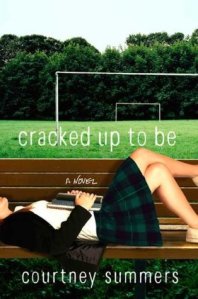
Cracked Up to Be – Courtney Summers

crackeduptobeCourtney Summers is one of my favourite YA writers. Cracked Up to Be was her debut novel, but it’s the fourth book I have read by this talented Canadian author. I have also read her terrific zombie novel This is Not a Test, her caustic novel about high school bullies, Some Girls Are and All the Rage, a frightening look at the aftermath of sexual assault.

In Cracked Up to Be, Parker Fadley has clearly gone off the rails. The once perfect student, cheerleading captain, and homecoming queen is potentially not going to graduate, must adhere to a strict curfew and she’s come to school hung over on more than one occasion. What could have possibly happened to upend Perfect Parker’s perfect life?

Figuring that out is what pushes this novel along and whether or not you’ll feel satisfied with the explanation for Parker’s fall from grace will be up to you. This is high school – so everything has a heightened sense of drama, but ultimately, that’s not what is so awesome about Summers’ book.

What’s awesome is Parker herself, a fully realized character that is both 100% unlikeable and 100% sympathetic…if that’s even possible.

The problem with alienating, self-destructive behavior is people get it into their heads it’s a cry for help. I wasn’t. It was just a really poorly executed plan to get everyone off my back. So now I’m halfway between where I started (not alone) and where I want to end up (alone) and I just have to roll with it if I want to graduate or else I’ll never be alone.

The thing about Perfect Parker is that she doesn’t sound like she was an altogether stellar human being even before whatever happened happened. Perhaps it’s true of all perfectionists: it’s their way or the highway. But post-event Parker is particularly prickly. Becky, the girl who has taken over as head cheerleader and hooked up with Parker’s ex-boyfriend, Chris, takes the blunt end of most of Parker’s vitriol.

“Screw him, Becky. I don’t care.”

“Parker – ”

“Becky, really. I don’t want to hear it. You’re dull.”

She rolls her eyes. “For five seconds you almost seemed human.”

The truth is that Parker is very much human. She is someone who feels as though she has done an awful thing and must be punished. If the universe can’t punish her sufficiently, she’ll punish herself. And if that means pushing away everyone who cares for her (Chris is about as good a friend as Parker has and he remains steadfastly in her corner even when she is utterly horrible to him.), well, that’s what she’s going to do.

The thing I have always admired about Summers’ writing is that it always feels unflinchingly honest. Her characters speak their minds. They are awful and vulnerable in equal measure. The more time we spend with Parker, the more we  start to see the cracks in her veneer. And by the novel’s conclusion, readers will be hopeful that those cracks will let a little healing light in.

Highly recommended.

The Woman in the Window – A.J. Finn

The-Woman-in-the-Window-A_-J_-FinnHoly unreliable narrator, Batman! There seems to be a whole slew of books of this type post  The Girl on the Train. A.J. Finn (nom de plume of Daniel Mallory, executive editor at Morrow) adds yet another to the cast with Anna Fox, the first person narrator in The Woman in the Window. A student in one of my classes wanted to read this book, so I bought it for my classroom library. He read it lickety-split and then encouraged me to read it, which I did, in two breathless days.

Anna Fox is a watcher. From the windows of her  Victorian home in Harlem, she watches the lives of her neighbours. “My Nikon D5500 doesn’t miss much, not with that Opteka lens,” she admits.

From her vantage point, she can observe people living their daily lives: cheating spouses, book club meetings, teenagers playing video games and musical instruments. Slowly it is revealed that Anna is separated from her husband and daughter, and also suffers from agoraphobia. As Anna explains “Agoraphobic fears…include being outside the home alone; being in a crowd, or standing in a line; being on a bridge.” She considers herself to be an extreme case, “the most severely afflicted…grappling with post-traumatic stress disorder.”

She occupies her time on the Internet, learning French and playing chess and overseeing a discussion board called Agora, set up for other sufferers of her condition. (She’s actually qualified because before her life went south, Anna was a psychologist.)  She’s a fan of old movies, particularly noir films, and merlot — of which she drinks a lot. The fear of being outside the safety of her mansion/prison is not the only problem in Anna’s life; she is clearly depressed and self-medicating with alcohol and the drugs her own psychiatrist prescribes, a lethal combination that impacts what Anna sees one night.

That would be a murder.

By then, Finn has done such a good job of portraying Anna as such a hot mess that readers won’t know what to believe. Anna doesn’t either. When the police investigate the crime, they discover there’s no body and the person Anna thought she saw doesn’t even exist. Oh, what a tangled web.

Keeping Anna trapped in her house ups the suspense ante, for sure. Her days are often a drunken blur and even when she tries to get it together so that she can figure out what she saw or didn’t see, she just can’t. Despite this, Anna is a sympathetic character, whose well-being you will care about, especially when you discover one of the novel’s central plot points (which I did relatively early on but, trust me, that in no way hindered my enjoyment of this novel).

The Woman in the Window has garnered a lot of buzz and for good reason. It’s well-written, page-turning fun, with a beating heart at its core.

Highly recommended.

Stronger Than You Know – Jolene Perry

strongerIn  Jolene Perry’s novel Stronger Than You Know, fifteen-year-old Joy Neilsons has come to live with her aunt and uncle after having been removed from the trailer home she was living in with her mother. The Child Services Summary Report  indicates that she wasn’t allowed out of the 750 sq. ft. mobile home, did not attend school and was dehydrated and malnourished when authorities removed her.

Turns out, not having enough to eat or drink was the least of Joy’s problems, and although Perry wisely spares us the graphic details of Joy’s abuse, readers will easily be able to fill in the horrific blanks.

Stronger Than You Know is the story of Joy’s recovery which, as you can imagine, is not without its setbacks. For one thing, Joy hasn’t been properly socialized, so dealing with large groups of people is problematic. Imagine going to school — high school, at that —  for the first time. For another thing, Joy distrusts men, making it difficult for her to be around her uncle, Rob, and her cousin, Trent. Trent’s twin sister, Tara,  is a little easier to cope with, but Joy is still distrustful of this new life she’s been given, a life she knows she doesn’t belong in. Aunt Nicole offers safety and comfort, but the PTSD Joy is experiencing is palpable.

She measures her recovery by listing her accomplishments:

  • Went to school.
  • Ate in the cafeteria.
  • Answered a teacher’s question.
  • Ate a few bites of dinner with the family in the dining room.

All the people in Joy’s new life, even Trent, who initially seems like an asshat (and one could make the argument that he turns the corner with a little too much ease), are warm and loving humans. The boy she meets on the walk to school is patient and understanding when Joy acts peculiarly. Her Uncle Rob is super protective because he’s had some personal experience with trauma. If any characters are under-developed it’s because they are the villains of the piece and it’s easy enough for smart readers to fill in those blanks.

Overall, Stronger Than You Know will speak to any young reader who has had to overcome horrific circumstances in the hopes for a better life. As Joy learns, a better life is waiting.

The Burning Air – Erin Kelly

burning airI was a big fan of Erin Kelly’s novel The Dark Rose and so I was very much looking forward to reading The Burning Air. Kelly is a terrific writer, which is what saved The Burning Air for me because while the writing was great and I certainly had no trouble turning the pages, I just thought it was a lot of fuss for nothing.

The MacBrides have it all. Dad, Rowan, is the headmaster at a prestigious school; mom, Lydia, is a magistrate, and then there are three adult children: Sophie, Tara, and Felix. The novel opens with a deathbed confession. Lydia writes:

Of course it was love for my children, love for my son, that caused me to act as I did. It was a lapse of judgment. If I could have foreseen the rippling aftershocks that followed I would have acted differently, but by the time I realized the extent of the consequences, it was too late.

When Sophie, Tara and Felix and their families arrive to spend a weekend with their father at the family’s special getaway, Far Barn in Devon, it’s clear that the death of their mother has caused some collateral damage. But there were cracks in the family’s perfect façade anyway. And they aren’t the only ones with secrets.

Darcy also has a connection to the MacBride family. I am carefully going to avoid saying too much about Darcy, other than to say that they are filled with vitriol for the MacBride family. Their lives intersect when Darcy interviews for a place at Rowan’s school and fails to make the grade, so to speak. What happens next sets the course for all their lives.

The novel flips back and forth between present day and back when Darcy and Sophie, Tara and Felix were children, mostly concentrating on Sophie’s 3rd person and Darcy’s first person narrative.

There is a lot of stuff happening in The Burning Air, complicated resentments and personal trauma. Darcy’s revenge plot seems over-the-top considering its impetus, but the thing about Kelly is that she can manage to make just about anything believable. I believed in Darcy’s hatred towards the MacBrides, but I felt that underneath all that pent up anger was little more than hot air and when the denouement finally arrived, it felt rather like a fallen soufflé.

That said – The Burning Air is way better than a lot of books in the genre and I will definitely be checking out the third Erin Kelly book on my TBR shelf: The Poison Tree.

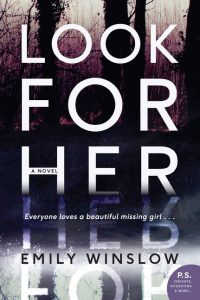
Look For Her – Emily Winslow

Look-for-Her-cover-200x300I have a feeling that I am going to be in the minority here, but I didn’t really groove to Emily Winslow’s Look For Her. This is the fourth book in a series featuring British detectives Morris Keene and Chloe Frohmann, but I didn’t know that going in and I don’t think it really matters in terms of your enjoyment (or in my case lack of) when reading the novel.

Back in 1976, Annalise Wood disappeared. Years later, another Annalise brings her up in a therapy session with Dr. Laurie Ambrose.

…she went missing when she was sixteen. My mother was the same age when it happened. Annalise was lovely, much prettier than my sister and I ever became. She was the kind of girl you look at and think, Of course someone would want to take her.

The body wasn’t found until 1992 and DNA didn’t yield any results at the time, but now there’s been a break in the case.  Keene (who is no longer an active detective) and Frohmann (who has recently had a baby) reunite to follow the trail of new evidence. The pair are prickly with one another; they have clearly had a falling out in a previous installment of the series.

You’d think that all the elements for a compelling mystery would be there, right? Decades old mystery. New evidence. Unreliable narration. So what didn’t work?

Look For Me lacked momentum. Told through transcribed therapy sessions and multiple points of view (the detectives, the therapist, e-mails), I just couldn’t settle into the narrative. (Trust me, multiple narratives aren’t usually a problem for me.)  There are a lot of characters to keep track of (also generally not a problem), and complicated family relationships. Perhaps I would have been more inclined to try to untangle the threads if I had cared one iota for any of the characters, but I didn’t.

So it’s weird that I didn’t like this book because it had all the right ingredients and it should have added up to a big win for me. To be fair, because I didn’t read it in one breathless gulp (as is often the case with books like this) I found the story way too convoluted. Part of what was unsatisfying to me was how neatly all these disparate threads were woven together at the end: perhaps just a little too neatly.

My dissatisfaction aside, Winslow can certainly write and I suspect that fans of the series and the majority of the readers who enjoy twisty mysteries will like this book.

Thanks to TLC Book Tours and Harper Collins for the opportunity to review this book.


My Sunshine Away – M.O. Walsh

My-Sunshine-AwayJust when I thought my reading slump was never going to end, I read M.O. Walsh’s compelling debut novel My Sunshine Away. I can’t even begin to tell you how much I loved this book – start to finish.
The unnamed adult narrator is recalling the time between ages 14 and 16, when he lived with his mother on Piney Creek Road, in an affluent area outside Baton Rouge, Louisiana. He’s obsessively in love with Lindy Simpson, the beautiful fifteen-year-old track star who lives across the street. After Lindy is raped, our narrator’s life is irrevocably changed. Through his eyes we try to unravel the mystery of who hurt Lindy and so, in that respect, My Sunshine Away is a total page-turner. But it is so, so much more than that.

First of all, Walsh evokes a sense of time and place that is both exotic (I have never been to Louisiana, although I would love to visit once Trump is no longer in office) and familiar. Set in 1989, the book’s sense of time and place is practically nostalgia now. The children on the street get together and play football, go fishing, wander the woods, gather piles of moss. It’s pre-Internet and so reminiscent of my own childhood despite the fact that it’s 20 years later. You know, back when kids played outside. With each other.

The main character is completely authentic. From his vantage point as an adult, he spills both the varnished and unvarnished truth about those two turbulent years when he watched Lindy so closely that readers might actually believe he could have had something to do with her attack. He even admits that  he was “one of the suspects”,  but then begs the reader to “Hear me out. Let me explain.”

There was something about My Sunshine Away that reminded me of Thomas H. Cook.  This is a compliment. Really. At his best, Cook writes literate mysteries that often plumb the complicated depths of family and memory. I couldn’t help but think of Cook while reading Walsh because Cook’s characters are never stereotypes. They are so fully realized that his novels always feel like  much more than just a straight-up mystery. This was true of My Sunshine Away, also. Like our narrator, we want to find out who had hurt Lindy, but we also want to come to terms with the narrator’s relationship with his father who has left the family home, and his wife and son bereft. We want to see him work his way through his awkward adolescence. This is  a bildungsroman done so well that your breath will literally catch in your throat.

The narrator’s self-awareness is so profound that it takes My Sunshine Away to another level entirely.

And it is not until times like these, when there are years between myself and the events, that I feel even close to understanding my memories and how the people I’ve known have affected me. And I am often impressed and overwhelmed by the beautiful ways the heart and mind work without cease to create this feeling of connection.

I highly and wholeheartedly recommend this book.

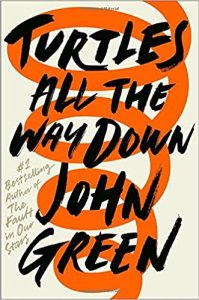
Turtles All the Way Down – John Green

turtlesI have a deep and abiding love for John Green. He’s a passionate advocate for reading and learning. He makes nerdish pursuits cool and I think he’s a terrific writer. Lord knows, I was a sobbing, snotty mess at 2 a.m. finishing The Fault in Our Stars. I was pretty excited, then, to get my hands on Green’s latest book, Turtles All the Way Down.

Aza is sixteen and suffers from almost debilitating mental illness. She has no control of her thoughts and her thoughts take her to some pretty unusual and scary places. Even the simple act of eating is problematic for Aza who finds “the whole process of masticating plants and animals and then shoving them down my esophagus kind of disgusting, so I was trying not to think about the fact that I was eating, which is a form of thinking about it.”

Still, she finds ways of coping. Daisy, for example, “played the role of my Best and Most Fearless Friend.” And then there’s Davis Pickett, a childhood friend with whom Aza reconnects after she reads in the paper that his billionaire father, Russell, has disappeared.

There’s not really a plot, but that’s not to say that nothing happens in the novel. Aza and Daisy decide they are going to play detective and figure out what happened to Russell. That leads to Aza and Davis picking up their friendship and discovering that they might have feelings for each other, which is complicated by the fact that Aza has spiraling thoughts. She fixates on things and can’t seem to stop, which leads her down a rabbit hole of worry. I suspect that anyone who suffers from anxiety or mental health issues will totally get Aza’s erratic thoughts. I didn’t, especially, but I thought Green did a tremendous job of illustrating how Aza gets trapped in her own head.

The sting of the hand sanitizer was gone now, which meant the bacteria were back to breeding, spreading though my finger into the bloodstream. Why did I ever crack open the callus anyway? Why couldn’t I just leave it alone? Why did I have to give myself a constant, gaping open wound on, of all places, my finger. The hands are the dirtiest parts of the body. Why couldn’t I pinch my earlobe or my belly or my ankle? I’d probably killed myself with sepsis because of some stupid childhood ritual that didn’t even prove what I wanted it to prove, because what I wanted to know was unknowable, because there was no way to be sure about anything.

Green has spoken quite openly about his own struggles with mental health. In an article with Time he said: “I still can’t really talk directly about my own obsessions. The word triggering has become so broadly used in popular culture, but anyone who has experienced an anxiety attack knows how badly they want to avoid it. It was really hard, especially at first, to write about this thing that’s been such a big part of my life. But in another way, it was really empowering because I felt like if I could give it form or expression I could look at it and I could talk about it directly rather than being scared of it. And one of the main things I wanted to do in the book was to get at how isolating it can be to live with mental illness and also how difficult it can be for the people who are around you because you’re so isolated.”

Turtles All the Way Down does not simplify Aza’s problems and there are no happy endings here, but I do believe this is a hopeful novel. And while it didn’t leave me a sobbing mess like The Fault in Our Stars there is much to admire here. Green remains one of my favourite YA writers.

That Was Then, This Is Now – S.E. Hinton

that was thenBack in the day, there probably wasn’t a teenager alive who hadn’t read The Outsiders, S.E. Hinton’s first novel. Written when Hinton was just sixteen and published around the time she graduated from high school, The Outsiders tells the story of the Curtis brothers Darry, Soda, and Ponyboy. It’s considered the seminal young adult novel and remains a classroom favourite almost 50 years after its publication.

I read it as a teenager, of course. Then I read Hinton’s second novel, That Was Then, This is Now and I remember that it had a profound impact on me. So, when it came time to choose the novel I wanted to begin my first ever Young Adult Literature class with, I chose Hinton’s second book – mostly because I knew that although many students would be familiar with The Outsiders, they might not know this book. Plus, it gave me an excuse to read it 40 odd years later after my first go-around.

That Was The, This is Now treads familiar ground (and in fact Ponyboy even makes an appearance in this book). It concerns the fates of Bryon, the novel’s sixteen-year-old narrator and his boyhood best friend and de facto brother, Mark.

I had been friends with Mark long before he came to live with us. He had lived down the street and it seemed to me that we had always been together. We had never had a fight. We had never even had an argument…He was my best friend and we were like brothers.

The two boys live a relatively hard-scrabble life with Bryon’s single mother mom. They hustle pool, chase ‘chicks’ and generally get up to no good. Occasionally, they meet up with M&M, a younger kid from their neighbourhood.

M&M was the most serious guy I knew. He always had this wide-eyed, intent, trusting look on his face, but sometimes he smiled and when he did it was really great. He was an awful nice kid even if he was a little strange.

That Was Then, This Is Now  is a coming of age story. The catalyst for Bryon’s transformation from dime-store hood to responsible young adult is his blossoming relationship with M&M’s older sister, Cathy, and an incident which puts M&M in harm’s way.

There’s no question that some of the references are dated. It was kind of funny to read about hippies and parents who are cross with their kids because their hair is too long. On the other hand, although styles come and go, some things remain the same. Parents and their children still have disagreements. Lots of teenagers are left to their own devices, as Bryon and Mark often are. There were several moments in the book that felt as relevant and fresh to me now as I am sure they did then.

Ultimately, Bryon must make a decision that changes the course of his life. It’s a hard epiphany to swallow, but it’s one that makes That Was Then, This Is Now as relevant as it was when it was first published.

The Vanishing Game – Kate Kae Myers

vanishingJocelyn’s twin brother Jack is dead. At least that’s what she thinks until she receives a letter from him that sends her on a wild chase. First stop: Noah Collier.
Noah becomes a reluctant participant in Jocelyn’s search after her car and belongings are stolen. She’s come to Noah looking for help because Noah had been Jack’s best friend. They’d both worked for the same computer programming company, ISI.

Kate Kae Myers’ YA novel The Vanishing Game is a twisty turny mystery novel that follows Jocelyn and Noah as they race around following Jack’s complicated clues. (Complicated enough that I stopped trying to figure them out, but I was wayyy distracted when I was reading this book.)

Jocelyn, Jack and Noah spent their adolescence at Seale House, a foster home run by Hazel Frey, a drug addict who locked kids in the basement as punishment. Jocelyn is convinced that there are clues in the ruined remains of the place she once called home. (Half the building had burned down.) It’s the first stop on her journey to finding out exactly what happened to her brother and if he is actually really dead.

Jack leaves a series of puzzles for Jocelyn and Noah to solve, puzzles reminiscent of the games they used to play as kids at Seale House. But the clues aren’t they only mystery: Seale House has some ghosts to give up and someone is following the pair as they try to get to the bottom of Jack’s death.

The Vanishing Game will intrigue careful readers


The American Girl – Kate Horsley

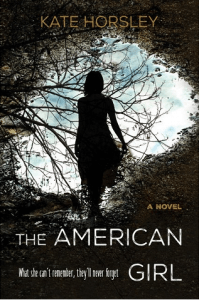
american girlMeet Quinn Perkins, a seventeen-year-old American exchange student spending a semester in the small French town of St. Roch.

Meet the Blavettes, Quinn’s host family. Sixteen-year-old Noemie, her nineteen-year-old brother, Raphael, and their mom, Emilie.

Meet Molly Swift, an American reporter for American Confessional, an podcast series that takes on “stories of police incompetence or just general incompetence, and find[s] the real story.”

When Quinn wanders out of the woods “barefoot and bloodied” only to be hit by a car (the driver of which doesn’t stop) and left in a coma, Molly and her journalistic muse, Bill, think Quinn would make a perfect story, something about “a young American girl coming of age, going into the world on her own only to encounter the unkindness of a stranger.”

Quinn’s story is slightly more complicated than that, though. Through a series of flashbacks, readers are introduced to the toxic Blavette household: father Marc  has left the family after an incident at the local school (which is attached to the house the family lives in and has subsequently been closed). Madame Blavette now takes exchange students as a way of making ends meet.

First thought to be away on a holiday, it is soon revealed that the Blavette family has disappeared without a trace. When Quinn wakes up in the hospital after her accident, she has no memory. Good thing, too, since Molly feels like the best way to get close to Quinn is to pretend to be her aunt. (Quinn’s father back home in America, is too busy with his much-younger pregnant wife to make the trip to France after Quinn’s accident.)

Kate Horsley’s The American Girl would make a terrific Netflix mini series. It’s populated with a cast of characters who all seem to have ulterior motives making it impossible to decide who is telling the truth. There are subplots galore including threatening Snapchat messages, sinister caves, locked doors and menacing strangers.

If this seems like a lot – it’s really not. The book was a lot of fun to read.