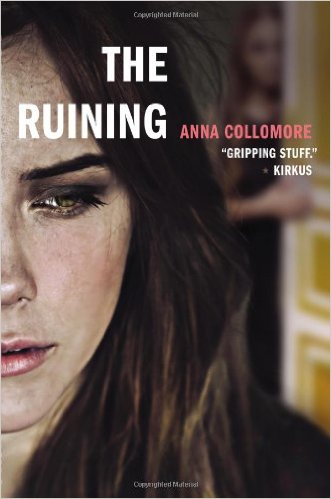
The Ruining – Anna Collomore

ruiningEighteen-year-old Annie Phillips, the first person narrator of Anna Collomore’s YA novel The Ruining,  is desperate to escape her trailer trash world outside of Detroit, Michigan and begin a new life. When she’s offered the opportunity to become a nanny on Belvedere Island, located about six kilometers north of San Francisco, she jumps at a chance. The gig sounds perfect: she’ll care for three-year-old Zoe and baby Jackson and take classes at San Francisco State University.

Libby and Walker Cohen are not like anyone Annie has ever met and it doesn’t take very long before Annie feels “a sudden, desperate urge to please Libby, to do everything right, to be the most exemplary nanny the Cohen family had ever had.”

In the beginning, life seems too good to be true. The Cohen’s house is “more like an estate or a castle” and  Libby seems more like a girlfriend than an employer, offering Annie wine, shared confidences and a chance to raid her closet. It’s heady stuff for Annie, who comes from nothing and is dragging the baggage of a personal tragedy from her past.

The reality of my life in Detroit, a reality I’d spent almost every day wishing to escape, was gone. Disappeared, like I’d never been a part of it at all. And in order to leave it in the past, I couldn’t let myself worry about leaving my mother behind.

It won’t take the reader long to see the cracks, though, even if Annie is a little bit slow on the uptake. I cut her some slack because she’s young and damaged and trying so hard to make something of her life. However, Annie seems determined to ignore the signs that something is not quite right in the Cohen house. Libby is like Dr. Jekyll and Mr. Hyde: solicitous and kind one day, passive aggressive the next.  Walker is gregarious and friendly, but  mostly absent. There are no grandparents, no extended family — Annie is isolated until she meets Owen, the literal boy next door.

The Ruining races along at a good pace, traversing the line between suspenseful and ridiculous with aplomb. Collomore manages to make it just possible for the reader to believe that Annie might be more damaged from her past than even she realizes; however, there can be no mistaking who the villain of the piece is.

The Ruining was fun to read, well-written and definitely recommendable; I know my students will gobble it up. Can’t say I was a huge fan of the ending, though. For me it was contrived and way too tidy given the complicated nature of Annie’s circumstances.

The Girl on the Train – Paula Hawkins

girlontrainSo, you know how everyone and their dog was reading and talking about Gone Girl when it was released? The Girl on the Train, Paula Hawkins’ debut novel, is this summer’s version of that book. I talked about books with buzz  last week on Information Morning and this book most definitely had buzz. Is it worthy, though? That’s the question.

Rachel takes the same trains from Ashbury, a tiny suburb outside of London, every day –  into the city on the 8:04 and home from the city on the 17:56. From her seat, she can see into the gardens of the homes she passes and one garden in particular captures her interest. That’s the house where Jason and Jess live.

They are a perfect, golden couple. He is dark haired and well built, strong, protective, kind. He has a great laugh. She is one of those tiny bird-women, a beauty,  pale- skinned with blonde hair cropped short. She has the bone structure to carry that kind of thing off, sharp cheekbones dappled with a sprinkling of freckles, a fine jaw.

Every day when Rachel’s train shudders to a stop at the red signal, Rachel imagines the life Jason and Jess must share (imagining is all she can do because she doesn’t really know them, not even their real names).  But  there is another reason that Rachel is fixated on this house and that’s because for five years she lived just down the road with her husband, Tom. Tom still lives in their old house, only now with his new wife, Anna, and their infant daughter, Evie.

It won’t take the reader very long to figure out that Rachel is an unreliable narrator and the reason for that will be obvious: Rachel is a drunk. She drinks in the morning, in the evening, mostly alone. She throws up, passes out and often doesn’t remember what has happened to her. She calls her ex-husband at all hours. She admits

I am not the girl I used to be. I am no longer desirable, I’m off-putting in some way. It’s not just that I’ve put on weight, or that my face is puffy from the drinking and the lack of sleep; it’s as if people can see the damage written all over me…

Then one day Jess (whose real name is Megan) goes missing and Rachel is sure that she has seen something that will help the police to find her. The problem is, of course, that once she pulls on the thread of what she thinks she saw, a whole lot of things start to unravel.

As messed up as Rachel is, it’s difficult not to empathize with her; her life has gone to hell in a hand basket in a variety of ways and she isn’t quite sure how to right herself.  Hers is not the only viewpoint Hawkins allows the reader, though. We also spend time with Megan and Anna and each woman has their own suspect relationship with the truth.

The Girl on the Train is an entertaining read. I can certainly see what all the fuss is about and given that it only took me a few hours to read, I certainly can’t say that I didn’t like it. But I didn’t love it.

Orphan Train – Christina Baker Kline

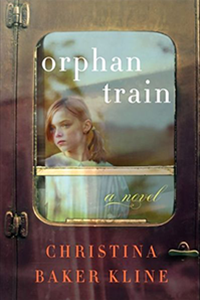
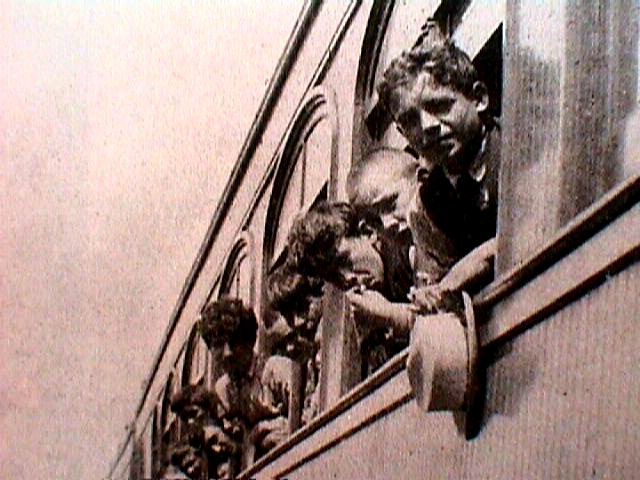
orphan2I was unaware of the history which inspired Christina Kline Baker’s novel Orphan Train. According to the notes found at the back of the book “between 1854 and 1929, so-called orphan trains transported more than two hundred thousand orphaned, abandoned, and homeless children – many of whom, like the character in this book, were first-generation Irish Catholic immigrants – from the coastal cities of the eastern United States to the Midwest for “adoption,” which often turned out to be indentured servitude.”

In a nutshell, Orphan Train is the story of one such girl.

But it is also the story of another girl, someone who is also without a home and has spent much of her childhood bouncing between foster homes. The lives of these two people (one just seventeen, the other ninety-one) intersect, but that is actually the least interesting part of this novel.

Niamh Power is a little girl when her parents decide to leave their impoverished lives in Western Ireland and make the arduous journey across the Atlantic to America.

People all around us were fleeing to America: we heard tales of oranges the size of baking potatoes; fields of grain waving under sunny skies; clean, dry timber houses with indoor plumbing and electricity. Jobs as plentiful as the fruit on the trees.

Of course, the reality is something quite different and Niamh finds herself living in a four-room apartment with her parents and three younger siblings. The landlord tells them “I have no trouble with the Irish, as long as you stay out of trouble.”  Still, Niahm is hopeful for a new start because her father “had the promise of a new job. We could pull a chain for light; the twist of a knob brought running water…”

Sadly, Niamh’s hopes for the future soon turn to despair and she finds herself alone and on one of the orphan trains bound for childrenontrainthe west. She is only nine when she is taken on a journey to find her a new family.

They call this an orphan train, children, and you are lucky to be on it. You are leaving behind an evil place, full of ignorance, poverty, and vice, for the nobility of country life.

Not so much, really.

Molly is the other character in this book. She works hard at being different in an attempt to push people away, mostly in an effort to protect herself. She had “liked the distance her persona created, the wariness and distrust she saw in the eyes of her peers.” Just lately, though, Molly has found that maintaining her ‘look’ was making her “impatient.”

When she tries to steal a copy of Jane Eyre from the local library, she is assigned community service and it is that sentence which brings her into Niamh’s world. From a prickly beginning, a real bond is formed between the two disparate women – which is both lovely and problematic for the novel.

I read Orphan Train in an afternoon; the pages literally turned themselves. I loved reading Niamh’s story. I knew nothing about these orphan trains and Niamh’s tale was fascinating and heartbreaking. Molly was also likeable. Despite her attempts at pushing people away, she is clearly smart and resilient. C’mon, her favourite book is Jane Eyre! It would be impossible for an avid reader not to like her.

For about two-thirds of the book I was all-in. Then, things started to speed up a little too much. Characters made decisions  that I just didn’t buy and things happened that made me go “oh no you didn’t!” and even though I kept turning the pages I can’t say that I enjoyed the book quite as much at the end as I did at the beginning.

Nevertheless, Orphan Train is an entertaining and well-written novel about a relatively unknown part of American history and many readers would certainly enjoy it.

The End of Everything – Megan Abbott

endofeverythingA few months back I read Megan Abbott’s YA novel Dare Me and despite the novel’s caustic depiction of teenage girls, I really loved that book. The End of Everything also tackles the secret lives of girls and, once again, Abbott’s writing is compelling.

Thirteen-year-old Lizzie and Evie are besties. They’ve lived next door to each other their whole lives – swapping bathing suits and secrets. On a bright afternoon, just before school breaks for the summer, Evie disappears. Lizzie remembers

It was long ago, centuries. A quivery mirage of a thirteen-year-old’s summer, like a million other girl summers, were it not for Evie, were it not for Evie’s thumping heart and all those twisting things untwisting.

Thirteen seems incredibly young to me now, but I don’t suppose it did when I was that age – a  million years ago. For Evie and Lizzie it is a time of curious longing, especially because Evie has an older sister, Dusty, “a deeply glamorous seventeen.”  Compared to Dusty, Evie and Lizzie “were all snips and snails, and when permitted into her candied interior, we were like furtive intruders.”

For Evie and Lizzie, thirteen is an age precariously close to the edge of experience – and both girls seem to want to topple, headlong, over the cliff. After Evie’s disappearance, Lizzie finds herself particularly drawn to Evie’s dad, Mr. Verner. He

could throw a football fifty yards and build princess vanity tables for his daughters and take us roller-skating or bowling, who smelled of fresh air and limes and Christmas nutmeg all at once…I couldn’t remember a time when I wasn’t craning my neck to look up at him, forever waiting to hear more, hungry for the moments he would shine his attentions on me

It doesn’t take long for Lizzie to remember a car that she’d seen driving past them on the day Evie disappeared. The suspect is identified and Lizzie makes it her mission to figure out where Evie is. All this makes for page-turning suspense, but that’s not what The End of Everything is really about.

This is a novel about power, sexual power, really, in the hands of girls too young to wield it. It is about an  impossible longing girls feel, but don’t wholly understand. It asks the questions for which there are no satisfactory answers. Lizzie  wonders why the man took Evie “if he didn’t mean to touch her, to do things to her?” and those thoughts send her to her room where she pulls “out a stack of old, gold-spined horse books, and read[s] them for hours.”

When the truth is finally revealed to Lizzie it is “a dark tunnel I stare down, like I might follow it, like it might swallow me whole and I would let it willingly.”

Abbott’s books are like that – but you have to be fearless to read them.

Highly recommended.

The Goldfinch – Donna Tartt

goldfinchMy son, Connor, purchased The Goldfinch in hardcover with his own money when it first came out. He read it avidly, misplaced it for a while, and took to reading it, a little at a time, whenever we visited Indigo. Eventually it turned up (but by then it was out in paperback and he’d purchased another copy)  and he finished it and talked about it for days.

The Goldfinch is not my first kick at the Donna Tartt can. Like Connor, I have read her two previous novels: her 1992 debut, The Secret History, a compelling literary page-turner which has stayed with me for years and which I recommend to everyone and The Little Friend, a slow-moving southern gothic. When my friend Karen chose The Goldfinch as her Facebook summer book club read, I knew I had to participate. For one thing, the novel is huge – 771 pages – and I knew I’d need uninterrupted time to finish it. Also, I flaked out on last summer’s epic, George Eliot’s Middlemarch and I needed to redeem myself.

Despite its accolades (The Goldfinch was the 2104 Pulitzer Prize winner and was (almost) universally praised by critics and authors) the novel isn’t without its detractors. Some critics wonder whether it’s deserving of being called Dickensian. In her 2014 Vanity Fair article, “It’s Tartt – But is it Art?” Evgenia Peretz  quotes novelist and critic Francine Prose’s assessment that “for all the frequent descriptions of the book as “Dickensian,” Tartt demonstrates little of Dickens’s remarkable powers of description and graceful language.” It’s hard to tell whether the vitriol for the author and the book (often in equal measure) is merely sour grapes. Perestz is correct, though, when she concedes that  “No novel gets uniformly enthusiastic reviews, but the polarized responses to The Goldfinch lead to the long-debated questions: What makes a work literature, and who gets to decide?”

Well, that would be you. And me. And Connor. And while this review – any of my reviews, really – won’t be on par with reviews found in well-respected magazines like The New Yorker and The Paris Review I do believe that, like any other reader on the planet, my assessment (as subjective as it might be) is valid. Consider that my disclaimer.

gfTheo Decker is just thirteen when he visits the Metropolitan Museum of Art with his mother to see an exhibition of the Dutch masters, including The Goldfinch, a 1654 painting by Carel Fabritius, which Mrs. Decker claims is “the first painting I ever really loved.”

The day is remarkable and horrific for Theo because after his mother wanders off to the gift shop there is an explosion which kills her and which also precipitates an act of thievery which informs Theo’s life for the next fourteen years.

The Goldfinch has been described as a bildungsroman – a word which was unfamiliar to me and therefore had to look up. It means “a novel whose principal subject is the moral, psychological, and intellectual development of a usually youthful main character.”

The bulk (and I use that word without irony) of the book is spent watching Theo implode – first while living with the Barbours, wealthy parents of his childhood friend, Andy. When his deadbeat father turns up, Theo goes off to Vegas to live with him and his girlfriend Xandra. There he meets Boris, another disenfranchised youth. The two spend their days cuffing school and getting high. Eventually, Theo makes his way back to New York City where he moves in with Hobie, an antique furniture restorer. The one constant in Theo’s life (besides his predilection for self-destruction via alcohol and drugs) is the painting of the goldfinch, which is his only real remaining connection to his mother.

Theo is not particularly likable. I don’t think that matters, actually. Boris shouldn’t be likable either, but I did like him. Quite a lot. I loved Hobie the best, for which Connor berates me. “Why does everyone like Hobie so much? He’s boring and spineless.” Maybe it’s the parent thing; he stepped up when he had no reason and he was unwaveringly supportive of Theo, even when he had every reason to kick him to the curb. Despite the novel’s insular first-person perspective, I felt as though I knew all the characters in this book. And if Theo seems just a tad precocious, chalk it up to the fact that he is setting the events down fourteen years after they’ve happened. He’s an adult, much like Scout Finch, looking back.

“Things would have turned out better if she had lived,” he says. But I wonder if that’s true because he also admits that “I’d been in trouble at school for a while.” Either way, the death of Theo’s mother sets him on a rather arduous and painful journey of self-discovery where ultimately he discovers that “we don’t get to choose our own hearts. We can’t make ourselves want what’s good for us or what’s good for other people. We don’t get to choose the people we are.”

Is Tartt’s world view really this grim? It’s hard to say. If we really spent any time thinking about it, even the most optimistic of us would have to admit that Theo might be on to something when he says:

This was a plunge encompassing sorrow and revulsion far beyond the personal: a sick, drenching nausea at all humanity and human endeavor from the dawn of time. The writhing loathsomeness of the biological order, Old age, sickness, death. No escape for anyone. Even the beautiful ones were like soft fruit about to spoil. And yet somehow people kept fucking and breeding and popping out new fodder for the grave, producing more and more new beings to suffer like this was some kind of redemptive, or good, or even somehow morally admirable thing: dragging more innocent creatures into the lose-lose game.

And if life is just a slow (but not that slow – which is also disconcerting), painful decline to the grave, what can possible sustain us? What gives life its meaning? In his article “Why Poetry is Necessary” Roger Housden argues that “Artists and poets are the raw nerve ends of humanity. By themselves they can do little to save humanity. Without them there would be little worth saving.”

Boris, as reprehensible as he might seem to some readers, seems to at least understand that the world is not black and white and that “Maybe sometimes – the wrong way is the right way? You can take the wrong path and it still comes out where you want to be?…As long as I am acting out of love, I feel I am doing best I know how.”

This is a big ideas book. Some readers might argue that the final twenty or so pages is exposition and something of a cheat. I wondered if we might have gotten there, say, 200 pages sooner, because I liked what Tartt has to say. I liked Boris’s attempt to disabuse Theo of the notion that the world can be boiled down to either pure good or pure bad. He understands that “the world is much stranger than we know or can say.” Theo, comes at least, to recognize that

It’s not about outward appearances but inward significance. A grandeur in the world, but not of the world, a grandeur that the world doesn’t understand. That first glimpse of pure otherness, in whose presence you bloom out and out and out.

I loved The Goldfinch. And I also think the book is bloated and slow and sometimes the punctuation drove me nuts. It is flawed, no question, but maybe – in some ways – the book mirrors life. Life is big and messy and random; sometimes all the pieces don’t fit; sometimes, unexpectedly, there is the “heat-shock of believing. for only a moment, that you might just have what could never be yours.”

There is also a little of Gatsby in this novel, the notion that we  “we beat on, boats against the current.”

I will carry The Goldfinch with me for a long time.

The Troop – Nick Cutter

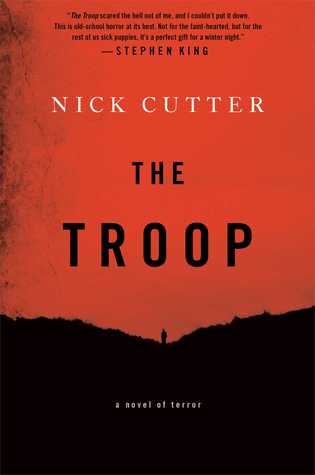
troopNick Cutter is a pseudonym for Canadian writer Craig Davidson, author of Rust and Bone and Cataract City. I haven’t read anything by Davidson, but The Troop ended up on my reading radar because it was on pretty much everyone’s  radar when it was released in 2014. Even Stephen King, master of all things macabre claimed The Troop “scared the hell out of [him]…This is old-school horror at its best.”

Scoutmaster Tim Riggs takes his troop of five fourteen-year-olds (Kent, Ephraim, Max, Shelley and Newt)  to Falstaff Island, which is located fifteen miles off the northern coast of Prince Edward Island. (Trust me, there is not even a whiff of Anne Shirley here.)  It’s October and it’s time for the annual camping trip – something that Tim (who is also the local doctor) and the boys (as varied an assortment of teenagers as you can get including the alpha male, the nerd and the psychopath) look forward to. Tim is “everything they could possibly want in a leader: knowledgeable and serene, exuding confidence while bolstering their own.”

They’ve only just settled in when a boat arrives at the island   and a man disembarks.

A quivering string of drool spooled over his lip, hung, snapped. His skin was stretched thin as crepe paper over his skull. Capillaries wormed across his nose, over his cheeks and down his neck like river routes on a topographical map. His arms jutted from his T-shirt like Tinker Toys. The skin was shrink-wrapped around the radius and ulna bones, giving his elbows the appearance of knots in a rope.

The man is starving. So hungry, in fact, that Tim watches in amazement as the man “picked up a handful of coarse soil and stuffed it in his mouth.”

A day later, the man is dead and all hell has broken loose on the island.

The man has brought a bioengineered threat with him and it doesn’t take very long for the chaos to begin. The boys, who are loosely divided into factions anyway, start to crumble under the weight of their own terror. Shelley, who is clearly a psychopath, uses the circumstances to “play.” He is, by far, the most horrifying character to spend time with. I could barely read the words on the page.

The other boys are equally well-drawn and you’ll want them all to be safe (well, except for Shel) even when you realize it’s just not possible.

I’m going to say it up front: The Troop isn’t a book for the squeamish. I’m talking skin-crawling, page-skimming squick here. I’ve got a pretty strong stomach when it comes to the written word (I’m less brave when the violence is on the screen) but there were seriously parts of this book that were just….awful.

Cutter includes newspaper articles, courtroom depositions and interviews to help fill in some of the narrative blanks – information the boys and Tim would not be privy to in the circumstances. It all makes for page-turning, gloriously icky fun.

Some Girls – Kristin McCloy

somegirlsWhat’s a reader to do when the author of her favourite book of all time, Velocity, encourages her to read another of her books. Said book, Kristin McCloy’s second novel, Some Girls, has been languishing on my tbr shelf for at least four years and clearly I intended to read it at some point – I wouldn’t have purchased it otherwise. The stakes are higher now, though. Not only have I recently re-read Velocity, but I’ve struck up a sort of email friendship with Ms. McCloy and I was terrified to read this book (I have her third book, Hollywood Savage also waiting to be read) for a variety of reasons – not the least of which is that I LOVE Velocity and nothing could ever be as good as that. Also, what happens if I don’t like this book or the next one. Gah!

Ok, I have my reader-angst out of the way.

Some Girls is the story of twenty-three-year-old Claire Stearn who flees Alamogordo, New Mexico for the bright lights of NYC circa  1989. She leaves behind her divorced and bitter mother, Ginny, her older sister, Paula, and her boyfriend, a rancher called Tommy. In many ways, Claire isn’t different from  any other young person who, desperate to escape the confines of their lives,  makes their way to a big city. Claire is “aware of her spine, the strength of her pelvic bones, the arches of her feet. It was all she needed to support her.” She’s ready to become herself.

New York City is very much a character In Some Girls. The 1989 version depicted in the novel isn’t the NYC of 2015.  As Claire rides into the city from the airport she describes it as “a terror, glossy buildings rising out of a slum, a place of anarchy, crooked and lawless, impenetrable.” I remember that New York because I spent some time in the city in the 1980s. It was a little rough around the edges, but for a small-town girl like me still spectacular.

For that reason, I related to Claire’s assimilation. Those first few days, when Claire had “nothing but the speed with which she walked and her sunglasses to protect her” reminded me of me. I was so desperate to blend in, to not look like I knew nothing.  I’m sure, in the early days,  you could smell my terror from twenty paces. And like, Claire, I was constantly pinching myself and thinking “I’m here, I’m in New York City, a shock each time.”

McCloy captures the frenetic energy, the heat and the smells, the blast of icy cold, the patchwork quilt of humanity that is New York City and I liked revisiting the city through her lens very much.

Claire meets Jade the day she moves into her little downtown apartment. (I sort of imagine it in the area of Soho, but I wasn’t familiar with White Street so I had to look it up on the map.)  Jade is, to Claire’s innocent eyes, “a woman of the city.”  When they finally spend a little time together Claire feels “the crushing sense of anonymity that had dogged her ever since she had arrived suddenly turned to reveal its other face.” There is erotic tension between the two women from the start.

This relationship was a little harder for me to relate to than Ellie’s relationship with Jesse in Velocity. I am worldly enough now to know that sexuality is vastly more fluid than I might have viewed it when I was Claire’s age. I think my unease has more to do with the fact that I didn’t particularly care for Jade. She seemed self-centered and reckless and I never felt as though I knew her well enough to understand Claire’s attraction to her. She was startlingly beautiful, but surely there was more to it than that? That said, I felt as though Claire’s feelings – about Jade, about her life, about what she was leaving behind when she said good-bye to Tommy – were authentic. Complicated and messy, but certainly true.

Some Girls does a fine job of capturing a young adult on the precipice of figuring her life out, making choices that are both difficult and blindingly simple. While I may not have been able to relate to Claire’s relationship with Jade, I did love her journey and ultimately, isn’t that the point?

I also loved the writing in this novel. It was different from Velocity, which demonstrates the depth of McCloy’s talents, but still a pleasure to read.

The Silent Girls – Eric Rickstad

silentgirlsI picked up Eric Rickstad’s novel, The Silent Girls, on a whim. Creepy cover. Compelling blurb. Killer opening. But. (Trust me, you’ll get it in a moment.)

So, Frank Rath is a former cop turned private investigator who lives in Canaan, Vermont. He’s a single dad to daughter, Rachel, who is away for her first semester at college. By his own admission, Rath was a womanizing asshole, until his sister and her husband were brutally murdered in their own home. Now he’s a middle aged ex-cop with a bad back and too much time on his hands.

Then local cop, Harland Grout, calls about a missing girl who happens to be the daughter of his wife’s cousin. He wants Rath’s help. Looking into the case, another cop, Sonja Test (yes, all the names are this weird) discovers that there have been several other missing girls in the area over the last few years. Rath starts poking around, as you do, allowing the reader to meet a strange (and often reprehensible) cast of minor characters complete with the requisite red herrings.

As far as mysteries go, this one is okay. Not fabulous, not horrible. I think part of the issue for me was that there was – perhaps – too much going on. The latest missing girl is one thing. All the other girls another thing. And Rath’s own troubled past also factors in and contributes to a completely implausible denouement. I don’t mean to imply that the plot is convoluted; it’s not hard to keep track of any of this. It’s just that…

I was distracted by the writing. So, instead of staying with Rath the whole time, Rickstad chose a less limited point of view. Okay – fair enough. However, he had this weird writing tick that drove me nuts.

“She sort of seems familiar. But. In that way that reminds you of someone from TV or a dream.”

*

“But. State borders aren’t going to stop a sicko,” Sonja said.

*

But. How did one person, or even two people, choose these girls. And why?

*

“Of course I can read.” Gale sighed. “But. Her handwriting is a first grader’s. I’ll give it my best.”

*

“That was when I thought you were an intruder. I’ve been known to fib, if circumstances warrant. But. He’s harmless.”

I’m sure you get my drift. It would be one thing if one character said “But.”  in this manner. Unfortunately, Rickstad uses it in exposition and every piece of dialogue I’ve quoted above is a different character. Is it a Vermont thing? Drove me bonkers.

Is The Silent Girls a page-turner? After all, that’s why we read books like this, right?  I was intrigued by the book’s opening  – which was uber-creepy and reminiscent of the movie The Strangers. (It took me three tries to watch that thing) but I can’t say that the rest of the book lived up to its promise. I didn’t really care for any of the characters and I hated the ending. I turned the pages, sure, but I wouldn’t turn the book over to someone else.

Velocity – Kristin McCloy

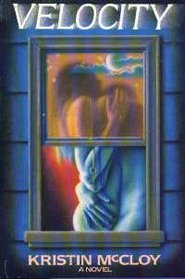
velocityA couple of days ago on Information Morning, I talked about how I wished that I could carve out some time to revisit some of my favourite books. I mentioned three in particular: A Tree Grows in Brooklyn by Betty Smith, Jane Eyre by Charlotte Bronte and Kristin McCloy’s Velocity. All three of these books had a profound impact on me, the first two when I was much younger and McCloy’s book when I first read it as a twenty-something. Of those three, I have actually already re-read Velocity numerous times and I just finished reading it again.

I think I am going to have a difficult time articulating exactly why I continue to find Velocity so compelling, but I do want to honour the book and its place in my personal canon here, especially because I recently had the very good fortune of exchanging a couple emails with the novel’s author, Kristin McCloy. (Insert fangirl squee here.)

When it was first published in 1988, Velocity caused quite a stir and earned copious praise. I am not sure what year I picked up my copy, perhaps 1989, but I definitely purchased it at The Strand in NYC. I devoured the book then for reasons that will surely become apparent a little further on.

So, what’s the book about?

Twenty-five-year-old Ellie Lowell has returned to her backwater North Carolina hometown to scatter her mother’s ashes. Ellie’s an only child and she’s been living in New York City for the past six years, so she’s finding it difficult to connect with her taciturn father, a local cop. They share the family home like two strangers might share a taxi ride to the airport – making small talk, but never really connecting.

Despite the awkwardness, Ellie decides to stay home for the summer, leaving her fledgling career in the film business and her boyfriend, Dec, back in the Big Apple. She gets a job at a local diner and before you can say two eggs over easy, she’s hooked up with Jesse, the half-Cherokee biker who lives down the road. Ellie knows he’s trouble. She says

…it occurs to me, a thousand woman, he’s had a thousand women, and every one of them has fed him everything she had.

Even though Jesse isn’t much for talking, Ellie finds herself pulled into his orbit. The attraction is sexual, of course, and she remarks that his “crazy height and that straight hair down to [his] shoulders, even from the shadows of [his] porch, the way [he] stared at me would’ve burned a hole in a blind woman’s side…”

When she’s with Jesse, she doesn’t think about anything else and that’s a good thing because what Ellie doesn’t want to think about is that her mother is dead. She can’t avoid the knowledge that “Everything crumbles. The walls, the rooftop…every structure will fall. Everything known, all that is so familiar, will vanish. Including myself.” What she can do, however, is push that knowledge away and although she is “aware of [her] grief waiting for [her], patient and thick,…right now it is remote.” Jesse is in its path.

At her age I was doing much the same thing, which is, I suppose, why Velocity struck a chord with me when I first read it all those years ago. I don’t recall what I was running from, but I sure knew what I thought I was running to. My guy, let’s call him S., was crazy tall, mostly silent, beautiful, at least to me, and he’d often disappear for days at a time, throwing me into a frenzy of longing, and then reappearing like an apparition. Like Ellie, I read into the smallest of gestures – a moment of tenderness could sustain me for weeks. S. wasn’t a criminal, but he definitely had his own demons and he was in no position to give me what I so desperately wanted. Our relationship was doomed from the start, but that didn’t prevent me from showing up where I’d know or hope he’d be or using sex as a bargaining chip. Our whole relationship was just fraught. And the weird thing is, 30 years later, I still feel that little electric charge on the rare occasion that I see him around.

When I read this book back in the day it was ALL about Jesse and Ellie’s relationship. I believed that Jesse did, in his own way, care for Ellie. I excused his bad behavior because Ellie excused it. I wasn’t blind to Ellie’s grief, but I hadn’t experienced real grief yet and so, although I could sympathize, I couldn’t personally relate to that part of her story. I knew exactly how she felt with Jesse, though. I knew that “electrical current” and the “pleasure like mercury.”

So, how does the book hold up upon rereading? Um – it’s still freaking fantastic. And here’s why. McCloy is a beautiful writer. That has always mattered to me. From the book’s opening line:

Sometimes in my dreams you rise up as if from a swamp, whole, younger than I remember, dazzling, jagged, and I follow you into smoky rooms, overwhelmed by the sense of being in the presence of an untamed thing, full of light, impossible to control.

…until the final pages, McCloy’s writing is fluid and evocative and painfully honest. But we readers know that beautiful writing only goes so far; we have to care about the characters, too. From this vantage point (on the slippery downward slope), I want to tell Ellie what I’m sure she already knows: he’s not the right guy. But I never wanted to shake her and say “Ellie, you’re acting like an idiot.” Her grief is palpable. I feel it like she feels it “a fist, hard-knuckled and small.”

She is so clearly out of control and there is no one able to ease her pain. Her father is caught in his own. Dec is helpless in New York and when he arrives unexpectedly, his presence just muddies the waters. It’s easy to see why Jesse becomes the center of her universe. He doesn’t ask questions that she can’t answer. He doesn’t ask anything of her at all, he simply “hunted down [his] needs – simple and precise – and in those days, it was me.”

Velocity is a novel about loss. And grief. It just so happens that it also has some incredibly erotic sex scenes; trust me, you’ll feel it in your knees. But here’s something interesting about my reread: this time, for the first time ever, I cried.

Now I understand. Since the last time I read this book – and it’s been a few years – both my parents have passed away, my mom in 2006 and my dad in 2009. I get Ellie’s frantic desire to sublimate her grief. Everything about her journey seemed organic and honest to me. I ached for her. I missed my parents. I also missed, strangely, that feeling of being so crazy in love with someone that you can’t think straight. All those things are lost to me now.

Velocity is a special book. Thanks, Kristin, for writing it.
Paris Letters – Janice MacLeod

parisI was attracted to Janice MacLeod’s memoir, Paris Letters, mostly because of its cover. I don’t often indulge myself  — book buying via aesthetics — although I do admit that I am a sucker for books with creepy houses on the front. Still, Paris Letters is a pretty book and when I read the blurb on the back I thought it sounded familiar. I used to keep track of all the books I want to read in a little notebook which I carted around with me. Then I lost the book and now I am flying solo. It’s kind of freeing, I have to admit, but I still wonder about all those titles I have logged over the past decade and think about the reading experiences I might have had. Oh well.

Paris Letters tells the story of MacLeod’s journey from exhausted copywriter to “someone who could make a great living creating something lovely.” Originally from Ontario, MacLeod lives in Los Angeles when the book opens where she admits to being “thirty-four, single, lonely, feeling unfulfilled by my job and on the brink of burnout.”

MacLeod knows she has to make a change and so, inspired by Julia Cameron’s book The Artist’s Way, she starts to keep a journal. She also created a blog –  a more visible way to make herself accountable. It doesn’t take MacLeod very long to figure out that what she really wants to do is quit her job, which is creatively unfulfilling.

I wrote true junk mail. I mucked up websites with ads, stuffed bills with flyers, and inundated the public with information on products they probably didn’t care about and likely never asked for. That was me. Mailing out perfect forest after perfect forest of perfectly useless messages from Fortune 500 companies. I was directly involved with the noise of daily life.

MacLeod decides that she is going to save enough money to take a year off to travel, an activity that has always given her pleasure in the past. So, with great determination, she pares down her life. She sells unused items, she gives up eating lunch out with her colleagues, she gives up cable and sells her TV. (MacLeod shares 100 things she did to save money at the back of the book.)

MacLeod’s plan was to start in Paris and end in Rome, but what she doesn’t factor into her plans is Krzysztof (Christophe), the cute butcher who “bore a striking resemblance to Daniel Craig.” Turns out, Krzysztof is one of the good ones and their relationship is the reason why Paris Letters isn’t Roman Letters.

Paris Letters isn’t so much of a story as it is a lovely meditation on what it is to live a simpler life. It’s a bit of a fairy tale, too. I mean, MacLeod is in Paris after all. She strolls around the city, visiting famous landmarks, writing in and about her favourite cafes and gardens and when her money starts to dwindle, she thinks about what she can do to supplement her income. That’s where the idea of the Paris letters comes from.

I would create a painted letter, copy it, personalize each copy, and mail them off to people who love fun mail….I listed the product on Etsy as a subscription service. For twelve months, people would receive a painted letter from me.

This is when I realized I had heard of MacLeod and her Paris letters, perhaps in a magazine like Canadian Living or Chatelaine. As a person who loves snail mail, I was intrigued by MacLeod’s concept. It’s cool, right?

Paris Letters is a love letter. To Paris. To Krzysztof. To living the life you want. You could argue that since MacLeod was unencumbered because she had no real ties to L.A. — no children or spouse or property —  leaving it all behind was easy. I still think it was an act of bravery. She didn’t know anyone; she didn’t really speak the language well; she was on her own. There are some days when I imagine shaking my own life up in exactly the same way.

Paris Letters is a quick read and, if nothing else, it will make you want to visit Paris. But for me, it made me consider the possibility of doing something other than.