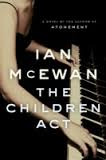
The Children Act – Ian McEwan

children's actYou can always count on Ian McEwan to bring on the controversy. This is the fourth of the prolific British novelist’s books we’ve read in my book club and it prompted a loud and lively discussion.

The main character in The Children Act is Fiona Maye, a High Court judge in London. She’s about to turn 60 when her husband, Jack, a professor, announces that he wants to have an affair (this is not a spoiler, really; the revelation comes pretty much on page one). She’s been married for thirty years and until the moment her husband tells her that he needs this because it is his “last shot” and he’s “yet to hear evidence of an afterlife” she’s been pretty smug about her life. While it is true that they don’t have children, they have had a good life together: enough money, a nice home, friendship and, Fiona admits ” she had always loved him.”  To say that Jack’s confession throws Fiona for a loop is an understatement, but she does not intend to “manage the rest of her life alone.”

Into Fiona’s fractured world comes the Henry family. Adam Henry is seventeen and he and his family are refusing the blood transfusion that may save his life because they are Jehovah’s Witnesses. According to their beliefs, “Mixing your own blood with the blood of an animal or another human being is pollution, contamination. It’s a rejection of the Creator’s wonderful gift. That’s why God specifically forbids it in Genesis and Leviticus and Acts.”

Fiona’s actually quite adept at sorting through these complicated and potentially incendiary cases, but even she is not quite sure what compels her to reserve judgment so she can visit Adam in the hospital. She calls the decision “a sentimental error,” but she goes anyway and discovers that seventeen – year – old Adam is , despite his illness, “beautiful.” It’ll be obvious to careful readers that Fiona is smitten. In fact, during the first few moments of their meeting she “caught nothing.” The visit that follows is charged – not sexually, really, although there is an element of that, too – with the kind of energy that happens when two people discover a shared passion. For Adam and Fiona it is music and poetry. Ultimately, Fiona’s decision sets Adam on a path that has profound consequences for them both.

I really liked The Children Act. McEwan is a smart writer and he’s adept at spinning a narrative that is tightly focused. Fiona isn’t a particularly likeable character, but that doesn’t mean it’s impossible to relate to her. This is a great book to get people talking.


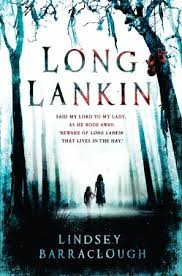
Long Lankin – Lindsey Barraclough

longlankin When I was a kid, they used to air these British films about kids on TV. They all would have been set in the 60s (it was probably the early 1970s when I watched them) and although I don’t really remember what any of them were about, I do remember that I wanted a British accent more than anything. I was also a fan of Enid Blyton’s books — especially the ones set in boarding schools.

Lindsey Barraclough’s debut novel Long Lankin doesn’t take place in a boarding school, but it did make me think of those movies. The language, in particular, was reminiscent of that particular time. Things in Barraclough’s novel are “smashing” and words like  “blimey,” “cheerio” and “crikey”  pepper the novel. The whole story unspooled in my head like one of those movies. I loved it!

Long Lankin is inspired by the English ballad “Lamkin” which tells the story of a woman and her infant son who are murdered by a mason who seeks revenge for not having been paid. The original ballad can be found here.

Said my lord to my lady as he rode away:/ Beware of Long Lankin who lives in the hay.

In Barraclough’s intelligent and creepy re-telling, Long Lankin is a sinister, slithering man who steals children in the small English town of Bryers Guerdon. When Cora and her little sister Mimi go to  Guerdon Hall to live with their great-aunt Ida, Cora soon discovers that her aunt’s crumbling home is full of secrets and her aunt doesn’t seem all that pleased about their arrival. It’s 1958 and Cora and Mimi’s father has sent his children to Ida as a last resort. Their mother is ‘away.’

The story is told from the perspectives of Cora, Aunt Ida and Roger, a local boy. Cora is smart and inquisitive and soon becomes interested in what she knows her aunt is not telling her. Something strange is going on in the isolated little town and it has to do with the church which Aunt Ida tells her she is “absolutely not — under any circumstances…it was completely forbidden” to visit. Of course, that makes it the first place Cora wants to go.

Long Lankin is atmospheric and smart. It’s filled with Latin warnings, menacing shadows, whispers and more secrets than you can shake a stick at. Readers will have to work a little to keep the characters and the story straight, but it’s totally worth the effort.  As with the best ghost stories, this one has a beating heart at its centre and it takes Cora and Roger quite a while to uncover the town’s secret. It’s worth the wait. The novel’s conclusion is terrific, too.

Highly recommended.

The Shining Girls – Lauren Beukes

shininggirlsFull disclosure: I like Criminal Minds. And no, it’s not just because FBI profiler Derek Morgan is sometimes shirtless and also often kicks down doors or flies through the air to take down the perps. I have to admit that I have a sick fascination with serial killers and their creepy-crawly minds. So Lauren Beukes novel The Shining Girls  seemed like it might totally be up my dark alley (with the crazy person waiting at the end in the shadows.) This book was a recent purchase, never a guarantee that I am going to read it imminently, but  – as it turns out – I did read it in short order. Was it a wholly satisfying experience? Um, no. However, I was still turning the pages way past my bedtime last night, so that’s saying something.

Harper Curtis is a nondescript sort of guy, remarkable only for his limp. Oh, plus he’s a time-traveling serial killer. Why he is able to skip through time is never really explained, but how is a different story. There’s this House (yes, with a capital ‘H’) and Harper has the key.

Kirby Mazrachi is almost seven when she meets Harper. Harper doesn’t like the “unpredictability of children” but he assures Kirby that he will be back for her. He tells her:

I’ll see you when you’re all grown up. Look out for me, okay, sweetheart? I’ll come back for you.

Harper does come back for Kirby; he comes back for all his “shining girls.” Beukes gives us just enough of their stories to make us care about their awful, violent deaths. One by one, he picks them off, leaving mementos of another time with their ruined bodies.

Harper doesn’t count on Kirby surviving, but she does. Now,  years after her attempted murder, she’s determined to find the man who almost did her in. The thing is, since he’s able to move through time, he’s almost impossible to catch.

The Shining Girls might be the sort of book that readers give up on because it’s too confusing or they don’t buy the time travel element of it. I was happy to go along for the ride, especially for the first three-quarters of the book or so. Harper wasn’t especially scary – we don’t really learn anything about him until about two-thirds of the way through the book – he’s pretty much a garden variety psychopath with a penchant for knives and intestines. What really kept me turning the pages was Kirby. She’s smart and resilient and determined. I liked her and I wanted her to be safe.

Something happened, though, near the end of the book. The carefully sustained tension was somehow deflated. Kirby became that girl. You know, the one who chases after the killer all on her own and then goes into the House all on her own…without a weapon. It was more than that, though. (Seriously, I knew she had to chase after Harper and go into the house – what kind of ending would we have had if she hadn’t?)  I think it was just that when all the pieces of Beukus’ intricate jigsaw puzzle were exposed it somehow seemed silly.

Time heals all wounds. Wounds clot, eventually. The seams knit together.

You had me, Ms. Beukes, until the very end. But even still – I’d highly recommend this book as  genre-bending, well-written, page-turning fun. (If serial killers are your thing, that is.)


Love Remains – Glen Duncan

loveremains Despite the fact that Glen Duncan’s novel Love Remains is only 277 pages long, it took me about a month to finish because I could never read any more than a few pages at a time before my head started to swim. But I mean that as a compliment rather than a criticism.  Duncan is a well-known and much-praised British author who was new to me when I purchased the book. Love Remains, Duncan’s second novel, is almost relentlessly grim. Again – it’s a compliment, honest. There’s no way you could tackle the topic Duncan does in this book without being a skillful craftsman, and Duncan really is an amazing writer.

Nick and Chloe meet in university.

The possibility of love revealed itself to Chloe immediately, in a shock. When they sat opposite each other that first Wednesday, with rain streaking the steamed windows and the delicious reek of frying bacon in the air, she felt (thinking, stunned, of the billions who had felt it, down the long bloodied canvas of history) the first murderous utterance of romance: It’s him.

Nick’s feelings for Chloe are slightly more ambivalent, although he does concede that “he was so curious about what was going on inside her that lust only followed along afterwards, like an obligatory bit of luggage.”

The trajectory of Chloe and Nick’s love story is mostly straightforward. They get married, start jobs,  eventually move into “their first proper home” in Clapham and then, as with many marriages, the romantic impetus drains from their lives as they deal with life’s mundane and often inane decisions: “Do you think we should get a futon, Nick.”  As their marriage closes in around them, “They suffered, periodically, the ache of familiarity.” Chloe feels “suffocated by the sound of his breath escaping through his nostrils” and Nick “hated her for having finished the shape of him.”

Duncan masterfully builds a marriage from the ground up and then, just as masterfully, wrenches it apart in the most violent way possible.  In some ways, it’s almost as though Duncan has written two different, but equally compelling, novels.

When the novel opens, Nick has already left London because that’s what you do “when the future ended.” He is on a journey, it seems, of self-destruction comprised of smoking, drinking and having sadomasochistic sex. None of it makes sense until we learn what has happened to Chloe and, even then, it’d difficult to wrap your head around. Is Nick reprehensible for having abandoned his wife? That’s just one of the moral questions Duncan asks you to consider in this book.

Chloe is on a journey of her own. It is equally compelling, although perhaps more heartbreaking. The random and horrific experience she has endured has sharpened her: “Her face in the mirror, barely recognizable, rewritten.”

What was once a path traveled together, has now been cleaved. I commend Duncan for resisting the urge to offer a tidy ending, but the ending, nonetheless, is remarkable.

Highly recommended.

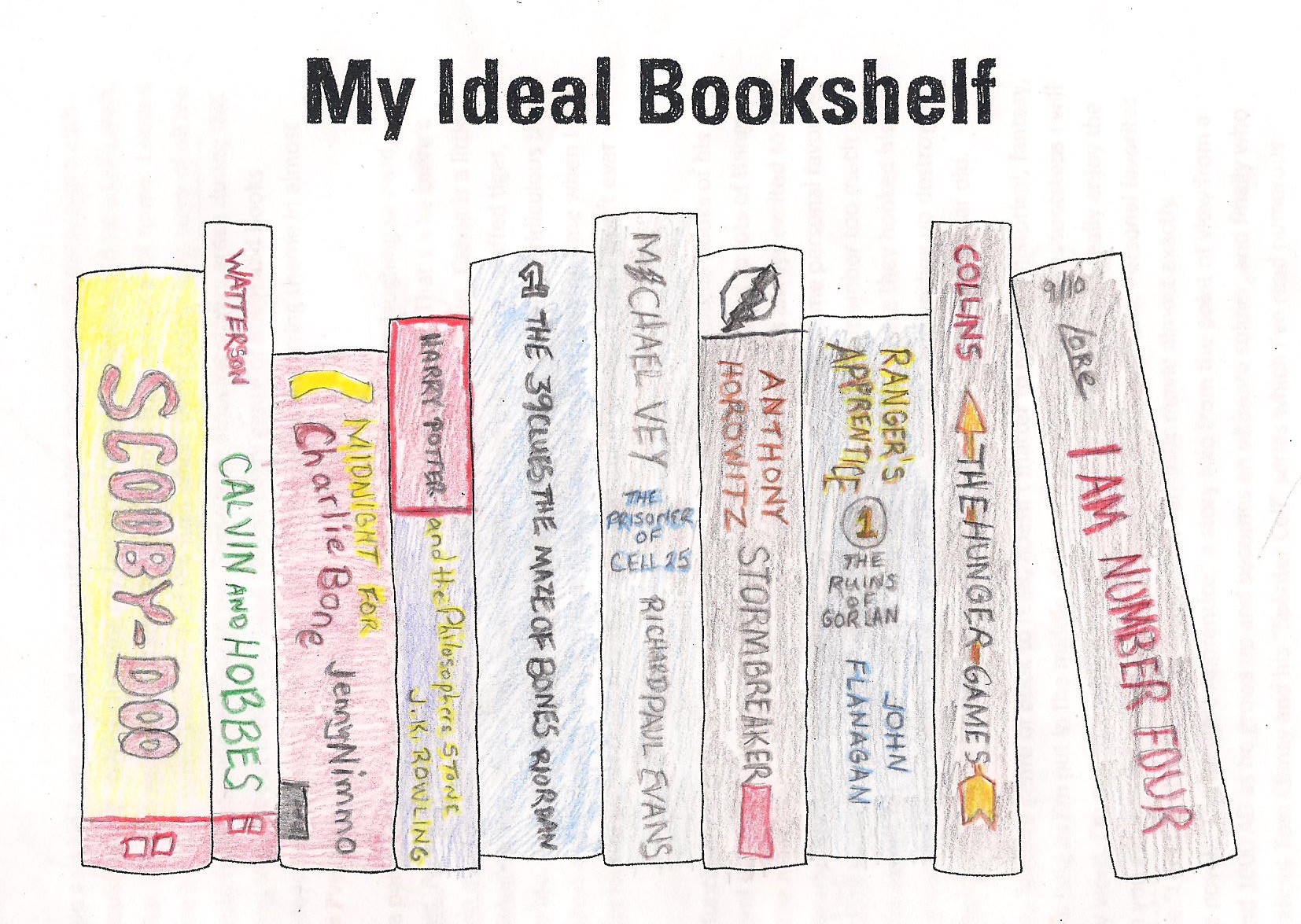
My students tackle their ideal bookshelves

For my birthday last May, my teenage son, Connor, gave me the most marvelous gift ever: My Ideal Bookshelf by Thessaly La Force & Jane Mount. This book is a book voyeur’s dream-come-true. Essentially the authors asked 100 plus people to curate their ideal bookshelf – no restrictions. Then they were invited to talk about their reading lives and to explain some of the books they had chosen.

When I finished the book, I had this crazy notion. I teach high school English and I have worked pretty hard over the last few years to create a text-rich environment in my room. I want my students to read. A lot. I have hundreds of books in my classroom and I am happy to say that my little library is well-used. My students know that I love to read and I love to talk about books and I love to recommend books and argue about them. I have some avid readers in my classes and I wondered what they would think about creating  their own ideal bookshelves. Heck, I wanted to create one!

The notion of trying to choose ten favourite books is ridiculous for any bibliophile, right? I stood in front of my bookshelves at home and pulled out 17 books without any trouble. Then I started the process of negotiation. Then I gave up. It’s hard. (In the end I decided on a YA shelf and eventually I’ll do another less specific shelf, but the thing is I’ll never be happy with my choices; I’ll always feel like I’ve left something important out.)

Here is my YA Ideal Bookshelf:

idealbookshelfya

When I suggested to my grade ten students that they were going to create their own ideal bookshelves, they were, I have to say, enthusiastic. They began the work of making lists and I was gratified to see that they had as much trouble choosing ten titles as I did. Once their lists were chosen, I gave them the bookshelf template which is provided in the back of My Ideal Bookshelf and also at their blog . The results were quite delightful.

LouiseT

Louise wrote: “In the fourth grade I was stuck in a Geronimo Stilton phase and I had a cousin who was bound and determined to see me break out of the 100-page cycle. She began sending me “adult” books. The first was The Giver by Lois Lowry. My mother read it first and then advised me to put it away for a few years until I could better handle it. I read it anyway, mainly out of sheer curiosity. And although it kept me up at night thinking about it, maybe that’s what I liked about it. I’ve read it every year since, and it always feels like I’m reading it for the first time.”

DanielleC

Danielle wrote: “The reason I like books so much is because I like to experience other lives; lives that would be impossible for me to even know someone living them let alone live them myself. Books open whole other worlds for me and reading them and experiencing them is like being reborn.”

DylanS

Dylan wrote: “I don’t just read these books, I make my own stories with them and when I was not doing that I’d be dreaming of the worlds of those realms and have myself take a place among the ranks of heroes. Reading definitely changed my life. It gave me refuge from the hardships of life and it’s probably the best hobby ever.”

EricaT

Erica wrote: “My personal favourite book on my shelf is Eragon by Christopher Paolini. I read this book in two days and immediately began to read its sequels. I’ve read the series twice now and I loved it even more the second time. This series had a great influence on me. While reading the third book, I had a strong desire to follow the elves’ path and become vegetarian. One of the main reasons I love this series so much is because of the characters: Eragon’s honour; Shaphira’s wisdom; Roran’s bravery, and Arya’s strength. There is nothing negative I could say about Eragon; I couldn’t recommend it enough.”

BriannS

Briann wrote: “I was a born reader. I even read before I was born. Well, I guess my mother read to me technically, and only when she wanted me to stop thrusting my feet against her stomach. These books are very different from one another, but they all gave me the same pleasure of living a different life through the unique characters. They all show how life can be wonderful and horrible, even if it’s fiction. I could never aspire to write anything as amazing as these authors did, but reading their stories is a reward on its own.”
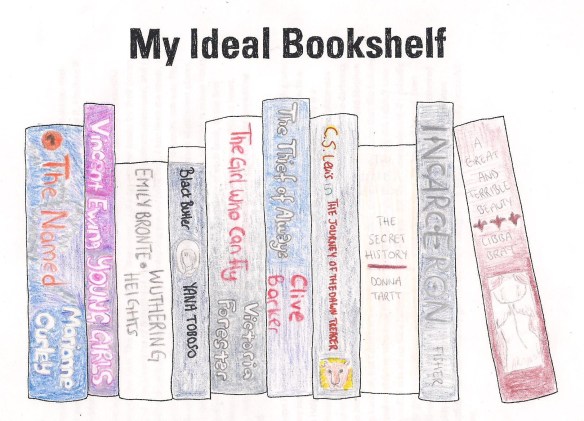
AlaraS

Alara wrote: “Even though there were many characters I liked, I never identified with any of them. They are their own person; they’re like real people to me. I would be happy for them, get jealous of them, and cry for them and get sad that I couldn’t help them. I love fictional worlds better than this one, I think. I have more than 750 books in my room (I paid my sister $20 to count them) and I wouldn’t get rid of any.”
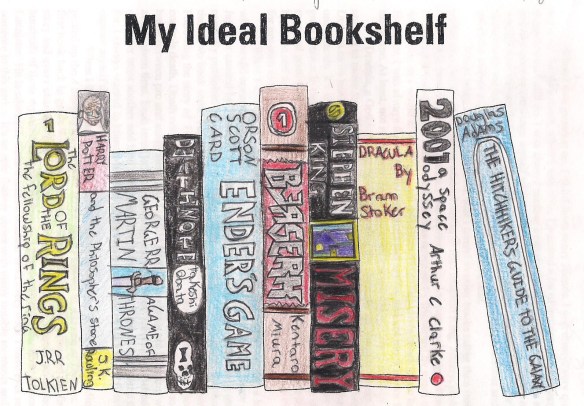
NoahR

Noah wrote: “I always had great interest in the noble Count Dracula. He was my favourite character for his strength, smarts, fits of rage and great passion. Everything about him was over-the-top, from his ability to shape-shift to his hypnotic and telepathic abilities. He was so cool to me. Every power he had was every power I wanted for my own as a kid.”
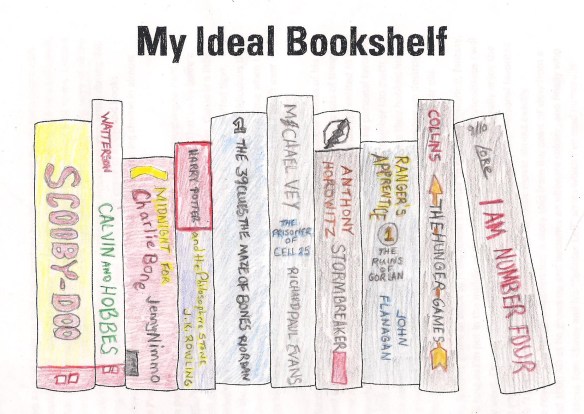
AndrewB

Andrew wrote: “My fondest memory of Calvin and Hobbes was in grade five during silent reading I lost it laughing and got kicked out of class. That’s a really stupid and funny moment I won’t ever forget.”

ErinG

Erin wrote: Books that make me cry are the most memorable because it’s a rare occasion when a novel is powerful enough to make me cry. War and slavery books usually leave me blubbering like a baby. The endings of The Book Thief and The Boy in the Striped Pajamas left me wailing. The Lottery Rose gets me to cry my eyes out after chapter three. It’s not easy to make me cry, so these books are extremely important to me.

This is an activity I will continue to do with my students because it was AWESOME!
Through the Woods – Emily Carroll

throughwoodsJust in time for Hallowe’en comes Canadian author Emily Carroll’s book, Through the Woods, a collection of chilling short stories. The stories would be quite enough on their own, but Carroll ups the ante with amazing art work. As far as graphic literature goes, Through the Woods goes to eleven. (Yes, yes I did just use a Spinal Tap reference.)

There are five stories in Carroll’s collection and each one of the stories feels vaguely old-fashioned. The monsters that live on these pages have been around for a very long time.

In the first story “Our Neighbor’s House,” Mary is left in charge of her two younger sisters, Beth and Hannah, while her father goes off to hunt. Their father tells them “I’ll be gone for three days…but if I’m not back by sunset on the third day, pack some food, dress up warm, and travel to our neighbor’s house.” When their father fails to return, things go from bad to worse in short order.

In the final story, “The Nesting Place, ” Bell, short for Mabel,  spends her school holidays with her older brother, Clarence, and his wife, Rebecca, at their isolated country house. Bell is a solitary child and she takes little interest in socializing with her brother. The only other person at the house is the housekeeper who warns Bell not to venture into the woods because she could easily become lost as Rebecca once had, “found three days later at the bottom of a cave…three days all alone in the dark drinking water out of a fetid pool to stay alive.” Rebecca, as Bell is soon to find out, has been deeply changed by that experience. And not in a good way.

woods

The stories between the first and last are every bit as unsettling. Dreams and teeth and blood and beasts loom large in this collection.Carroll’s illustrations are saturated with primary colours: blood-red moons and sapphire blue rivers. I don’t know much about art, but Through the Woods is a beautiful book to look at – if slightly macabre.

See more of Carroll’s work at her website.


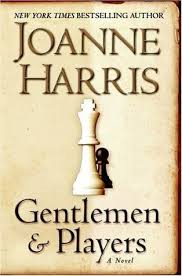
Gentlemen & Players – Joanne Harris

gentlemenGentlemen & Players is an intricate mystery by Joanne Harris, an author probably best known for her best-selling novel, Chocolat. Before she made it big in the publishing world, Harris was a school teacher which probably came in handy while writing this story of a public (in Britain this is the equivalent of our private, thus you pay a tuition)  school in England. For readers unfamiliar with the British school system, the story will likely seem extra exotic. I grew up reading Enid Blyton books and dreaming about going to boarding school in the UK, so I was all over the notion of the tuck shop (the place to buy sweets) and copious gallons of tea consumed by the teachers.

The novel gets its name from cricket, another very British enterprise. A first class cricket match pitting a team of amateurs (the Gentlemen) against the professionals (the Players) is a throw back to the class system in the 19th and 20th centuries. The Players were the working class guys and the Gentlemen from the middle and upper classes.

Harris’s novel has two narratives taking place over two different time periods. In one we follow Roy Straitley, a Classics teacher at St. Oswald’s Grammar School. He’s been in the business for over three decades and is soon to be turning 65. (I was relieved to see that Mr. Straitley still enjoys teaching since I’ll be at least that old before I will be able to afford to retire.) Straitley has dedicated his adult  life to teaching at the school and prides himself on his ability to control his class and remember all the boys he’s taught over the years.

In the other narrative, an unnamed narrator watches St Oswald’s from the gatehouse where they live with their father, the school’s porter (aka custodian).

I understood at once that they were a different race to myself; gilded not only by sunlight and their proximity to that lovely building but by something less tangible; a slick of assurance; a mysterious shine.

Later, of course, I saw it as it really was. The genteel decay behind the graceful lines. The rot.

Fifteen years later, the narrator shows up at St. Oswald’s with forged credentials and begins to teach and all hell breaks loose. At first the pranks are minor, missing registers and pens, but before long things get serious and lives are ruined and lost.

Gentlemen & Players was an easy read (despite all the wacky names I had to keep straight). Does it have something to say about the haves and the have-nots? Not really, since the second narrator just seems jealous and, quite frankly, crazy. Will I be thinking about these characters in a week? Not likely. Was I shocked by the surprise? No, I figured it out. Careful readers will. Still, I passed a pleasant few hours reading the book and if you like suspense thrillers, this is well-written (except for the over-the-top use of semi-colons!) and fun – if you don’t think too long on all the novel’s implausibilities.

The Splendor Falls – Rosemary Clement-Moore

splendorClement-Moore’s novel, The Splendor Falls, contains several recognizable gothic characteristics including an atmosphere of mystery and suspense, an ancient prophecy, a heroine who experiences visions, and supernatural events (there’s ghosts galore). Sadly, the book is too long and too slow to add up to much that would be considered frightening.

Seventeen-year-old Sylvie Davis is the “youngest-ever principal dancer for the American ballet” when she suffers a freak accident which ends her dancing career forever. Dancing is all Sylvie has ever known and the fact that she no longer can sends her into a tailspin of depression which is completely understandable. What is not understandable, however, is the fact that she starts to see things that she can’t explain. She starts to doubt her sanity and her mother, who has recently married a psychiatrist, decides to send her to her deceased father’s ancestral home in Alabama.

Sylvie and her purse dog, Gigi, arrive at Bluestone Hill, a plantation house which is currently being restored by her father’s cousin, Paula. It won’t take long for the reader to recognize the bit-players: the snotty daughter of Paula’s business partner, Clara; the golden-boy president of the Teen Council, Shawn; the mysterious and handsome, Rhys.

Sylvie is petulant about her circumstances. She doesn’t really know, Paula, and knows even less about her father’s childhood. It seems, though, that everyone in the small town knows her family. To make matters worse – she starts seeing things and hearing things.  The reader, by rights, should be creeped out right along with her. I can’t quite figure out why I wasn’t.

The Splendor Fallsbiggest problem is, I think, with pacing. At just over 500 pages, there just weren’t enough thrills and chills to keep the pages turning. The novel’s denouement, when it comes, doesn’t really live up to its potential.

I’d been really looking forward to this book. I loved the title and the cover and the promise of things that go bump in the night, but at the end of the day the book was more whimper than bang.

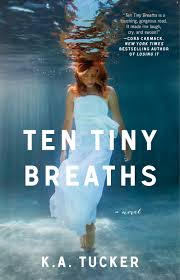
Ten Tiny Breaths – K.A. Tucker

tentinybreaths“New Adult (NA) fiction is a developing genre of fiction with protagonists in the 18-25 age bracket. The term was first coined by St. Martin’s Press in 2009 when they held a special call for “…fiction similar to YA that can be published and marketed as adult—a sort of an ‘older YA’ or ‘new adult’.”[1] New Adult fiction tends to focus on issues such as leaving home, developing sexuality, and negotiating education and career choices,” says Wikipedia.

K.A. Tucker’s novel Ten Tiny Breaths ticks all the New Adult boxes. Protagonist Kacey Cleary’s life is irrevocably  altered at sixteen when her parents, best friend and boyfriend are all killed in a drunk driving accident. Kacey is spared and so is her younger sister, Livie. Flash forward four years and Kacey and her younger sister, who is now fifteen, have left their aunt and uncle’s home in Michigan and headed for Florida. They had to go: Kacey had seen the looks Uncle Raymond had been giving her sister.

So now Kacey and Livie are in Miami. They’ve got enough money to pay for a skanky apartment they found online (luckily their superintendent has a heart of gold). They move in and meet the stripper and her daughter who live next door (luckily the stripper has a heart of gold and also gets Kacey a good gig bar-tending at the club where the owner and all the bouncers have hearts of gold). Then Kacey meets the too-hot-to-be-believed guy who lives in the complex (also with a heart of gold…and a big ol’ secret).  So, yeah, New Adult, sure since there’s a teensy bit of not-very-graphic sex, some swearing and a main character in the 18-25 range…but none of her story is plausible. None. Of. It.

Okay – it’s completely believable that Kacey would be messed up after losing her parents.  Kacey had “spent a year in physical rehabilitation to repair her shattered body, only to be released with a shattered soul…sank into a world of drugs and alcohol for a year to cope…doesn’t cry, not a single tear.”  I get that. Kacey doesn’t like physical touch, that Livie’s hand is the only one she can hold because it “doesn’t feel dead.”

The problem with Ten Tiny Breaths isn’t the writing; it’s the plot and the characters – all of whom seem to have completely altruistic motives. Kacey’s messed up, no question. And sure, Post Traumatic Stress can do some wonky stuff…but the last third of the book is just overwrought and unbelievable and saccharine.

If you want to give the New Adult genre a try, I recommend you check out  Easy. That’s a New Adult novel with some meat on its bones.


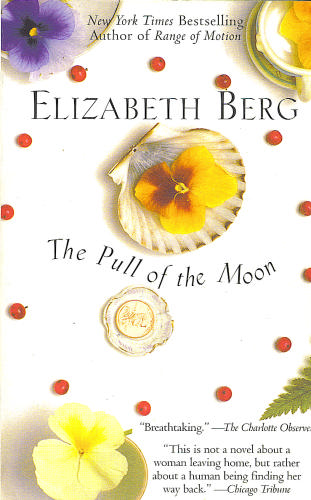
The Pull of the Moon – Elizabeth Berg

pullofthemoon Nan is fifty. One day she wakes up and just decides to leave. Her daughter, Ruthie, is grown and gone; her husband, Martin, remains at home receiving the letters Nan writes to him from the road. In the first she tells him

I just wanted you to know I was safe. But I shouldn’t have said I’d be back in a day or two. I won’t be back for awhile. I’m on a trip. I needed all of a sudden to go, without saying where, because I don’t know where. I know this is not like me. I know that. But please believe me, I am safe and I am not crazy, I felt like if I didn’t do this I wouldn’t be safe and I would be crazy.

Elizabeth Berg’s novel The Pull of the Moon is one of those novels that book clubs (whose members are of a certain age) will have a field day over. And I would be the dissenting voice. (I usually am.) It’s not because I don’t get it, it’s just because I didn’t wholly believe it.

So Nan (who has enough money at her disposal that she can just take the car and wander off and stop whenever and wherever she wants – and there’s the first fly in this self-discovery ointment; it’s Eat, Pray, Love for the middle-aged set) has had it with her suburban life. But it’s not even that so much as that she no longer recognizes the woman she’s become. All her dreams and aspirations have buckled under the weight of being a mother and wife and now she wonders “who in the hell am I?”

This question is likely something most women of a certain age can understand because many of us chuck our own desires under the bus when the kids come along. Nan takes this opportunity to examine who she was and who she is and what she wants going forward. She writes letters to Martin and also writes in a journal, something she hasn’t done since she was eleven.

She meanders along back roads, stopping for food and rest and pondering the sorry state of her life. She also randomly befriends people: the waiter in the diner where she gets breakfast, a hitchhiker she picks up, a man mourning the loss of his wife, an old woman shelling peas. These interactions weren’t all that believable to me because Berg expects the reader to believe that a simple question will open everyone’s floodgates. Suspicion quickly gives way to confession.

Strangely, despite the fact that I didn’t really buy the characters Nan meets (or the short time she spends with them) I did empathize with Nan.  Maybe that’s because, although my kids aren’t yet grown and gone and I no longer have a ‘Martin’, I am 53. I am way past the mid-way point of my life and although I try not to spend my life wallowing in regret, I do wish I had done some things a little differently. I also desperately wish I could call someone up and say, “I want and new house and this is what it’s going to look like. As soon as I get back from this roadtrip, we’re building that puppy. You got that buster?” (Seriously, Nan writes to Martin that she wants a new house!)

Nan writes in her journal that when she was twelve her life “was like a wild, beating thing, exotic, capable of unfolding and enlarging itself, pulling itself higher and higher like a kite loved by the wind.”  The best thing about The Pull of the Moon is Nan’s attempt to recapture the essence of that feeling, life’s enormous possibilities which have long been buried under the weight of the expectations of others. When she does that, Nan’s journey is one worth taking.