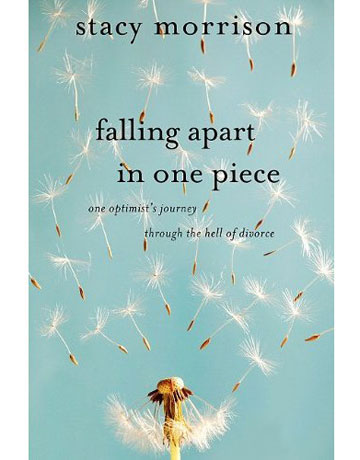
Falling Apart in One Piece – Stacy Morrison

Most of my friends will tell you that I am not really a self-help kinda gal. I read for pleasure — thus the name of this blog. I have to do a fair amount of reading-to-learn for my job, so my personal reading tends to lean towards the “lost-in-a-book” category. A nice balance of fluff and more challenging fare.

That said, there are so many memoirs out there which actually fall into the category of reading I like to do. Stacy Morrison’s book Falling Apart in One Piece ticked a whole bunch of  boxes for me: well-written, engaging, takes place in NYC, heroine who was relatable and, okay, yes, it just happened to be about the deterioration of a marriage…a subject that has been much on my mind these last few months.

Morrison was, for many years, a well-regarded magazine editor (Marie Claire, Modern Bride, Redbook) in New York City. An over-achiever, her career is hitting new heights just as her thirteen-year relationship (ten of them married) to Chris starts to skid. The night he announces that their marriage is over is a shock to Morrison, although she is certainly able to trace its demise once she sets herself to the task.

Falling Apart in One Piece doesn’t gloss over any of the details. The stages of grief are all there in full view: shock and denial, pain and guilt, anger and bargaining, depression and loneliness and finally, hope.  Morrison is also quick to share the blame for what went wrong; she’s done the hard work and scratched beneath the surface of her own shortcomings as a partner.

 Falling Apart in One Piece isn’t a finger-pointing memoir. (In fact, the book is dedicated to Morrison’s son and Chris.) Morrison honestly tries to work through what went wrong, but it takes months of soul-searching to finally get to a place of hope. The beauty of her memoir is that she doesn’t ever make it feel like all it takes is the snap of a finger or a new man to fix what has gone horribly wrong. Her heartbreak is palpable:

Somehow I came back downstairs to finish a conversation I’d never wanted to start, a conversation I had never even had the foresight to dread. I sat on the sofa next to Chris, not touching him and barely even looking at him because I was so afraid, and I cried. He talked, and I talked. I reasoned and begged and pleaded and sobbed and wailed. I tried to manipulate. I tried to convince him I would die That Very Second if he didn’t realize the total wrongness of his thoughts. I didn’t yet understand that these tactics would no longer work, that I was already out of the equation.

Morrison is left with no choice but to pick up the shattered pieces of her life and move on: she has a baby, a new job, a house in need of many repairs and suddenly, she is all alone. Her memoir is full of moments of humour, insight, sadness and, ultimately, hope.

Anyone who has been set on this path  — whether or not they have chosen it themselves or had it chosen for them — will benefit from Morrison’s reflections. The end of a marriage is heart-wrenching, but as Morrison’s favourite poet, Rainer Maria Rilke says: “The point is to live everything.”
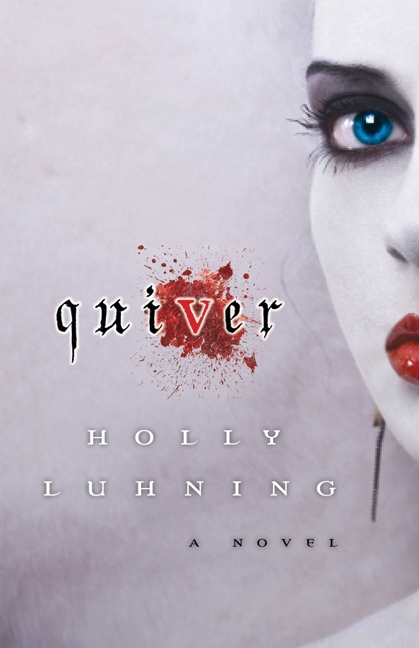
 

Quiver – Holly Luhning

Saskatchewan native Holly Luhning  has written a compelling novel based on the shocking life of the Hungarian Countess, Elizabeth Bathory.  Bathory, who was born in 1560, earned her shocking reputation for having tortured and killed over 600 young girls so that she might bathe in their blood and thus retain her youthful beauty.

Luhning’s novel, Quiver, is a creepy crawly book that follows Danica, a young foresnic psychologist, who has moved to London with her artist boyfriend, Henry, to work at Stowmoor, a Victorian hospital for the criminally insane. Danica’s patient is Martin Foster, a young man incarcerated for murdering a young girl as a tribute to Bathory.

Danica’s fascination with Bathory grows when a woman from her past, the  beautiful and duplicitous Maria, comes back into her life. Maria, it seems, has discovered Bathory’s private diaries and as she translates them and begins sending the horrific snippets to Danica, Danica’s life starts to shift.

We’re all, to some degree at least, train-wreck fascinated by the heart of darkness.  Danica’s morbid curiousity about Bathory (and the translated diary entries are not for the weak-stomached, believe me!) is complicated by her attraction/repulsion to Maria. Maria is impossibly beautiful and crazy-cool. I didn’t trust her at all, but I could see Danica’s attraction. There was something sinister about her and always an undercurrent of sexual attraction, too.

Quiver races along like the best thrillers, but it also has something compelling to say about art and that 15 minutes of fame so many of us seem to desperately crave.

Calling Mr Lonely Hearts – Laura Benedict

I’ve tried to write a review for Calling Mr Lonely Hearts several times but every time I try to say what this book is about I get stuck. It could be summer brain; my mind just isn’t firing on all cylinders or it could be that I really don’t know what to say about Benedict’s book.

We first meet Roxanne, Del and Alice in the park. Roxanne is casting a spell or conjuring a spirit. It’s really nothing more than a childhood prank, but it has serious repercussions for the three friends. We don’t get too much more information about the girls at this stage except for the fact that Roxanne, clearly the daredevil, seduces Father Romero, a new young teacher at their parochial school.

Fast forward to the girls as adults: Roxanne is an unmarried artist of some note, Del is happily married to Jock  and stepmother to Wendy and Alice is married to Thad, a dentist on the cusp of leaving her. The past is just about to bite them all in the ass.

Here’s where I get stuck. Is this book a supernatural thriller, a revenge fantasy gone awry, a titillating sex romp? I dunno. There are elements of all these things many of the wrapped up in the character, Varick, a mysterious and dangerous man who visits the lives of all the women.

The book clicks along at a reasonable pace and the characters are interesting, but the elements of supernatural means they have no free will and so, ultimately, they’re just fish on a hook.

See, I really don’t know what to say about this book. ::sigh::

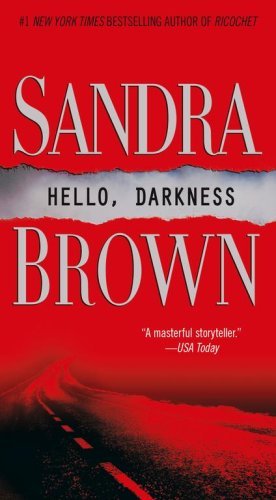
hello, darkness – Sandra Brown

For many years I subscribed to Entertainment Weekly and for a while Stephen King contributed a monthly column called ‘Pop of King’ where he rattled on about pop culture – movies and music and such. I love King; I love the way he writes and I love his ‘every man’ sensibilities when it comes to popular culture. Every year he did a book round up – sort of a top ten books list and I would avidly copy down the names of books I found interesting. That’s how Sandra Brown’s novel hello, darkness came to be on my tbr shelf. Actually, although the book was on my tbr list for a few years, I only just purchased it in May when I discovered it at the annual library book sale. I was familiar with Brown’s name, but hadn’t ever read anything by her.

hello, darkness is the story of reclusive radio host Paris Gibson. Every night she listens to people tell their tales of woe and plays them a song to cheer them up. And then she gets a call from a man called Valentino who tells her that his girlfriend had acted on some advice she’d given her and dumped him and now Paris is going to pay.  “I’m going to make you sorry that you gave her that advice,” he warns her. He vows to hold her, torture her and kill her within 72 hours.

The girl in question is the wild child daughter of a local judge and once the authorities know she’s missing, they bring in police psychologist Dean Malloy to help solve her disappearance and her connection to Valentino. This isn’t exactly good news for Paris. She and Dean have a history. You know what that means, right? All sorts of unfulfilled lust and crossed wires and missteps until they finally get it…um…together.

In the meantime, there are red herring subplots galore  to keep the reader guessing about Valentino’s true identity. It comes right down to the wire, and then all is resolved. I have no doubt that  fans of the genre (romantic suspense thriller) will be wildy satisfied with both the suspense and the romance. As for me – I was wondering why it made King’s top ten. Sure, it was a  decent thriller and Brown is a capable writer – but  it felt  formulaic for me.

Still, chuck it in your beach bag. It’ll kill a satisfying hour or two.

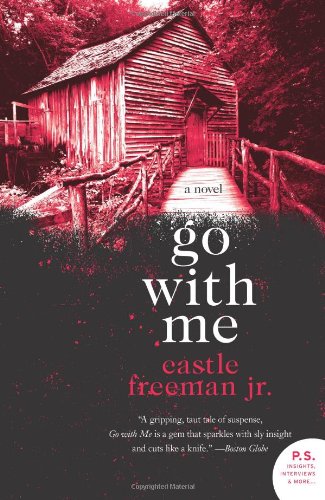
Go With Me – Castle Freeman Jr.

Lillian is a young woman who has recently moved to a small Vermont town. Early one morning, the town sheriff finds Lillian asleep in her car in the police station parking lot. She’s come for help. The town thug, Blackway, has been harrassing her; has, in fact, driven her boyfriend out of town and killed her cat. The sheriff’s advice is simple: go home.

Blackway is an enigmatic, altogether menacing, figure. The sheriff himself is afraid of him.

“You’re telling me you can’t do anything. You’re telling me I have to wait till he does something. till he gets to me, kills me, before you can do anything?”

“You could put it that way, I guess,” the sheriff said.

“How would you put it?”

“That way.”

The sheriff’s advice is to head over to the mill and find Scotty Cavanaugh because “he and Blackway have had dealings.” But Cavanaugh is not at the mill and instead Lillian solicits the help of the strange, quiet brute, Nate, and an old man named Lester to help her find and confront Blackway.

Go With Me is the strangest book I’ve read in a long time. It is both laugh-out-loud funny and strangely creepy. The book tracks Lillian and her small posse to various places where they might find Blackway, breaking the tension of their search with the commentary of the men at the mill who wonder – Greek chorus style –  at how it might all turn out.

Blackway, as it turns out, is not a man to be trifled with. He deserves his reputation. Lester is resourceful, though, and Nate “ain’t scared” and this slim book rockets along to its shocking climax.

I’d never heard of Castle Freeman Jr. before, but this book was well received and although it wasn’t really my cup of tea, it was weirdly compelling.

The Book of Lost Things by John Connolly

Once upon a time – for that is  how all stories should begin – there was a boy who lost his mother.

Thus begins John Connolly’s amazing story The Book of Lost Things. When I finally turned the last page of this book this morning, I felt that keen sense of satisfaction one feels when they have read an amazing book, a book you know you are going to recommend to everyone. I loved every minute of it.

David is just twelve when his mother dies. An only child, David is devoted to his mother and does everything in his power to keep her alive.

He prayed. He tried to be good, so that she would not be punished for his mistakes….He created a routine, and he tried to keep to that routine because he believed in part that his mother’s fate was linked to the actions he performed.

David is not able to save his mother however; she dies. Soon after, his father remarries and he and his new wife, Rose,  have another son, Georgie. David, still heart-broken over the loss of his mother, resents his father’s wife and his new brother.

This family drama plays against the backdrop of WW2. One night, after a fight with Rose, David escapes to the garden. From the sky, a German bomber falls and to escape, David slips into a crack in the swimming pool cum sunken garden. He finds himself, suddenly, in another world — a world of dark and twisted fairy tales.

I am making the book sound much simpler than it actually is. The Book of Lost Things is a coming-of-age-tale and a hero’s journey, a quest for truth and a horror story all rolled into one. Fairy tales, many familiar, are upended, revealing their slimy and rotten underbellies. David’s youth is slowly taken from him as he must fight, both alone and with companions, for his survival.

David begins his journey as a scared and self-involved adolescent, but as he makes his way towards the castle where the old king apparently has a ‘book of lost things’ which may have the answer to how David can get home, he matures and comes to understand certain truths. It’s an exciting  story — funny in places, creepy in others.

And like Dorothy’s journey to Oz, David soon comes to understand the value of what he has left behind. At journey’s end, he is  a changed person. I was profoundly moved by the book’s final pages.

Love Falls by Esther Freud

Esther Freud (Sigmund’s great-granddaughter) has written a compelling, if slightly unsatisfying,  coming-of-age tale with her novel, Love Falls. When 17 year old Lara heads to Tuscany with her father (a man who is practically a stranger to her) for a summer holiday, she isn’t quite sure of what to expect. Her father, a slightly distant intellectual historian called Lambert, has been invited to visit an old friend and wants Lara to accompany him. Lara is well-traveled: she and her bohemian mother, Cathy, have been all over together, but Lara has never been to Italy, so she’s excited at the prospect of leaving London for a few weeks.

Italy is transformative for Lara. She has the opportunity to observe her father, his relationship with the woman they are visiting, the elegant and slightly snobbish, Caroline, and observe the complicated and fraught relationships of the adults around her.

At a nearby villa, Lara meets Willoughbys. There are a lot of names and relationships to keep track of but the most important Willoughby is Kip – a boy about Lara’s age who is irreverant and beautiful.

Lara spends her weeks swimming and visiting with the Willoughbys and the days unfold in a sort of dreamy, hot haze. It’s as you imagine a summer in Italy might be…or, at any rate, as I imagine it.

There’s menace, though, in Lara’s world and it’s this menace that speeds the reader along. Even though it doesn’t amount to much in the end, Lara is certainly changed by the events which she experiences. I think Freud does a terrific job of suspending Lara in that particular space between youth and adulthood. Lara is as much an observor as a participant in what happens during those long, hot days. And because we see things only from Lara’s point of view, many of the tangled relationships are never untied; animosities are never explained and wrongs never quite righted.

As a coming-of-age tale, though, it is compelling and well-written.

The Sister by Poppy Adams

It’s ten to two in the afternoon and I’ve been waiting for my little sister, Vivi, since one-thirty. She’s finally coming home, at sixty-seven years old, after an absence of almost fifty years.


Thus begins Poppy Adams’ strange debut novel, The Sister.  Narrated by the incredibly brilliant Ginny, The Sister tells the story of the sisters and their parents, Maud and Clive. They share  a crumbling English estate known as The Red House because of the Virginia Creeper. Whole areas of the house have been shut down because Clive, a moth expert, and Maud can’t afford the estate.

Ginny takes the reader back in time, to the moment that her mother brought Vivi home from the hospital “her fluffy hair sticking up and her big round eyes gazing at me”. She recounts the time Vivi fell off the bell tower, an injury which very nearly cost her her life, but which did make it impossible for her to bear children. Ginny is the keeper of the memories and is in sole possession of the secrets, too.

Why did Vivi leave, never to return? It will be left to the reader to decide whether her homecoming is worth the hype. For me, the book falls short of the opening line’s promise. I was expecting something altogether more suspenseful. Instead, Adams spends a great deal of time instructing the reader on the nature of moths – a subject that holds absolutely no interest for me- and not nearly enough time examining just what keeps two sisters apart for fifty years.

The novel is well-written, certainly, but it moved too slowly and didn’t deliver on its early promise.

Moth lovers will likely be delighted.

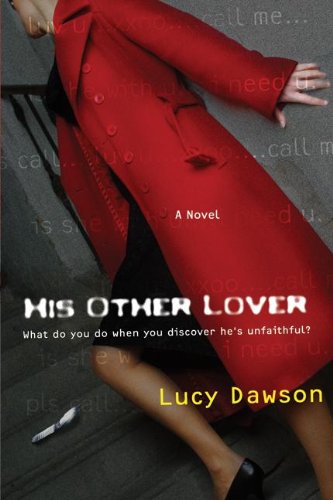
His Other Lover by Lucy Dawson

I seem to be on an infidelity kick lately. I read Lucy Dawson’s debut novel, His Other Lover, over two nights, reading until my eyes burned. In all the ways Love and Other Natural Disasters failed, His Other Lover succeeded.

One night, Mia, a 20-something woman who works for a small advertising firm somewhere near London, discovers a text message on her live-in boyfriend’s phone. Mia thought Pete was the one. Turns out he’s someone else’s one, too. That someone else is an actress named Liz.

The discovery of the text message begins a downward spiral of destructive behviour which upends Mia’s life. But hers is not the only life shattered by the discovery.

It’s interesting, but true, I think: women who are cheated on often blame the other woman. Mia pours all her anger and hatred on top of Liz. She almost makes Pete seem like another victim, someone who fell into Liz’s Black Widow trap and was helpless against her sticky charms.

Of course it’s all much more complicated that that. Mia goes completely off the rails, calling in sick for days on end while she tries to track down Liz. She wants her boyfriend back and the only way to do that is annihilate the enemy.

Dawson does a terrific job of getting inside of Mia’s head. The whole range of emotions are there: grief, anger, the hot desire for revenge. Mia is single-minded in her thirst for getting back her man. The thing is: he’s not worth it.

But the book is.

Love and Other Natural Disasters by Holly Shumas

When Eve, a young mother pregnant with her second child, overhears her husband having what sounds like a very intimate conversation on the phone in the middle of Thanksgiving dinner, her whole neatly ordered world is turned upside down. She overhears her husband say: “Shh, you’re going to be okay” and that’s all it takes to know that something is going on.

Holly Shumas’ novel Love and Other Natural Disasters explores the effects of an affair – not a physical affair, but an  emotional one – on a marriage. I suspect that there are probably some people who would say that if there isn’t any sex, it’s a “no harm, no foul” situation. Shumas does a pretty good job, though, of illustrating that looking outside of your marriage for any sort of fulfillment can have devastating consequences.

Love and Other Natural Disasters traces Eve and Jonathan as they try to put their marriage back together. It’s a push/pull affair as they both try to cope with their own issues and the unresolved issues in their marriage.

Shumas herself is a licensed marriage and family therapist and if I have any niggles with the book it’s that sometimes it seems instructional. The characters each have a part to play to demonstrate the various stages of grief: the disbelief and anger, forgiveness and acceptance. Sometimes their reactions seemed over-the-top or not quite harsh enough. For example, after she discoveres her husband’s relationship, she reads his emails looking to understand what’s gone wrong. Later, in therapy, Jon blows up about her invasion of his privacy. Um, hello, there wouldn’t have been any need for her to go snooping if you hadn’t done something inappropriate. But I know the therapist’s point of view might be to suggest that Jonathan has a right to his anger.

Some of Love and other Natural Disasters resonated with me, but not because the book was beautifully written or original. And even though I sometimes felt as though it was too instructional, and that the characters weren’t particularly nuanced – Love and Other Natural Disasters is topical.